Last updated: September 2026
A vending machine that reportedly cost around $25,000 to build sat outside a Phoenix elementary school in early 2025, repurposed from a beverage brand's Super Bowl stunt that the internet spent a week calling tone-deaf and wasteful. A few boroughs over in Manhattan, a woman posting cookie-decorating videos from a home kitchen built a following large enough to start baking for Dior and Netflix, without a media budget of any kind. Both are genuinely innovative marketing campaigns, judged by two completely different definitions of the word, and most "top campaigns" roundups only ever tell you about the first kind.
What follows are nine campaigns that held up under an actual fact-check — brand newsroom pages, trade coverage from Ad Age, Marketing Dive, The Drum, AdWeek and Marketing Brew, not recycled blog stats — plus the parts those roundup posts almost always skip: what these campaigns cost, whether B2B marketers can use any of it, how to tell if a campaign actually worked instead of just getting attention, and two well-documented cases where a genuinely creative idea backfired.
Innovative Marketing Campaigns 2026: Why B2C and B2B Innovation Look Nothing Alike
Most lists of innovative marketing campaigns are built almost entirely from consumer brands with nine-figure ad budgets, which quietly trains readers to think "innovative" means "expensive and aimed at everyone." It doesn't. A B2C campaign like Spotify Wrapped is built to spread through millions of individual social feeds in a single week. A B2B campaign, by contrast, has to survive a buying committee, a procurement cycle, and a sales rep who needs it to still be relevant six months later when the deal actually closes.
That's why the strongest B2B examples below don't look like ads at all — Salesforce turned its own customers into the campaign, and Adobe built an entire industry initiative around a single anxiety (can you trust what you're looking at) rather than a product feature. Neither would work as a 15-second TikTok spot, and neither needed to.
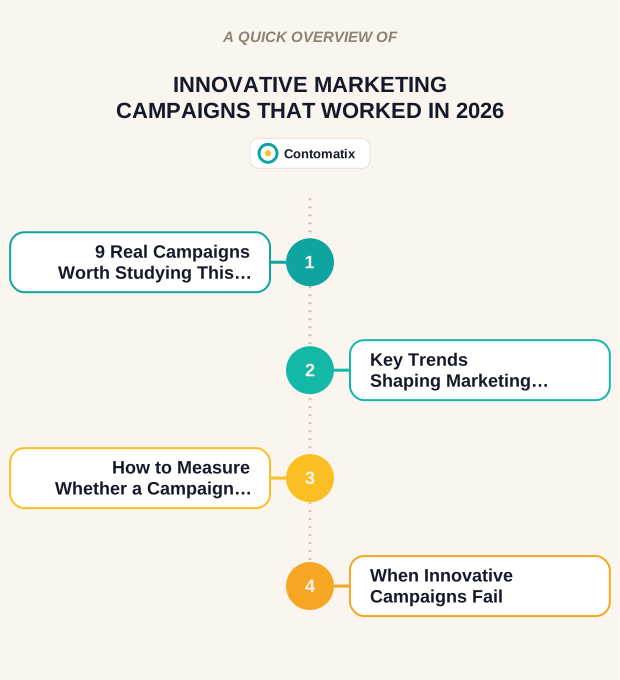
9 Real Campaigns Worth Studying This Year
Each of these cleared the same bar: a named brand, a verifiable source outside the brand's own press release, and a claim that held up when checked against a second outlet. A few campaigns that show up on other "innovative marketing" lists this year — including some involving unverifiable engagement percentages or product claims no outlet could confirm — were left off entirely rather than repeated as fact.
1. Nike's Never Done Evolving: AI as the Creative Engine, Not Just a Tool
Nike's "Never Done Evolving" spot staged a virtual tennis match between a rookie-era Serena Williams and her 2022 self, built from machine-learning models trained on years of match footage to recreate her footwork and shot patterns at each stage of her career. It's a rare example of generative AI used as the actual creative concept rather than a production shortcut, and it picked up multiple Cannes Lions honors along with a genuine spike in organic views in the days after launch, according to the campaign case study published by Ads of the World. The lesson for anyone without Nike's archive of footage: the AI didn't create the idea, it executed a concept — the concept (watching an athlete race herself across time) was the innovation.
2. Dove's The Code: Turning AI Ethics Into the Whole Campaign
Where most brands treat AI ethics as a footnote, Dove built an entire campaign around it. "The Code" shows a woman prompting an AI image generator for "the most beautiful woman in the world" and getting back a narrow, hyper-idealized image — until she appends "according to Dove," at which point the results widen to reflect real variation in skin tone, age, and body type. Dove paired the film with a public pledge, reported by Marketing Dive, never to use AI-generated bodies in place of real women in its own advertising, alongside a published "Real Beauty Prompt Playbook" for other creators. It won the Cannes Grand Prix, and it's the clearest example this year of privacy and data-ethics messaging built into the creative itself rather than bolted on as a disclaimer.
3. Spotify Wrapped 2025: From App Notification to Global Event
Wrapped has been running since 2016, but the 2025 edition is worth studying specifically because Spotify pushed it off the phone screen and into physical space in more than 30 markets — an 800-foot cascade of red hair inspired by a Chappell Roan lyric inside a New York subway station, a giant paw print on Copacabana Beach for Lady Gaga fans, a Ferrari parade through Paris, according to Spotify's own newsroom recap of the campaign. The underlying mechanic hasn't changed: personal listening data, turned into a shareable artifact, released on a fixed date every year so the internet talks about it in unison. What changed is the scale of the real-world activation layered on top of it.
4. Duolingo on TikTok: Winning Attention With Zero Media Budget
Duolingo's owl mascot getting "killed off" in memes, showing up in a full costume at a Doja Cat concert, or lip-syncing through a trending audio isn't a paid campaign in any conventional sense — it's a social team responding to culture in near real time. TikTok's own case study on the account credits a hire made in 2021 with reviving a dormant account into one that now drives measurable brand awareness; individual posts have scored engagement rates above 20%, well past typical platform benchmarks. There's no production budget line here worth reporting, which is exactly why this is the single most copyable example on this list for a business with no ad spend at all.
5. Poppi's Vending Machine Stunt: A Real Budget Number and a Real Backlash
Ahead of its first Super Bowl commercial in February 2025, the prebiotic soda brand Poppi shipped 32 oversized branded vending machines, stocked with drinks, to influencers and NFL-city venues. A rival brand publicly claimed each machine cost roughly $25,000 to produce — Poppi disputed the figure without offering its own — which would put the stunt north of $800,000 before a single can was sold, as reported by Marketing Brew. The backlash arrived fast: critics called it wasteful and out of touch, pointed out that only two of the 32 recipients were non-white, and asked why the machines didn't go to hospitals or schools first. Poppi's follow-up move, redeploying the machines to a fire station, an elementary school, and community centers, is the part worth studying as much as the original stunt.
6. Salesforce's Trailblazer Program: What B2B Innovative Marketing Actually Looks Like
Salesforce's "Trailblazer" campaign turns its own customers into the advertising — full-page ads modeled on vintage national-park travel posters, run in outlets like The New York Times, featuring real users who built careers or businesses on the platform. It's paired with free certification training through Trailhead, so the campaign and the product education loop are effectively the same program, a structure The Drum traced back to Salesforce's own brand strategy. There's no viral video moment here; the innovation is structural — a community that keeps generating its own case studies and referrals long after the original ad budget is spent, which is precisely the kind of long-horizon thinking a B2B sales cycle rewards and a 24-hour news cycle does not.
7. Adobe's Content Credentials: A B2B Campaign Built on Trust, Not Features
Rather than pitching a new Photoshop feature, Adobe built its Content Authenticity Initiative campaign around a single question every marketer and publisher now has to answer: how do you prove a piece of content wasn't faked? Content Credentials, as Adobe's own blog describes them, attach verifiable metadata — when an image was created, whether AI touched it, how it was edited — the digital equivalent of a nutrition label. It's a slower, less flashy kind of innovative marketing than a viral stunt, but it positions Adobe's tools as the safe, defensible choice at exactly the moment enterprise buyers are nervous about AI-generated content liability, which is the entire job of B2B marketing.
8. Angel Baked NYC: The Campaign With No Campaign Budget At All
Abbey Kowalec started Angel Baked, a custom cookie business run out of a home kitchen, in 2023. Posting day-in-the-life and cookie-decorating content on TikTok — no ad spend, no agency — built a following large enough that she now bakes for clients including Dior and Netflix, per a profile in NYC outlet OT Downtown, independent of any TikTok promotional material. She isn't an outlier on the platform: TikTok's own newsroom reports that U.S. small businesses selling through TikTok Shop grew sales 66% in 2025, with more than 215,000 small sellers now active on the platform. This is the example worth pinning to the wall if your entire marketing budget is a phone and consistency.
Key Trends Shaping Marketing Campaigns in 2026
Look across these nine campaigns and a few patterns repeat. AI now shows up on both sides of the same story — as the creative engine behind Nike's rematch and as the thing Dove built an entire campaign against — and brands are increasingly forced to pick a side rather than mention it in passing. Purpose and trust messaging has shifted from broad statements about sustainability toward specific, checkable claims: Dove's pledge is a policy, not a slogan, and Adobe's metadata is a technical standard, not a mission statement. Real-world, in-person activation is back in a way it wasn't during the several years when "digital-first" meant "digital-only" — Spotify's subway takeovers and Poppi's physical vending machines both bet on something people can film themselves standing next to. And organic, creator-style content, whether it's a mascot in a owl costume or a home baker's kitchen counter, is out-competing polished production on the platforms where attention is actually won or lost right now.
Platform-Specific Plays: TikTok, YouTube and the Channels Everyone's Chasing
TikTok rewards a specific kind of campaign: fast, personality-driven, and tolerant of imperfection, which is why Duolingo's owl and Angel Baked's kitchen videos both work there and would fall flat as a 30-second broadcast spot. TikTok Shop specifically has become a direct sales channel rather than just an awareness play, which changes the KPI conversation for anyone using it — a video that doesn't go viral can still convert if the shopping tag is set up correctly. YouTube runs on a different logic: long-form and Shorts coexist on the same channel, connected-TV placements now put YouTube ads on the living-room screen alongside traditional broadcast buys, and creator partnerships there tend to reward depth (a 10-minute honest review) over the split-second hook TikTok demands. Treating both platforms with the same 15-second video and the same success metric is one of the more common ways brands waste a channel that could have worked.
Privacy and Data Ethics: The Part Most "Innovative" Campaigns Skip
Dove's pledge not to replace real women with AI-generated bodies is the most visible privacy commitment on this list, but it's really a narrow slice of a bigger problem most campaigns never address: what happens to the data a "personalized" or "interactive" campaign collects along the way. Spotify Wrapped only works because a platform holds a full year of behavioral data on every listener — data most users forget they've handed over until it comes back to them as a shareable graphic. Any campaign built on personalization, quizzes, AR filters, or user-submitted content should be able to answer three plain questions before launch: what data does this actually collect, does the participant clearly know that at the moment they engage, and is there a real opt-out that doesn't just mean opting out of the fun part. Most competitor coverage of "innovative" campaigns treats transparency as a nice-to-have message; it's better understood as a design requirement, because regulators in the US and EU are treating it that way whether marketing teams have caught up or not.
How to Measure Whether a Campaign Actually Worked
Impressions and engagement rate tell you a campaign got noticed. They don't tell you whether it made the business more money, and treating the two as interchangeable is how a campaign with great vanity metrics quietly loses money. A workable framework runs in layers, each one closer to revenue than the last:
- Reach and attention — impressions, views, and engagement rate. Useful for gut-checking creative, but stop treating this as the finish line; it's the entry point.
- Brand lift — a pre/post survey or a matched-market test measuring aided and unaided brand recall, and whether purchase intent moved. This is the layer most small teams skip because it costs money to run properly, but it's the first honest signal that attention turned into memory.
- Search and direct-traffic lift — branded search volume and direct site visits in the weeks during and after the campaign, compared against a control period. If a campaign genuinely worked, people go looking for the brand by name; if it didn't, this number barely moves even when the view count looks great.
- Cost per acquisition and marketing-attributed revenue — what it actually cost to generate a sale or a qualified lead traceable to the campaign, using UTM tracking, unique promo codes, or incrementality testing rather than last-click attribution alone.
- Retention and repeat behavior — whether customers acquired during the campaign stick around and buy again. A campaign that pulls in one-time bargain hunters can look identical to one that builds a loyal base until you check this layer.
None of the nine campaigns above published a full breakdown across all five layers — most companies don't, for competitive reasons — but the ones with the most durable payoff (Salesforce's Trailblazer program, Duolingo's TikTok presence) are the ones clearly built for the search-lift and retention layers rather than a single week of impressions.
What Small and Mid-Size Businesses Can Actually Take From This
Almost none of a small business's budget or team looks like Nike's or Spotify's, which is exactly why the Duolingo and Angel Baked examples matter more here than the flashier ones. Three things actually transfer down in scale:
- Pick one platform where your actual customers already spend time, and post consistently rather than occasionally. Duolingo's team posts daily; Angel Baked's growth came from routine day-in-the-life content, not a single viral swing. Consistency is a strategy a two-person marketing team can execute that a $25,000 stunt is not.
- Let a real person carry the brand voice. A mascot in a costume or a founder talking straight to camera reads as more trustworthy on short-form video than a polished ad, and it costs a phone and time rather than a production budget.
- Track the search-lift and repeat-purchase layers from the measurement framework above, even informally. A local business can watch branded search volume in Google Search Console and repeat-customer rate in its point-of-sale system for free; those two numbers will tell you more about whether a campaign worked than a follower count ever will.
The Poppi example is worth a second look here too, specifically as a cautionary one: a mid-size DTC brand with real venture backing still got the audience-targeting part wrong by sending high-value gifts to already-famous people instead of the community it was trying to win over. A small business generally can't afford that mistake even once, which is another argument for the lower-risk, consistency-based approach above.
When Innovative Campaigns Fail
Creative risk-taking doesn't always pay off, and skipping the failures makes "innovative marketing" sound safer than it is.
Coca-Cola's AI-Generated Christmas Ad
Coca-Cola replaced its long-running "Holidays Are Coming" holiday commercial with an AI-generated version, produced with three AI studios, that traded a year-long production timeline for about a month. The reaction was swift: critics called the result soulless and off-putting, and pointed out that leaning on AI for a commercial built entirely on nostalgia and warmth undercut the exact feeling the ad was supposed to sell. The company brought back a version of the AI approach again for its 2025 holiday campaign and drew fresh criticism, as AdWeek documented, which is the more useful part of the story — the lesson wasn't learned the first time.
Jaguar's "Delete Ordinary" Rebrand
Jaguar's late-2024 rebrand, developed with agency Accenture Song, dropped the brand's cars from its own launch campaign in favor of abstract color-block visuals and slogans like "Delete Ordinary," while retiring the growler logo people had recognized for decades. European sales fell from 1,961 vehicles in April 2024 to 49 in April 2025, and Jaguar dropped its agency amid the fallout, a collapse Creative Boom laid out in detail. The failure wasn't boldness for its own sake — it was launching an identity change built around vague aspiration before there was an actual new vehicle to point to, leaving both loyal and prospective buyers with nothing concrete to attach the new positioning to.
The Bottom Line
The campaigns worth studying this year split cleanly by what they're optimizing for. Nike, Dove and Spotify are built to be talked about in the same week they launch. Salesforce and Adobe are built to still be relevant during a nine-month B2B sales cycle. Duolingo and Angel Baked prove the mechanics that actually matter — consistency, a real voice, showing up where the audience already is — cost nothing close to Poppi's five-figure vending machines or Coca-Cola's AI production budget. And Coca-Cola's repeated misstep and Jaguar's near-halved sales are the reminder that "innovative" is not the same claim as "worked" — that second claim only holds up if someone actually measured past the impression count.
Related Reading
- For the platform-native, low-budget playbook behind campaigns like Duolingo's and Angel Baked's, see our guide to faceless digital marketing.
- For getting the on-site content behind a campaign to actually rank once the attention arrives, see our SEO content writing guide.
- For structuring content, including FAQs like the ones below, so AI Overviews and answer engines cite it directly, see our answer engine optimization guide.
Related reading: our guide to cross-channel attribution covers how to credit SEO, ads and email in one report.
Frequently Asked Questions
What makes a marketing campaign "innovative" in 2026?
Not the size of the budget. The nine campaigns here range from Spotify's multi-market physical activations down to a single home baker's TikTok account with no ad spend. What they share is a mechanic that couldn't have worked the same way five years ago — generative AI as the concept itself, data-driven personalization at scale, or a platform-native format like short-form video that didn't exist in its current form until recently.
What is the most successful marketing campaign of 2026 so far?
It depends what "successful" is measured against. Spotify Wrapped 2025 reached the widest audience across the most markets. Duolingo's TikTok presence produced the best return relative to spend, since the ongoing cost is a social media team's salary rather than a media budget. Neither company has published full ROI figures, so any claim of "the best" campaign is really a claim about which metric you're prioritizing.
How much do big brand marketing campaigns actually cost?
Costs are rarely published, but Poppi's Super Bowl vending-machine stunt gives a rare data point: a rival brand estimated roughly $25,000 per machine for 32 machines, or north of $800,000, a figure Poppi disputed without providing its own number. Coca-Cola's CMO confirmed its AI-generated holiday ad cut production time from about a year to roughly a month, which was explicitly a cost-cutting move rather than a creative one.
How is AI changing marketing campaigns in 2026?
It's splitting brands into two camps. Nike used AI as the actual creative concept behind its Serena Williams rematch spot. Dove built an entire campaign, "The Code," around refusing to use AI-generated bodies in place of real women. Coca-Cola tried AI as a cost-saving production shortcut for its holiday ad in both 2024 and 2025 and drew backlash both times. The technology is the same; the strategic choice about how visibly to use it is what separates these outcomes.
Can small businesses run innovative marketing campaigns without a big budget?
Yes, and the strongest proof of that on this list isn't a Fortune 500 brand — it's Angel Baked NYC, a home-kitchen cookie business that built a following large enough to bake for Dior and Netflix through consistent TikTok content and no media spend. Duolingo's viral TikTok presence works on the same underlying mechanic: consistency and personality, not production value.
What KPIs should you track to measure a marketing campaign's success?
Impressions and engagement rate only measure attention. A fuller framework layers in brand lift (aided/unaided recall and purchase intent), branded search and direct-traffic lift during and after the campaign, cost per acquisition and attributed revenue, and repeat-purchase or retention rate among customers acquired during the campaign. The last two layers are where most "successful" campaigns quietly turn out not to have paid for themselves.
What's the real difference between B2B and B2C marketing campaigns?
A B2C campaign like Spotify Wrapped is built to spread across social feeds within days and can fade just as fast. A B2B campaign has to survive a buying committee and a sales cycle that can run six to nine months, which is why Salesforce built its Trailblazer program around long-term customer community rather than a single viral moment, and Adobe built its Content Credentials push around an ongoing trust concern rather than a product launch.
Why do some innovative marketing campaigns fail despite big budgets and real creativity?
Coca-Cola's AI-generated Christmas ad and Jaguar's "Delete Ordinary" rebrand both failed for a related reason: each one dropped the concrete thing customers actually connected the brand to (holiday warmth for Coca-Cola, recognizable cars for Jaguar) in favor of something abstract, before giving people a reason to trust the replacement. Creative boldness didn't cause either failure; removing the familiar anchor without a strong enough substitute did.
Is TikTok still worth investing in for marketing in 2026?
For platform-native content, yes — TikTok Shop sales from U.S. small businesses grew 66% in 2025 with over 215,000 small sellers now active, per TikTok's own newsroom figures, and Duolingo's and Angel Baked's organic growth both ran through the platform. It rewards fast, personality-driven content and tolerates rough production; a polished 30-second broadcast-style ad tends to underperform native-feeling content there.
What is data ethics in marketing, and why does it matter for a campaign?
It's the practice of being able to answer, before a campaign launches, exactly what personal data it collects, whether participants clearly understand that when they engage, and whether there's a genuine way to opt out. Dove's pledge around AI-generated imagery is one narrow example; personalization features like Spotify Wrapped run on a full year of behavioral data most users don't think about until it's shown back to them. Regulators in the US and EU increasingly treat this as a design requirement, not just good practice.
What's a realistic marketing campaign budget for a small business?
There's no universal figure, but the campaigns in this piece that cost the least — Duolingo's and Angel Baked's organic TikTok presence — ran on staff time rather than a media budget line at all. A more useful benchmark than a dollar figure is the measurement question: whichever budget you pick, be able to show branded search lift and repeat-purchase rate moved, since those two numbers separate an innovative campaign from an expensive one.
Contomatix builds SEO and content strategy that gets found by search engines and cited by AI answer engines alike — no recycled stats, no shortcuts. Want a free review of your current content?
Get a free SEO review →