Last updated: August 2026
Answer engine optimization is the practice of structuring content so search and AI systems select it as the answer — in Google's AI Overviews, featured snippets, People Also Ask boxes, voice results and AI assistants — rather than just listing it as one result among ten.
The shift it responds to is simple. For twenty years the goal was to be clicked. Increasingly the goal is to be quoted, because a growing share of searches end without anyone visiting a website at all.
This guide covers what AEO actually involves, where it genuinely differs from SEO and where the two are the same thing wearing a new name, and the specific structural changes that make content extractable.

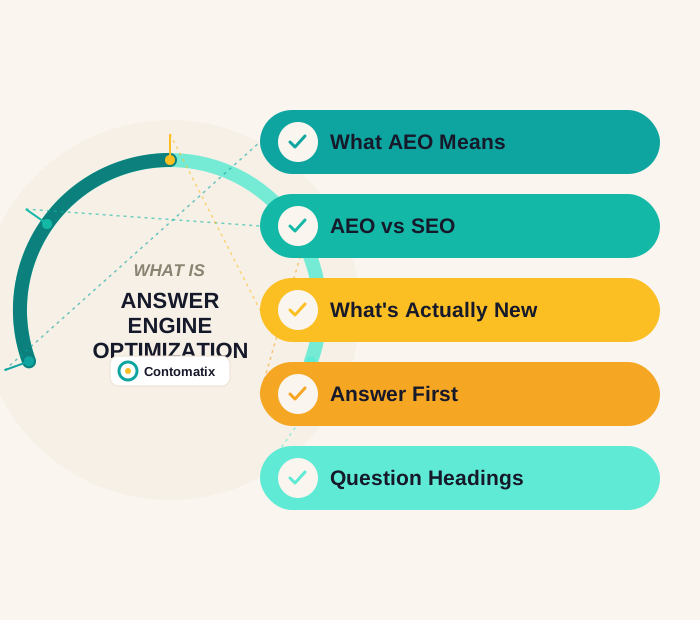
What Answer Engine Optimization Actually Means
An "answer engine" is any system that returns a direct answer instead of a list of links to sources. That covers Google's AI Overviews and featured snippets, Bing Copilot, ChatGPT, Perplexity, Gemini, and voice assistants.
AEO is optimizing for selection by those systems. The unit of success changes: not "does my page rank" but "is my specific paragraph the one that gets lifted and shown."
That distinction sounds academic until you look at what it changes in practice — the page that ranks third can supply the AI Overview while the page ranking first doesn't, because extractability and ranking aren't the same property.
AEO vs. SEO vs. GEO: Where Each One Differs
These three overlap enough that the terms get used interchangeably, which causes real confusion. They aren't the same practice: AEO targets a specific answer slot inside search itself (a featured snippet, an AI Overview, a voice result), while GEO (generative engine optimization) targets being cited inside a fully generated, conversational response from a chat product like ChatGPT or Perplexity, where there's no fixed "snippet" position to win at all — just a paragraph the model chose to write, sourced or not.
| SEO | AEO | GEO | |
|---|---|---|---|
| Goal | Rank the page | Be selected as the answer | Be cited inside a generated response |
| Unit | The page | The passage | The fact or claim |
| Where it shows up | The results page | Featured snippets, AI Overviews, voice | ChatGPT, Perplexity, Gemini chat, Duck.ai |
| Wins with | Depth, links, authority | Clarity, structure, extractability | Original data, unambiguous claims, being crawlable at all |
| Measured by | Position, clicks | Snippet/overview appearance, citations | Brand mentions across model outputs, cited or not |
| Outcome | A visit | Often a mention without a visit | Usually a mention, rarely a click |
In practice the three aren't separate campaigns — the same well-structured, clearly sourced content tends to win at all three, just measured differently depending on which surface picked it up.
Worth being blunt about one thing: a lot of what gets sold as AEO is ordinary good writing and structure rebranded. The genuinely new parts are narrower than the marketing suggests.
What's Actually New, and What Isn't
Genuinely new: optimizing individual passages rather than whole pages, accepting brand mentions without clicks as a legitimate outcome, and tracking appearance across systems that don't publish rankings.
Not new at all: answering questions clearly, using sensible headings, structured data, being credible, and matching search intent. Google has rewarded all of that for years.
This matters because it tells you where to spend effort. If your content is already clear and well-structured, AEO is an adjustment. If it isn't, AEO isn't a shortcut past the fundamentals.
Answer First, Context After
This is the single highest-leverage change, and most sites do the opposite.
Conventional article structure builds up to the answer: background, nuance, then the conclusion. Extraction systems need the answer available immediately, in a passage that stands alone without the surrounding text.
So invert it. State the answer in the first one or two sentences under a heading, in complete sentences that make sense pulled out of context. Then add the nuance, caveats and depth underneath for the human who keeps reading.
Practically: a paragraph beginning "There are several factors to consider…" is unusable. One beginning "Local SEO typically costs $500 to $3,000 per month, depending on competition and number of locations" is extractable.
The self-contained requirement is the part people underestimate. A sentence like "As mentioned above, it depends on the factors we covered" is meaningless once lifted out of the page, so it can't be selected no matter how well the page ranks. Avoid pronouns referring backwards, avoid "this" and "that" pointing at earlier paragraphs, and repeat the subject rather than assuming it carries over. It feels slightly repetitive when read top to bottom, and it's what makes a passage usable in isolation.
A useful test before publishing: copy any single paragraph, paste it somewhere with no surrounding context, and read it. If it still answers a question on its own, it's extractable. If it needs the paragraph above to make sense, rewrite it.
Write Headings as Questions People Ask
Headings do double duty here. They tell a reader what a section resolves, and they give extraction systems an explicit question-answer pair to match against a query.
"Pricing considerations" is a weak heading. "How much does local SEO cost per month?" is a strong one, because it matches how the query is actually phrased and the paragraph beneath it becomes an obvious answer.
Don't force every heading into a question — that reads as robotic. Use them where a real question exists, which for most informational content is most of the time.
Formats That Get Extracted Most
- Definitions — a term, then a one-sentence definition, then elaboration
- Numbered steps — for any process or how-to question
- Short comparison tables — for "X vs Y" queries
- Bulleted criteria — for "what to look for" questions
- Direct Q&A blocks — the reason FAQ sections earn their place
Google's documentation on featured snippets is worth reading here, and its central point is deflating in a useful way: you can't mark up a page to force a snippet. Google selects programmatically from pages that answer well. Structure improves your odds; nothing guarantees selection.
Cover the Follow-Up Questions Too
Answer engines rarely stop at one question. Someone asking "what is answer engine optimization" will next ask how it differs from SEO, whether it replaces SEO, and how to measure it.
A page covering the whole question cluster can supply answers to several related queries, which multiplies its chances of being selected somewhere. A page answering one question narrowly competes for exactly one.
Check the People Also Ask box for your target query — that's a free list of the follow-ups worth covering.
Voice Search Is the Same Discipline
Voice assistants are answer engines with one extra constraint: they usually read out a single result. There is no second place at all.
Two things follow from that. Spoken queries are longer and more conversational than typed ones — someone types "local seo cost" but says "how much does local SEO cost per month for a small business" — so question-shaped headings match voice queries better than keyword-shaped ones. And answers need to work when read aloud, which means short sentences and no reliance on formatting, since a bulleted list read by a speaker loses its structure entirely.
Usefully, this needs no separate workstream. Content structured to be extracted for a featured snippet is already close to what a voice assistant needs.
Structured Data: Useful, Not Magic
Structured data helps machines classify what a page contains — an article, an FAQ set, a product, an organization. Implementing it correctly is good practice.
But be realistic about what it does. Google's documentation on AI features in Search states there's no special markup for AI Overviews, and eligibility follows normal Search eligibility. Schema is supporting infrastructure, not a lever that produces answers.
Implement Article, FAQPage and Organization where genuinely applicable, verify it's valid, then focus your remaining effort on content structure — which is where the actual difference gets made.
Credibility Still Decides Who Gets Quoted
Extraction systems are selective about what they'll repeat, because repeating something wrong is costly for them.
That means the usual credibility signals matter as much as ever: specific verifiable claims rather than vague ones, sources cited for statistics, clear authorship, and content that demonstrates genuine familiarity with the subject. Google's guidance on creating helpful, people-first content remains the clearest statement of the standard.
Perfectly structured content that's thin or unreliable doesn't get selected. Structure improves the odds for content that already deserves to win.
There's a practical consequence worth acting on: vague hedging actively costs you selection. "Costs vary depending on your needs" is safe to write and impossible to extract. "Costs typically range from $500 to $3,000 per month" is a claim you have to stand behind, and it's the kind of sentence that gets quoted. Committing to specifics — with a source where one exists — is both better writing and better AEO.
The same applies to freshness. Systems selecting an answer about a topic that changes tend to prefer content that's visibly current, so dated claims and stale figures quietly reduce your chances even when the page still ranks.
The Traffic Problem Nobody Wants to Discuss
Here's the uncomfortable part most AEO content skips.
If you succeed at AEO, some of your reward is a user who reads your answer inside Google or ChatGPT and never visits your site. You've won the visibility and lost the session. Optimizing harder for extraction can mean optimizing for fewer clicks.
Two honest responses. First, the alternative is worse — if someone else's answer gets shown instead, you lose the visibility and the click. Second, it changes what you measure: brand mentions and branded search lift become real metrics rather than consolation prizes.
It also means the pages you push hardest on AEO should usually be top-of-funnel informational ones. Keep the commercial pages optimized for the click, where the visit is the point.
How to Measure AEO
There's no single dashboard, so measure in layers.
In Search Console, watch for the pattern of rising impressions with flat or falling clicks on informational pages — that's often extraction happening. Track whether your pages appear in featured snippets and People Also Ask for target queries by checking manually on a fixed set.
For AI assistants, you need a prompt-based approach rather than a rankings one — running a fixed set of questions across the major systems and recording whether you're mentioned or cited. We covered that method in detail in our guide to LLM visibility, which is the measurement companion to the practice described here.
Where to Start on an Existing Site
You don't need to rewrite everything. Sequence it:
- Find pages already ranking on page one for question-shaped queries — these are closest to selection already
- Restructure their openings so the answer appears immediately under a question-shaped heading
- Add the follow-up questions from People Also Ask as new sections or FAQs
- Add or fix structured data where it genuinely applies
- Re-check after a month and expand to the next set
Fixing ten pages that already rank beats restructuring a hundred that don't. This overlaps heavily with ordinary on-page SEO work, which is the point — it's an adjustment to an existing discipline, not a separate one.
Mistakes That Waste Effort
- Turning every heading into a question — reads as robotic and helps nothing
- Adding FAQ blocks with questions nobody asks — padding, not optimization
- Treating schema as the whole strategy — it's supporting infrastructure
- Optimizing commercial pages for extraction — you want the click on those
- Abandoning SEO fundamentals — extraction systems still draw from what ranks
- Expecting immediate results — selection changes lag content changes by weeks
If you want help working out which of your existing pages are closest to being selected, get in touch — that audit is usually a faster win than producing more content.
What is answer engine optimization (AEO)?
The practice of structuring content so search and AI systems select it as the direct answer — in AI Overviews, featured snippets, People Also Ask, voice results and AI assistants — rather than just ranking it as one result among many.
How is AEO different from SEO?
SEO optimizes a page to rank; AEO optimizes a passage to be extracted. SEO wins on depth, links and authority. AEO wins on clarity, structure and extractability. The success metric shifts from clicks to appearances and citations.
Does AEO replace SEO?
No. Answer engines largely draw from content that already ranks and is crawlable, so SEO fundamentals remain the foundation. AEO is an additional layer of structure applied on top, not a replacement discipline.
What is an answer engine?
Any system returning a direct answer rather than a list of links — Google AI Overviews and featured snippets, Bing Copilot, ChatGPT, Perplexity, Gemini, and voice assistants.
How do I structure content for AEO?
Put the answer in the first one or two sentences under a question-shaped heading, written so the passage makes sense pulled out of context. Add nuance and depth beneath it for readers who continue.
Does schema markup guarantee a featured snippet?
No. Google states you can't mark up a page to force snippet selection — it's chosen programmatically from pages that answer well. Structured data helps machines classify content but doesn't produce answers by itself.
Does AEO reduce my website traffic?
It can. If your answer is shown inside Google or an AI assistant, the user may never visit. The counterpoint is that losing the selection to a competitor costs you both the visibility and the click, so the realistic goal is winning the mention while measuring brand lift alongside sessions.
Which pages should I optimize for AEO?
Mainly top-of-funnel informational pages, where a mention has value even without a click. Keep commercial and conversion pages optimized for the visit, since that's where you need the user on your site.
How do I measure AEO results?
Watch Search Console for rising impressions with flat clicks on informational pages, manually check featured snippet and People Also Ask appearances for target queries, and run a fixed prompt set across AI assistants to track mentions.
Do FAQ sections help with AEO?
Yes, when the questions are ones people genuinely ask — a Q&A block is an explicit question-answer pair that's easy to extract. Adding invented questions to pad a page doesn't help and makes the content worse.
How long does AEO take to show results?
Weeks rather than days. Content changes need recrawling and reassessment before selection changes, and snippet or overview selection fluctuates more than rankings do, so judge over a month rather than a few days.
Is AEO the same as GEO?
They overlap heavily and the terms are often used interchangeably. AEO generally covers direct answers broadly, including featured snippets and voice; GEO usually refers specifically to generative AI systems. The practical work is largely the same.
Related Reading
- A related foundational question worth addressing directly: is SEO dead?