Some of the fastest-growing pages on YouTube, TikTok, and Instagram right now belong to accounts nobody could pick out of a lineup. No presenter, no talking head, no personal brand built around one person's face — just consistently useful or entertaining content, edited well and posted often. Faceless digital marketing is the strategy behind that growth, and in 2026 it has moved from a workaround for shy creators to a deliberate choice made by serious marketers and business owners.
This guide covers what faceless digital marketing actually is, why it's grown so fast, which niches perform best, the tools that make it realistic for a small team or a solo operator, and — just as important — where it falls short compared to a personality-led brand.
None of this is a claim that showing your face is wrong, or that faceless content is somehow easier. It isn't easier; it just moves the effort somewhere else — into research, scripting, editing, and consistency — rather than into being on camera. For plenty of businesses and creators, that trade is exactly the right one.

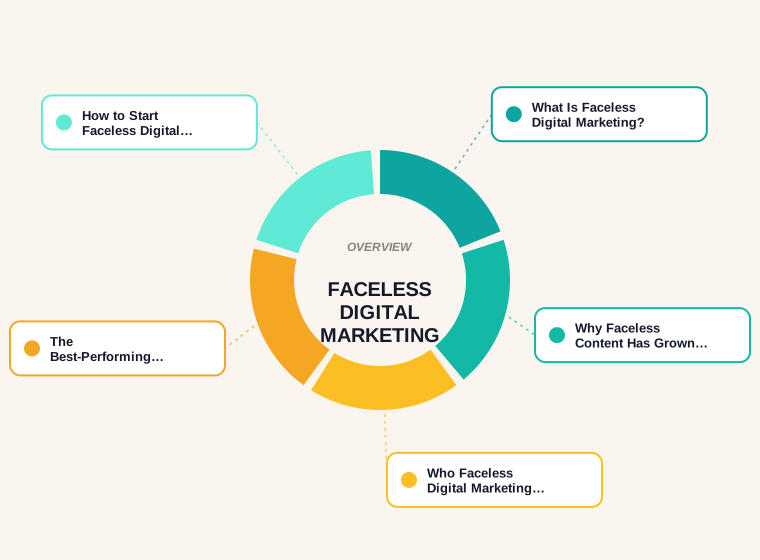
What Is Faceless Digital Marketing?
Faceless digital marketing is the practice of building an audience, a brand, or a marketing channel using content that doesn't rely on a visible, recurring personal presenter — voiceovers, on-screen text, stock or licensed footage, animation, screen recordings, or a narrator who's heard but never shown. The channel or account can still have a strong identity; it's just built around a name, a niche, and a consistent format rather than a face.
It sits on a spectrum rather than being one fixed thing. Some accounts are fully anonymous. Others use a consistent avatar or animated character. Others show hands, a desk, or a product on screen while a voiceover does the talking. All of these count as faceless in the sense that matters commercially: the brand isn't dependent on one identifiable person continuing to appear.
Why Faceless Content Has Grown So Fast
The audience shift driving this is straightforward: viewers increasingly care about whether content is useful, well-made, or entertaining — not about who's delivering it. That's especially true in informational, explainer, and niche-education content, where a clear script and good editing outperform charisma on camera.
On the creator side, the barrier to entry dropped. AI voiceover tools, stock and licensed footage libraries, and faster editing software made it realistic for one person, or a very small team, to publish at a pace that used to require a full production crew. Faceless accounts now make up a large and fast-growing share of new monetized channels, not a fringe tactic — recent creator-economy data puts faceless YouTube channels at well over a third of new monetization approvals in 2026, up sharply from a small minority just a few years earlier.
For businesses rather than individual creators, there's a second reason: a faceless channel isn't tied to one employee. If the person behind a personality-led account leaves, the channel's identity often leaves with them. A faceless brand built around a name and a format can keep running with a different writer, editor, or voice behind it.
Who Faceless Digital Marketing Actually Works For
It tends to work best for three overlapping groups. Businesses that want a content channel without turning an employee into the face of the brand — useful for agencies, SaaS companies, and service businesses that would rather the brand be the star. Creators and marketers who want to test a niche before committing to being permanently on camera, since a faceless format is far easier to pivot or shut down without personal fallout. And anyone building in a niche where the information matters more than the messenger — explainer content, data breakdowns, finance psychology, productivity systems, and similar categories where credibility comes from being right and clear, not from being likeable on camera.
It tends to work less well where trust is built specifically through a recognisable person — coaching, high-ticket consulting, and anything where buyers are essentially buying a relationship with an individual. Those categories usually still benefit from at least some face-forward content alongside anything faceless.
The Best-Performing Faceless Niches Right Now
- Explainer and "how it works" content — breaking down tools, systems, industries, or processes without needing a presenter's face to hold attention
- Finance and money psychology — budgeting, investing basics, and spending psychology content that performs on information density, not personality
- AI tools and productivity systems — screen-recording-led content demonstrating software, workflows, and tools
- Internet culture and story breakdowns — narrated compilations and analysis where the story is the draw
- Niche education — history, science, true crime, and similar deep-dive content built on research and scripting quality
The common thread across all of them: the value is in the information or the story, and a face on screen wouldn't meaningfully add to that value.
How to Start Faceless Digital Marketing
The businesses and creators who make this work tend to follow a similar sequence, rather than jumping straight to publishing:
- Pick a narrow niche and format first. "Faceless content" isn't a niche — explainer videos about a specific industry, or narrated breakdowns of a specific topic, is. The format (voiceover plus B-roll, screen recording, animation, text-on-screen) should match what that niche's audience already watches.
- Build a repeatable production process. Script, source footage or visuals, record or generate voiceover, edit, publish — in that order, every time, so output doesn't depend on one person's mood or availability.
- Treat research and scripting as the actual skill. Without a presenter's charisma to lean on, the writing has to do the work. Weak scripts are the most common reason faceless channels stall, not weak editing or bad luck.
- Get the on-page and technical foundation right if there's a website behind it. A faceless YouTube or TikTok channel that funnels back to a site still needs solid on-page SEO and keyword research to convert that attention into traffic that actually ranks.
- Distribute beyond one platform. The same script and voiceover can usually be repurposed across YouTube, Shorts/Reels/TikTok, and a blog post, multiplying the return on the research and writing time that went into it.
Faceless Digital Marketing vs Personal Branding
These aren't rivals so much as different tools for different goals, and plenty of businesses eventually run both. Personal branding builds trust faster in categories where buyers want to know who they're dealing with, and it tends to command a price premium tied to one person's reputation. Faceless content scales more predictably, survives staff changes, and lets a business or creator test multiple niches or angles without the personal exposure of being wrong in public.
The honest trade-off: a personal brand is usually a stronger long-term asset for high-trust, high-ticket categories, while a faceless brand is usually the more scalable, more transferable asset for content-driven, information-first categories.

How Faceless Creators and Brands Make Money
Monetization for faceless channels mirrors face-forward content in most respects — advertising revenue, brand sponsorships, and affiliate income all work the same regardless of whether a presenter appears. Digital products tend to fit particularly well: templates, guides, and courses can be sold entirely off the strength of the content's usefulness, with no need for a personality to drive the sale. Production costs also tend to run meaningfully lower than face-to-camera formats, since there's no need for on-camera talent, styling, or reshoots when a line is delivered badly — a script fix and a re-recorded voiceover line solve most problems.
None of that means faceless content is free to produce. Research, scripting, sourcing or licensing footage, and editing all take real time — the cost simply shifts away from being camera-ready and toward production quality.
Common Mistakes in Faceless Digital Marketing
- Publishing generic content with no distinct angle — a faceless channel has to earn attention through the content alone, so a bland, undifferentiated format gets lost fast
- Treating it as a shortcut that needs less effort — the effort moves to writing and editing rather than disappearing
- Inconsistent posting — algorithms and audiences both reward channels that publish predictably, and faceless channels have no personality loyalty to fall back on during gaps
- No website or owned channel behind the content — social platforms can change reach and monetization rules overnight; content that never builds an owned asset like a site or email list is fully exposed to that risk
- Ignoring SEO entirely — a faceless YouTube channel or blog built on strong keyword research keeps earning traffic long after a single video's initial view spike fades
Is Faceless Digital Marketing Right for You?
It's a strong fit for information-led niches, businesses that don't want their brand tied to one employee, and anyone who'd rather invest effort into research and editing than into being on camera. It's a weaker fit for high-trust, relationship-driven categories where buyers specifically want to know the person behind the brand.
Most realistic strategies in 2026 aren't purely one or the other — many businesses run a faceless content engine for reach and SEO, alongside a smaller amount of face-forward content where a real relationship with an audience matters most.
Conclusion
Faceless digital marketing isn't a gimmick or a phase — it's a legitimate, increasingly mainstream strategy built on a simple insight: audiences reward clarity, usefulness, and consistency far more than they reward a familiar face. Done well, it produces a brand asset that scales, survives staff changes, and keeps earning traffic long after the content is published. Done badly, it's just as forgettable as any other low-effort content — the format removes the excuse of personality, not the requirement to be genuinely useful.
What is faceless digital marketing?
It's building a brand, channel, or marketing content without a visible, recurring presenter — using voiceovers, text, screen recordings, animation, or licensed footage instead of a personal on-camera identity.
Is faceless digital marketing profitable in 2026?
Yes, in the right niches. Faceless channels now make up a large share of new monetized creator accounts, and digital products, sponsorships, and ad revenue all work the same way regardless of whether a presenter appears on screen.
What are the best faceless content niches?
Explainer and "how it works" content, finance and money psychology, AI tools and productivity, internet culture breakdowns, and niche education all tend to perform well, since the value comes from information rather than personality.
Do I need expensive equipment to start faceless content?
No — many faceless formats rely more on scripting, voiceover, and editing than on camera equipment. A decent microphone and editing software matter more than a high-end camera for most faceless formats.
Is faceless marketing better than personal branding?
Neither is universally better — personal branding tends to build trust faster in high-ticket, relationship-driven categories, while faceless content tends to scale more predictably and survive staff or personnel changes. Many businesses use both.
Related Reading
- For platform-specific tactics, see our guide to Instagram search optimization.
- For real, fact-checked examples of what innovative brand campaigns actually look like in practice, see our roundup of innovative marketing campaigns in 2026.
- Want to see what competitors are running before you build your own campaign? Our Meta Ad Library guide shows you how.
Contomatix helps businesses build the content, SEO, and distribution system behind a faceless brand — so the content doesn't just get views, it actually ranks and converts. Want a free audit of your current content and SEO setup?
Get a free audit →

