Last updated: September 2026
Meta published a plain-language breakdown of how Instagram Search actually ranks results, and it is short enough to read in three minutes — yet almost none of the "grow on Instagram" advice circulating right now seems to reference it. That gap is the starting point for this guide. Rather than repeat the usual list of caption tips recycled across fifty near-identical posts, this is Instagram search optimization built directly from what Instagram's own team has published in writing, checked against independent marketing research for anything Meta hasn't confirmed itself, and honest about the handful of claims nobody — Meta included — has actually put a number on.
That distinction matters more than it sounds. A lot of what gets called "Instagram SEO" is really Explore or Reels advice wearing a search hat, and the two systems don't run on the same signals. This piece keeps them separate, adds a dedicated Reels section and a Stories section most competing guides skip entirely, walks through three different niches to show how the same tactic plays out differently for each, and closes with a way to audit the accounts already winning in your category instead of guessing.
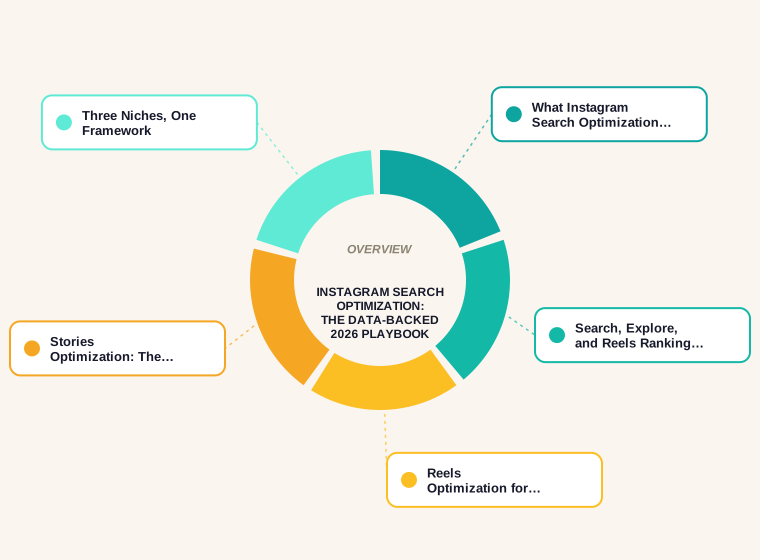
What Instagram Search Optimization Actually Means
Instagram Search is the specific system behind the magnifying-glass tab — the one that returns results when someone types a word or phrase. It is a different engine from Explore (the personalized grid of recommended posts) and different again from the ranking that decides who sees your Reels and feed posts. Instagram search optimization is the practice of shaping your account and content so that when someone types a relevant term, your profile, post, or Reel is one of the matches that surfaces — and, ideally, one of the higher ones.
That's a narrower goal than "going viral" or "beating the algorithm," and it's also a more controllable one. Virality depends on unpredictable sharing behavior. Search visibility depends largely on whether your text, keywords, and profile setup actually match what people are typing in — which is a problem you can audit and fix directly.
How Instagram Search Actually Ranks Results, According to Meta
In its own explainer, Instagram's team lays out three ranking signals for Search, in order of weight. Text is first and, in Meta's own words, "by far the most important signal for Search" — matching what someone types against usernames, bios, captions, hashtags, and places. Activity is second: accounts you follow, posts you've viewed, and past interactions, which is why two people searching the same word see different results. Popularity is third and mostly breaks ties once many accounts already match the same text, according to the official breakdown published on About Instagram.
Two details in that same explainer are easy to miss and directly useful. First, Instagram now indexes audio, not just visible text, which means what's actually said in a Reel's voiceover can factor into a text match the way a caption does. Second, Meta is explicit that captions, not comments, are what search reads: "for a post to be found in Search, put keywords and hashtags in the caption, not the comments." A lot of legacy advice about hiding hashtags in the first comment to keep captions clean actively works against this.
Search, Explore, and Reels Ranking Aren't the Same System
This is the split most competing guides collapse into one blob of "the algorithm," and it produces bad advice. Meta's separate post on ranking explains that Reels weigh your activity, your history with the specific creator, and reel-level signals like audio, visuals, and early engagement, with predicted watch-through, resharing, and saves driving distribution. Feed ranking runs on a related but distinct set of signals. Search runs on text match first, full stop — popularity and behavior only matter once several accounts already match the words typed.
The practical takeaway: content built purely for watch time or shares isn't automatically content that shows up in Search. Both jobs have to be done at once, and treating them as one task is exactly how an account ends up with strong engagement and near-zero search traffic, or the reverse.
Profile, Username, and Bio Optimization: The Foundation Signal
Because text match outweighs everything else in Search, your profile is the highest-leverage place to work first. Meta's own guidance states that "using an Instagram handle or profile name that's related to the content of your posts is your best bet for showing up in relevant searches" — a generic handle built around a personal nickname or a string of numbers gives Search nothing to match against a category term.
The bio should carry the same weight. Include the actual words someone would type to find you — the service, the niche, or the city, not just a tagline. A bio that reads as a personality statement to a human but contains zero searchable nouns is optimized for neither audience. For local or location-bound accounts, Meta specifically recommends including location information in the bio for exactly this reason.
Captions, Hashtags, and Alt Text: Keyword Placement That Matches How Search Reads
Once the profile carries keywords, captions need to carry them too, because captions sit directly inside the text-match signal. Write the caption the way the target viewer would actually phrase a search — a specific dish name, a specific exercise, a specific software category — rather than a vague mood line, and put the two or three hashtags that matter most inside that caption rather than buried in a comment.
Alt text deserves more attention than it usually gets. It was built as an accessibility feature, but it is machine-readable text attached directly to the post, and it costs nothing to write well. A generic auto-generated alt tag ("photo of person, indoor") wastes the slot; a manually written one that names the specific subject gives Search one more field to match against. None of this replaces a real caption — it's a supplement, not a shortcut.
Reels Optimization for Search and Discovery
Reels carry outsized weight for discovery because Instagram actively recommends them to non-followers, and because the audio and on-screen text inside a Reel are now searchable content in their own right. Three mechanics matter most.
The hook has roughly three seconds to work. Independent tracking from Hootsuite's algorithm research points to the first three seconds as the window where a viewer decides whether to keep watching, and Instagram's own head of product has pointed to watch-through past that mark as a strong signal the Reel is worth pushing wider. Open with the payoff or the question, not a slow intro.
Say the keyword, don't just caption it. Since audio is now part of what Search indexes, saying the actual term you want to be found for — the treatment name, the recipe, the software category — out loud in the first few seconds gives you a second shot at the same text match a caption provides, on top of the on-screen text overlay doing the same job visually.
Sends may matter more than likes. According to reporting from Sprout Social attributing the claim to Instagram's own head of Instagram, "sends per reach" is treated internally as one of the strongest signals of a Reel's value, ahead of raw like counts. A Reel built to be forwarded in a DM — something surprising, useful, or arguable — tends to outperform one built only to look polished, according to Sprout Social's breakdown of the current ranking factors. Recycled content stripped of a watermark and reposted verbatim is also flagged and suppressed rather than rewarded, so native, made-for-Instagram Reels still have an advantage over repurposed TikToks.
Stories Optimization: The Section Most Guides Skip Entirely
Stories rarely get mentioned in search-optimization content, which is a real gap, because Stories carry two features that directly aid discoverability: the location sticker and the hashtag sticker, both of which attach a Story to a broader searchable feed the way a geotag does on a permanent post. A restaurant, gym, or event-based business skipping Stories is leaving an entire discoverability channel unused.
Engagement stickers earn their keep too. Polls, quizzes, and question stickers give a viewer a one-tap reason to interact instead of swiping past, feeding the same activity signal that shapes what Instagram shows that person next, according to Later's analysis of current Stories ranking behavior. One practical ceiling: stacking Stories much past five slides in one sitting tends to see completion drop off, so a long update is often better split across the day.
Three Niches, One Framework
The same four moves — handle, bio, captions, and format — play out differently depending on what the account actually sells. Treating a fitness coach, a restaurant, and a B2B software company identically, the way most generic guides do, wastes the parts of each playbook that don't transfer.
A fitness coach
A handle like @coach_first-name tells Search nothing; @coachname.strength or a bio line naming the actual specialty ("online strength coaching for postpartum recovery") gives it something concrete to match. Captions should name the exact movement or program rather than a general "workout" descriptor, and Reels work best as short form-check clips with the rep count and cue spoken aloud, so the audio carries the same keyword the caption does.
A local restaurant
Location is the single highest-leverage lever here: geotagging every post and Story, and naming the neighborhood in the bio, is what surfaces the account for the exact "near me" pattern people actually search. Reels showing a specific dish should say the dish's name in the audio, not just show it, and Stories built around a daily-special poll double as both engagement bait and a location-adjacent discovery point.
A B2B software company
There's no dish or workout to show, so the keyword has to live in the problem being described. A caption or Reel voiceover naming the exact category a buyer searches — "HR compliance software" rather than "our platform" — matches intent a product screenshot alone never will. Founder-led or employee-led video tends to outperform polished brand footage for reach, and Stories are better spent on hiring and culture content aimed at the recruiters and prospects who check a company's Instagram before a first call.
Auditing Competitor and Top-Ranking Accounts in Your Niche
Before writing a single new caption, spend twenty minutes searching the exact terms your audience would use and noting which accounts consistently appear. That list is a free research file most people never build.
- Open each account's bio and note the exact wording and keyword pattern used — not to copy it, but to see which phrasing is already earning a match.
- Check whether they geotag consistently, use location stickers on Stories, and how heavily they lean on Reels versus static posts.
- Scan the last eight to ten captions for a repeated hashtag set; a small, consistent set usually beats a scattershot one.
- Note posting cadence over the last two weeks directly from the grid and Story highlights, rather than guessing at a "should post X times" rule.
The point isn't to imitate the account word for word. It's to see which specific phrasing already has traction in your category, so new content competes on an underused variant of the term instead of the exact head phrase every top account already owns.
Visibility Isn't Conversion: Reading the Right Metrics
Reach and impressions measure whether Search or Explore showed your content to someone. Neither number says whether that person did anything about it. A Reel can rack up hundreds of thousands of views purely on autoplay momentum in Explore and still convert almost nobody, while a smaller, keyword-matched post that pulls in fifty profile visits from people who actually typed a relevant search term can outperform it on every metric that pays the bills.
Profile visits, website taps, and DMs started from a post are the numbers that actually track intent, and Instagram's Insights panel reports all three per post. A post with a modest view count but a comparatively high profile-visit rate is doing the job search optimization is actually for; a viral post with a near-zero profile-visit rate usually means the audience it reached doesn't match what the account sells.
Realistic Benchmarks and Timeframes
Neither Meta nor any of the independent trackers referenced here publish an exact number of weeks before search visibility improves, and a specific figure repeated confidently online is usually a guess dressed up as a fact. What can be said honestly: activity-based signals need repeated interactions to build up, so a profile or hashtag change typically needs several weeks of consistent posting before Instagram has enough behavioral data to act on it. Treat four to eight weeks of steady, keyword-matched posting as a more realistic first checkpoint than the "two to three weeks" figure that circulates in a lot of casual advice.
Posting frequency works the same way. There is no published Instagram rule requiring a specific number of posts per week. Sprout Social's own tested recommendation is to start around one to two posts a day and adjust from there, treating frequency as something to test per account rather than a fixed target, and Meta's own ranking material weights consistency and relevance over raw volume in every explanation it has published.
Common Mistakes That Quietly Kill Search Visibility
- Hiding hashtags in the first comment. Search reads captions, not comments, so this habit removes keywords from the one field that matters most for text match.
- A handle or bio with no searchable nouns. A clever username with zero connection to what the account offers gives Search nothing concrete to match against.
- Skipping alt text or leaving the auto-generated version. It's a free, machine-readable field that most competitors leave blank.
- Treating every Reel as a Search play. A Reel optimized purely for watch time and shares can still miss Search entirely if the caption and spoken audio never name the actual keyword.
- Ignoring Stories geotags and stickers. Local and event-based accounts in particular lose an entire discoverability channel by treating Stories as an afterthought.
- Measuring only reach. A high view count with no lift in profile visits or DMs means the content reached the wrong audience, or the profile itself isn't converting the visibility it gets.
Related Reading
- For the caption and on-page keyword discipline this guide builds on, see our SEO content writing guide.
- For structuring FAQs and answers so AI Overviews and answer engines cite them directly — the same logic behind the FAQ section below — see our answer engine optimization guide.
- For the low-budget, founder-optional content playbook referenced in the B2B and creator examples above, see our guide to faceless digital marketing.
Frequently Asked Questions About Instagram Search Optimization
What is Instagram search optimization?
It's the practice of shaping an account's handle, bio, captions, hashtags, alt text, and content format so that when someone types a relevant term into Instagram's search bar, that account or post is more likely to appear as a match. It's a narrower, more controllable goal than "going viral," since it depends mainly on keyword and text alignment rather than unpredictable sharing behavior.
Is Instagram SEO the same as ranking in Explore or getting more Reels views?
No, and treating them as the same thing is the most common mistake. Meta's own published guidance separates the systems: Search ranks primarily on text match, Explore and Reels rank primarily on predicted engagement behavior like watch time, shares, and saves. Content can perform well in one system and be invisible in the other.
What are the actual ranking signals for Instagram Search?
According to Instagram's own explainer, three signals matter, in order: text (matching what's typed against usernames, bios, captions, hashtags, and places), activity (your follows, views, and past interactions), and popularity (likes, shares, follows, and clicks), which mainly comes into play as a tiebreaker once several results already match the text.
Do hashtags in the caption still matter for Instagram Search?
Yes. Instagram's own guidance states directly that a post needs keywords and hashtags in the caption, not the comments, to be found in Search. Hiding hashtags in a first comment to keep the caption visually clean removes them from the field Search actually reads.
Does posting Reels help with Instagram Search specifically?
It can, but only if the Reel is built for both jobs at once. Instagram now indexes spoken audio and on-screen text, so a Reel that says the target keyword aloud and displays it on screen gets a text-match opportunity a silent, caption-only post doesn't. A Reel optimized purely for watch time with no keyword in the audio or caption won't automatically help Search.
How important are saves compared to likes for Instagram ranking?
For Reels and Explore specifically, independent reporting on Instagram's own stated priorities treats saves and sends as carrying more weight than passive likes. Neither Meta nor any outlet checked for this guide has published an exact weighting, so treat this as informed practice rather than a precise ratio.
Should I include my location in my Instagram bio and posts?
If the business is location-bound, yes. Meta's own guidance recommends including location information in the bio for accounts tied to a specific place, and geotagging posts and Stories gives Search and Explore an additional field to match against location-based searches like "coffee shop near me."
How often should I post to improve Instagram search visibility?
There's no official Instagram rule specifying a number of posts per week. Independent guidance varies by source; Sprout Social's own tested recommendation is to start around one to two posts a day and adjust based on results, while Meta's published ranking material consistently emphasizes relevance and consistency over raw volume.
How long does it take to see results from Instagram search optimization?
No official timeframe exists. Because activity-based signals need repeated interactions to accumulate, four to eight weeks of consistent, keyword-matched posting is a more realistic checkpoint than the two-to-three-week figure that circulates in casual advice.
What's the difference between reach and actual results on Instagram?
Reach and impressions only measure how many people were shown a post; they say nothing about what those people did next. Profile visits, website taps, and DMs are the metrics that reflect actual interest, and comparing that conversion rate against the raw view count is a better health check than tracking reach alone.
How do I find out what's already working for competitors in my niche?
Search the exact terms your audience would use and note which accounts consistently appear. Review their bio wording, hashtag patterns, use of geotags and Story stickers, and posting cadence over the last couple of weeks. The goal is spotting an underused keyword variant, not copying the leading account word for word.
Contomatix builds SEO and content strategy that gets found by search engines and cited by AI answer engines alike — no recycled stats, no shortcuts. Want a free review of your current content?
Get a free SEO review →