Last updated: September 2026
No, AI content is not inherently bad for SEO. Google's own public position is that it evaluates content on quality and helpfulness, not on the tool used to produce it. What gets penalized isn't "AI-written content" as a category — it's low-effort, unedited, scaled content published primarily to manipulate rankings, which is covered by Google's scaled content abuse policy and would be treated the same way if a person had typed it by hand. The industry conflates two things that aren't actually the same axis, and untangling them is most of what you need to know.
This guide covers what Google has actually said, what genuinely gets sites penalized versus what doesn't, and where ChatGPT specifically fits into that picture.
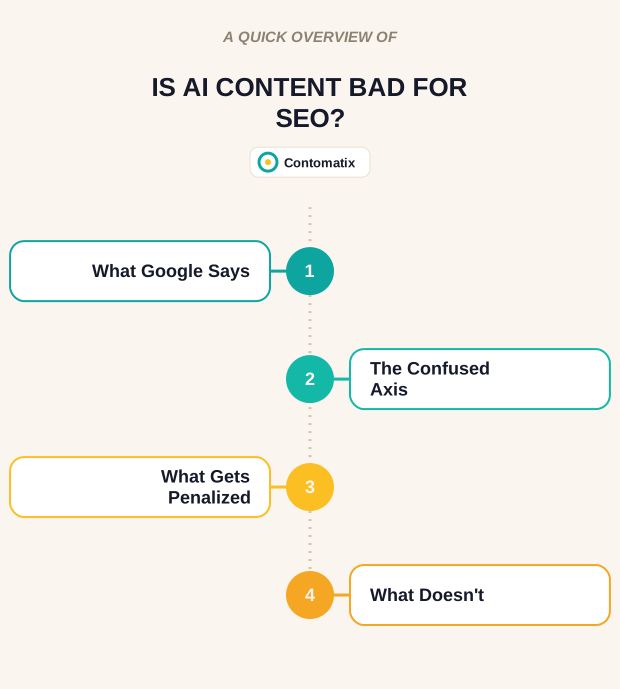
What Google Has Actually Said About AI Content
Google's Search Central team addressed this directly in a public guidance post: using automation, including AI, to generate content with the primary purpose of manipulating search rankings violates its spam policies. But it was equally explicit that not all automated or AI-assisted content is spam — automation has long been used for genuinely helpful content like sports scores, weather forecasts, and transcripts, and that isn't the target.
The consistent theme across Google's public statements on this is that its ranking systems aim to reward original, helpful content that demonstrates what it calls E-E-A-T (experience, expertise, authoritativeness, trustworthiness), and that this focus on quality rather than production method is deliberate. In other words: the question Google says it's asking isn't "did a human or a model write the first draft," it's "is this page actually useful, accurate, and demonstrably credible."
The Axis Everyone Confuses
Most of the anxiety around "AI content and SEO" comes from treating "AI-written" and "low-quality" as the same thing. They're not, and separating them clears up almost every confused question on this topic.
Picture two axes instead of one. On one axis: was this content produced with AI assistance, partly, mostly, or not at all? On the other, completely independent axis: is this content genuinely useful, accurate, edited, and backed by real expertise, or is it thin, generic, unoriginal, and effectively unedited?
A page can land in any combination. AI-assisted and genuinely good: a draft generated by a model, then substantively rewritten, fact-checked, and shaped by someone who actually knows the subject. Human-written and genuinely bad: a freelancer-churned page with no real expertise, templated structure, and nothing original to say — a failure mode that predates AI entirely and that Google's helpful-content guidance has targeted for years. Search rankings track the second axis. The first one, on its own, isn't the variable that matters.
What Actually Gets Sites Penalized
Based on Google's own stated policy, the pattern that triggers action is specific: thin content published at scale, with no genuine expertise or editorial review behind it, often following a duplicated or templated structure across many pages that all say roughly the same thing with the names swapped. That's the definition of scaled content abuse — content generated primarily to manipulate rankings rather than help users, and the policy is explicit that it applies "no matter how it's created." It's the same failure mode as old-school spun-article farms and thin affiliate doorway pages; AI tooling just makes it faster to produce at a volume that used to require a much larger team.
We've written before about how this specific risk shows up when SEO work is delegated to autonomous agents rather than to careful human oversight — an agent can generate five hundred thin, near-identical pages exactly as easily as fifty genuinely useful ones, and nothing about the tooling tells you which one you're doing. See our piece on AI SEO agents for the specifics of where that risk actually comes from.
The volume matters more than people expect. One AI-drafted page, heavily edited by someone with real subject knowledge, isn't the pattern the policy targets. Two hundred AI-drafted pages published in a week with minimal review, covering slight variations of the same topic, is exactly the pattern — regardless of whether a human or a model did the typing.
What Doesn't Get Penalized
Using AI as a drafting or research tool, with a real person doing substantive editing, fact-checking, and adding genuine expertise or examples the model couldn't have supplied on its own, doesn't match the abuse pattern Google describes. Neither does using automation for structurally repetitive but genuinely useful content — Google's own example of sports scores and weather data makes the point that automated production isn't disqualifying by itself.
The practical test worth applying to your own content: if you removed every AI-assisted sentence and had to defend the page's usefulness and originality on the strength of the human judgment behind it, would it still hold up? If a genuine editor with real subject knowledge shaped the final version, reworded the generic parts, checked the claims, and added something a generic model output wouldn't have included, that's a defensible page regardless of how the first draft got written.
Is ChatGPT Itself "Bad for SEO"?
ChatGPT as a tool isn't good or bad for SEO in the abstract — it's a drafting and research assistant, and the outcome depends entirely on how it's used. Used to speed up research, generate a rough structure, or draft sections that a knowledgeable editor then substantially reworks, it's no different from any other productivity tool. Used to publish hundreds of barely-edited pages to chase long-tail keyword variations, it's a fast way to trigger exactly the scaled content abuse pattern described above.
The more interesting question long-term isn't whether ChatGPT affects a given page's ranking eligibility — it's that ChatGPT and similar assistants are increasingly also where people go to ask questions directly, which is a separate, genuinely new competitive dynamic covered under generative engine optimization rather than under classic ranking risk. Our AI SEO strategy guide covers how that fits alongside the ranking question addressed here.
Why "AI Content" Became Shorthand for Risk
The confusion has an obvious origin. Once general-purpose language models made it trivial to produce fluent-sounding text at a speed no human writing team could match, a wave of low-effort, high-volume content aimed squarely at manipulating rankings showed up across the web almost overnight — programmatic pages targeting thousands of keyword variations, with barely any unique substance between them. Google's response was to sharpen and expand what its spam policies call scaled content abuse, explicitly framing it as targeting the pattern of mass-produced, low-value content regardless of the tool used to produce it, rather than targeting "AI" as a category.
That framing matters because it explains why the correct mental model isn't "avoid AI" but "avoid the specific failure pattern that AI made dramatically easier to produce at scale." The tool changed. The thing that actually gets penalized — content with no genuine value published in bulk to game rankings — is the same thing that's been against the spirit of Google's guidelines since long before large language models existed, back when it was called content spinning or article farming.
A Practical Checklist Before Publishing AI-Assisted Content
- Was every factual claim checked against a real source, rather than trusted because the model stated it confidently?
- Did someone with real subject knowledge substantively edit it, not just skim for typos?
- Does it say something the ten other pages on this topic don't, whether that's a specific example, a corrected misconception, or a genuinely original angle?
- Is it part of a batch of many near-identical pages published in a short window, with the same structure and only the specifics swapped? If yes, that's the pattern to be most careful about.
- Would it read as obviously generic and unedited to someone who actually knows the topic well?
None of these are exotic checks — they're the same editorial bar good content has always needed to clear. AI drafting just makes it easier to skip that bar at volume, which is precisely the behavior the policy is written to catch.
Frequently Asked Questions
Is AI content bad for SEO?
Not inherently. Google evaluates content on quality and helpfulness, not on whether AI was used to produce it. What gets penalized is low-effort, unedited, scaled content published to manipulate rankings — a pattern that applies regardless of whether a human or a model wrote it.
Is ChatGPT bad for SEO?
ChatGPT itself isn't good or bad for SEO — it's a drafting tool. Used to speed up research and produce a first draft that a knowledgeable editor substantially reworks, it's no different from any other productivity tool. Used to publish large volumes of minimally edited pages, it becomes a fast route to a scaled-content-abuse penalty.
Is ChatGPT good for SEO?
It can genuinely help with research, outlining, and speeding up drafting when paired with real editorial review and subject expertise. It doesn't help, and can actively hurt, when it's used to publish content at volume without proportional human oversight.
How will ChatGPT affect SEO going forward?
Two separate effects are worth tracking. As a production tool, it changes how fast content gets drafted, which raises the risk of scaled content abuse if oversight doesn't scale with it. As a discovery surface in its own right, it's also where people increasingly ask questions directly, which is a generative-engine-optimization question rather than a classic ranking risk.
Does Google penalize AI-generated content specifically?
No. Google's public guidance says its spam policies target content generated primarily to manipulate rankings — a description based on the content's purpose and quality, applied the same way regardless of whether it was AI-generated, human-written, or a mix.
Can AI-written content rank well on Google?
Yes, when it's genuinely helpful, accurate, and substantively edited by someone with real subject knowledge. Plenty of well-ranking pages use AI somewhere in the drafting process; what predicts ranking is the quality of the finished page, not the method used to produce the first draft.
How much editing does AI-generated content need before publishing?
Enough that a subject-matter expert has substantively reworked generic phrasing, verified every factual claim, and added something the raw output didn't already say. A light typo pass isn't sufficient; a real editorial pass that changes the substance of the page is what separates a defensible page from the pattern Google's scaled content abuse policy targets.
Is using AI to write blog content against Google's guidelines?
Not by itself. Google's guidelines target manipulative intent and low-quality output at scale, not the use of AI as a tool. Using AI to draft content that's then genuinely edited, fact-checked, and improved by a person doesn't violate the guidelines described in Google's own published guidance.
Related Reading
- For where this risk shows up specifically with autonomous tooling, see AI SEO agents: what they can do and where they fail.
- For how content quality fits into a broader AI SEO plan, see our AI SEO strategy guide.
Sources: Google Search Central, "Google Search's guidance about AI-generated content"; Google, Spam Policies for Google Web Search (scaled content abuse).
Contomatix uses AI as a research and drafting tool inside a real editorial process — every page we publish is fact-checked and shaped by someone who actually knows the topic, which is the distinction Google's own guidance says actually matters.
See how our AI SEO service works →