Last updated: September 2026
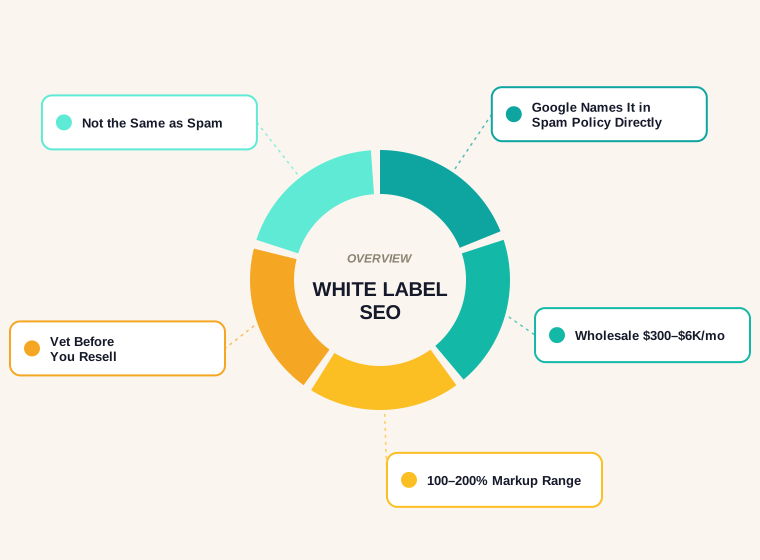
Most guides to white label SEO cover pricing and workflow and stop there. Almost none of them mention that Google's own spam policy names "white-label services" directly, as one specific example of the third-party content it scrutinises. That is not a reason to avoid white labelling — it is a reason to understand exactly what the policy actually restricts, because it is narrower than the phrase sounds.
This guide covers what white label SEO is, what Google's policy actually says and does not say, realistic 2026 pricing and margins, how to decide what to keep in-house versus outsource, how to pick a provider, and the handful of practices that turn a normal reseller arrangement into the kind Google is describing.
What White Label SEO Actually Is
An agency sells SEO to a client under its own brand, while some or all of the actual work — audits, content, link building, reporting — is delivered by a separate company working behind the scenes. The client sees one point of contact. The provider doing the work is invisible to them.
It is a normal, long-standing business model, not a workaround. Plenty of legitimate industries run on white labelling: manufacturing, software, financial products. SEO is not unusual in reselling capacity this way; what is unusual is how directly Google has now named the practice in its spam documentation.
What Google's Policy Actually Says
This is worth reading carefully, because the phrase gets repeated online more often than the actual policy gets quoted.
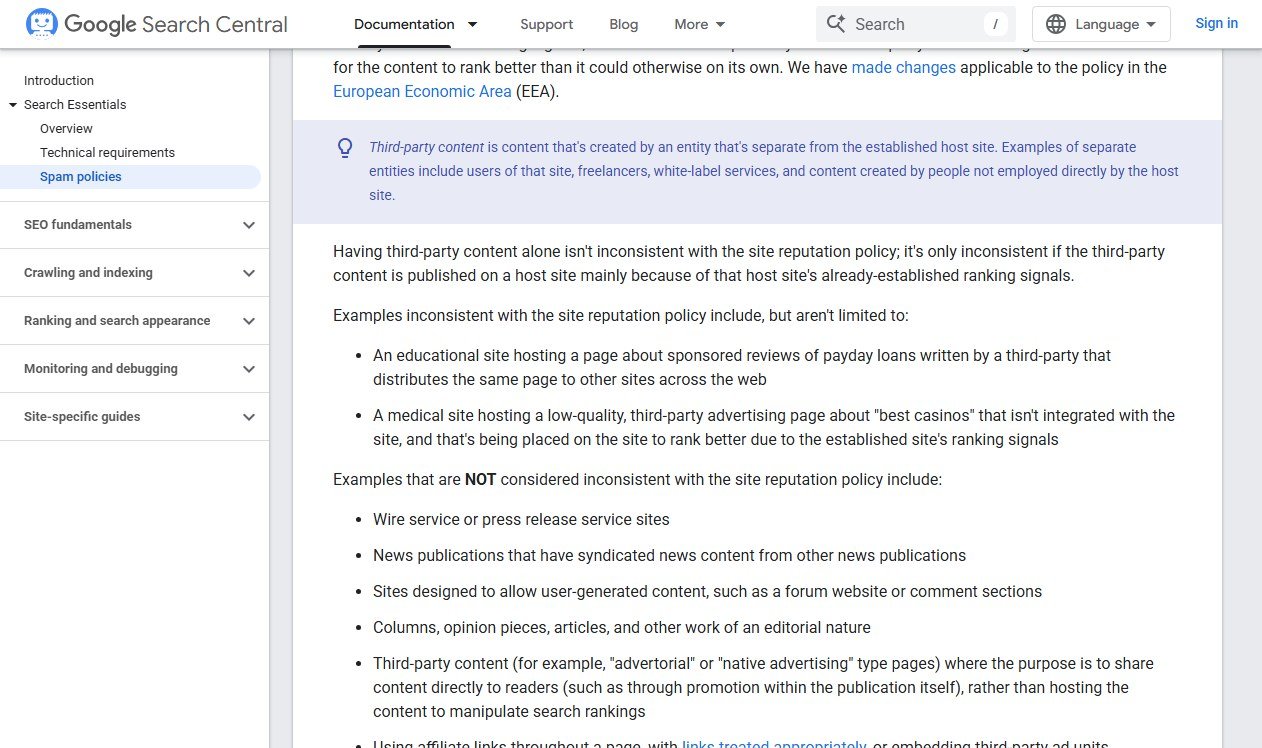
Google's spam policies page, under site reputation abuse, defines third-party content as "content that's created by an entity that's separate from the established host site," and lists examples of separate entities: "users of that site, freelancers, white-label services, and content created by people not employed directly by the host site."
Read past the headline and the policy is more specific than "white label content is spam." Google states directly: "Having third-party content alone isn't inconsistent with the site reputation policy; it's only inconsistent if the third-party content is published on a host site mainly because of that host site's already-established ranking signals."
The examples Google gives of what actually violates the policy are narrow and specific: a payday loan review syndicated across unrelated sites purely to exploit their rankings, or a low-quality casino page bolted onto a medical site with no editorial integration. Both examples share one trait — content with no topical connection to the host site, placed there only because the host site already ranks.
What This Means for Ordinary White Label SEO Work
A local agency selling SEO under its own name, delivered by a white label partner, publishing content the client's audience actually wants to read, on a site the agency genuinely manages — this is not the scenario Google describes. The policy targets exploitation of an unrelated host's ranking signals, not the business model of reselling labour.
Where it does apply is a specific and avoidable pattern: a white label provider mass-producing near-identical content and placing it on someone else's established site purely to borrow that site's authority, with no genuine editorial relationship or topical fit. That is the same scaled content abuse problem Google targets everywhere else, wearing a white-label label.
In practice, the policy is a reason to check what your white label provider is actually producing, not a reason to avoid the business model.
Wholesale Pricing in 2026
What agencies pay a white label provider, before their own markup.
| Scope | Typical wholesale cost | What it usually includes |
|---|---|---|
| Local / single location | $300 – $900/month | GBP management, basic content, local citations |
| Mid-market | $900 – $2,500/month | Content programme, link building, technical fixes |
| Ecommerce / enterprise | $2,500 – $6,000+/month | Larger content volume, dedicated strategist, advanced reporting |
These are wholesale rates — what the reselling agency pays. What they charge the end client is a separate decision, and it is where most of the actual business judgement in white label SEO lives.
Markup and Margin: The Numbers Agencies Actually Use
Markup and margin are not the same number, and confusing them leads to underpricing.
- 100% markup — buy at $1,000, sell at $2,000 — is a 50% margin.
- 200% markup — buy at $1,000, sell at $3,000 — is a 67% margin.
Most agencies work in a 100%–200% markup range, translating to roughly 45–65% gross margin. Low-touch, productised packages tend to sit at the lower end of that band; high-touch accounts with real strategy and account management can justify 150%+ markup, because the agency is adding real value on top of the delivered work, not just relabelling an invoice.
A useful rule of thumb: if your margin is consistently below 45%, you are underpricing relative to the account management, sales and client relationship work you are doing on top of the delivered service. Above 65%, check that the client is actually still getting a full scope rather than a shaved-down version of what the retainer describes.
Currency and location matter here more than most pricing guides admit. A provider quoting in a lower-cost market can make a 200% markup look easy while still underpaying for genuinely senior work, and a client-facing agency that never checks who is actually doing the work has no way to know whether that margin reflects real value added or just a wide cost gap between markets.
What to Vet Before Signing With a White Label Provider
Six checks that separate a provider worth building an agency on from one that will eventually damage your client relationships.
- Ask to see sample deliverables — actual content, actual link placements, actual reports — not a sales deck describing them.
- Check whether content is genuinely unique per client, or a templated structure with names swapped. The second is how scaled content abuse happens inside a white label relationship.
- Confirm who owns the work. Content, backlinks and reports built for your client should be usable by your client if the relationship with the provider ends.
- Ask how link building is actually done. "Outreach" that turns out to be private blog networks or paid placements with no disclosure is a liability you inherit, not the provider's alone.
- Test their reporting with a real question. Ask for the reasoning behind one specific recommendation. A generic answer suggests generic work.
- Check turnaround and communication under your own brand — a provider that is slow or inconsistent becomes your problem the moment the client notices.
Disclosure: What You Do and Do Not Have to Tell Clients
There is no legal requirement in most jurisdictions to disclose that work is subcontracted, and plenty of legitimate agencies run this way without ever mentioning it. The practical question is not legal, it is relational: what happens to the client relationship if they find out from someone else rather than from you.
Two positions both work, chosen deliberately rather than by accident. Full transparency — "we manage strategy and QA; execution is delivered through vetted specialist partners" — tends to build more durable trust and heads off any awkward discovery later. Full opacity works fine too, provided the agency is genuinely adding value on top (strategy, account management, quality control) rather than simply forwarding invoices, because that is the difference clients notice even if they never learn about the white label arrangement itself.
What does not work long-term is presenting subcontracted, template-driven work as bespoke, high-touch service while charging accordingly. That gap is what eventually costs the client relationship, with or without Google's spam policy getting involved.
Build In-House or White Label: A Decision Framework
Agencies usually make this call based on gut feel about cost. A clearer way to decide is to separate the question by discipline, because the right answer is rarely the same across content, links and technical work.
- Content at volume is the easiest to white label well, because quality is checkable — read the draft before it ships, and a templated structure is obvious on inspection.
- Link building is the riskiest to white label without close vetting, because the methods are the hardest for a client-facing agency to verify directly. A provider's private network or paid placement habits become your liability the moment a client's site is affected by a future policy update.
- Technical SEO sits in between — a competent white label technical audit is genuinely useful, but implementation on the client's own site usually still needs someone who can be accountable to that client directly, in-house or not.
A common and sensible pattern: keep strategy, account management and client communication in-house, white label the content production that scales linearly with client count, and vet link building the hardest of the three because it is the one most likely to create a problem you cannot see coming.
How White Label Fits Into a Client's SEO Stack
For an agency evaluating whether to build or buy, it helps to compare against the alternative your client might consider directly. Our guide to local SEO services covers what a client should expect from an in-house-delivered local programme, which is a useful benchmark for what a white label version needs to match. And if the arrangement includes content production at any real volume, our website SEO audit guide is worth running against the delivered work periodically — a white label relationship that has quietly drifted into thin, templated output shows up the same way any other quality problem does, in the indexing and content layers of an audit.
Quick Recap
- White label SEO means one company sells the service, another delivers it — a normal business model, not a workaround.
- Google's spam policy names white-label services as an example of third-party content, but the actual violation is narrow: content placed on an unrelated host purely to exploit its existing rankings.
- Ordinary agency reselling, with genuine editorial fit and real client relationships, is not what the policy targets.
- Wholesale pricing runs $300–$6,000+/month depending on scope; most agencies mark up 100–200%, landing at 45–65% gross margin.
- Vet a provider on sample work, content uniqueness, ownership, link-building methods, and real answers under questioning.
- Disclosure to clients is a relationship decision, not usually a legal one — the failure mode is charging bespoke rates for templated work, not the white labelling itself.
Frequently Asked Questions
What is white label SEO?
An arrangement where an agency sells SEO services under its own brand while the actual work is delivered by a separate specialist company, invisible to the end client. The agency is the single point of contact; the provider does the execution.
Does Google penalise white label SEO?
Not the business model itself. Google's site reputation abuse policy names white-label services as an example of third-party content, but the actual violation requires that content be placed on an unrelated host site mainly to exploit its existing ranking signals — not simply that the work was subcontracted.
How much does white label SEO cost?
Wholesale rates in 2026 run roughly $300–$900 a month for local scopes, $900–$2,500 for mid-market, and $2,500–$6,000 or more for enterprise and ecommerce work. What the reselling agency charges clients is a separate, usually marked-up figure.
What markup should an agency charge on white label SEO?
Most agencies work in a 100%–200% markup range, equivalent to roughly 45–65% gross margin. Lower-touch productised packages sit toward the lower end; accounts with real strategic input and account management justify the higher end.
Do I have to tell clients their SEO is white labelled?
Usually not legally required, and it is a business decision rather than a compliance one in most cases. Full disclosure tends to build more durable trust; full opacity is also common and workable, provided the agency adds genuine value on top of the delivered work.
How do I vet a white label SEO provider?
Ask for real sample deliverables rather than a sales deck, confirm content is unique per client rather than templated, check who owns the finished work, ask specifically how link building is done, and test their reporting by asking the reasoning behind one recommendation.
What is scaled content abuse and how does it relate to white labelling?
Scaled content abuse is Google's term for content generated at volume, with minimal per-page value, primarily to manipulate rankings. A white label provider that reuses templated structures across many clients with only names swapped is producing the same pattern under a different label.
Is white label SEO the same as private label SEO?
Yes, the terms are generally used interchangeably. Both describe a reseller model where the delivering company's brand is invisible to the end client.
Who owns content produced through a white label arrangement?
This should be settled in the contract before work starts, and the reselling agency's client should retain usable ownership of content and links delivered on their behalf, regardless of who executed the work.
Can a small agency compete without white labelling?
Yes, but white labelling lets a small agency offer a fuller service scope — technical work, content and link building — without hiring specialists in each area, which is why it remains common even among agencies with strong in-house capability in one discipline.


