Last updated: September 2026
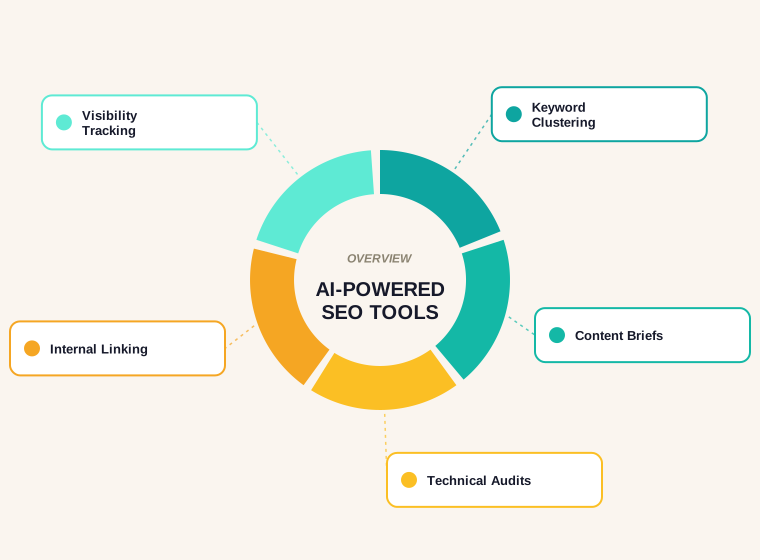
AI-powered SEO tools aren't one category of software doing one job — they're several genuinely different jobs that happen to share the word "AI" in their marketing. A tool built for clustering keywords by intent and a tool built for tracking whether a brand gets mentioned by ChatGPT are solving almost nothing in common, even though both get filed under the same "AI SEO tools" heading in most buyer's-guide content. That framing — a listicle of product names — usually obscures the more useful question, which is what job each category actually does well and where its output still needs a human to catch what it gets wrong.
This guide breaks it down by category rather than by brand: what each one genuinely does well, the mechanics behind it, and its real limitations.
AI-Assisted Keyword Research and Topic Clustering
What this category does well: grouping large keyword lists into topic clusters based on semantic meaning rather than exact-match text, which is faster and often more accurate than manually sorting a spreadsheet of a few thousand terms. A language model can recognize that "how much does local seo cost" and "local seo pricing" belong in the same cluster even though they share almost no words, which older keyword tools built on string-matching struggle with.
The mechanics: these tools typically embed each keyword as a vector representing its meaning, then group keywords whose vectors are close together, sometimes layering a language model on top to label each cluster and suggest which one deserves a dedicated page versus a subsection.
The limitation: clustering tells you which terms are related, not which cluster is worth targeting. Search intent, commercial value, and realistic competitiveness still need human judgment layered on top, and search-volume estimates surfaced by these tools are themselves modeled data with real error margins, not a ground truth — treat them as directional, not exact.
AI-Generated Content Briefs and Outlines
What this category does well: compressing the research phase of content creation by summarizing what's already ranking for a target query — common subtopics, typical structure, questions competitors already answer — into a brief a writer can work from quickly.
The mechanics: the tool crawls or retrieves top-ranking pages for a query, extracts recurring themes and headings, and generates a suggested outline, sometimes with target word counts or entities to include, based on that competitive set.
The limitation: a brief built entirely from what's already ranking tends to reproduce the structure and framing of existing content rather than improving on it, which is exactly the sameness problem that makes content forgettable and, at scale, risks drifting toward the templated, low-differentiation pattern search engines' spam policies are designed to catch. A brief is a useful starting skeleton, not a substitute for a genuinely original angle, a real example, or a correction of something the existing top results get wrong — which is usually what actually earns a page attention.
AI-Assisted Technical SEO Audits
What this category does well: pattern-matching across large crawl datasets to flag pages that are likely thin, orphaned, duplicate, or slow, far faster than a human reviewing a site section by section. On a site with tens of thousands of pages, this kind of triage is genuinely valuable groundwork.
The mechanics: a crawler collects page-level signals (word count, internal link count, load timing, duplicate-content similarity, and so on), and a model or rules layer scores or clusters pages by likely issue type, surfacing the ones most worth a human looking at first.
The limitation: pattern-matching at scale produces false positives, and root-cause diagnosis for anything non-trivial — a JavaScript rendering issue, a faceted-navigation crawl trap, a server-side caching bug — still generally needs an engineer or experienced technical SEO to confirm and fix. Treat the automated flag as a prioritized to-do list, not a finished diagnosis.
AI-Assisted Internal Linking Suggestions
What this category does well: suggesting which existing pages should link to a new or updated page based on topical relevance, rather than relying only on manual memory of what else exists on the site or on exact anchor-text matching, which misses a lot of genuinely relevant pages that just happen to use different wording.
The mechanics: similar to keyword clustering, this typically works by comparing the semantic similarity between a new page's content and the rest of the site's existing pages, then surfacing the closest matches as link candidates.
The limitation: topical relevance and strategic priority aren't the same thing. A suggestion engine might correctly identify that a low-priority blog post is topically closest to a new page, while missing that a commercial service page deserves the link more even though it's a slightly looser topical match. Internal linking is partly an editorial decision about where you want authority and traffic to flow, which a similarity score alone doesn't capture.
AI Visibility and Citation Tracking
What this category does well: giving some visibility into whether a business is mentioned or cited when AI assistants answer questions relevant to it — the measurement layer that classic rank trackers were never built to cover, since there's no results page and no fixed position to track.
The mechanics: these tools generally run a fixed set of representative questions against several AI systems on a recurring schedule and log whether, and how, a given brand or page shows up in the responses, tracking that over time the way a rank tracker tracks position.
The limitation: there's no standardized industry benchmark or dashboard equivalent to classic rank tracking yet, and answers from generative systems can vary from one run to the next even for the identical question, which means a single check is close to meaningless — the value comes from repeated sampling over time, and even then it's measuring a noisier signal than a search results position ever was. Be skeptical of any tool presenting a single "visibility score" as a precise, stable number.
Where the Categories Blur Together
In practice these five jobs aren't always sold as five separate products. A platform built primarily for technical audits will often bolt on a content-brief feature; a keyword-clustering tool will often add a lightweight visibility tracker. That's a reasonable product decision, but it doesn't change the underlying mechanics of each job, and a bolted-on feature is rarely as capable as a tool built specifically to solve that one problem. If citation tracking is the actual bottleneck, a technical-audit platform's basic version of it is unlikely to match a tool built around that mechanism from the start.
This is worth checking directly rather than taking a feature list at face value: ask what data or method actually powers the secondary feature, not just whether the feature exists. A "content brief" generator built on the same crawl data as the platform's technical audit tool is solving a narrower version of the job than one built specifically around competitive content analysis.
Choosing Without Getting Locked Into One Category
The buying mistake this framing is meant to prevent is picking a single all-in-one platform because its marketing claims to cover every category above, then discovering that it does two of the five jobs well and the rest as an afterthought. Each category has a genuinely different underlying mechanism, and the tools that are strongest at clustering keywords aren't generally the ones that are strongest at citation tracking, because those are different technical problems being solved with different techniques.
A more useful approach is to identify which specific job is actually the bottleneck in your current process — research time, technical triage, internal linking consistency, or visibility measurement — and evaluate tools against that one job specifically, rather than against a feature checklist that claims to do everything. And across every category here, the constant is that none of them replace the human judgment layer: a strategist deciding what's actually worth targeting, an editor deciding what makes a piece genuinely original, an engineer confirming a root cause. The tools compress research and triage time; they don't replace the decisions that determine whether the work is actually good.
For a closer look at where AI tooling in general tends to succeed and where it needs the most supervision, see our piece on AI SEO agents: what they can do and where they fail, and for a working set of prompts across several of these categories, see ChatGPT for SEO: 25 prompts we actually use.
Frequently Asked Questions
What are AI-powered SEO tools?
A broad category covering several genuinely different jobs: AI-assisted keyword clustering, content brief generation, technical audit triage, internal linking suggestions, and AI visibility or citation tracking. They share underlying AI techniques but solve different problems and generally aren't interchangeable.
Are AI SEO tools accurate?
Accuracy varies by category and by the specific problem being solved. Pattern-matching tasks like clustering or flagging likely-thin pages tend to be reasonably reliable as a first pass; anything involving search volume estimates, root-cause technical diagnosis, or AI visibility scoring should be treated as directional rather than exact.
Can AI SEO tools replace an SEO strategist?
No. They compress research and triage time on specific tasks but don't replace the judgment involved in deciding what's worth targeting, what makes content genuinely original, or how to prioritize conflicting signals — all of which still require a person with real domain expertise.
What's the difference between AI SEO tools and traditional SEO tools?
Traditional SEO tools are generally rules-based or index-lookup systems — matching exact keywords, checking backlink counts, running fixed technical checks. AI-powered tools typically add a semantic or generative layer on top, letting them group by meaning rather than exact text, summarize patterns across large datasets, or generate draft output like outlines.
Do AI SEO tools guarantee better rankings?
No credible tool can guarantee rankings, AI-powered or not, since ranking depends on factors outside any single tool's control, including how competitors respond. Treat guarantees of specific ranking outcomes as a red flag regardless of what technology backs the tool.
Is ChatGPT considered an SEO tool?
It's commonly used as one, for research, drafting, and structuring tasks, even though it isn't purpose-built for SEO the way a dedicated clustering or audit tool is. Its usefulness depends heavily on how specific and well-informed the prompts are, and its output still needs the same editorial review as any AI-assisted drafting.
How do AI visibility or citation tracking tools work?
They run a fixed set of representative questions against AI systems on a recurring schedule and log whether and how a brand appears in the responses, tracked over time similarly to how a rank tracker tracks position — though the underlying signal is noisier since generative answers vary run to run.
Are AI-generated technical SEO audits reliable?
They're a reliable way to triage and prioritize large sites quickly, flagging likely issues faster than manual review. They're less reliable as a final diagnosis for complex technical problems, which generally still benefit from an experienced technical SEO or engineer confirming the root cause.
Related Reading
- For a practical prompt library across several of the jobs covered here, see ChatGPT for SEO: 25 prompts we actually use.
- For where automated tooling succeeds and where it needs supervision, see AI SEO agents: what they can do and where they fail.
Contomatix uses AI tooling where it genuinely speeds up research and triage, with a strategist and editor making the calls the tools can't — what's actually worth targeting, and what makes a page worth citing.
See how our AI SEO service works →