Last updated: September 2026
Two years ago nobody sold AI SEO services. Now every agency has a page for it, most of them promising visibility inside AI answers, and very few of them willing to say what the work actually is.
This guide takes the awkward route: what Google itself says you need to do differently for AI features, what that leaves worth paying for, how the work can finally be measured since Google shipped a report for it this year, and the promises that should end a sales call.
What AI SEO Services Are Sold As
Strip the labels off and the market is selling four different things under one name.
- Visibility in Google's AI features, meaning AI Overviews and AI Mode.
- Citations inside chat assistants, where a model names your brand or links your page in an answer.
- Content production using AI tools, which is an efficiency service rather than a visibility one.
- Technical work aimed at machine readers, from structured data to crawler access rules.
Those are four distinct jobs with four different success measures, and conflating them is how a retainer ends up unaccountable. Before signing anything, make the provider say which of the four they are being paid for.
What Google Says You Need to Do Differently
This is the part of the conversation most proposals avoid, because Google's own answer is inconvenient.
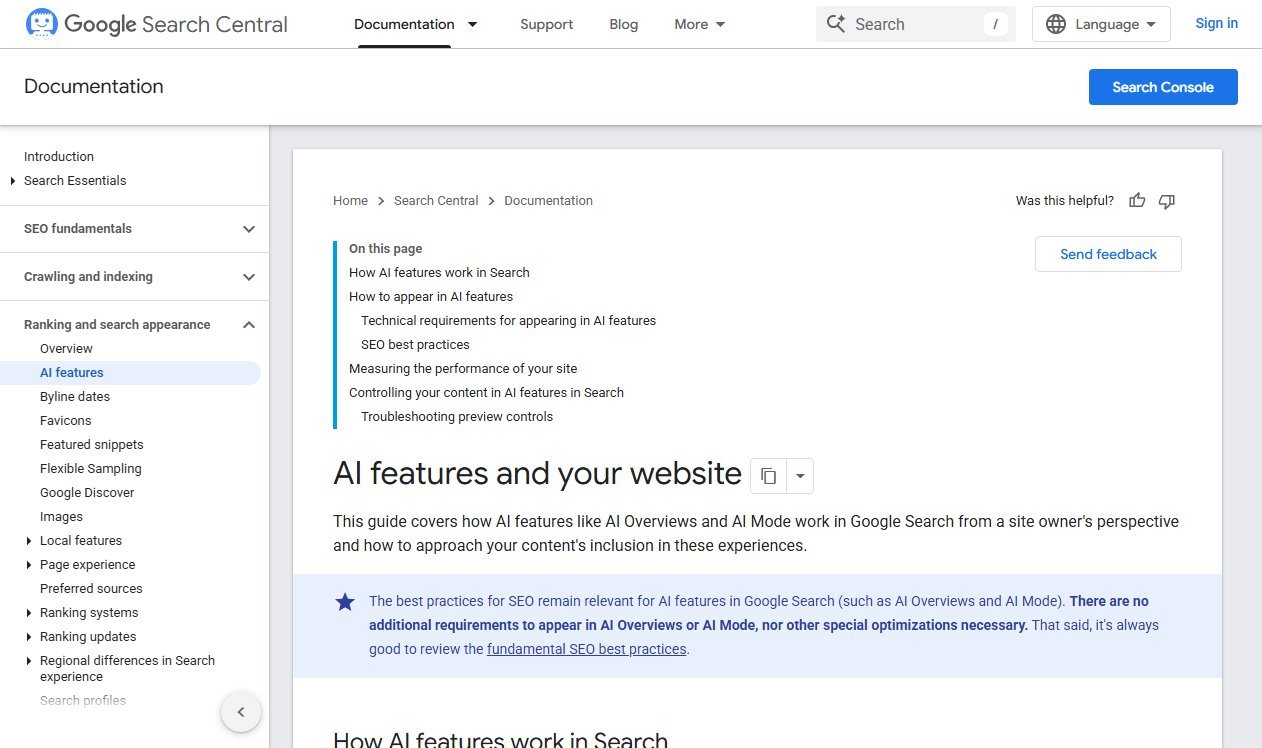
Google's guidance on AI features and your website states that the best practices for SEO remain relevant for AI features in Google Search, and that there are no additional requirements to appear in AI Overviews or AI Mode, nor other special optimizations necessary.
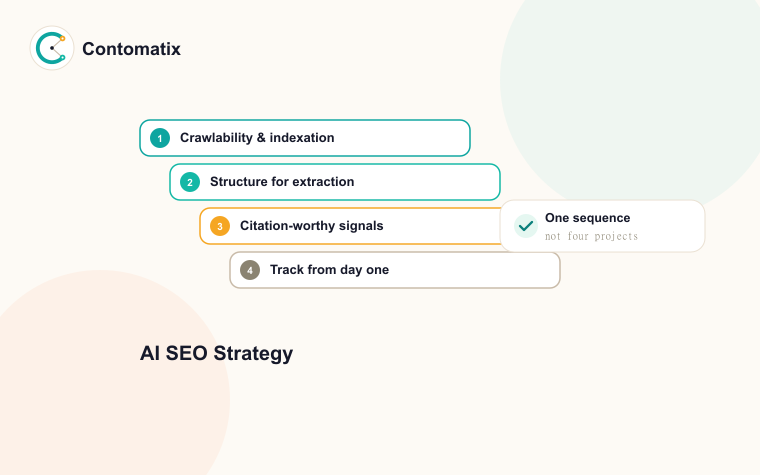
Read that carefully before you buy anything. It does not say AI search changes nothing. It says the levers are the same levers: content that answers the question, pages a crawler can reach, clear structure, and enough credibility that the system is willing to quote you.
So an honest AI SEO service is not selling a secret technique. It is selling the same fundamentals, prioritised differently, plus measurement that did not exist eighteen months ago.
What Genuinely Changes
Four things are different in practice, and they justify a distinct workstream even if the techniques are familiar.
- The unit of retrieval is the passage, not the page. A 3,000-word guide that buries the answer in paragraph nine gets skipped in favour of a page that states it in two sentences under a clear heading.
- Entity clarity matters more. The system has to be confident about who you are, what you do and where, which is why consistent naming, an about page that reads like a fact sheet and clean structured data now pull above their weight.
- Corroboration beats assertion. Claims that appear in several independent places are safer to repeat than claims that appear only on your own site.
- Some clicks are gone for good. Definitional and simple how-to queries are increasingly answered in place. That is a content strategy problem, not a technical one: the answer is to move up the funnel, not to fight for a click that no longer exists.
Our AI SEO strategy guide covers how we translate those four points into an actual editorial plan.
How the Work Can Finally Be Measured
For two years the honest answer to "is this working?" was a shrug. That changed this year.
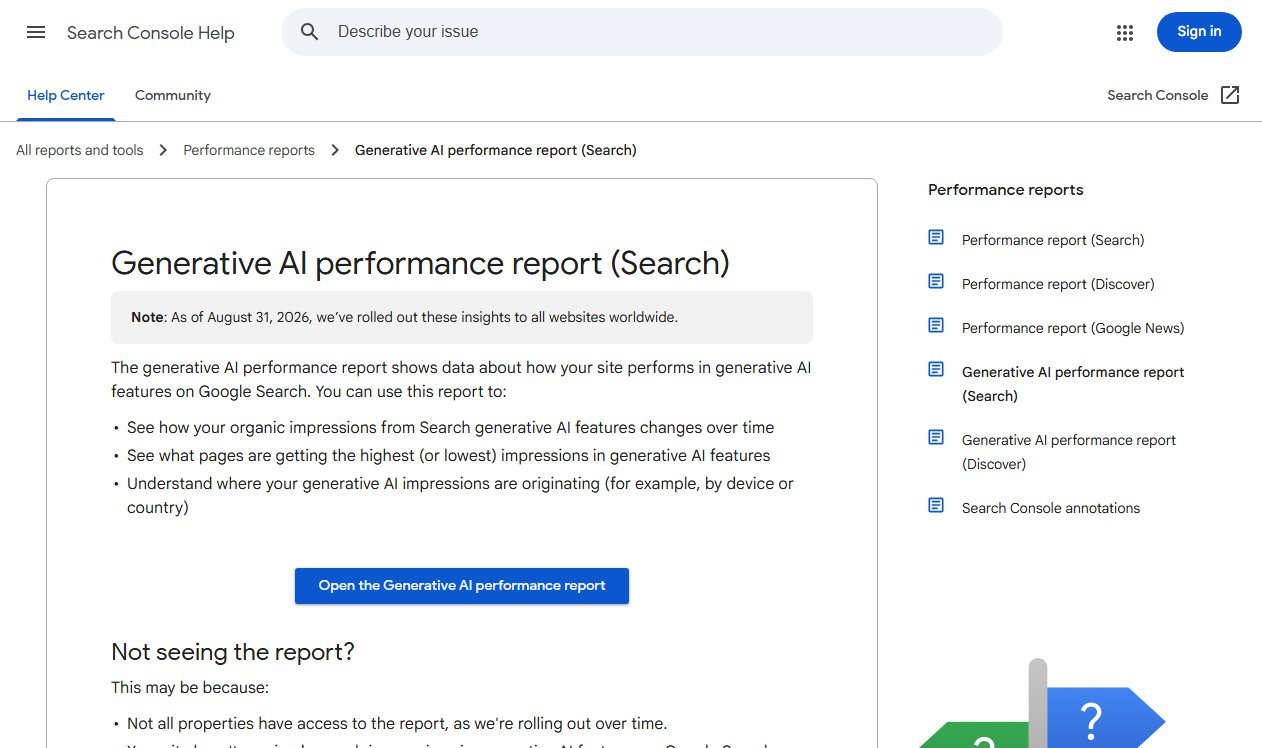
Google's generative AI performance report shows how your site performs in generative AI features on Google Search. It covers AI Overviews and AI Mode, it shows which pages get the highest and lowest impressions in those features, and it breaks the data down by device and country. The help page states that as of 31 August 2026 the insights were rolled out to all websites worldwide, though not every property has access yet.
Two limits matter for anyone buying a service against it. The report is impressions-based, so it tells you where you appeared rather than what it earned you. And data from Search Labs experiments is excluded, so anything still in testing will not show up.
That is still a transformation. For the first time an AI SEO retainer can be judged on a first-party Google number rather than on screenshots of a chatbot.
What Can and Cannot Be Promised
Here is the split we use when scoping this work, and the one we would want to see in any proposal we were asked to sign.
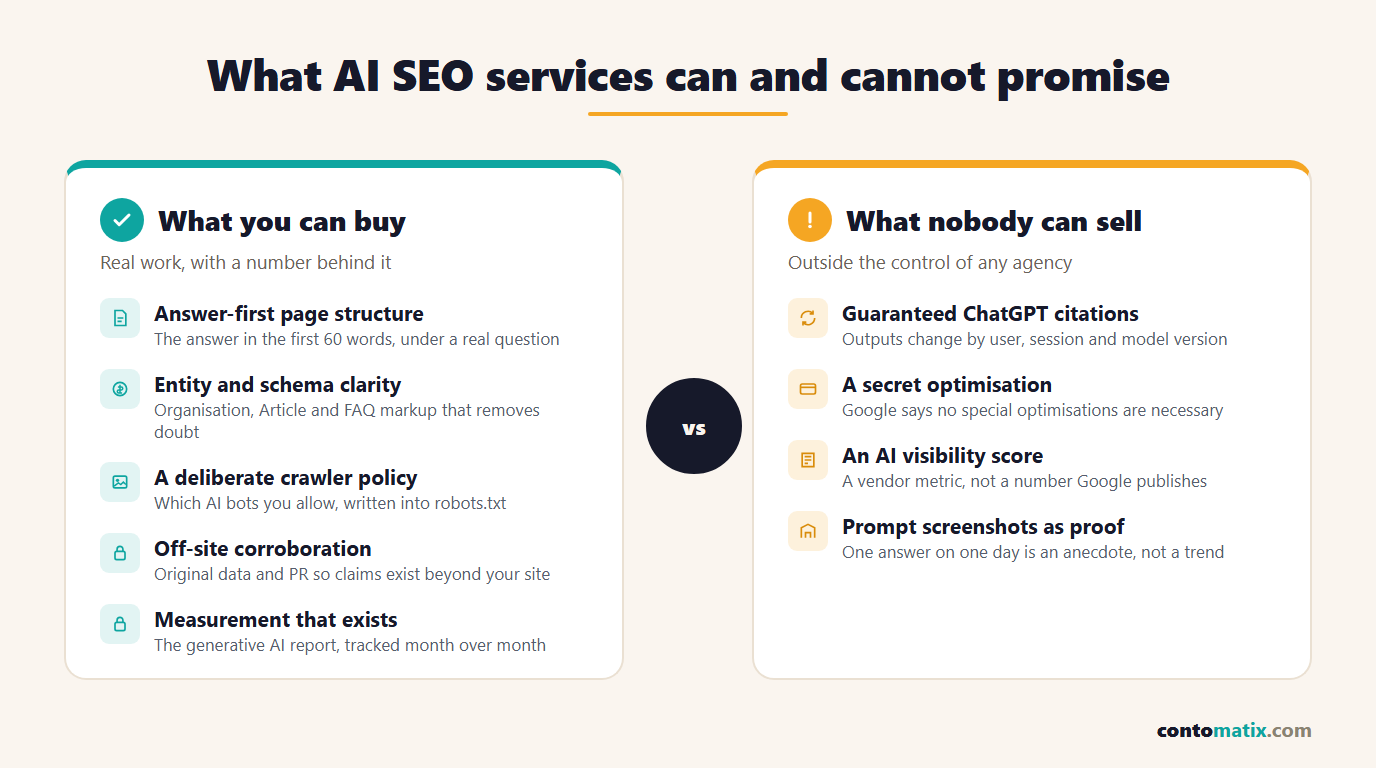
The pattern is simple. Anything that improves how clearly your site states and supports its answers is legitimate work with a measurable proxy. Anything that promises a specific model will say a specific thing on a specific date is not, because the provider controls neither the index nor the model.
Where Chat Assistants Differ From Google
Google is the measurable half of this market. Chat assistants are the half everyone asks about, and they behave differently in three ways worth understanding before you pay for them.
- There is no report. No assistant publishes an impressions dashboard for your domain, so any provider reporting on it is sampling prompts by hand and calling the result data. Useful as a spot check, worthless as a trend.
- Retrieval differs by product. Some assistants answer from training data, some search the live web first, and some do both depending on the question. The same brand can be cited in one and invisible in another on the same day.
- Answers are not stable. Ask the same question twice and the sources can change. That is normal behaviour, not a ranking drop, and it is why prompt screenshots make such poor reporting.
What travels across all of them is unglamorous: a page that states the answer plainly, facts that are corroborated somewhere other than your own marketing, and structured data that removes ambiguity about what the page is. Those hold whether the reader is a person, a crawler or a model.
A Fair Scope for an AI SEO Engagement
A real engagement has deliverables you could photograph. Ours, and the ones we would expect from anyone competent, look like this.
| Workstream | What is actually delivered | How it is measured |
|---|---|---|
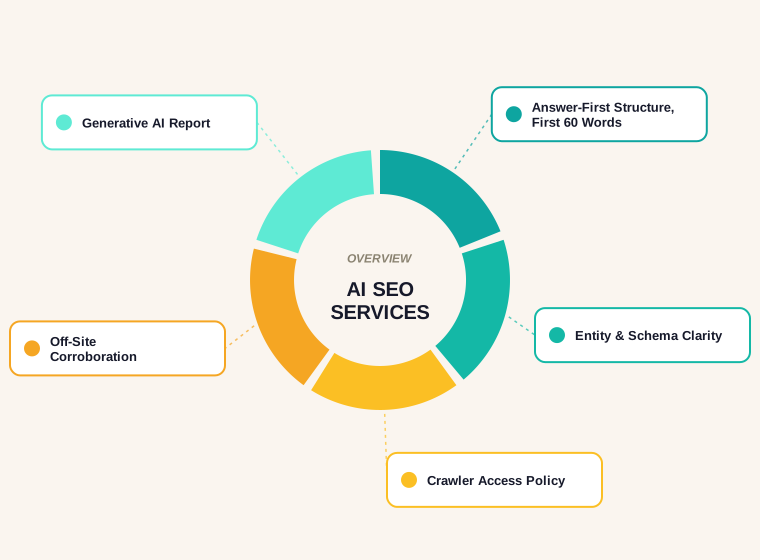
| Answer-first restructuring | Priority pages rewritten so the direct answer sits in the first 60 words under a question-shaped heading | Generative AI impressions for those URLs |
| Entity and schema work | Organisation, Product, FAQ and Article markup; consistent naming; a factual about page | Rich result eligibility, crawl and validation reports |
| Crawler access policy | A deliberate decision on which AI crawlers are allowed, written into robots.txt | Server logs, crawl stats |
| Corroboration | Digital PR, original data, directory and profile accuracy so claims appear off-site too | Referring domains, brand mentions |
| Measurement and reporting | Generative AI report tracked monthly alongside classic performance data | The report itself, not screenshots |
If a scope has none of the left-hand column in it, you are buying monitoring, not optimisation. Monitoring is a fine product; it just should not cost what a retainer costs.
What AI SEO Services Cost
Pricing has settled into roughly three tiers this year.
- Add-on to an existing retainer, $500 – $1,500 a month. Answer-first rewrites on priority pages, schema, and the new report added to reporting. This is where most sites should start.
- Standalone programme, $2,000 – $6,000 a month. Adds original data, digital PR for corroboration, entity work across the web and a larger content programme.
- One-off audit, $1,500 – $5,000. A prioritised list of pages to restructure, a schema plan, a crawler policy and a measurement baseline. Genuinely useful if you have an in-house team to execute it.
Be sceptical of anything priced far above a conventional SEO retainer. The work is not more expensive to do; it is the same craft applied with different priorities.
Red Flags in an AI SEO Proposal
- "Guaranteed citations in ChatGPT." Nobody can guarantee what a model outputs, and outputs vary between users and sessions.
- A secret technique. Google has published that no special optimisations are necessary. A provider claiming otherwise is either wrong or selling something else.
- Screenshots as reporting. A chat answer naming your brand is a nice moment, not a metric. Ask for the generative AI report.
- Bulk AI-written pages. Scaled, low-value content is exactly what Google's spam policies target, and the risk lands on your domain rather than the agency's.
- No mention of your existing SEO. If the fundamentals are broken, AI visibility work is decoration on a page nobody can crawl.
- Pressure about a closing window. Urgency is a sales tactic; the fundamentals here have been stable since Google documented them.
Doing It Yourself: A Five-Step Start
If you would rather test the water before hiring, this is the sequence with the best return on an afternoon.
- Open the generative AI report in Search Console and note which pages already earn impressions in AI features. Those are your strengths; the goal is more of them.
- Take your ten most valuable pages and move the direct answer into the first paragraph, under a heading phrased the way a person would ask it.
- Add or fix schema on those pages. Organisation and Article markup is the baseline; FAQ markup where the content genuinely is a set of questions.
- Decide your crawler policy deliberately rather than by default, and write it into robots.txt so the decision is explicit.
- Publish one thing only you can publish each quarter: your own data, a tested process, a real teardown. Corroborated, distinctive claims are what systems quote.
For the retrieval side of this in more depth, our guide to answer engine optimisation goes through the page-level mechanics.
Quick Recap
- AI SEO services cover four different jobs; make a provider name which one they are selling.
- Google states there are no additional requirements or special optimisations needed to appear in AI Overviews or AI Mode.
- What changes is emphasis: passage-level answers, entity clarity, corroboration, and accepting that some clicks are gone.
- Since 31 August 2026 the generative AI performance report has been available worldwide, which finally makes the work measurable.
- The report shows impressions only, and excludes Search Labs experiments.
- Expect $500 to $1,500 a month as an add-on, more for a standalone programme with PR and original data.
- Walk away from guaranteed chatbot citations, secret techniques and bulk AI-written pages.
If you want this handled rather than explained, our AI SEO service page sets out how we scope it.
Frequently Asked Questions
What are AI SEO services?
They are services aimed at getting a site surfaced and cited in AI-generated answers, mainly Google's AI Overviews and AI Mode and chat assistants. In practice the work is answer-first content structure, entity and schema clarity, crawler access decisions, off-site corroboration and measurement.
Does Google require special optimisation for AI Overviews?
No. Google's documentation says the usual SEO best practices remain relevant and that there are no additional requirements or special optimisations necessary to appear in AI Overviews or AI Mode.
How do I measure AI search visibility?
Use the generative AI performance report in Search Console. It shows impressions from AI Overviews and AI Mode, which pages earn them, and breakdowns by country and device. It does not include click data.
Can anyone guarantee citations in ChatGPT or other assistants?
No. Model outputs vary by user, session and version, and no agency controls the underlying system. Treat a guarantee as a reason to stop the conversation.
Is AI SEO different from traditional SEO?
The levers overlap almost entirely. The difference is emphasis: answers stated early and plainly, stronger entity signals, corroboration off-site, and different expectations about clicks on informational queries.
How much do AI SEO services cost?
Commonly $500 to $1,500 a month as an add-on to existing SEO, $2,000 to $6,000 for a standalone programme including digital PR and original data, or $1,500 to $5,000 for a one-off audit with an execution plan.
Should I block AI crawlers?
It is a business decision rather than a technical one. Blocking protects content from being used without attribution; allowing keeps you eligible to be surfaced. Whichever you choose, make it deliberate and record it in robots.txt.
Will AI search kill organic traffic?
It reduces clicks on queries that can be answered in a sentence. Commercial, comparison and local queries still send visits, which is why the content mix matters more than it did.
How long before AI SEO work shows results?
Pages have to be recrawled and re-evaluated first, so expect several weeks before the generative AI report moves, and longer for competitive topics. Anything faster is usually noise.
Can I do AI SEO myself?
Yes, for a small site. Check the generative AI report, restructure your top ten pages so the answer comes first, add correct schema, set a crawler policy and publish something original each quarter. Hire help when the site is large or the schema and PR work outgrow your time.