Last updated: September 2026
An AI SEO strategy isn't a separate discipline you bolt onto classic SEO — it's the same job with a second scoreboard. You're still trying to be the source Google trusts enough to rank. You're now also trying to be the source ChatGPT, Gemini, and Perplexity trust enough to cite by name, often without sending a single click back to your site. Most of what gets sold under the label "AI SEO" is really three overlapping disciplines — answer engine optimization, generative engine optimization (sometimes called LLM SEO), and plain old technical and on-page SEO — relabeled and bundled together. That's not a criticism of the term. It's useful shorthand. But treating it as one undifferentiated thing is exactly how businesses end up paying for an "AI visibility audit" before fixing the crawlability problem that's keeping them out of Google's index in the first place.
This guide is the practical, sequencing-focused version: what AI SEO actually covers, how the pieces relate to each other, and what to do first, second, and third if you're planning this quarter's work rather than reading definitions.
What "AI SEO" Actually Means (and Where the Deep Dives Live)
We've written full breakdowns of the two specialist disciplines that sit inside AI SEO, so this section stays short on purpose — read those if you want the mechanics.
Answer engine optimization (AEO) is about structuring content so it gets selected as the direct answer — in Google's AI Overviews, featured snippets, and voice assistants. It's fundamentally an extraction problem: can a system pull a clean, self-contained answer out of your page? Our full AEO guide covers answer-first structure, question-phrased headings, and the formats that get extracted most often.
LLM SEO (also called generative engine optimization, or GEO) is about getting cited inside a generated conversational answer — ChatGPT explaining something in its own words and naming you as a source, rather than showing a snippet of your page verbatim. It leans harder on brand mentions, citation-worthy phrasing, and being the kind of source a model has actually encountered and trusts. Our LLM SEO guide covers how that differs mechanically from classic ranking.
AI SEO, as a strategic umbrella, is the practice of running both of those alongside classic technical and on-page SEO, in a deliberate order, instead of treating any one of them as the whole job.
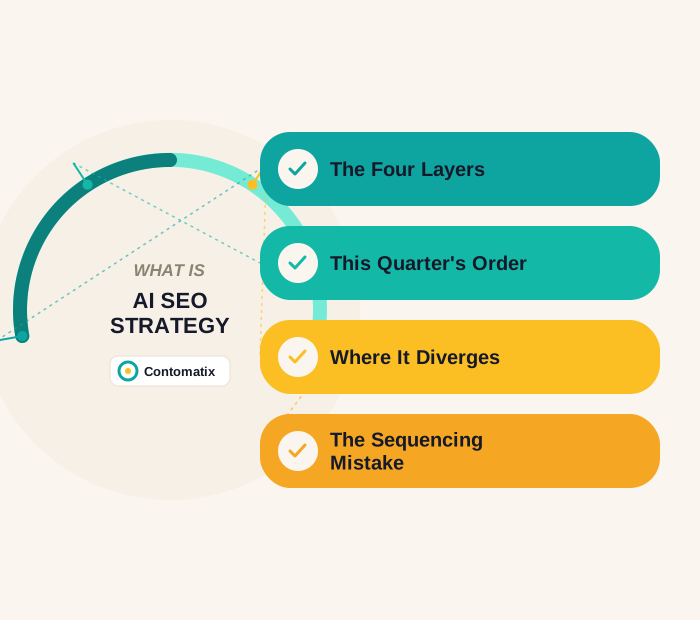
The Four Layers, and Why Order Matters
Skipping a layer doesn't just leave a gap — it usually wastes the work you did on the layers above it.
Layer 1: Crawlability and indexation. If Google can't reliably crawl and index a page, no AI system built on top of Google's infrastructure (AI Overviews, AI Mode) can cite it either, and most other engines' bots need the same basic access. This is unglamorous, and it's also the layer most "AI SEO" pitches skip straight past because it isn't new or exciting. It's still the floor everything else sits on.
Layer 2: Answer-first content structure (AEO). Once a page is indexable, it needs to actually contain a clean, extractable answer near the top, organized under headings that mirror real follow-up questions. This is the layer that turns "technically indexed" into "actually extractable."
Layer 3: Citation-worthy presence (LLM SEO / GEO). Brand mentions across the web, consistent framing of what you actually do, and genuine editorial coverage — the things that make a language model recognize and trust naming you, not just a single page ranking well. Our piece on whether backlinks still matter for AI search goes deep on how this layer actually gets built and why unlinked mentions now carry real weight alongside links.
Layer 4: Measurement. Checking whether any of the above is working, on a cadence, rather than assuming it is. See what AI visibility actually means for how to track this layer specifically.
Each layer depends on the one below it. Polishing your AEO structure on a page Google can't crawl fixes nothing. Building brand mentions for a business whose actual site content is thin or hard to extract just makes an AI model recognize the name without having anything worth citing when it does.
What to Actually Do This Quarter, in Order
Weeks 1–2: Audit before you touch anything. Run a standard technical crawl (index coverage, broken internal links, page speed on your key pages) and, separately, a manual AI-visibility check: ask ChatGPT, Gemini, Perplexity, and Google AI Mode the real questions your customers ask, and log whether you're mentioned, cited, or absent, and who gets cited instead. Do this before any content work — it tells you whether you have an indexation problem, an extraction problem, or a citation problem, and each one gets fixed differently.
Weeks 3–4: Fix the floor. Resolve whatever the technical audit surfaced first — crawl errors, thin or duplicate pages, missing internal links to your most important content. This is the least interesting work in the whole plan and the most commonly skipped, which is exactly why it's first.
Month 2: Restructure for extraction. Take your highest-intent existing pages — the ones closest to a buying decision, not just the ones with the most traffic — and rework them using AEO structure: a direct answer in the first 40–60 words, question-phrased subheadings, and an FAQ section built from real phrasing customers use. New content should be written this way from the start rather than retrofitted later.
Month 2–3, running in parallel: Build citation-worthy presence. This is where a link building program earns its keep for AI SEO specifically — not bulk directory links, but editorial placements and genuine mentions in the kind of comparison content, industry write-ups, and community discussion that both AI models and Google's own systems treat as credibility signals. Consistency matters more than volume here: showing up repeatedly across relevant conversations reads as a real category player in a way one burst of activity doesn't.
Month 3 and ongoing: Re-check, don't assume. Repeat the manual AI-visibility check from weeks 1–2 against the same query set. If nothing has moved, the diagnosis from step one was probably wrong, or the citation-building work hasn't had time to compound yet — brand recognition inside a language model builds slower than a ranking position does.
Where AI SEO Genuinely Diverges From Classic SEO
Most of AI SEO is classic SEO discipline applied to a new surface, but a few things really are different, and pretending otherwise leads to bad expectations.
A top classic ranking no longer guarantees visibility. A page can hold position one in Google's organic results and still get skipped entirely when an AI Overview or ChatGPT answers the same question, because these systems evaluate relevance and trust somewhat independently of SERP position. Google's own documentation on AI features in Search is explicit that ranking well and getting included in an AI-generated response are related but distinct outcomes.
The loss, when it happens, tends to be binary rather than gradual. Classic ranking dilution is usually a slow slide down the results page. An AI answer either cites you or it doesn't for a given query — there's no equivalent of "ranking eleventh" in a generated paragraph. That makes AI SEO feel higher-stakes per query, even though the underlying content work that earns either outcome overlaps heavily.
Volume of content isn't the lever it used to be. Publishing more pages to capture more long-tail variations is a classic-SEO habit that maps poorly onto AI SEO, where a model is more likely to cite one well-established, clearly-answered page repeatedly than to discover twelve thin variations of the same topic. Google's own guidance on creating helpful, people-first content makes the same point for classic ranking, but the AI-citation version of this problem is less forgiving — a model has to pick one source to name, and thin, duplicated pages give it nothing to prefer.
The Sequencing Mistake We See Most Often
The single most common mistake isn't a bad tactic — it's the order of operations. A business hires a specialist for AI visibility, gets a report showing they're invisible in ChatGPT for their core terms, and immediately commissions a round of AI-optimized content and outreach without first checking whether their existing pages are even reliably indexed. Weeks later, visibility hasn't moved, because the new content sits on the same crawlability problems the old content had. The fix isn't a different AI SEO tactic. It's running the audit in step one of the quarterly plan above before spending on anything else, so the money goes toward the layer that's actually broken instead of the layer that's easiest to sell.
Frequently Asked Questions
What is an AI SEO strategy, exactly?
It's a plan for being findable and citable across both classic search rankings and AI-generated answers (ChatGPT, Gemini, Perplexity, Google AI Overviews). In practice it combines technical/on-page SEO, answer engine optimization (AEO) for direct-answer extraction, and brand-mention or citation building for generative engine optimization (LLM SEO/GEO), done in that order.
Is AI SEO different from SEO for AI search?
Not really — "AI SEO," "SEO for AI," and "SEO for AI search" describe the same practice: optimizing so that AI-generated answers, not just traditional search results, surface and cite your content. The terminology varies more than the underlying work does.
What's the difference between AI SEO, AEO, and GEO?
AI SEO is the umbrella strategy. AEO (answer engine optimization) is specifically about structuring content to be extracted as a direct answer — in featured snippets, AI Overviews, and voice assistants. GEO (generative engine optimization, also called LLM SEO) is specifically about being named and cited inside a generated conversational answer. AI SEO runs both alongside classic SEO rather than treating either as the whole job.
Do I need a separate strategy for AI search, or does classic SEO already cover it?
Classic technical and on-page SEO is still the necessary foundation — a page that isn't crawlable or indexed won't get cited by an AI system built on that same index. But it isn't sufficient on its own: answer-first structure and citation-worthy brand presence are additional, deliberate work on top of classic SEO, not a byproduct of it.
How long does an AI SEO strategy take to show results?
Technical fixes and content restructuring can show up in AI answers within weeks once a page is re-crawled. Citation and brand-mention building, which relies on a model recognizing a name across multiple sources, tends to compound more slowly and is worth re-checking on a monthly cadence rather than expecting an immediate shift.
What should I fix first if I'm starting from zero?
Run the audit before anything else: a technical crawl for indexation issues, plus a manual check of ChatGPT, Gemini, Perplexity, and Google AI Mode against your real customer questions. Fix crawlability and indexation problems before investing in AEO restructuring or citation-building outreach, since both of those depend on the underlying pages being reliably indexed.
Can a page rank well on Google and still be invisible in ChatGPT?
Yes, and it's common. Ranking position and AI-citation likelihood are related but separately evaluated. This is one of the clearest ways AI SEO diverges from classic SEO — a strong ranking is necessary groundwork but not a guarantee of AI visibility.
Does AI SEO replace link building?
No. Editorial link building remains one of the stronger ways to build the citation-worthy presence AI systems weigh, and it now sits alongside unlinked brand mentions rather than being replaced by them. See our piece on whether backlinks still matter for AI search for the specifics.
Related Reading
- For the practical prompt library we use to speed up the research and structuring work above, see ChatGPT for SEO: 25 prompts we actually use (publishing soon).
- For where automated tooling fits into (and falls short of) this plan, see AI SEO agents: what they can do and where they fail (publishing soon).
Contomatix runs AI SEO as a sequenced strategy, not a bolt-on service — technical foundation first, then answer-first structure, then citation-worthy brand presence, measured against the real questions your customers ask.
See how our AI SEO service works →