Last updated: August 2026
A client asked us recently why their competitor kept coming up when customers asked ChatGPT for a recommendation, even though the client's site ranked higher on Google. The honest answer: ranking and getting cited by an AI model are no longer the same game. What is LLM SEO, and why does it matter separately from the SEO you're probably already paying for? It's the practice of structuring your content so large language models like ChatGPT, Gemini, and Perplexity can actually find, trust, and quote it — and it's quickly becoming a second channel businesses can't ignore.
This guide covers what LLM SEO actually means, how it differs from traditional SEO, and the practical steps that move the needle — without the tool-comparison fluff most guides bury it under.
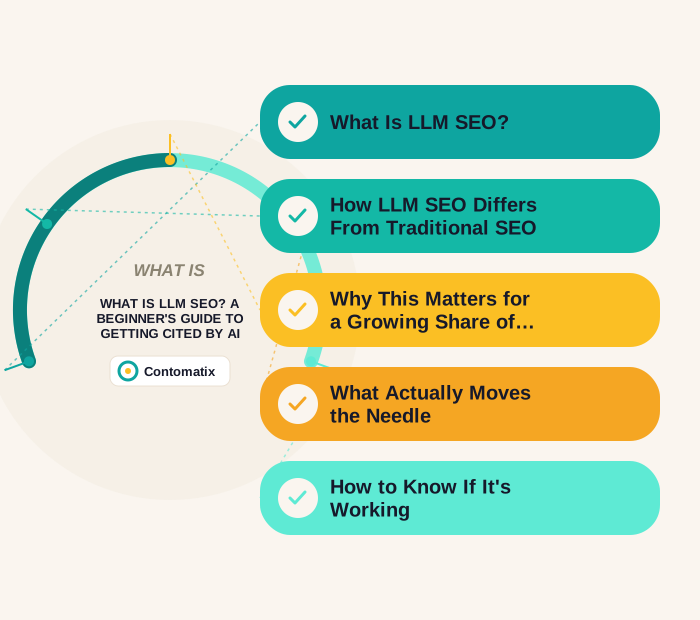
What Is LLM SEO?
LLM SEO (Large Language Model SEO) is the process of optimizing content so AI systems like ChatGPT, Gemini, and Perplexity can understand, interpret, and surface it in their generated answers. Instead of competing for a ranking position, you're competing to be one of the sources a model decides is trustworthy enough to cite — or clear enough to paraphrase — when it answers a question.
The shift behind this is real and already measurable. A 2025 survey covered by Deutsche Welle found that 27% of Americans had already used an AI tool such as ChatGPT, Gemini, or Copilot in place of a traditional search engine. That's not a niche behavior anymore — it's a meaningful slice of the audience your content used to reach exclusively through Google.
How LLM SEO Differs From Traditional SEO
Traditional SEO is a rankings game: you optimize for Google, climb the results page, and measure success in position and clicks. LLM SEO is a citations game: you optimize to be quoted, referenced, or paraphrased inside an AI-generated answer, and success is measured in mentions and visibility — sometimes even when the user never clicks through to your site at all.
The two share a foundation. Both reward well-structured, genuinely useful content and strong signals of expertise and trust. Where they diverge is in emphasis: classic SEO leans heavily on backlinks and click-through optimization, while LLM SEO rewards clarity, direct answers, and content a model can lift cleanly without misrepresenting it. Neither replaces the other — a site with no technical or content foundation won't succeed at either.
Why This Matters for a Growing Share of Searches
The practical risk is straightforward: if your content isn't structured for how these systems read and select sources, your expertise may never surface in an AI answer even if you already rank well on Google. A competitor optimizing for both channels captures visibility you're leaving on the table entirely.
This also compounds. As more platforms roll out AI-driven answers and adoption keeps climbing, every month spent ignoring this shift is a month of visibility handed to whoever did adapt.
What Actually Moves the Needle
None of this requires abandoning what already works. It requires adjusting how you apply it.
Write in direct, conversational language. Models are built to process natural questions and answer them plainly. Content that reads like a real answer to a real question gets pulled far more often than content stuffed around an exact-match keyword phrase.
Structure for extraction. FAQ sections, clear headings, and concise takeaways give a model an obvious, ready-made snippet to lift. This is the same structural discipline that helps human readers scan a page — it isn't a separate skill, just a sharper application of one you likely already practice.
Build genuine authority signals, not just links. A brand that publishes consistently, earns mentions across credible third-party sites, and maintains a coherent presence across its own blog and social channels reads as more trustworthy to a model evaluating which source to cite. This is where backlinks and brand mentions both still play a real role — just not the exact same role they played for classic rankings.
Publish original data or insight. Models are designed to prioritize information that isn't easily found elsewhere. A genuinely original stat, case study, or perspective gives an AI system a reason to cite you specifically rather than paraphrasing whichever competitor said something similar first.
Check what the models are actually saying about you. Query ChatGPT, Gemini, and Perplexity directly with the questions your customers would realistically ask. Note whether your brand comes up, and which competitors get cited instead. This kind of manual spot-check catches gaps no analytics dashboard will show you on its own.
How to Check Your LLM Visibility
This is the one check most sites skip entirely, and it takes about ten minutes. Open ChatGPT, Gemini, and Perplexity separately and run the same short list of realistic customer questions through each — not your brand name, but the question a prospect would actually type before they know your brand exists ("best [service] for [use case]", "how much does [service] cost", "[service] vs [alternative]"). Log three things for each: whether your brand is mentioned at all, which competitors get named instead, and whether the model links out to a source or just states the answer with no citation.
Run the same list again after any major content push. A brand that goes from zero mentions to appearing in two of five model answers over a quarter is a real, trackable signal — even though no analytics dashboard will show it to you automatically. This manual spot-check is also the fastest way to catch a factual error a model has picked up about your business, which is worth correcting at the source before it keeps getting repeated.
How to Know If It's Working
Keyword rank isn't the metric here. Watch three things instead: whether your brand gets mentioned when you query the major AI platforms with realistic customer questions, whether any referral traffic starts showing up from AI tools that do link out, and whether unlinked brand mentions are increasing across the comparison articles, forums, and industry sites these models draw from. None of these show up in a classic rank tracker, which is exactly why they get missed.
A Practical Framework: Four Pillars of LLM Visibility
Rather than treating LLM SEO as a loose collection of tips, it helps to organize the work around four concrete pillars. A page or brand that is weak on all four is unlikely to get cited no matter how much content volume it produces.
- Extractability — can a model lift a clean, accurate answer from your content without misrepresenting it? Short, direct paragraphs under clear headings extract more cleanly than long, meandering prose that buries the answer three paragraphs in.
- Authority — does your brand show up consistently, with consistent facts, across the sources a model actually trains on and retrieves from — your own site, third-party mentions, forums, and comparison content? Inconsistent claims about your own business across different sources actively hurt this.
- Freshness — is the content current, and does it say so explicitly? A model weighing two similar sources will often favor the one that visibly states when it was last updated.
- Structured clarity — does the page use headings, lists, and explicit question-and-answer formatting that mirrors how a model breaks down a query, rather than a single unbroken block of text?
Structured Data and Technical Setup Worth Getting Right
A handful of technical details make it meaningfully easier for a model — and the crawlers that feed it — to parse your content correctly:
- Schema.org markup for FAQs, articles, and organizational details, giving machine-readable structure to information a model would otherwise have to infer from prose.
- A clean, crawlable site structure with no critical content locked behind rendering a crawler cannot easily execute.
- Accurate, consistent author and organization information, since AI systems increasingly weigh clear authorship and expertise signals when deciding what to trust.
- A deliberate robots.txt policy that reflects an actual decision about which AI crawlers can access your content, rather than a default you have never reviewed.
None of this guarantees a citation on its own, but skipping it means a model has to work harder to understand content that might otherwise be genuinely useful to cite — and a model under no obligation to do that extra work will simply move to a source that made it easier.
Common Mistakes When Trying to Optimize for AI Citations
A few patterns show up repeatedly in sites that struggle to gain any LLM visibility despite genuine effort:
- Treating LLM SEO as a rewrite of existing content into more keywords, rather than a rewrite toward clarity and directness. Keyword density has little bearing on whether a model chooses to cite a source.
- Publishing once and never revisiting — since freshness is a real factor, content that has not been reviewed in over a year quietly loses ground to more recently updated competitors covering the same topic.
- Chasing every AI platform equally instead of checking which ones your actual customers use, and prioritizing accordingly.
- Ignoring inconsistencies about your own business across the web — a different phone number, service list, or founding date on different platforms confuses a model's confidence in any of them.
Frequently Asked Questions
What is LLM SEO in simple terms?
LLM SEO is optimizing your content so AI systems like ChatGPT, Gemini, and Perplexity can understand it and cite it in their answers, rather than optimizing purely to rank on a search results page.
Is LLM SEO the same as traditional SEO?
No, though they overlap. Both need strong, well-structured, trustworthy content. Traditional SEO measures success through rankings and clicks; LLM SEO measures success through citations and mentions inside AI-generated answers, sometimes without a click at all.
Do I need to abandon traditional SEO for LLM SEO?
No. LLM SEO builds on the same foundation — quality content, technical health, and authority signals. The adjustment is in emphasis: writing more conversationally, structuring for extraction, and tracking citation frequency alongside rankings.
How many people are actually using AI instead of search engines?
A widely cited 2025 survey found that 27% of Americans had already used an AI tool such as ChatGPT, Gemini, or Copilot in place of a traditional search engine for at least some queries — a meaningful and growing share of search behavior.
Do backlinks still matter for LLM SEO?
Yes, though their role has shifted. Backlinks remain a strong trust signal, but brand mentions and consistent presence across trusted sources now carry comparable or greater weight in how AI models evaluate credibility.
How do I check if my content is being cited by AI models?
Query ChatGPT, Gemini, and Perplexity directly with the real questions your customers would ask, and note whether your brand appears and how it compares to competitors. Dedicated AI-visibility tracking tools have also emerged to automate this monitoring at scale.
What kind of content works best for LLM SEO?
Content written in direct, conversational language, structured with clear headings and FAQs, and backed by original data or genuine expertise. Generic, keyword-stuffed content built purely for classic rankings tends to underperform for AI citation purposes.
Does LLM SEO replace the need for a link building strategy?
No. Editorial backlinks and brand mentions both feed into how AI models judge a source's credibility. A link building strategy built around genuine, relevant placements supports LLM SEO rather than competing with it.
Disclaimer: This article is for informational purposes only. Cited research figures reflect the source studies at time of publication and may be updated by those organizations over time.
Contomatix builds the editorial backlinks and content authority that support visibility in both classic search rankings and AI-generated answers. Want a free check of how your brand currently shows up across ChatGPT, Gemini, and Perplexity?
Get a free AI visibility check →

