Last updated: September 2026
An AI SEO agent is a system that doesn't just answer a question about SEO when asked — it takes a goal (audit this site, draft these ten pages, find and pitch these outreach targets) and works through the steps on its own, often touching dozens or hundreds of pages before a human looks at the output. That autonomy is the entire appeal, and it's also exactly why the failure mode is worse than the equivalent human mistake. A junior SEO who misjudges a page's tone produces one bad page a day. An agent that misjudges the same thing produces the same mistake at whatever scale you pointed it at, before anyone notices.
What the Category Actually Covers
"AI SEO agent" isn't one product type — it's a handful of distinct jobs that happen to share the same underlying pattern: give a system a goal and access to tools, let it plan and execute multiple steps, review the output.
Audit agents crawl a site, cross-reference technical issues (broken links, missing meta tags, duplicate content, slow pages) against a rule set, and produce a prioritized findings list — the same job a technical SEO audit does manually, run continuously instead of quarterly.
Content drafting agents take a brief or a keyword list and produce full draft pages, sometimes hundreds at a time, following a template for structure, headings, and internal linking.
Outreach agents identify link-building targets, draft personalized pitch emails, and manage follow-up sequences with less human involvement per contact than a manual campaign requires.
Rank-tracking and monitoring agents watch positions and AI-citation appearances across a query set and flag movement, sometimes triggering an automated response (a content refresh task, an alert) rather than just a dashboard update.
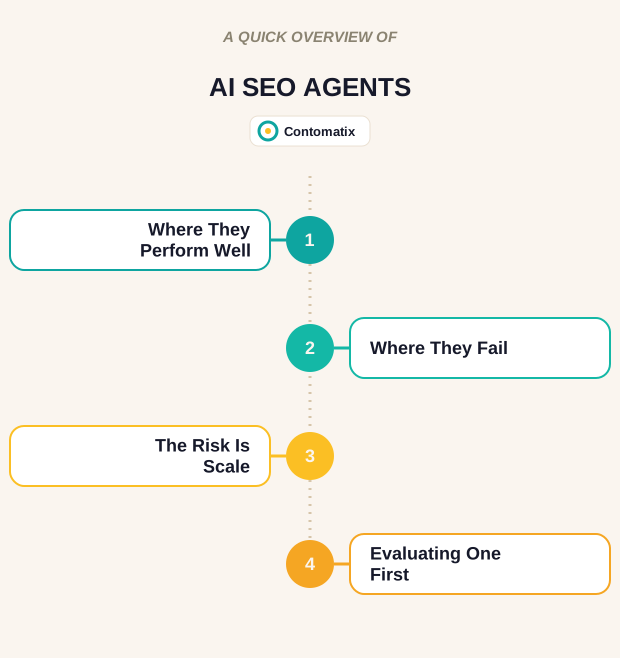
Where They Genuinely Perform Well
The capability is real in a specific, narrower band than the marketing around it suggests.
Bulk pattern-matching across a large site. Finding every page with a missing canonical tag, every internal link pointing to a redirected URL, or every title tag over a length threshold is exactly the kind of exhaustive, rule-based check an agent does faster and more completely than a human spot-checking a sample. This is the strongest, least controversial use case in the category.
First-draft generation at speed. Producing a structurally complete first draft — correct headings, a reasonable outline, an FAQ section built from a keyword list — in minutes rather than hours is a genuine time saving, provided the draft is treated as a first draft and not a finished page.
Consistency across a template. When a genuinely large number of near-identical pages need the same structural elements applied (schema markup, a specific internal-linking pattern, a standard disclosure block), an agent applies the rule identically every time in a way manual work drifts on over hundreds of iterations.
Continuous monitoring instead of periodic checks. Catching a ranking drop or a broken page within hours instead of at the next scheduled audit is a real advantage of automation that doesn't require much judgment to execute well.
Where They Fail, Specifically
These aren't hypothetical edge cases — they're the predictable failure points given what these systems are actually built to do.
E-E-A-T and quality judgment calls. An agent can check that a page has an author byline. It can't judge whether that author's credentials are actually relevant to the topic, whether a claim in the draft is true, or whether the page demonstrates real first-hand experience versus a plausible-sounding paraphrase of other content on the same topic. Google's own guidance on creating helpful, people-first content is built almost entirely around judgment calls of exactly this kind — it's asking whether content demonstrates genuine expertise and experience, which is a different question from whether it follows a checklist.
Understanding a specific brand's actual expertise. A drafting agent works from a brief and whatever source material it's given. It doesn't know which claims your business can actually back up with real experience versus which ones are generic industry statements that happen to sound fine. That distinction matters enormously for trust and for accuracy, and no amount of prompt engineering substitutes for a human who actually knows the business reviewing the output.
Recognizing when a topic needs a human, not a template. Legal, medical, financial, and safety-adjacent topics carry real consequences for getting a detail wrong. An agent applying the same drafting template it uses for a general how-to piece won't reliably flag that a specific topic needed more caution, a citation to an actual authority, or a human expert's review before publishing.
Scaled content abuse risk. This is the failure mode that's specific to agents rather than to AI content generally. Google's scaled content abuse policy targets content "generated for the primary purpose of manipulating search rankings," and is explicitly method-neutral — it treats AI-generated, human-written, and templated content the same way if the pattern is scaled, low-value duplication. An agent makes it trivially easy to cross that line by accident: it's just as capable of generating five hundred thin, templated pages as fifty genuinely useful ones, and nothing about the tooling itself tells you which one you're doing.
The Real Risk Isn't the Mistake — It's the Scale
A human writer who produces a mediocre, generic page makes that mistake once, at the pace of one page. The same underlying misjudgment, executed by an agent given a keyword list and a publish button, produces the same mistake hundreds of times before anyone reviews a sample of the output. This is the actual risk profile of AI SEO agents that most coverage of the category undersells: it's not that the technology is unreliable in a novel way, it's that autonomy plus scale turns a small, correctable error into a site-wide pattern before a human notices. A single mediocre page is a minor cleanup. Five hundred mediocre pages published under the same domain, in the same pattern, is the kind of signal search engines' spam policies are specifically built to catch and penalize.
The practical implication isn't "don't use agents." It's that the review step scales with the output, not with the effort it took to produce it — a batch of 200 agent-drafted pages needs proportionally more human review before publishing than 200 individually written ones would ever have gotten, because the agent didn't individually reconsider each one the way a tired human writer occasionally does anyway.
A Closer Look at Outreach Agents Specifically
Outreach agents deserve a separate note because the failure mode there is social, not just editorial. A drafting agent's mistake sits quietly on your own site until someone reviews it. An outreach agent's mistake lands in someone else's inbox immediately, under your brand's name, and there's no undo once it's sent. The specific failure pattern is a pitch that reads as personalized — it names the recipient's site, references a real page — but gets a detail wrong: a page that no longer exists, a topic the site actually doesn't cover, a "recent article" that's two years old. A human writing twenty pitches a day usually catches this because they're reading the target's actual page as they write. An agent working from a scraped summary or a stale crawl doesn't have that same check built in unless someone specifically added it, and the wrong detail is exactly what marks a pitch as automated rather than genuine — the opposite of what outreach is supposed to accomplish.
Evaluating an Agent Before You Turn It Loose
A few concrete questions are more useful than a general "is this trustworthy" gut check.
- What is it actually checking its work against? A technical audit agent checking HTML against a documented rule (missing canonical, broken link) is verifiable. A "content quality" agent scoring its own drafts against a vague internal rubric is grading its own homework, and that score shouldn't be treated as equivalent to human review.
- What happens when it's uncertain? A well-built audit or drafting agent flags low-confidence findings for human review instead of presenting every output with the same confidence. An agent that never expresses uncertainty is a warning sign, not a feature.
- How current is the data it's working from? A rank-tracking or outreach agent pulling from a crawl that's weeks old will confidently act on outdated information — a page that's since changed, a contact who's since left. Ask specifically how fresh the underlying data is before trusting an automated action based on it.
- What's the blast radius of one bad decision? An audit agent that misflags one page costs you a few minutes of review. A publishing or outreach agent that acts on a bad decision at scale costs considerably more, which is the actual argument for keeping a human approval step on anything publish- or send-facing, even after the agent has proven reliable on smaller batches.
How to Use Them Without the Failure Mode
The pattern that actually works treats an agent as a fast first pass, not a final decision-maker, at every stage where judgment matters more than pattern-matching.
- Let agents run unsupervised on rule-based, verifiable tasks — technical audits, broken-link detection, schema validation — where the output is checkable against an objective standard.
- Never publish agent-drafted content without a human who knows the subject reviewing it for factual accuracy, genuine expertise, and whether the topic needed more care than the template gave it.
- Cap batch size on anything publish-facing until you've manually reviewed enough of the agent's output at a smaller scale to trust the pattern it's following.
- Treat outreach agents as a drafting tool for pitches, not an unsupervised sender — a personalized-sounding pitch that's actually wrong about the recipient's site damages a relationship an agent can't repair on its own.
Frequently Asked Questions
What is an AI SEO agent?
A system that takes a goal — audit a site, draft a set of pages, find outreach targets — and works through the steps autonomously, rather than answering one question at a time. It covers several distinct jobs, including technical audit agents, content drafting agents, outreach agents, and rank-tracking or monitoring agents.
Can an AI SEO agent replace an SEO team?
Not for judgment-heavy work. Agents perform well on bulk, rule-based tasks like technical audits and consistency checks. They don't reliably judge content quality, genuine expertise, or when a topic needs a human expert's review, which is exactly the work Google's helpful-content guidance is built around evaluating.
Is using AI SEO agents to publish content risky for search rankings?
It can be, specifically at scale. Search engines' scaled content abuse policies target low-value, templated content generated to manipulate rankings, regardless of whether it was written by a human or generated by an agent. The risk comes from publishing agent output at volume without proportional human review, not from using an agent at all.
What can AI SEO agents actually do well right now?
Bulk pattern-matching across large sites (finding every instance of a technical issue), fast first-draft generation, applying a consistent structural template across many pages, and continuous monitoring that catches issues faster than periodic manual audits.
Where do AI SEO agents fail most often?
Judgment calls: evaluating E-E-A-T and genuine expertise, understanding what a specific brand can actually back up with real experience, and recognizing when a topic (legal, medical, financial) needs more caution than a standard content template applies.
How much human review does agent-generated SEO content need?
More than the same volume of individually written content typically gets, not less. Because an agent can produce the same misjudgment at scale, review needs to scale with output volume — every batch needs a human who knows the subject checking for accuracy and genuine relevance before publishing, not a sample check after the fact.
Are AI SEO agents against Google's rules?
Using automation isn't itself against the rules. What violates Google's spam policies is publishing scaled, low-value, or manipulative content, whatever tool produced it. An agent used to speed up genuinely reviewed, useful content isn't the problem; an agent used to publish unreviewed content at volume is exactly the pattern the scaled content abuse policy targets.
Related Reading
- For the sequencing this fits into, see our AI SEO strategy guide.
- For the manual, prompt-by-prompt version of this same work before you'd ever hand it to an autonomous agent, see ChatGPT for SEO: 25 prompts we actually use.
Contomatix uses automation for the rule-based grunt work — audits, consistency checks, monitoring — and keeps a human expert on every piece of content and every outreach pitch before it goes out. No unsupervised bulk publishing.
Talk to a real strategist →

