Last updated: September 2026
Type "how to get more backlinks fast" into Google and within a few clicks you'll land on a tool promising to put your outreach on autopilot. Automated link building is the umbrella term for that entire category — software that finds prospects, sends emails, tracks placements, or in the worst cases, generates links outright without a human ever reviewing where they land.
Some of that automation is genuinely useful. Some of it is the fastest way to get a manual action from Google. The difference isn't the word "automated" — it's which part of the process you hand off to software, and which part still needs a person deciding whether a link is actually worth having.
This guide breaks down what automated link building actually covers, what Google's own policies say about it, which parts of the process are safe to automate and which aren't, and the hybrid model that real agencies use to scale without triggering a penalty.
What "Automated Link Building" Actually Means
The term gets used for at least three very different things, and conflating them is where most confusion starts.
Research automation — tools that crawl the web and surface data: who links to your competitors, which of your own backlinks recently disappeared, which pages on a target site are already ranking. This is just faster access to public information. Nothing about it manipulates rankings.
Outreach automation — software that finds contact emails, sends templated (sometimes personalized) pitches, and tracks replies across hundreds of prospects at once. This replaces the manual labor of outreach, not the link-earning itself. A human still decides whether to accept a placement and what it says.
Link generation automation — scripts or networks that place links on autopilot with no editorial review: mass blog comment spam, auto-submitted directory blasts, private blog networks (PBNs), or paid link schemes that skip human judgment entirely. This is the category Google's guidelines are written to catch.
Most vendors marketing "automated link building" software are really selling the first two. The confusion is that all three get marketed under the same phrase, and only the third one is actually risky.
Is Automated Link Building Against Google's Guidelines?
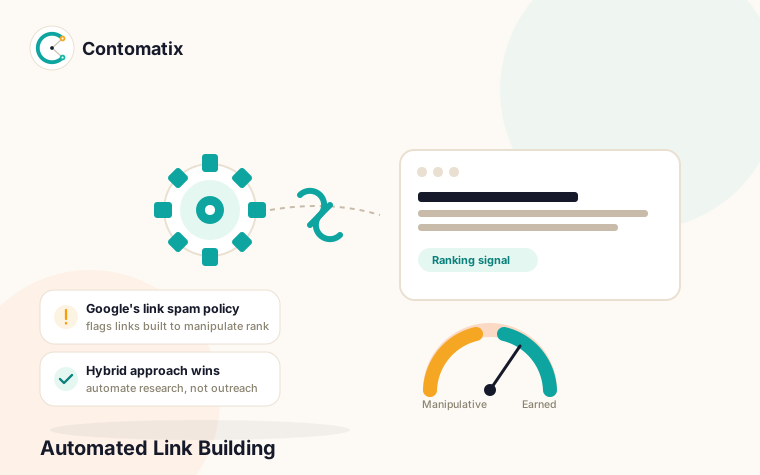
Google's Spam Policies for Google Web Search define link spam as any link created primarily to manipulate a site's ranking, regardless of whether a human or a script placed it. The policy doesn't single out automation by name — it targets intent and pattern. A link built at scale, with no relevance to the linking page, no editorial reason to exist, and no rel="sponsored" or rel="nofollow" tag where required, reads as manipulative whether one person built it by hand or a tool built ten thousand of them overnight.
That's the part most "top automated link building tools" roundups skip over: the policy risk was never really about automation as a method. It's about what the automation is used to produce. A tool that helps a person find 200 genuinely relevant prospects faster carries no more risk than doing the same research manually. A tool that auto-submits your URL to 5,000 directories overnight is a footprint Google's spam systems are specifically built to catch.
The Real Risks of Full-Automation Link Building
Pushing every stage of link building — including the actual placement — onto autopilot tends to produce a specific, recognizable set of problems:
- Footprints. The same anchor text pattern, the same link velocity, the same class of low-authority sites, all appearing in a short window — this is exactly the signature Google's algorithmic spam systems (and any human reviewer during a manual action audit) are trained to spot.
- Irrelevant placements. Software optimizing for volume rather than topical relevance will happily place a plumbing-company link on a crypto forum, because the tool has no concept of whether the placement makes editorial sense — only whether it succeeded technically.
- PBN and link-network exposure. A meaningful share of "automated" link services route links through networks of low-quality sites built for the sole purpose of passing authority. When Google devalues or deindexes one node in that network, every site that received a link from it can lose the benefit overnight, sometimes taking a ranking hit along with it.
- No recovery path. Manual outreach leaves a paper trail — you know who you emailed and why a placement exists. Fully automated placements often leave no record of the reasoning, which makes cleanup (disavows, removal requests) far slower when something needs to be undone.
None of this means automation itself is the problem. It means automation applied to the wrong stage of the process removes the one safeguard — human judgment about relevance and quality — that keeps link building inside Google's guidelines in the first place.
Safe to Automate vs. Not Safe to Automate
| Stage of the process | Automation risk | Why |
|---|---|---|
| Backlink & competitor research | Safe | Pulling public data faster doesn't touch anyone's ranking |
| Prospect list building | Safe | Finding relevant sites is information-gathering, not link placement |
| Contact/email discovery | Safe | Locating a public contact address, not manipulating a SERP |
| Outreach sending & follow-ups | Safe with guardrails | Fine if pitches stay relevant and personalized; mass identical spam pitches burn domain reputation and response rates |
| Link placement decision | Keep human-reviewed | Judging whether a placement is genuinely relevant is exactly what a script can't do |
| Mass directory submission | Not safe | Bulk submission to low-relevance directories is a textbook spam-policy pattern |
| PBN / link network placement | Not safe | Built solely to pass authority with no independent editorial purpose |
Tool Categories: What Automated Link-Building Software Actually Does
Rather than ranking specific vendors — pricing and feature sets change constantly, and what's "best" depends entirely on budget and niche — it's more useful to understand the categories, since most software on the market fits cleanly into one. Moz's beginner's guide to link building is a solid primer if you want the manual-outreach fundamentals before layering automation on top of them.
Backlink research & prospecting platforms (the Ahrefs/Semrush/Moz category) build their own index of the web's link graph, letting you see who links to a competitor, which of your links dropped, and where broken-link or unlinked-mention opportunities exist. These are research tools first — the actual outreach still has to happen elsewhere.
Outreach & CRM platforms (the Pitchbox/Respona/BuzzStream category) manage the sending, tracking, and follow-up side: templated-but-personalizable emails, reply tracking, and campaign organization across dozens or hundreds of prospects. They speed up a process a person used to run out of a spreadsheet and an inbox — they don't decide which links are worth having.
Contact-finding tools (the Hunter.io category) solve one narrow problem: turning a domain into a verified email address so outreach doesn't start with a guess. Useful, low-risk, and rarely sufficient on its own.
Full-service "done for you" automation covers a wide range — from legitimate managed link-building services that use software internally but still vet every placement by hand, to bulk link-selling operations that automate placement itself with no editorial review. The tool category tells you almost nothing here; the vetting process the provider actually follows is what determines whether you're buying a safe service or an eventual penalty.
The Hybrid Approach: What Actually Works in 2026
The agencies and in-house teams getting real, durable results treat automation as a time-saver for the repetitive 80% of the work, while keeping a person in the loop for the 20% that determines whether a link helps or hurts:
- Automate the research. Use backlink and competitor tools to generate prospect lists at scale — this is where automation genuinely multiplies output with zero added risk.
- Automate the logistics. Let outreach software handle sending, sequencing, and tracking replies so a person isn't manually copy-pasting emails.
- Keep a human on relevance and quality. Every prospect gets a quick manual check — does this site actually cover this topic, does it have real traffic and an editorial process, would this link make sense to a reader who isn't an SEO — before a pitch goes out.
- Keep a human on the final placement. Read the page the link actually lands on. A relevant domain can still produce an irrelevant, low-quality individual page.
- Track velocity, not just volume. A sudden spike in new referring domains is one of the easier patterns for spam systems to flag, even when every individual link is legitimate — pace acquisition the way natural link growth would look.
This is the same principle behind Contomatix's own link building service: software does the finding, a person does the deciding. It's slower than pure automation and considerably safer than it — the same reasoning behind our category-specific breakdowns like link building for dentists, where the safe tactics are almost entirely research- and relationship-driven rather than automated placement.
Red Flags That an "Automated" Service Will Hurt You
- Guaranteed link counts or rankings on a fixed timeline — nobody controls Google's index on a schedule.
- Pricing based purely on Domain Authority or Domain Rating with no mention of topical relevance.
- No sample of actual live placements, or placements you can't independently verify are indexed and dofollow where claimed.
- Homepage-only links delivered in bulk, rather than links to relevant inner pages or resources.
- Zero anchor text diversity — every link using the exact same commercial keyword phrase.
- A network of sites that all share the same footprint: identical WordPress theme, similar "About" page language, or a suspiciously narrow range of hosting IPs.
How to Vet Any Link-Building Tool or Vendor
- Ask exactly which stage of the process is automated versus human-reviewed — a vague answer is itself an answer.
- Request 3-5 live example placements from the last 30 days and check each one is indexed, relevant, and still live.
- Check whether pitches or placements are personalized to the specific page, or copy-pasted with the site name swapped.
- Confirm how link velocity is paced — a provider offering "50 links this week" for a small local business is offering a footprint, not a strategy.
- Ask what happens if a placement gets deindexed or the linking site disappears — a real process has a replacement or reporting policy; a bulk seller usually doesn't.
Automated link building isn't a single practice to embrace or avoid — it's a spectrum, and where a given tool or vendor sits on it is what actually determines whether it helps your rankings or ends up needing a disavow file six months later. The research and outreach logistics are safe to hand to software today. The judgment about whether a specific link deserves to exist is the one part worth keeping human, no matter how good the automation gets. If you're weighing whether links still matter as much given how search itself is changing, see do backlinks still matter for AI search for the current data.
Frequently Asked Questions
What is automated link building?
Automated link building is the use of software to speed up some or all of the backlink acquisition process — commonly prospect research, contact finding, and outreach sending. Some tools go further and automate the actual placement of links with no human review, which is the higher-risk end of the category.
Is automated link building against Google's guidelines?
Google's spam policies target links built primarily to manipulate rankings, regardless of whether a person or a script created them. Automating research and outreach logistics doesn't violate this. Automating link placement itself — mass directory submissions, PBNs, paid links with no disclosure — does.
Can automated link building get you penalized?
Yes, if the automation is used for placement rather than research and logistics. Google's algorithmic spam systems and manual reviewers both look for footprints — identical anchor text, sudden link spikes, low-relevance networks — that fully automated placement tends to produce.
What tools are commonly used for automated link building?
Backlink research platforms like Ahrefs, Semrush, and Moz for prospecting; outreach and CRM platforms like Pitchbox, Respona, and BuzzStream for managing campaigns at scale; and contact-finding tools like Hunter.io for locating verified email addresses. Each covers a different, narrow stage of the process.
Is it worth paying for automated link-building software?
For research and outreach logistics, generally yes — these tools save real time on work that's otherwise manual and repetitive. For services that automate placement itself with no editorial review, the cost savings usually come with meaningful penalty risk attached.
How is automated link building different from manual outreach?
Manual outreach means a person handles research, contact finding, pitching, and placement decisions from scratch. Automated link building uses software for one or more of those stages — usually research and sending — while a hybrid approach keeps a human decision point on relevance and final placement.
Can small businesses use automated link building safely?
Yes, if the automation stays limited to research and outreach logistics rather than placement. A small business is often more exposed to a penalty than a large site, since it has fewer pages and less authority to absorb a spam signal, so pacing and relevance matter even more.
What's the safest way to scale link building in 2026?
Automate the repetitive 80% — prospect research, contact finding, sending, and tracking — and keep a person deciding which prospects are actually relevant and reviewing where each link lands before and after it goes live.
Do backlink automation tools work for local SEO?
Research and outreach tools work the same way for local businesses as any other site, but local link building leans more heavily on genuinely local sources — chambers of commerce, sponsorships, local press — that automation is less useful for finding than a person who knows the market.
How much does automated link building software cost?
Backlink research platforms typically range from roughly $100 to $500+ per month depending on tier. Outreach and CRM platforms run from about $150 to $800+ per month. Contact-finding tools are usually the cheapest at $30-200+ per month. Full-service managed link building is priced separately, usually as a monthly retainer or per-placement fee.
Will Google eventually allow fully automated link placement?
Google's stated policy targets manipulative intent, not automation as a method, and that framing isn't tied to any particular generation of technology. Fully automated placement with no relevance or editorial check is likely to keep reading as manipulative regardless of how sophisticated the tooling producing it becomes.
Disclaimer: This article is for informational purposes only and does not constitute a specific SEO recommendation for any individual site. Tool pricing changes frequently and should be verified directly with each vendor. Nothing in this article should be read as legal advice regarding Google's policies.
Contomatix builds links the hybrid way — software-assisted research and outreach, with every placement reviewed by a person before it goes live. No PBNs, no bulk directory blasts, no guaranteed link counts.
Get a free link-building strategy review →