Last updated: August 2026
A growing number of business owners are asking their SEO agency some version of the same question this year: if ChatGPT and Google's AI Overviews are answering searches directly, is link building still worth paying for? Do backlinks still matter for AI search, or has the entire game changed underneath everyone? The honest answer, backed by real published research rather than guesswork, is yes — but not in exactly the way backlinks mattered for classic Google rankings, and understanding that difference changes what you should actually be building.
This guide breaks down what the current data actually shows, why AI engines choose the sources they cite, and what that means for how you should be spending a link building budget in 2026.
Backlinks for AI Search — The Headline Finding: Mentions Beat Links, But Links Aren't Dead
Ahrefs analyzed 75,000 brands to see what actually correlates with a brand's visibility in Google's AI Overviews. The result surprised a lot of SEOs: branded web mentions correlated with AI Overview visibility at 0.664, while traditional backlinks correlated at only 0.218 — roughly three times weaker as a signal.
That doesn't mean backlinks stopped mattering. It means AI systems are weighing something broader than a raw link graph: how often and in what context your brand gets talked about across the web, whether or not every mention includes a clickable link. A backlink is still one of the strongest individual signals available, but it now competes with unlinked mentions, forum discussions, and review-site citations for the same job — convincing an AI model that your brand is a credible answer to a question. The full breakdown is worth reading directly in Ahrefs' original correlation study.
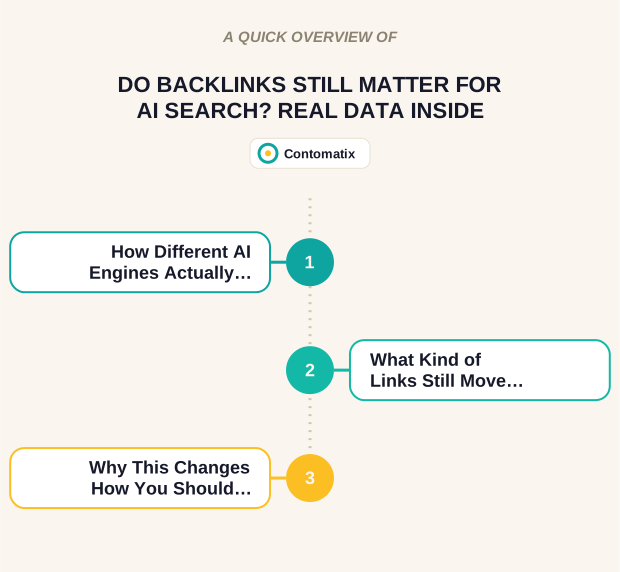
How Different AI Engines Actually Pick Their Sources
The three major AI answer engines don't source citations the same way, which matters for where you focus link building effort.
Google AI Overviews and Gemini pull heavily from Google's own index and favor content with strong E-E-A-T signals. Research on AI Overview citation patterns has found that a majority of the links cited in AI Overviews come from high-authority domains — and Reddit and Quora show up disproportionately often, reflecting how much weight community discussion carries.
ChatGPT blends its training data with live search results when browsing is active, and shows a clear preference for expert blogs, industry publications, and Wikipedia-style reference content. A notable pattern in the data: a substantial share of ChatGPT's cited links come from business and service sites that don't even rank in Google's top 20 for the equivalent query — meaning ChatGPT is evaluating relevance and authority somewhat independently of classic SERP position.
Perplexity leans hardest toward specialist and analytical sources: review platforms, industry reports, and practitioner-written content over generic marketing pages.
What Kind of Links Still Move the Needle
Not every backlink carries the same weight in an AI-search world, and the gap between useful and useless links has widened.
Editorial links from expert-adjacent sources outperform everything else. A link earned inside a genuine comparison article, industry report, or expert roundup does two jobs at once: it passes traditional authority and it places your brand inside exactly the kind of "trusted context" AI models look for when deciding who to cite.
Placement inside the actual content matters more than ever. Links embedded naturally within an article's main body consistently outperform links sitting in a footer or an author bio — a pattern consistent with how these systems parse a page for genuinely relevant context rather than treating every link on a page as equal.
Directory submissions and low-effort link farms are close to worthless here. They were already flagged as low-value link schemes under Google's own spam policies; for AI citation purposes, a link with no surrounding editorial context or topical relevance gives a language model almost nothing to work with.
Repetition and co-citation compound. A brand that shows up once in a random blog post is a weak signal. A brand that shows up repeatedly across comparison articles, industry write-ups, and community threads — especially alongside recognized competitors — reads to an AI model as a genuine category player, not a one-off mention.
Why This Changes How You Should Build Links in 2026
The practical shift is less about abandoning link building and more about widening what counts as a worthwhile placement.
A backlink strategy built entirely around directories and generic guest posts was already the weakest version of link building before AI search existed. Now it's actively behind the curve, because it produces exactly the kind of thin, disconnected mentions that neither Google's classic algorithm nor an AI citation model finds convincing.
The stronger approach layers three things: genuine editorial backlinks from topically relevant, expert-adjacent sites; unlinked brand mentions in comparison content, reports, and forums, which now carry real weight even without a clickable link; and consistency, so your brand keeps appearing across the same industry conversations rather than in a single burst of activity.
None of this replaces the fundamentals — a link from a respected, relevant site remains one of the best investments in SEO. It simply means the definition of a "good placement" has expanded to include content and context that wouldn't have been tracked as a link building win two years ago. The same editorial-over-bulk principle holds across every industry we've covered, including our guide to link building for HVAC companies.
How to Check Whether Your Links Are Actually Working for AI Search
Rankings alone no longer tell the full story. A page can sit in Google's top three and still be invisible in ChatGPT or Perplexity's answers for the same topic. The most direct way to check is manual: ask ChatGPT, Perplexity, and Google AI Mode the actual questions your customers would ask, and see whether your brand appears, and which competitors get cited instead.
Tools built specifically for this — tracking brand mentions and citations across AI platforms rather than just keyword rank — have emerged rapidly over the past year as this gap became obvious to marketers. Whichever method you use, the metric that matters is citation frequency across real queries, not backlink count in isolation.
Frequently Asked Questions
Do backlinks still matter for AI search visibility?
Yes, but less than they used to relative to brand mentions. Ahrefs' analysis of 75,000 brands found branded web mentions correlate with AI Overview visibility at 0.664, versus 0.218 for backlinks — roughly three times weaker. Backlinks still help, but they're now one signal among several rather than the dominant one.
What matters more for AI search: backlinks or brand mentions?
Brand mentions currently show a stronger statistical correlation with AI Overview visibility than backlinks do. That doesn't make backlinks irrelevant — a link from a high-authority, topically relevant site is still valuable — but an unlinked mention in the right context can now carry real weight too.
Do ChatGPT and Google AI Overviews cite the same kind of sources?
No. Google AI Overviews leans on Google's own index and favors high-authority domains along with community sites like Reddit and Quora. ChatGPT shows a notable preference for expert blogs and industry publications, and often cites business sites that don't rank in Google's top 20 for the same query. Perplexity favors specialist and analytical sources.
Are directory links still worth building for AI search?
Generic, low-context directory links carry very little weight for AI citation purposes. They lack the surrounding editorial content that helps an AI model understand why your brand is relevant to a topic. They can still help with basic local citation consistency, but they shouldn't be treated as a meaningful AI-visibility strategy on their own.
Where should link building anchor text and placement go for AI search?
Links embedded naturally within the main body of an article consistently outperform links placed in a footer or an author bio. Research on ChatGPT's citation patterns has found that a majority of cited links come from substantive content sections, not peripheral page elements.
Can a page rank well on Google but still be invisible in ChatGPT?
Yes, and this is increasingly common. Ranking position in Google and citation likelihood in an AI-generated answer are measured differently. A page can hold a strong Google position while still being skipped by ChatGPT or Perplexity in favor of a source those models weigh differently.
How do I know if my backlinks are helping with AI search specifically?
Ask the AI platforms directly. Query ChatGPT, Perplexity, and Google AI Mode with the real questions your customers would ask, and check whether your brand is cited and how it compares to competitors. Backlink count alone doesn't answer this question — actual citation frequency does.
Should I stop building backlinks and focus only on brand mentions?
No. The data shows mentions correlate more strongly, but the strongest position combines both: genuine editorial backlinks from relevant, authoritative sources, plus consistent unlinked mentions across comparisons, reports, and community discussion. Treating them as separate, either-or strategies misses how AI models actually evaluate credibility.
Does link building still make sense to pay for in the AI search era?
Yes, provided the links are genuinely editorial and topically relevant rather than bulk directory or PBN placements. Those bulk tactics were already weak for classic SEO and are close to worthless for AI citation purposes. Quality, contextual link building remains one of the better investments available.
Disclaimer: This article is for informational purposes only. Cited research figures reflect the source studies at time of publication and may be updated by those organizations over time.
Contomatix builds the kind of editorial, topically relevant backlinks that hold up for both traditional rankings and AI search citations — through manual outreach, never bulk directories or PBNs. Want a free review of where your brand currently stands in AI search?
Get a free AI visibility review →