Last updated: September 2026
Almost every forum backlink you'll ever get is tagged rel="nofollow" or rel="ugc", which means it passes zero direct ranking authority to your site. If that's the whole story, forums are a waste of time for SEO — but that's not actually the whole story, and treating "no ranking value" as "no value" misses what forums are genuinely good for.
This guide covers what forum links actually do and don't do for SEO, why the nofollow tag doesn't make them worthless, how to participate without it reading as spam, and the specific red flags that turn forum activity into a liability instead of an asset.
What Forum Backlinks Actually Are
A forum backlink is any link to your site placed on a discussion forum — in a post signature, a user profile field, or inline within a reply where it's genuinely relevant to the conversation. Most major forum platforms (Reddit, most vBulletin and phpBB-based communities, industry-specific forums) mark outbound links with rel="nofollow" or, for platforms that adopted Google's 2019 link-attribute update, the more specific rel="ugc" tag — short for user-generated content.
Do Forum Links Actually Help SEO?
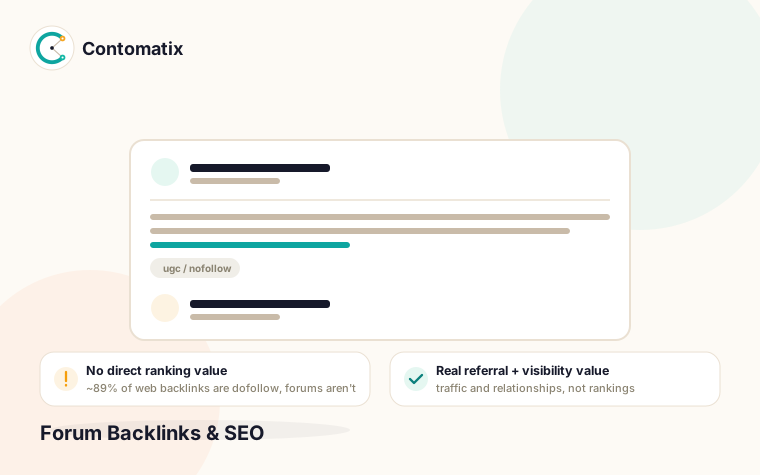
Directly, no. A nofollow or UGC-tagged link tells Google not to pass ranking credit through it, and forums almost universally use one of those tags specifically because they're a well-known spam vector — letting every registered user drop a followed link would turn any forum into a link farm within weeks.
Ahrefs' own study of nofollow, UGC, and sponsored attributes found that nofollow links make up roughly 10.6% of all backlinks pointing to the top 110,000 sites on the web — meaning the other ~89% are dofollow. Forums are one of the most consistent sources of that nofollow slice, precisely because of how easy they are to post to.
So the direct-ranking-value answer is genuinely no. But three indirect benefits are real and worth having: referral traffic from people who click through because the link was relevant to what they were reading, brand visibility and recall in a niche community, and — for platforms that don't nofollow everything — the rare genuinely-followed link from an active, well-moderated industry forum with real domain authority.
The Case for Treating Forums as a Discovery Channel, Not a Link Tactic
The framing that causes the most confusion is calling this "forum link building" at all. Link building implies the point of the activity is the link. For forums, the link is closer to a side effect of doing something else well — being genuinely useful to a community that includes your potential customers or the people who write about your industry.
Reframed that way, the metric that matters shifts from "how many links did I get" to "did the right people see this, and did it make them think better of my brand or my expertise." Some of that visibility never converts into anything measurable. Some of it turns into a reader who later writes a genuinely earned, fully-followed backlink from their own blog or publication, because they remembered a useful answer you gave months earlier. That second-order link is the actual SEO payoff, and it doesn't show up in any report tied to the forum post itself.
Why Bother, Then?
Because SEO isn't the only reason to be visible in a niche community, and a lot of "does X help SEO" framing misses that a tactic can be worth doing for reasons other than direct ranking impact. Backlinko founder Brian Dean has described his own early forum participation this way: he got a few links, but the more durable outcome was that his content reached the right people, some of whom went on to link to him from their own sites — real, followed, editorially-earned links, downstream of the forum activity rather than from it directly.
That's the honest case for forums: not as a direct link-building channel, but as a discovery and relationship channel that occasionally produces real backlinks as a second-order effect, plus direct referral traffic and brand exposure that doesn't show up in a backlink checker at all.
Where Forum Links Fit in a Link-Building Program
Forums are not a substitute for the tactics that actually move rankings — they're a supplementary channel. Compare their role to guest posting and niche edits, which pass real ranking authority when properly earned or disclosed: those tactics belong in the core of a link-building plan, while forum participation belongs alongside them as a low-cost way to build visibility and occasionally surface genuine linking opportunities you wouldn't have found otherwise.
How to Participate Without It Reading as Spam
- Answer the actual question first. A reply that's 90% generic advice and 10% "check out my site" reads as spam even with a relevant link. A reply that's genuinely useful, with a link included only where it adds something the text alone didn't cover, reads as a real contribution.
- Use your real profile, not a keyword-stuffed username. Forums (and readers) trust consistent, recognizable participants more than accounts that show up once to drop a link and disappear.
- Pick forums where your actual target audience spends time, not just any forum with a high domain metric. A high-DR general forum sends the wrong readers; a smaller, tightly-focused niche forum sends the right ones even with modest traffic.
- Space out your activity. A new account that posts 20 links in its first week looks exactly like what forum spam filters are built to catch, regardless of how relevant each individual link is.
- Expect a resource page or profile link, not a link on every post. Many forums restrict signature links to established members or don't allow them at all — check the rules before treating link placement as the goal of participating.
Red Flags That Turn Forum Activity Into Spam
- Mass account creation across many forums for the sole purpose of signature links — this is exactly the pattern Google's link spam policies are built to catch, since it's link placement with no genuine participation behind it.
- Exact-match commercial anchor text in every signature or profile link — a natural profile uses branded terms or a plain URL, not "best plumber in [city]" repeated across a dozen forums.
- Posting the same canned reply across multiple threads or forums — easy for both moderators and spam-detection systems to flag, and it damages the account's standing in the community even before any SEO consideration.
- Ignoring forum-specific rules on self-promotion — most active forums have explicit policies on when and how members can share their own links; violating them gets accounts banned and links removed, which wastes the time invested either way.
The Kinds of Forums Where This Actually Works
Not all forums are equal for this purpose, and the differences matter more than most link-building advice acknowledges:
- Active, moderated niche communities (a specific software's user forum, an industry trade association's discussion board, a well-run subreddit for your exact field) tend to have engaged readers who actually click through relevant links and remember helpful contributors. These are worth real, sustained participation.
- Large general-purpose forums with broad topic coverage dilute your visibility across an audience mostly uninterested in your specific niche, even when the forum's overall traffic numbers look impressive.
- Q&A platforms like Quora or Stack Exchange-style sites function similarly to forums for this purpose — nofollow-tagged links, but genuine visibility to people actively searching for an answer, which is often a higher-intent audience than a general discussion thread.
- Dead or barely-moderated forums that still rank for some queries are usually not worth the time — low remaining engagement means low referral value, and their moderation is often too thin to prevent the forum itself from being flagged as a spam-link source, which drags down the standing of anyone who participated there.
The practical filter: would a real member of this community actually read your reply and click through because it's useful, or is the forum just a large audience with no genuine connection to what you're posting? If it's the latter, the SEO case for participating there was never real to begin with.
What a Reasonable Time Investment Looks Like
Given that forums don't pass direct ranking value, the time spent on them should be proportional to their actual return — referral traffic, visibility, and occasional relationship-driven links — not treated as equivalent in priority to guest posting or niche edits, which do pass ranking authority directly. A realistic allocation for most small businesses is a modest, consistent weekly presence in one or two genuinely relevant communities, rather than a broad campaign spread across dozens of forums chasing link count. Depth of participation in the right community consistently outperforms breadth across many loosely-relevant ones, both for the referral traffic it generates and for the credibility it builds with the people who might eventually link to you from their own sites.
A Realistic Way to Measure Forum Participation
Don't judge forum activity by a backlink count the way you would a guest posting or niche-edit campaign, since a raw link count was never the metric this particular channel is actually good at moving. Track referral traffic from forum links in your analytics, note any genuine editorial backlinks that can be traced back to a relationship originally built through forum visibility and participation, and treat brand mentions and community recognition as a real, if genuinely unquantified, outcome rather than dismissing the whole channel because it doesn't show up cleanly in a backlink report like a dedicated backlink analysis tool would for a guest post or niche edit.
Frequently Asked Questions
Do forum backlinks help SEO?
Not directly — most forum links are tagged nofollow or ugc, which blocks ranking credit from passing through. Their real value is indirect: referral traffic, niche brand visibility, and occasionally leading to a genuine followed backlink from someone who discovered your content through the forum.
Are forum links nofollow or dofollow?
The large majority are nofollow or the more specific ugc (user-generated content) tag, adopted by most forum platforms specifically to prevent spam. A small number of less-moderated or older forum platforms still allow dofollow links, though this is increasingly rare.
What's the difference between nofollow and ugc tags?
Both tell Google not to pass ranking credit through the link. The ugc tag, introduced in Google's 2019 link-attribute update, specifically identifies user-generated content like forum posts and comments, giving Google more granular signal than the older, more general nofollow tag — but functionally both block direct SEO value the same way.
Is it worth building forum backlinks in 2026?
As a primary link-building strategy, no — the direct ranking value isn't there. As a supplementary channel for referral traffic, niche visibility, and occasional relationship-driven backlinks, yes, provided the participation is genuine rather than link-drop spam.
Can forum links get my site penalized?
Genuine, relevant participation with occasional links carries essentially no risk, since nofollow/ugc tags already tell Google not to count them for ranking. Mass account creation purely for signature-link placement is a different pattern — that reads as link spam and can contribute to a broader manipulative-link footprint if done at scale.
How much referral traffic can forum links actually bring?
It varies enormously by niche and forum size — a highly targeted, active niche forum can send meaningful, well-qualified traffic even with modest overall size, while a large general forum often sends more volume but lower-intent visitors. Track it directly in analytics rather than assuming based on the forum's size alone.
Should I use my real name or a business account on forums?
A consistent, recognizable identity — whether personal or a clearly-branded business account — builds more trust over time than a generic or keyword-stuffed username, which reads as created solely for link placement.
What forums are best for building links and visibility?
Niche, industry-specific forums with active moderation and real ongoing discussion tend to outperform large general forums for both relevance and long-term community standing, even when their raw traffic numbers are smaller.
How is forum link building different from guest posting?
Guest posting produces a dofollow link (when not paid/sponsored) that can pass real ranking authority, in exchange for creating dedicated content for the host site. Forum participation produces a nofollow/ugc link with no direct ranking value, in exchange for far less time investment — see our automated link building guide for where forum outreach fits alongside outreach automation more broadly.
Do search engines ignore nofollow links completely?
Google has stated nofollow is treated as a "hint" rather than an absolute directive for crawling and indexing purposes, though it still does not pass ranking credit for typical use cases like forum and comment links. In practice, treat nofollow forum links as having no direct ranking value and value them for their indirect benefits instead.
Disclaimer: This article is for informational purposes only. Forum rules and platform link-attribute policies vary and change over time — check the specific forum's guidelines before participating for promotional purposes.
Contomatix builds link profiles around tactics that actually pass ranking authority — guest posts, niche edits, and digital PR — with forum and community participation used only as a genuine, supplementary visibility channel, never counted as a core link-building tactic.
Get a free link-building strategy review →