Last updated: September 2026
The real difference between guest posting vs niche edits isn't which one is "better" in the abstract — it's that they trade off against each other on three things that actually matter to your budget and timeline: cost, speed, and compliance risk. Pick based on those three, not on whichever tactic your last agency happened to sell you.
This guide covers what each actually costs in 2026 (with real pricing data, not vague ranges), what Google's own guidance says about the compliance risk niche edits carry that guest posts don't, and a practical framework for choosing between them based on your specific situation rather than a generic pros-and-cons list.
What Guest Posting and Niche Edits Actually Are
Guest posting means writing a new article for someone else's site in exchange for a backlink, usually placed naturally within the content or in an author bio. You (or your agency) create the content; the host site publishes it and gets a fresh piece for its readers.
Niche edits (also called link insertions) skip the content-creation step entirely: a link gets added into an already-published, already-indexed article on someone else's site, usually for a fee paid to the site owner or an intermediary. No new content, no editorial pitch process — just a link dropped into existing text.
Both are common, both are used by legitimate agencies, and both carry real tradeoffs that the rest of this guide breaks down.
What They Actually Cost in 2026
| Method | Typical range | Average |
|---|---|---|
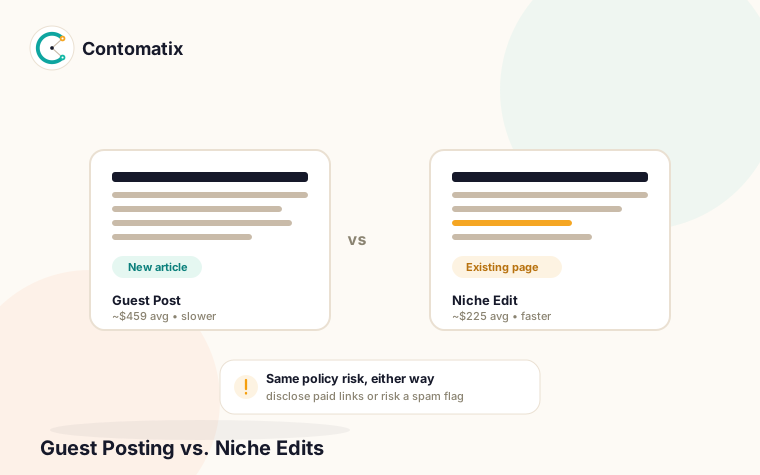
| Guest post | $78–$609+ per placement (up to $10,000+ on top-tier publications) | ~$459 |
| Niche edit / link insertion | $50–$365 per link ($141–$361 on DR 40+ sites) | ~$225 |
Niche edits run roughly 56% cheaper than guest posts on average across comparable domain ratings, largely because there's no content-creation cost baked in. Domain Rating drives price more than method does either way — each additional 10 DR points adds roughly 32% to the cost of a placement, guest post or niche edit alike.
Two numbers explain most of the price spread within each method. First, niche edits skip content production entirely, so the fee is pure link cost rather than link cost plus a writer's time. Second, guest post pricing on any given site scales with how much editorial gatekeeping that site actually does — a publication with a real editor reviewing every pitch charges more than a site that will run almost anything for a fee, because the former is protecting something (its own credibility with readers and with Google) that the latter isn't.
The Compliance Difference Most Comparisons Skip
This is the part that actually matters most and gets glossed over in most "guest posting vs niche edits" breakdowns: they carry different risk profiles under Google's own spam policies, not just different price tags.
Google's John Mueller has stated the position plainly: paying to add a link to an already-existing piece of content is treated exactly the same as buying a link outright — the fact that the article existed before the payment changes nothing about the policy. A niche edit that passes ranking authority without a rel="sponsored" or rel="nofollow" tag is a link-scheme violation, full stop, regardless of how relevant or well-placed it is.
In practice, a single well-placed niche edit on a genuinely relevant page tends to fly under the radar. The risk scales with volume: buying one or two niche edits a month on topically relevant sites reads very differently to Google's spam systems than running fifty a month across a rotating blog network — the latter is exactly the footprint automated detection is built to catch.
Guest posts carry a lighter version of the same risk (a guest post that exists purely to house a commercial link, with no real editorial value to the host site's readers, is still spam under the same policy) but the act of creating genuine content for a specific audience makes that outcome less automatic than it is with a paid insertion into existing text.
Speed: Which One Shows Results Faster
Niche edits win on raw speed because the host page is usually already indexed and already carries whatever authority it's going to carry — there's no waiting for new content to get crawled and settle in search results. A niche edit can start passing value within days of going live.
Guest posts take longer by nature: the new article has to be written, published, and then indexed before it contributes anything, which typically adds one to several weeks on top of the outreach and approval time before the link even goes live.
Editorial Control and Long-Term Value
Guest posting gives you a real, if modest, secondary benefit niche edits don't: a piece of content you at least partly control, published under your byline or brand voice, that can drive referral traffic and brand exposure on its own merits, independent of whatever SEO value the link carries. A well-placed guest post on a site with real readership can bring in direct visitors for years.
A niche edit has none of that upside. You're not creating anything a reader would seek out; you're adding a sentence or two to someone else's existing page. If that page's traffic or rankings decline, your niche edit's value declines with it, and you have no content asset of your own to show for the spend.
A Practical Framework for Choosing
- Tight budget, need volume fast: niche edits generally make more sense — lower cost per link, faster to go live, provided you keep volume and relevance disciplined per the compliance section above.
- Building topical authority in a specific niche you want to be known in: guest posting wins, since the content itself (and the audience relationship it can build) has value beyond the link.
- Recovering from a thin or spammy-looking backlink profile: guest posts on genuinely relevant, well-trafficked sites do more to look natural than a batch of niche edits, since the content-creation step itself signals real effort rather than a pure transaction.
- Running both concurrently: most established link-building programs use both — niche edits for efficient, targeted authority on pages already ranking well, guest posts for the relationship-building and content-marketing value a pure link buy can't provide.
Common Myths About Niche Edits
A few misconceptions come up often enough to address directly, since they lead to bad buying decisions:
- "Niche edits are always riskier than guest posts." Not inherently true. The risk comes from disclosure and volume, not the method itself. A properly-tagged niche edit on a genuinely relevant page carries the same compliance status as a properly-tagged guest post link.
- "A niche edit on an old post has less value than a link on a new one." Often the opposite: an older, already-indexed page with an established backlink profile and stable rankings can pass more consistent authority than a brand-new guest post that hasn't yet earned its own trust signals.
- "Guest posts are always 'safer' because they're new content." New content only matters if it's genuinely useful to the host site's audience. A guest post written purely to house a commercial link, with no real value to readers, doesn't get a pass just because it's technically original.
- "You can tell a niche edit was paid for just by looking at it." Not reliably. A well-chosen niche edit reads as a natural addition to the existing text — which is exactly why disclosure matters more than visual detection, from Google's perspective.
How to Evaluate a Vendor Offering Either Service
Whether you're buying guest posts, niche edits, or both, the vetting questions are largely the same:
- Ask for the exact target URL before paying — not just a domain metric like DR or traffic estimate. You want to see the specific page your link would live on.
- Ask directly how the link will be tagged — sponsored, nofollow, or fully organic — and get the answer in writing before the placement goes live, not after you've already paid.
- Check the site's own content for relevance — a niche edit inserted into a completely unrelated article, or a guest post published on a site with no topical connection to your business, does little for rankings regardless of the domain's authority score.
- Ask how placements are paced — a vendor promising 20+ links this month, on either tactic, is optimizing for volume in a way that reads as a footprint rather than a natural acquisition pattern.
- Request a sample of 3-5 recent live placements and independently confirm each one is still indexed, still live, and still carries the link as promised — links do get removed or noindexed after the fact.
Red Flags With Either Method
- No disclosure of paid placement. Any vendor who doesn't discuss
rel="sponsored"orrel="nofollow"attribution at all is either uninformed about the policy or hoping you won't ask. - Guaranteed high-DR placements at a flat, suspiciously low price. Real DR 40+ placements cost real money; a flat $20 "guest post on any site" offer is almost always a low-quality or irrelevant placement.
- No visibility into the actual site before you pay. You should see the specific target page before committing to either a guest post pitch or a niche edit, not just a domain metric.
- Exact-match commercial anchor text on every placement. A natural link profile mixes branded, naked-URL, and generic anchors — all-exact-match anchors are a spam signal regardless of method.
These same red flags apply directly to automated link-building services that skip human vetting on either tactic — the automation risk and the guest-post/niche-edit risk both come down to the same root issue: no one checking whether a specific placement actually makes editorial sense. If you're running your own vetting rather than outsourcing it, our guide to backlink analysis tools covers how to check a prospective site's authority and existing link profile before you pay for anything.
Frequently Asked Questions
Is guest posting or niche edits better for SEO?
Neither is universally better. Niche edits are cheaper and faster; guest posts cost more but add a content asset and lighter compliance risk. The right choice depends on budget, timeline, and whether you want the secondary content-marketing value guest posts provide.
How much do niche edits cost in 2026?
Typically $50-$365 per link, averaging around $225, with DR 40+ placements running $141-$361. Niche edits are roughly 56% cheaper than guest posts on average across comparable domain ratings.
How much does a guest post cost in 2026?
Typically $78-$609+ per placement, averaging around $459, with top-tier publications running into the thousands. Domain Rating is the biggest price driver: each additional 10 DR points adds roughly 32% to the cost.
Are niche edits against Google's guidelines?
Paying for a niche edit without a rel="sponsored" or rel="nofollow" attribute violates Google's link spam policy — Google has stated that paying to add a link to existing content is treated the same as buying a link outright. Properly disclosed niche edits, or ones acquired without payment for ranking purposes, don't carry this risk.
Why are niche edits cheaper than guest posts?
Niche edits skip content creation entirely — you're paying only for the link placement into an existing page, not for a new article to be written, edited, and published. That removes the largest cost component of a guest post.
Can I use both guest posting and niche edits together?
Yes, and most established link-building programs do. Niche edits work well for efficient, targeted links on already-ranking pages; guest posts add topical authority and a content asset with value beyond the link itself.
Do niche edits work as well as guest posts for rankings?
A niche edit on a genuinely relevant, well-trafficked page can pass similar ranking value to a guest post link, since both are ultimately backlinks from an external domain. The difference is in the secondary benefits (content asset, audience reach) and the compliance risk profile, not the raw link-equity mechanics.
How do I know if a niche edit vendor is legitimate?
Ask to see the specific target page before paying, confirm whether the link will carry a rel attribute or be fully organic, and be skeptical of high-DR placements offered at flat, suspiciously low prices — real placements on authoritative sites cost real money.
What's the risk of buying too many niche edits at once?
Volume is the main risk factor Google's spam systems key on. A handful of niche edits on genuinely relevant pages tends to go unnoticed; dozens per month across a rotating network of sites creates a detectable pattern.
Does a guest post need to be disclosed to Google the same way as a niche edit?
Yes, the underlying rule is the same: any link that changes hands for compensation and passes ranking authority needs a rel="sponsored" or rel="nofollow" attribute. A guest post written purely to house a commercial link with no genuine editorial value to the host's readers carries the same spam-policy exposure as an undisclosed niche edit.
Disclaimer: This article is for informational purposes only. Pricing figures are aggregated industry averages that vary by market and change over time — verify current rates directly with any vendor. Nothing here constitutes legal advice regarding Google's policies.
Contomatix runs both guest posting and niche-edit campaigns for clients — always with disclosed attribution where compensation is involved, and always vetted for genuine topical relevance before a placement goes live.
Get a free link-building strategy review →