Last updated: September 2026
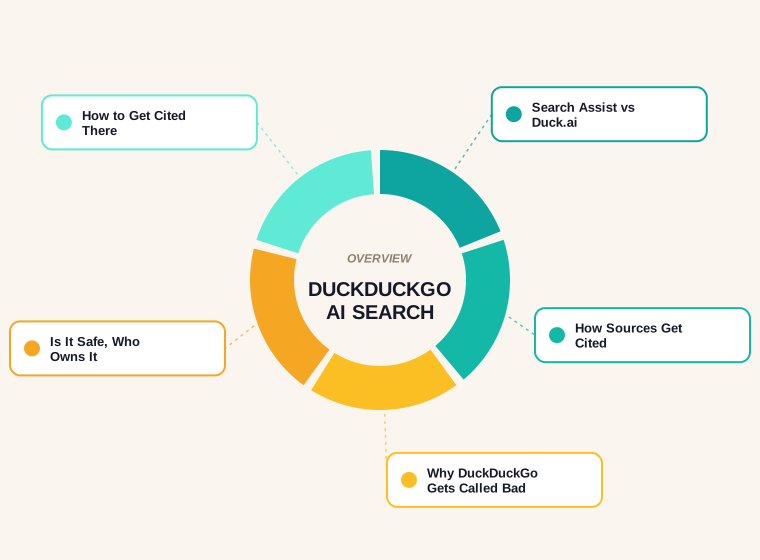
DuckDuckGo's AI search is actually two separate systems wearing one brand name. Search Assist adds AI-generated answers directly into search results, built on its own web crawler and always showing one or two source links. Duck.ai is a private chat interface that routes your conversation to a third-party model — GPT, Claude, Llama, or others — and doesn't work like a search engine at all. Most explainers on this topic blur the two together, which is a problem if you're trying to figure out either how to use it or how to get your own content cited by it.
DuckDuckGo AI Search Explained: Two Products, Not One
DuckDuckGo's AI features exited beta on August 16, 2026, which is when most of the current confusion started — two products moved out of testing on the same day, under names similar enough to blur together in casual use.
Search Assist lives inside regular search results. Type a question into the DuckDuckGo search bar, and if Search Assist judges the query answerable, it generates a short AI answer above the usual ten blue links, citing where that answer came from. You can turn it off entirely in settings if you'd rather just get links.
Duck.ai is a separate, standalone private chat product. It's a multi-turn conversation interface, not a search results page, and it deliberately doesn't reveal which underlying model is doing the work unless you check the model picker yourself. The free tier currently routes to models including Claude 4.5 Haiku, GPT-5.4 nano and mini, Mistral Small, and a couple of open-weight options; paid Plus and Pro subscriptions unlock GPT-5.4, Claude Sonnet 4.6, and Claude Opus 4.8 with higher usage limits.
The distinction matters more than it looks. One is an extension of search with its own citation mechanism; the other is a chat product where citation behavior depends entirely on whichever model you happen to be talking to that session.
How Search Assist Actually Finds and Cites Sources
This is the part worth understanding if you run a website and care whether AI search sends you traffic. Search Assist doesn't reuse DuckDuckGo's main crawler. It runs on a dedicated bot called DuckAssistBot, separate from the regular DuckDuckBot that feeds organic search results — and separate again from the Bing crawler that supplies most of DuckDuckGo's traditional link results in the first place.
Two details make this genuinely different from how Google's AI Overviews work:
- DuckAssistBot respects robots.txt independently. A site can block just this bot and keep showing up in regular DuckDuckGo search results, or block regular crawling and still theoretically appear in Search Assist — the two permissions are decoupled rather than bundled into one all-or-nothing crawl directive.
- Publishers can opt out of only the AI-answer feature. There's no equivalent granularity in how Google Search treats AI Overviews versus organic indexing for most sites — it's a meaningfully more surgical control than the industry default.
- Every answer names one or two sources, not zero. Search Assist doesn't synthesize an answer and hide where it came from; the citation is part of the interface, not an afterthought you have to dig for.
Practically, this means Search Assist behaves like a compressed featured snippet more than a chatbot: it's pulling from crawled, indexed pages and pointing back to a specific one or two of them. The content that already wins classic featured snippets — a direct answer in the first sentence, a clear heading matching the question, no fluff before the payoff — is the same content that tends to get pulled into a Search Assist answer.
Duck.ai Doesn't Work Like That At All
This is where a lot of advice about "optimizing for DuckDuckGo's AI" goes wrong by treating Duck.ai the same way as Search Assist. It isn't the same mechanism.
Duck.ai is DuckDuckGo's privacy layer sitting in front of chat models it doesn't build itself. When you ask Duck.ai a question, you're not querying DuckDuckGo's index — you're talking to whichever underlying model is active, anonymized so the model provider never sees who you are. Whether that conversation involves live web browsing, and whether it cites sources at all, depends on the model and the query, not on a DuckDuckGo-specific citation system the way Search Assist has one.
The practical implication for anyone doing AI-visibility work: if a brand or a page is already showing up when people ask GPT-5.4 or Claude Sonnet 4.6 questions directly on those companies' own products, that same visibility should carry over into Duck.ai conversations using the same models, because it's the same model reasoning the same way — DuckDuckGo isn't reweighting anything on top. That work isn't wasted here; it just doesn't get any DuckDuckGo-specific boost either. Search Assist is the one product in this pair with its own separate rules to learn.
Why "DuckDuckGo Is Bad" Comes Up So Often
Search interest in variations of "why is DuckDuckGo bad" has stayed real and durable, and most of it traces back to one specific misunderstanding: DuckDuckGo doesn't run its own full independent index for organic web results. The large majority of its traditional "ten blue link" results come from Microsoft Bing's index, layered with DuckDuckGo's own crawler (DuckDuckBot) for supplementary results, Wikipedia-sourced instant answers, and partner data like Wolfram Alpha for calculations. That arrangement hasn't changed as of 2026.
That's a legitimate thing to know, but it's not the damning fact some framing makes it sound like. DuckDuckGo has never claimed to run a Google-scale independent crawler — its actual pitch has always been privacy (no search history tracking, no personalized-ad profile) rather than a proprietary index. The complaints that hold up are narrower and more specific: results can feel less locally tuned than Google's for a searcher with a long personalization history, and the smaller engineering team behind DuckDuckGo means new features roll out slower than at Google or Microsoft. The complaint that doesn't hold up as often as it's repeated is that DuckDuckGo is somehow a fake or hollow search engine — it's a real product built on a documented, disclosed blend of sources, not a hidden one.
For a site owner, the actionable version of this is simple: because Bing supplies most of DuckDuckGo's organic results, a page that isn't indexed in Bing generally isn't showing up in DuckDuckGo's organic results either, regardless of how well it ranks on Google.
Is DuckDuckGo Safe, and Who Actually Owns It
Two questions come up often enough together that they're worth answering plainly. DuckDuckGo is a genuinely independent company, founded by Gabriel Weinberg in 2008 and still run by him as CEO. It has taken outside investment over the years — including from Union Square Ventures and Sequoia Capital — but Weinberg and the team retain majority ownership, and the company has never been acquired by Google, Microsoft, Meta, or any other major tech company, despite that claim circulating periodically online.
On safety: DuckDuckGo's core business model is built around not tracking search history or building an ad-targeting profile on users, which is the opposite incentive structure from most free search products. That business model doesn't automatically make every downstream feature risk-free — using any AI chat product still means being thoughtful about what you paste into it — but the company's revenue doesn't depend on harvesting personal data the way a typical ad-funded search engine's does, which is the core of its actual privacy claim.
What This Means If You Want to Get Cited There
Pulling the mechanics above into something actionable, getting found by DuckDuckGo's AI features actually breaks into three separate jobs, not one:
- Get indexed in Bing first. Since Bing supplies the bulk of DuckDuckGo's organic layer, Bing Webmaster Tools submission matters here in a way it often gets skipped for Google-only SEO workflows.
- Write for Search Assist specifically. Direct-answer openers, one clear claim per heading, and content DuckAssistBot can actually crawl (check robots.txt isn't accidentally blocking it) are what earns the one-or-two-source citation slot. This is the same discipline behind writing for answer engine optimization generally — DuckDuckGo isn't a special case requiring different content, just one more surface the same content can win on.
- Treat Duck.ai as inherited, not separate, visibility. There's no DuckDuckGo-specific tactic for Duck.ai beyond making sure the underlying models it routes to already recognize and cite a brand accurately — the same work covered in getting cited by ChatGPT transfers here because it's frequently the same model underneath.
The mistake worth avoiding is spending effort on a "Duck.ai SEO strategy" as if it were its own channel. It isn't one. Search Assist is the one part of DuckDuckGo's AI stack with mechanics genuinely worth optimizing for on its own terms.
Sources: DuckDuckGo Help — About Search Assist · Gabriel Weinberg — 9 Ways Search Assist Differs From Google's AI Overviews · DuckDuckGo Help — Duck.ai Chat Models · Wikipedia — DuckDuckGo
Related Reading
- Not sure whether a brand is showing up in AI search at all yet? See how to check if your brand appears in ChatGPT and AI search.
Does DuckDuckGo use Google or Bing for search results?
Neither exclusively, but mostly Bing. The large majority of DuckDuckGo's traditional organic web results come from Microsoft Bing's index, supplemented by DuckDuckGo's own crawler (DuckDuckBot) and partner sources like Wikipedia and Wolfram Alpha. It does not use Google's index.
What's the difference between DuckDuckGo's Search Assist and Duck.ai?
Search Assist adds AI-generated answers inside regular search results, built on DuckDuckGo's own DuckAssistBot crawler and always citing one or two sources. Duck.ai is a separate private chat product that routes conversations to third-party models like GPT and Claude, with no DuckDuckGo-specific search index or citation system behind it.
Is DuckDuckGo actually safe to use?
DuckDuckGo's business model doesn't rely on tracking search history or building an ad-targeting profile, which is a materially different privacy posture than most free search engines. That doesn't eliminate every risk of using AI features generally, but the company's core incentive structure isn't built around harvesting personal data.
Who owns DuckDuckGo?
DuckDuckGo is an independent company founded by Gabriel Weinberg in 2008, who still runs it as CEO. It has taken investment from firms including Union Square Ventures and Sequoia Capital, but Weinberg and the team hold majority ownership. It has never been owned by Google, Microsoft, or Meta.
Can a website opt out of DuckDuckGo's AI features without losing regular search visibility?
Yes. DuckDuckGo runs Search Assist on a separate crawler, DuckAssistBot, distinct from its regular crawling. A site can block DuckAssistBot specifically via robots.txt and still appear in DuckDuckGo's normal organic search results.