Last updated: August 2026
Every week we run into a business owner who assumes they're "doing fine" with AI search simply because they rank well on Google. Most have never actually opened ChatGPT and asked it a question a real customer would ask. How to check if your brand appears in ChatGPT and AI search is a five-minute exercise, and the results usually surprise people — sometimes in a good way, often not.
Here's a practical, no-tool-required way to find out where you actually stand, plus what to do if the answer is "nowhere."
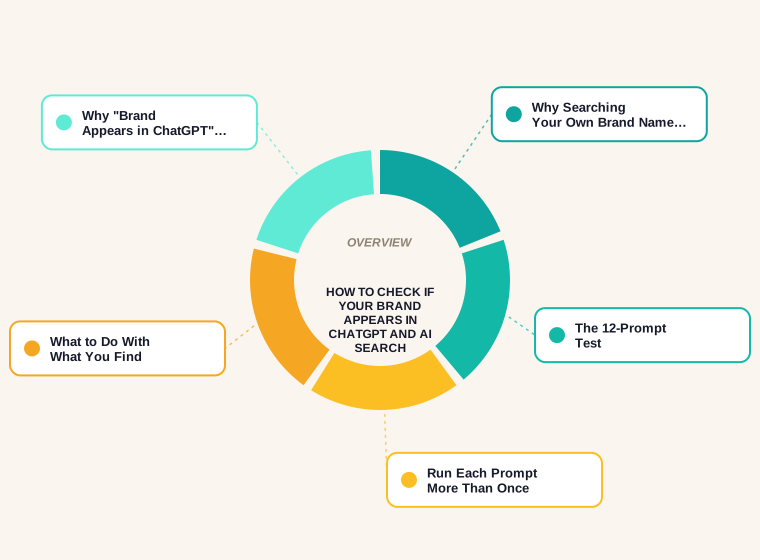
Why Searching Your Own Brand Name Doesn't Count
The instinct is to open ChatGPT and type your company name. That test tells you almost nothing useful — if your brand has any web presence at all, the model will usually produce a reasonably accurate summary of who you are. That's not visibility, that's just the model reading your About page back to you.
The test that actually matters is asking the questions a prospective customer would ask before they know your name — category questions, comparison questions, and problem-first questions. That's where you find out whether you're actually part of the answer.
The 12-Prompt Test
Write down 10–12 real questions your customers ask before they've decided on a provider. Mix in three types:
- Category discovery: "best [your service] companies for [your niche]"
- Comparison: "[Competitor A] vs [Competitor B] for [use case]"
- Problem-first: "how do I fix [problem your service solves]"
Run each one logged out (or in an incognito/temporary chat) across ChatGPT, Perplexity, Gemini, and a Google search that triggers an AI Overview. Note three things every time: does your brand appear, where in the answer, and is it linked or just named.
Run Each Prompt More Than Once
AI answers aren't fixed the way a Google ranking is. The same prompt can return a different set of sources on back-to-back runs. Run each question two or three times before drawing a conclusion — a single pass can make a real gap look like a fluke, or a fluke look like a trend.
It's also normal for results to differ sharply between platforms. Being cited confidently by Perplexity and completely absent from ChatGPT isn't a bug in your process; each engine pulls from a different index and weighs sources differently.
What to Do With What You Find
If you show up consistently, note which pages the model is pulling from and keep them updated — that's your beachhead. If you're missing entirely, look at who the model cited instead. Are they publishing the direct, structured, FAQ-style content you're not? Do they have more third-party mentions and editorial coverage feeding the model's sense of who's trustworthy in your space?
A gap here usually traces back to one of two things: content that isn't written in a way models can easily extract and cite, or a thin footprint of mentions and links across the sites these models actually draw from. Both are fixable, and neither requires starting over — it's an adjustment to an existing content and outreach strategy, not a replacement for one. We've covered the mentions-and-links side of this in more depth in our piece on whether backlinks still matter for AI search, which is worth reading alongside this one if the gap looks structural rather than content-related.
Why "Brand Appears in ChatGPT" Is Worth Tracking at All
It's fair to ask whether any of this matters if it isn't driving clicks the way a top Google ranking does. The honest answer is that it's still early, and the businesses treating this as a real channel now are the ones building the content and mention footprint before it gets crowded. A prospective customer who asks ChatGPT for a recommendation and never sees your name has effectively removed you from consideration without you ever knowing a sale was on the table. That's the actual cost of not checking — not a vanity metric, a closed door you never saw.
Free Tools That Speed This Up
The manual 12-prompt test is the most reliable starting point because you control exactly what's being asked. Once you want to track this over time instead of spot-checking it, Ahrefs' free AI visibility checker is a straightforward way to see how a domain shows up across AI answers without building your own tracking process from scratch.
How Often to Check If Your Brand Appears in ChatGPT
Monthly is a reasonable cadence for most small businesses — frequent enough to catch a real shift, infrequent enough that you're not chasing noise from run-to-run variation. If you're actively publishing new content or running a link building campaign, checking right before and a few weeks after gives you a rough read on whether it moved the needle.
Keep a simple log each time you run the test: the date, the prompts used, which platforms mentioned you, and which competitors came up instead. A few months of that log tells you far more than any single check ever could — it turns a one-off curiosity into an actual trend line you can act on.
Building a Simple Tracking Sheet
A spreadsheet with a handful of columns is enough to turn this from a one-off curiosity into something you can actually act on over time. At minimum, track: the date you ran the test, the exact prompt used, the platform (ChatGPT, Perplexity, Gemini, an AI Overview), whether your brand appeared, where in the answer it appeared, whether it was linked or just named, and which competitors appeared instead.
Run the same set of prompts each time rather than inventing new ones on the fly. Consistency in the questions asked is what makes the log useful month over month — if the prompts keep changing, you can't tell whether a shift in results reflects a real change or just a different question.
Add a short notes column for context: did you publish anything new that month, did a competitor launch a campaign, did the platform itself get a known update. That context is often the difference between noticing a real pattern and reacting to noise.
Mentioned, Named, or Linked: Why the Distinction Matters
Not all appearances in an AI answer carry the same weight, and lumping them together in your log will blur what's actually happening. There's a real difference between three outcomes:
- Not mentioned at all — the model answered the question using other sources entirely, and your brand didn't come up.
- Named without a link or citation — the model mentioned your brand as part of a general answer, likely drawing on its training data rather than a live source, with nothing pointing a reader back to your site.
- Cited with a link or clear source attribution — the model pulled specific information from one of your pages and pointed to it, which is the outcome that actually drives a visit.
Being named without being linked is a genuinely different problem than not appearing at all, and it calls for a different fix. If you're named but never linked, the issue is usually that your site doesn't have a page structured well enough to be worth citing directly, even though the model already knows who you are.
Adjusting the Test by Business Type
The same 12-prompt framework works across business types, but what you should be listening for changes depending on what you sell.
A local service business should weight problem-first and "near me"-style prompts heavily, since that's how most of its real demand arrives. A B2B or supply-chain business should focus more on capability and comparison prompts, since buyers there are less likely to phrase things as a local search and more likely to ask a model to compare vendors on a specific technical requirement. An ecommerce brand should pay particular attention to product-comparison and "best [category] for [use case]" prompts, since that's where AI-generated shopping answers increasingly draw from a narrower set of sources than a standard search results page would show.
Whatever your business type, resist testing only the prompts that flatter you. The uncomfortable prompts — the ones where a direct competitor is the obvious answer — are usually the most informative, because they show you exactly what the model considers a stronger source right now.
When Declining Visibility Should Trigger Action
A single missed appearance isn't a crisis. What's worth acting on is a trend across several months of consistent tracking: you were showing up for a category question in the spring and quietly stopped by fall, or a new competitor started appearing in your place across multiple platforms rather than just one.
When that pattern shows up, the useful next step is diagnostic rather than reactive. Look at what changed on the pages the model used to cite — did content go stale, did a redesign quietly remove structure that used to help, did a competitor publish something more current on the same topic. Compare that against your own mention and link footprint elsewhere on the web, since a drop in citations sometimes tracks a broader drop in how often your brand is referenced across the sites these models draw from, not just something on your own site.
Treat a confirmed decline as a prompt to revisit your most important pages the way you'd revisit an underperforming landing page after a traffic drop — not as a reason to panic, and not as something to ignore either.
Frequently Asked Questions
How do I check if my brand appears in ChatGPT?
Ask ChatGPT the category, comparison, and problem-first questions your customers would ask before they know your brand name — not your company name directly — and note whether you're mentioned, where, and how you're described.
Does searching my own company name in ChatGPT tell me anything useful?
Not much. If you have any web presence, ChatGPT will usually summarize it accurately regardless of your actual visibility. The useful test is category and comparison questions where the model has to choose who to mention.
Why do I get different answers when I ask the same question twice?
AI-generated answers aren't deterministic the way a search ranking is. The same prompt can pull a different set of sources across runs, which is why it's worth testing each question two or three times before drawing a conclusion.
Should I expect the same results on ChatGPT, Perplexity, and Gemini?
No. Each platform draws from a different index and weighs sources differently. Being cited on one and absent on another is common and doesn't necessarily mean something is wrong.
What does it mean if my competitors show up but I don't?
It usually points to one of two gaps: your content isn't structured in a way AI models can easily extract and cite, or you have fewer mentions and links across the third-party sites these models treat as trust signals.
Are there free tools to check AI visibility?
Yes. Ahrefs offers a free AI visibility checker that shows how a domain appears across AI-generated answers, which is a useful starting point before investing in a dedicated ongoing tracking tool.
How often should I check my AI search visibility?
Checking monthly is reasonable for most small businesses. If you're actively publishing content or running a link building campaign, check before and a few weeks after to get a rough sense of impact.
Do backlinks affect whether AI models mention my brand?
Yes, though not in exactly the same way they affect Google rankings. A stronger footprint of editorial mentions and links across trusted sites gives AI models more signal that your brand is a credible source worth citing.
What kind of questions should I test instead of my brand name?
Mix category discovery questions ("best [service] for [niche]"), direct comparisons between known competitors, and problem-first questions describing the issue your service solves without naming any brand.
Disclaimer: This article is for informational purposes only. AI platform behavior changes frequently and individual results will vary.
Related Reading
- Before running that prompt test, it helps to understand what AI visibility actually means and how it's measured.
Contomatix helps businesses build the content structure and editorial link footprint that AI models actually look for when deciding who to cite. Want a free rundown of where your brand currently stands?
Get a free AI visibility check →

