Last updated: September 2026
Every "ChatGPT SEO prompts" list eventually asks it to "analyze your competitors" or "find keyword opportunities" as if that's a complete instruction. It isn't. ChatGPT has no live connection to Google's index, no view of your actual analytics, and no ability to check current search volumes — unless you hand it that data directly. Ask it a vague question and it will still answer confidently, often with specific-sounding numbers it invented on the spot. The prompts below are the ones we actually reuse day to day, written specific enough to be useful the first time you paste them in, organized by the job they do, plus the honest caveats about where this tool's SEO advice can't be trusted at face value.
What ChatGPT Is Genuinely Good For in SEO Work — and What It Isn't
It's a strong thinking partner for structuring, drafting, and pattern-spotting across text you give it. It's a weak source of live facts about your own rankings, competitors' current content, or actual search demand.
It can't see live search results. Unless you're using a version with active browsing and you confirm it actually searched, ChatGPT is reasoning from training data and whatever you paste in — not today's SERP.
It can't see your analytics or Search Console data unless you export and paste it in directly. Asking "what are my top pages" without giving it the data gets you a plausible-sounding guess, not an answer.
It will state a specific search volume with total confidence and no way to verify it. Treat any exact number ChatGPT gives you for search volume, traffic, or ranking position as a starting guess to check in a real keyword tool, never as a citable figure.
It's excellent at restructuring, summarizing, and pattern-matching across content you provide. Paste in ten of your own pages and ask it to find structural gaps, and it will do that reliably, because it's working from real text instead of guessing at data it can't access.
Every prompt below assumes you're either giving it real data to work with, or asking it to draft and structure rather than to report facts it can't actually know.
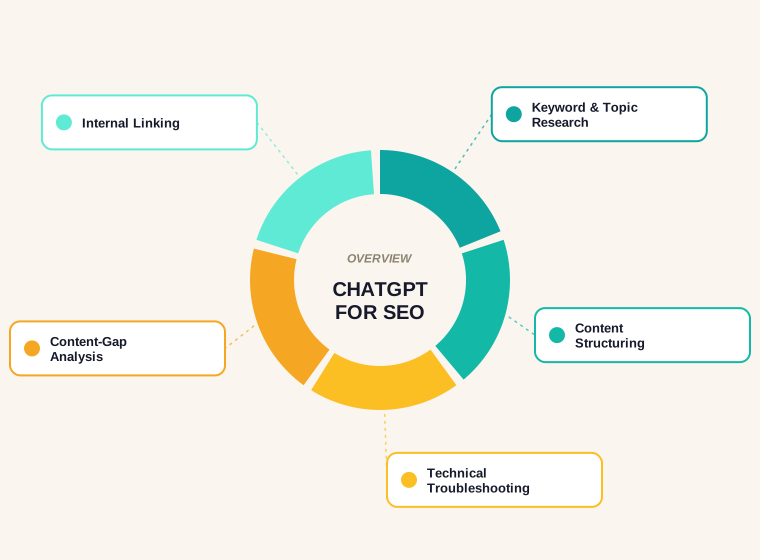
Keyword and Topic Research Prompts
- "Here is a list of [20–30] keywords I'm considering [paste list]. Group them into topic clusters by search intent (informational, commercial, transactional, navigational), and flag any that seem to overlap so much they'd cannibalize each other on the same page."
- "I run a [type of business] targeting [audience]. List 15 questions this audience would realistically type into Google or ask ChatGPT before deciding to buy — phrase them exactly as a real person would ask, not as clean keyword phrases."
- "Here is the full text of a competitor's page on [topic] [paste text]. List every sub-question or sub-topic it covers that my draft on the same topic [paste your draft] does not, so I can decide whether to add them."
- "I have a page targeting [primary keyword]. Suggest 10 closely related long-tail variations a real searcher might use instead, and note which ones are different enough in intent that they'd need their own page rather than a mention on this one."
- "Take this list of blog post titles [paste list] and identify which ones are likely targeting the same underlying search intent, so I can decide which to merge, redirect, or differentiate."
Content Structuring Prompts
- "Here's a rough draft on [topic] [paste draft]. Rewrite the opening 60 words as a direct, self-contained answer to the question '[exact question]', with no throat-clearing or 'in this article we'll cover' framing."
- "Turn this list of sub-topics [paste list] into H2 headings phrased as the actual follow-up questions a reader would ask next, in a logical order from most to least urgent."
- "Here is my draft [paste draft]. Draft 6 FAQ questions and answers based only on things this draft already explains, phrased the way someone would actually type the question into a search bar, not as generic filler questions."
- "Review this paragraph [paste paragraph] and tell me which sentences a language model could lift as a standalone answer, and which are too dependent on surrounding context to be extracted cleanly on their own."
- "I want to convert this narrative explanation [paste text] into a scannable structure using a numbered list or table where it would genuinely improve extractability, without forcing structure onto content that reads better as prose."
Technical SEO Troubleshooting Prompts
- "Here is the raw HTML head section of a page [paste head tags]. Check for missing or duplicate title tags, missing meta description, incorrect canonical tag, and any obviously conflicting directives."
- "Here is a robots.txt file [paste contents]. Explain in plain language exactly which bots and paths this file blocks or allows, and flag anything that looks like it's unintentionally blocking a bot it shouldn't."
- "Here is a chunk of schema markup in JSON-LD [paste code]. Validate the structure logically and tell me if any required properties for the [FAQPage / Article / Product] type are missing."
- "I'm getting [specific error, e.g. 'soft 404' or 'duplicate without user-selected canonical'] in Search Console for these URLs [paste list]. Given what you know about that error type, list the most likely causes to check first, in order of how common they are."
- "Here are the redirect rules on a page migration [paste rules]. Check this chain for redirect loops, unnecessary hops, or a redirect that skips straight from an old URL to a 404 instead of the intended destination."
Content-Gap Analysis Prompts
These are written generically on purpose — paste in whatever competitive content you're legitimately allowed to review yourself, rather than asking ChatGPT to name or evaluate a specific external tool or company.
- "Here is my page on [topic] [paste text] and here is a competing page covering the same topic [paste text]. List what the second page covers that mine doesn't, and separately, what mine covers that it doesn't, so I can see the real gap in both directions."
- "Here are the H2 and H3 headings from four competing pages on [topic] [paste headings]. Identify which sub-topics appear in most of them (likely expected by searchers) versus which appear in only one (likely a genuine differentiation opportunity)."
- "Here's my FAQ section [paste FAQs] and here's a competitor's FAQ section on the same topic [paste FAQs]. Which real customer questions does theirs answer that mine skips?"
- "Compare the opening paragraph of my page [paste] against this competing page's opening paragraph [paste]. Which one answers the core question faster, and specifically why?"
- "Here is a list of internal links pointing out of a competitor's page on [topic] [paste list, if visible in the page source]. What does the pattern suggest about which related topics they consider most important to that page?"
Internal Linking Prompts
- "Here is a list of my site's blog post titles and one-line summaries [paste list]. Given this new post about [topic], suggest 5 existing posts it should link to, and 5 existing posts that should link back to it, based on genuine topical relevance."
- "Here is the full text of a page [paste text]. Suggest natural anchor text for 3 internal links to related pages on my site [list the related page topics], phrased so the anchor text reads naturally in the sentence rather than as an obviously inserted keyword phrase."
- "Here is my site's category structure [paste list of categories/topics]. Identify any orphaned topic that doesn't clearly link up to a broader hub page, and suggest which hub it should connect to."
- "Review this paragraph [paste paragraph] and tell me if the internal link placed at [describe location] interrupts the sentence's flow, and suggest a rewrite that keeps the link but reads more naturally."
- "Here are the top 10 pages by traffic on my site [paste list, from your own analytics] and here is a new cornerstone page on [topic]. Which of the top 10 pages would a link to the new cornerstone page make sense on, based on topical relevance rather than just traffic volume?"
Making ChatGPT Stop Guessing
The pattern across every prompt above is the same: ChatGPT gets genuinely useful the moment you give it real material to work with — your draft, your competitor's actual text, your real Search Console export, your real analytics numbers — instead of asking it to imagine data it doesn't have. According to Ahrefs' analysis of ChatGPT's most-cited pages, cited pages skew toward high-authority domains but also show a strong recency bias — the large majority had been updated within the past year — which is a real reason to paste in your current numbers and current draft rather than let it work from whatever it last saw indexed.
If you only take one habit from this list: never ask ChatGPT a question it can only answer by guessing (search volume, current rankings, "what's trending") when a real tool or your own data can answer the same question with a fact instead of a plausible-sounding invention.
Frequently Asked Questions
How do I use ChatGPT for SEO effectively?
Use it for tasks that involve reasoning over text you provide — restructuring drafts, spotting content gaps between two pieces of real text, drafting FAQ sections, or troubleshooting a specific technical issue you describe. Avoid asking it to report facts it has no access to, like current search volume or your actual rankings, unless you supply that data yourself.
Can ChatGPT see real-time Google search results?
Only if it's actively browsing and you've confirmed that happened for that specific answer. By default, it's reasoning from training data and whatever text you paste into the conversation, not a live SERP.
Are ChatGPT's keyword search volume numbers accurate?
Treat them as unreliable. ChatGPT will state a specific search volume with full confidence even though it has no live connection to keyword-volume data, and there's no way to verify the number from inside the conversation. Check any volume figure in a real keyword research tool before using it in a decision.
What are the best ChatGPT SEO prompts for keyword research?
The most useful ones ask ChatGPT to organize or interpret keywords you already have — clustering by intent, spotting cannibalization risk, or generating question-phrased variations — rather than asking it to generate search volume or ranking difficulty figures from nothing.
Can ChatGPT do competitor analysis for SEO?
It can meaningfully compare text you paste in from two pages — headings, opening paragraphs, FAQ coverage — and identify genuine content gaps. It can't independently browse and evaluate a specific competitor's site, or name and rate specific commercial SEO tools, without you feeding it the actual content to compare.
Should I let ChatGPT write my SEO content directly?
It's a strong drafting and structuring assistant, not a replacement for subject-matter review. Content published without a human checking facts, examples, and claims for accuracy carries real risk, both for reader trust and under search engines' policies on low-quality content produced at scale.
What's the biggest mistake people make using ChatGPT for SEO?
Asking it to report facts it has no access to — current rankings, real search volume, what a live competitor page currently says — and then treating a confident-sounding answer as verified data. The fix is simple: paste in your own real data whenever the question depends on it.
Related Reading
- For how these individual tasks fit into a broader plan, see our AI SEO strategy guide.
- For what happens when these prompts get chained into a fully autonomous workflow instead of run one at a time, see AI SEO agents: what they can do and where they fail.
- If getting cited by ChatGPT directly (rather than using it as a tool) is the goal, see how to get cited by ChatGPT.
We use ChatGPT as a drafting and structuring assistant on every piece we write — never as an unreviewed content generator. Real research, fact-checking, and editorial review happen on every post before it publishes.
Get a free content strategy review →