Last updated: August 2026
We recently pulled up ChatGPT for a client in a fairly competitive local-services niche and watched it cite a two-person shop with a DR under 15 over a much bigger, better-ranked competitor. That single moment is worth more than any theory: how to get cited by ChatGPT has almost nothing to do with your Google position and almost everything to do with how your page is written and structured.
Here's what actually correlates with getting picked, based on how these models source their answers, not guesswork.
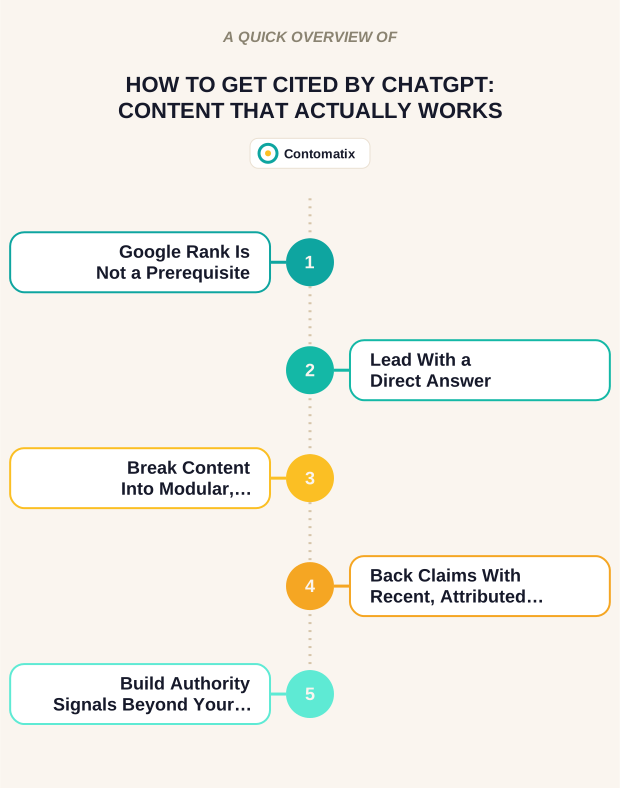
Google Rank Is Not a Prerequisite
This is the part that trips people up first. A small, specific, factual page from a low-authority domain gets cited constantly, provided it answers the exact question being asked clearly and isn't buried in fluff. ChatGPT isn't reading a ranking signal the way a search engine crawler does — it's evaluating whether a page directly and cleanly answers the question in front of it.
That's genuinely good news for a smaller business. You don't need to out-rank an established competitor on Google to get cited in an AI answer for the exact same question — you need to answer it more clearly than they did. It also means the usual months-long wait for a new page to earn enough authority to rank doesn't apply the same way here — a well-structured page published this week can get cited before it would ever climb a competitive search results page.
Lead With a Direct Answer
Structure the top of any page you want cited as a short, self-contained answer — a 40 to 60 word block that answers the core question with no fluff, no "in this article we'll cover," and no throat-clearing. According to Ahrefs' analysis of ChatGPT's most-cited pages, 44.2% of citations pull from the first 30% of a page. If your best information is buried three scrolls down, you're competing with pages that put it in the first paragraph.
Break Content Into Modular, Question-Answering Sections
Long, unstructured essays are harder for a model to extract cleanly than a page organized into clear sections, each answering one sub-question. Use headings that mirror how a real person would phrase a follow-up question, and keep each section focused enough that it could stand alone as an answer.
This is also where the broader shift toward LLM SEO shows up in practice — the structural discipline that helps a model extract your content is the same discipline that helps a human skim it.
Back Claims With Recent, Attributed Data
For anything where freshness matters — pricing, comparisons, industry statistics — recently updated content tends to outperform older pages that haven't been touched in years. Include a visible "last updated" date, and attribute any statistic to its original source rather than stating it as an unsourced fact. Models weigh specific, sourced claims more heavily than vague generalizations.
Build Authority Signals Beyond Your Own Site
Sites with an established backlink profile, genuine third-party mentions, and a presence on review platforms tend to get cited more consistently than brand-new or obscure domains with no outside footprint. This is where editorial link building and consistent brand mentions still matter directly — they're one of the signals a model uses to judge whether a source is trustworthy enough to quote.
Use Schema Markup
FAQ schema, Article schema, and Organization schema help these models parse and correctly attribute your content when they browse the web. It's a small technical step, but it reduces the chance a model misreads or skips your page entirely in favor of a competitor's cleaner markup.
Don't Accidentally Block the Crawlers
Any public page can appear in ChatGPT search results, provided you're not blocking OAI-SearchBot in your robots.txt. This is an easy thing to overlook, especially on sites that locked down crawler access years ago for unrelated reasons. Check your robots.txt before assuming a content problem is actually the issue.
Putting It Together: Getting Cited by ChatGPT Consistently
None of these tactics work in isolation. A page with a perfect answer capsule but no crawler access never gets seen in the first place. A well-crawled page with vague, unsourced claims gets skipped in favor of a competitor's more specific one. The businesses that show up consistently are the ones treating this as a full checklist — direct answers, modular structure, sourced data, schema markup, open crawler access, and a genuine authority footprint — rather than picking one tactic and hoping it carries the rest.
Start with the pages that already answer a specific, factual question well, since those are the fastest wins. Restructure the top of the page into a tight answer capsule, add a last-updated date, attribute your stats, and check that your robots.txt isn't quietly blocking the crawler that would have found you anyway.
A Practical Audit Checklist for Citability
Before rewriting anything, run an existing page through a short audit so you know exactly what's holding it back. Work through these in order:
- Read only the first 60 words. Cover the rest of the page with your hand or a browser window and ask whether those 60 words alone would satisfy someone who typed the question into a search box. If they wouldn't, the answer capsule needs to move up or be rewritten.
- Count how many separate questions the page tries to answer. A page trying to cover five related but distinct questions dilutes the signal for all of them. One clear primary question per page performs better than one page trying to be comprehensive.
- Check whether headings read like questions or like marketing labels. "Our Approach to Roof Repair" tells a model nothing about what question it answers. "How Much Does a Roof Repair Typically Cost" does.
- Look for unattributed numbers. Any statistic, price range, or claim without a visible source next to it is weaker evidence to a model than the same claim with a citation, even an internal one like "based on jobs we've quoted this year."
- Check the page's schema in a validator. A page that claims to be an FAQ but has no FAQ schema, or has schema that doesn't match the visible content, sends a mixed signal.
- Confirm the page is reachable and not accidentally noindexed. This sounds obvious, but staging flags and accidental noindex tags left over from a redesign are a common, invisible cause of a page that should be cited but never is.
Run this checklist against your three or four most important informational pages first, not your entire site at once. Fixing the pages that already answer a real question well produces results faster than spreading the same effort thin.
Common Mistakes That Keep Pages From Getting Cited
A few patterns show up repeatedly on pages that should be strong candidates for citation but aren't:
- Burying the answer under a long introduction. A page that opens with three paragraphs of company background before addressing the actual question loses the advantage of a clear answer capsule, even if the eventual answer is good.
- Writing persuasive copy instead of informational copy. Sentences built to sell rather than to inform are harder for a model to lift cleanly as a factual answer. Save the pitch for the closing section, not the opening one.
- Letting facts drift out of sync across the site. If your pricing page says one number and your FAQ page implies another, that inconsistency can make a model less confident citing either one.
- Treating this as a one-time project. A page optimized for citation in January can quietly go stale by summer if the underlying facts change and nobody updates the date or the content.
- Ignoring how the content reads out of context. A model often lifts a single paragraph or sentence, not the whole page. If a paragraph only makes sense with the surrounding context, it's a poor candidate for citation regardless of how good the full page is.
How to Monitor Whether Your Citation Efforts Are Working
Treat this the same way you'd treat rank tracking, just with a different method. Build a running log rather than checking once and moving on.
Pick eight to ten questions your ideal customer would realistically ask before they know your brand name, and run them logged out or in a private/incognito session across the AI platforms your audience actually uses. Do this monthly, on the same day if you can, and record three things each time: whether you appeared, where in the answer, and who was cited instead of you when you weren't.
Watch your referral traffic in analytics for sessions originating from AI platforms and chat interfaces, since a growing share of visits now arrive this way even though the traffic itself is usually harder to attribute cleanly than a standard search click. A sudden new source of direct or unattributed traffic to a specific page is sometimes the first real evidence that a citation is landing.
Resist the urge to judge a single run as proof of anything. These answers are not static, and a page that gets cited three times out of five checks over a couple of months is a stronger, more honest signal than one lucky result you noticed once.
Frequently Asked Questions
Do I need to rank #1 on Google to get cited by ChatGPT?
No. Specific, clearly written pages from smaller, lower-authority domains get cited regularly. ChatGPT evaluates how directly a page answers the question, not its Google ranking position.
What is an "answer capsule" and why does it matter?
It's a short, self-contained block near the top of a page — typically 40 to 60 words — that directly answers the core question. A large share of ChatGPT citations pull from the first 30% of a page, so front-loading a clear answer matters.
Does schema markup actually help with AI citations?
Yes. FAQ, Article, and Organization schema help these models parse and correctly attribute your content, reducing the chance your page is skipped or misread in favor of a competitor's more structured page.
Do backlinks still help get you cited by ChatGPT?
Yes, indirectly. A stronger backlink profile and genuine third-party mentions are among the trust signals these models weigh when deciding which sources are credible enough to cite.
Can blocking crawlers stop me from appearing in ChatGPT search?
Yes. If your robots.txt blocks OAI-SearchBot, your public pages won't be crawled or cited, regardless of how well the content itself is written. It's worth checking directly rather than assuming.
Does content freshness matter for AI citations?
For topics where facts change — pricing, comparisons, statistics — yes. Recently updated content with a visible last-updated date tends to be favored over stale pages on the same topic.
Should every page on my site be optimized for AI citation?
No. Focus on pages that directly answer specific, factual questions your audience asks — those are the ones models pull from. General marketing pages rarely get cited regardless of how well they're written.
How is this different from optimizing for a Google featured snippet?
There's real overlap — both reward direct, structured answers. The difference is that ChatGPT draws from a broader range of pages regardless of Google ranking, so a page with no featured-snippet chance can still get cited in an AI answer. Optimizing for one tends to improve your odds at the other, so it's worth treating them as complementary rather than choosing between them.
Disclaimer: This article is for informational purposes only. AI citation behavior changes as these platforms are updated and individual results will vary.
Related Reading
- Not sure where you currently stand? Start by learning how to check if your brand already appears in ChatGPT.
Contomatix helps businesses structure content and build the editorial link footprint that gets picked up by both search engines and AI models. Want a free review of how citation-ready your key pages actually are?
Get a free content review →

