Last updated: September 2026
Search for digital PR services and most of what comes back is agencies describing the same three tactics with different adjectives. What actually separates a service worth paying for from a link-building retainer wearing a press badge is whether the output could exist without SEO as the reason for it.
This guide covers what digital PR actually means, what happened to the journalist-outreach platforms everyone used to build campaigns around, what a real deliverable looks like, what it costs, and how to tell it apart from link building with a press release attached.
Digital PR Is Not Link Building With Extra Steps
The distinction matters more than most proposals admit.
- Link building starts with the link. Someone decides they need backlinks to a page, then works backwards to find or manufacture a reason a site would link to it.
- Digital PR starts with something genuinely newsworthy: original data, a survey, a study, an expert take on something happening right now. The links and mentions are what happens when journalists and other sites pick that story up on their own.
The test is simple. Would the piece exist, and would a journalist plausibly cover it, if search rankings were not part of the goal at all? If the honest answer is no, it is link building with a press release wrapped around it, and it should be scoped and priced as link building rather than PR.
What Happened to HARO
For years, "digital PR" for a lot of agencies meant one thing: pitching journalist queries on HARO. That channel has had a genuinely turbulent two years, and any digital PR proposal that treats it as a stable, unchanged tool has not kept up.
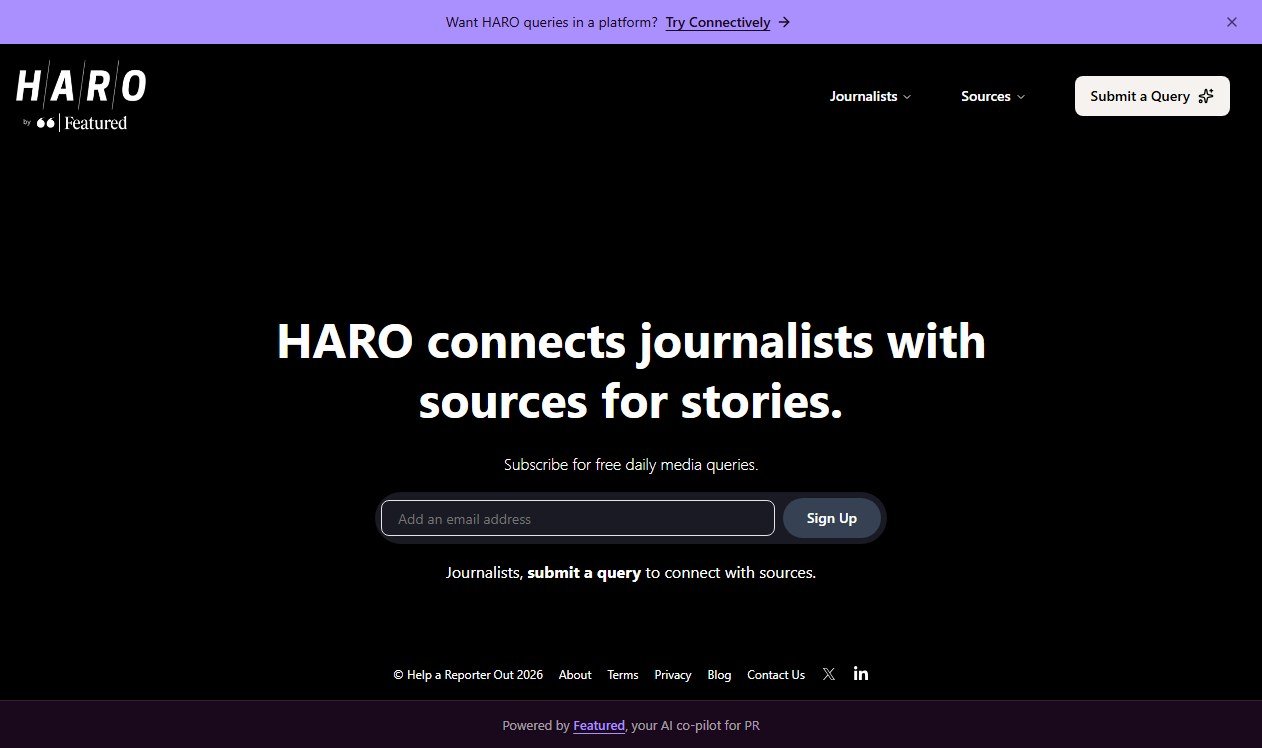
The short history: HARO was rebranded to Connectively and shut down under that name in December 2024. In early 2025, Featured acquired the HARO brand from its previous owner and relaunched it, and the current HARO homepage confirms it is now free again, running the familiar three-times-daily email format with added spam and AI filtering.
Two things follow from that timeline. First, HARO is genuinely active again in 2026, not a zombie brand kept alive for search traffic. Second, the query quality complaints that drove people away in 2023 and 2024 — AI-generated pitches, obvious link-building queries dressed as journalist requests — are exactly what the new filters are aimed at, so results vary by how recently an agency actually tested the platform rather than by reputation from two years ago.
A realistic 2026 stack rarely relies on one platform. It typically spreads pitching across HARO, one or two paid alternatives aimed at higher-authority outlets, and the #journorequest tag on X and Bluesky, where journalists post requests directly outside any platform at all.
What a Real Digital PR Deliverable Looks Like
Strip the buzzwords and a competent digital PR campaign produces one of a small number of concrete things.
| Format | What it actually is | Why it earns coverage |
|---|---|---|
| Original survey or data study | Primary research your brand commissioned or ran itself | Nobody else has the number, so citing you is the only way to use it |
| Data journalism piece | Public datasets analysed and visualised into a new finding | Saves the journalist the analysis work; the finding is genuinely new |
| Expert commentary / reactive PR | A fast, quotable take on something already in the news | Speed and a real credential, not volume of pitches |
| Newsjacking with a genuine angle | Connecting your data or expertise to a live news story | Rides existing attention rather than competing for new attention |
| Founder or expert byline placement | A written piece placed under a named expert in a relevant outlet | Editorial judgement decided it was worth publishing on its own merit |
Every row on that list can fail, and most campaigns produce a mix of hits and misses. The difference between a real digital PR service and a link-building service in disguise is whether the misses were genuine journalism swings that did not land, or obviously manufactured pitches that were never going to land anywhere reputable.
What Digital PR Services Cost in 2026
Pricing splits fairly cleanly into project-based data campaigns and ongoing retainers.
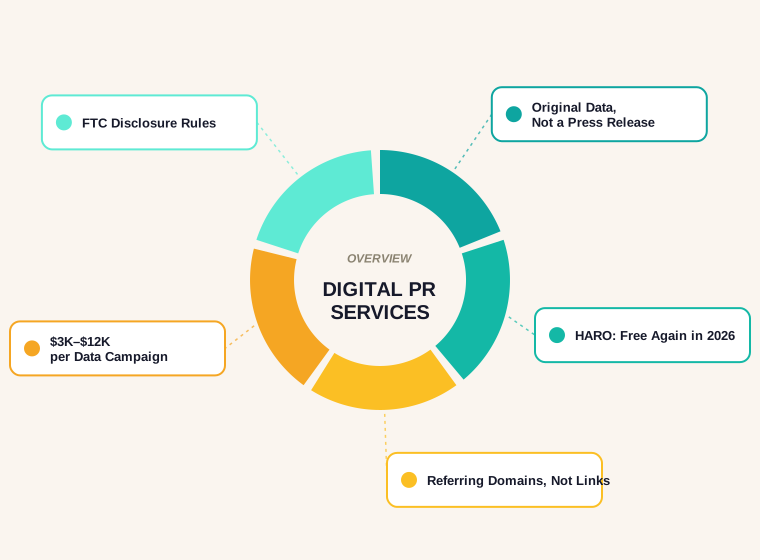
- One-off data campaign: $3,000 – $12,000. Covers research or survey design, analysis, a coverage-ready asset, and a pitching push. Wide range because the research itself — a proprietary survey versus reanalysing an existing public dataset — is most of the cost variance.
- Ongoing retainer: $2,500 – $8,000 a month. Regular reactive commentary, a smaller data piece every quarter, and continuous pitching relationships. Lower than the project rate per month because the research cost is amortised.
- Expert commentary / HARO-style pitching only: $800 – $2,500 a month. The cheapest tier, and the one most likely to be link building wearing a press badge if there is no original research behind it at all.
The honest question to ask a prospective provider is not "what does it cost" but "what would you actually build in month one", because the answer tells you which of the three tiers above you are really buying.
How to Judge Whether a Pitch Will Land
Before spending money on outreach, run any story idea through four questions.
- Is there a number nobody else has? "We surveyed 1,000 homeowners" beats "we think homeowners feel X" every time.
- Does it work without your brand name in the headline? If the story only exists to mention the company, it is advertising, not news, and most outlets will treat it that way.
- Is it timed to something? A seasonal peg, a policy change, an anniversary, or breaking news gives a journalist a reason to run it this week rather than filing it for someday.
- Can you back it up if a journalist pushes? Methodology, sample size, and raw data should survive a follow-up question, not just a first glance.
A pitch that fails more than one of these rarely earns coverage regardless of how well it is written.
Measuring Digital PR the Right Way
Link count and domain authority are the easy numbers to report and the least useful ones on their own. A stronger scorecard adds context.
- Referring domains, not total links — a placement on one outlet often syndicates to several sites under the same network, inflating a raw link count without adding new authority.
- Relevance of the outlet to your actual audience, not just its size.
- Branded search volume in the weeks after a big placement, which is the clearest sign real people saw it and looked the brand up.
- Referral traffic from the specific placements, separated from organic search gains that take longer to show up.
- Whether the coverage still exists a year later. A surprising number of "wins" get quietly deleted or de-indexed once the news cycle moves on.
If your existing link profile needs a check before investing further, our guide to free keyword and site research tools covers the free-tier options for auditing where you already stand.
Red Flags in a Digital PR Proposal
- A guaranteed number of links per month. Genuine coverage cannot be guaranteed, because a journalist's editorial decision is not something an agency controls.
- No original research or data anywhere in the plan. If every deliverable is a press release about the company itself, it is advertising, not PR.
- Vague "high authority outlets" with no example outlets named. Ask for three recent placements from other clients and check they are real, current, and still live.
- Reporting that stops at link count. No mention of referring domains, relevance, or traffic impact is a sign the campaign was built to produce a number rather than a result.
- Buying placements outright. Paid, undisclosed placements that look editorial are exactly the territory covered by the FTC's endorsement guidance, which has tightened enforcement in 2026 — any material relationship between the brand and the publication needs a clear, visible disclosure, not a buried mention.
Doing It Yourself: Where to Start
A small team can run a credible version of this without an agency.
- Pick one dataset you can actually produce. A short survey of your own customers, an analysis of your own product usage data, or a public dataset nobody has cut the way you plan to.
- Build one clean asset around it — a page with the key chart and the headline number, written so a journalist can lift the finding without needing to interview anyone.
- Pitch it directly. HARO, one or two paid alternatives if budget allows, and the
#journorequesttag, matched to journalists actually covering your topic rather than a mass list. - Track what lands, and repeat the format that worked rather than starting from scratch each quarter.
For the link-earning side of this once coverage starts landing, our guide to building a backlinks report covers how to track what a placement is actually worth once it is live.
Digital PR for Small and Local Businesses
Most digital PR case studies come from national brands with research budgets. A local plumbing company or a regional law firm can still run a smaller version of the same playbook, and it often works better precisely because there is less competition for local journalists' attention.
- Local data beats national data for local coverage. A survey of homeowners in your specific metro will get picked up by the local paper and TV station far more readily than a national statistic they have already seen from a bigger brand.
- Trade press is easier to break into than consumer press, and often more valuable for a B2B business, since the audience reading it is exactly the audience you want.
- Local journalists want local experts for reactive comment on stories about weather, housing, the local economy, or industry-specific news. A standing relationship with two or three reporters who cover your beat outperforms a mass pitch list every time.
A single local data story, pitched well, can out-earn a much larger budget spent on generic national outreach that never quite lands.
Quick Recap
- Digital PR starts with something genuinely newsworthy; link building starts with the link it wants.
- HARO shut down in December 2024 and relaunched free under Featured in April 2025 — it is active again, but treat any proposal citing 2023 complaints as outdated.
- A real deliverable is original data, data journalism, expert commentary, newsjacking, or a byline — not a press release about the company.
- Expect $3,000–$12,000 for a one-off data campaign, $2,500–$8,000 a month for an ongoing retainer.
- Judge a pitch on whether it has a unique number, works without the brand name in the headline, and is timed to something.
- Measure referring domains, outlet relevance and branded search lift, not raw link count.
- Walk away from guaranteed link counts and undisclosed paid placements.
Frequently Asked Questions
What are digital PR services?
Services that earn media coverage and backlinks through genuinely newsworthy content — original research, data studies, expert commentary and reactive pitching — rather than through direct outreach asking sites to link to a page.
Is HARO still active in 2026?
Yes. HARO shut down under the Connectively name in December 2024, was acquired by Featured, and relaunched free in April 2025 with the same three-times-daily query format and added spam filtering.
How much do digital PR services cost?
One-off data campaigns typically run $3,000 to $12,000. Ongoing retainers run $2,500 to $8,000 a month. Pitching-only services without original research are usually $800 to $2,500 a month.
What is the difference between digital PR and link building?
Digital PR produces something that would be newsworthy even if SEO were not a goal — original data, a study, expert commentary — and links follow as a byproduct of coverage. Link building starts by deciding a page needs backlinks and works backwards from there.
What makes a story likely to get picked up by journalists?
A number nobody else has, a story that works without the brand name in the headline, a timely peg such as a news event or season, and data that survives a follow-up question about methodology.
How do you measure digital PR success?
Referring domains rather than total link count, the relevance of the outlets to your audience, any lift in branded search after a major placement, referral traffic from specific pieces of coverage, and whether the coverage is still live months later.
Can a small business do digital PR without an agency?
Yes. Pick one dataset you can genuinely produce — a small survey or an analysis of your own usage data — build one clean asset around it, and pitch it directly through HARO, a paid alternative, and journalist request tags on social platforms.
Are paid media placements the same as digital PR?
No, and treating them as equivalent risks an FTC disclosure problem. A placement your brand paid for needs clear disclosure of that relationship; presenting it as independent editorial coverage when it was not is the practice regulators are actively enforcing against.
What replaced HARO during the shutdown?
Several platforms grew to fill the gap, including Qwoted, Featured itself, and Source of Sources, a free platform built by HARO's original founder. Many practitioners now pitch across several of these rather than relying on one.
Do digital PR links help SEO if they are nofollow?
Yes, indirectly. A nofollow link from a major outlet still drives referral traffic, brand search, and often gets picked up and re-cited by other sites with a dofollow link, which is one reason coverage on a highly relevant outlet is worth more than the single link tag suggests.