Last updated: August 2026
A client once told us their analytics looked flat for a month despite a big content push, then found out ChatGPT had been recommending them by name the entire time — just without a single click showing up anywhere in Google Analytics. What is AI visibility, and why does it need its own measurement approach instead of borrowing the metrics you already track for SEO? It's the practice of tracking how often AI answer engines mention, cite, or recommend your brand — a layer of presence that traditional analytics simply isn't built to see.
Here's what the term actually means, why it can't be measured the old way, and which numbers are worth tracking.
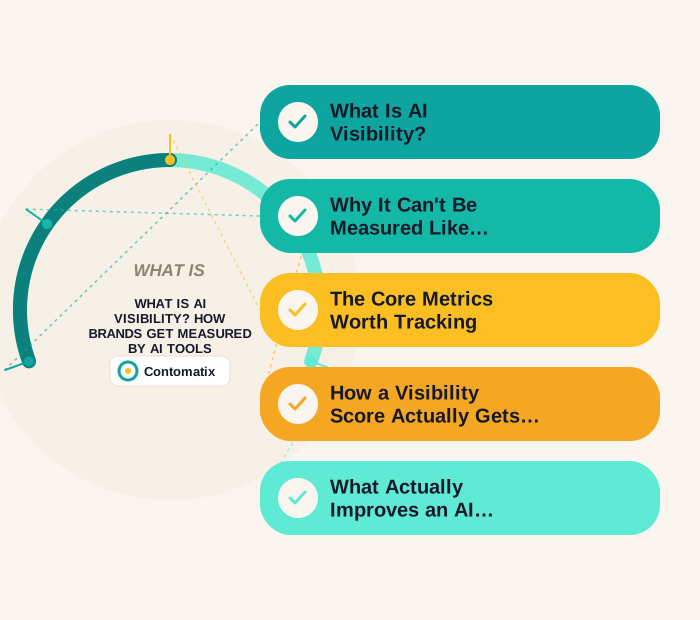
What Is AI Visibility?
AI visibility is how often AI answer engines like ChatGPT, Gemini, Perplexity, and Google AI Overviews mention or cite your brand when people ask questions about your category. Instead of tracking a ranked position on a results page, it tracks your presence inside the generated answer itself — whether you're named, how you're described, and whether a source link is attached.
This distinction matters because a brand can perform well on this metric while showing almost nothing unusual in standard web analytics. An AI answer can fully satisfy a user's question before they ever click through, so the value shows up as brand awareness and consideration rather than as a session in your traffic reports.
Why It Can't Be Measured Like Traditional SEO
AI answer engines are non-deterministic — the same exact prompt can surface a different set of brands on different attempts, even minutes apart. A single check tells you almost nothing reliable; the number that matters is a pattern across repeated checks over time, not a one-off snapshot.
Traditional SEO metrics also stop being sufficient on their own, because they're built around what happens after a click. AI visibility measures something that can happen entirely before or instead of a click, which is why it needs its own set of numbers rather than a repurposed rankings dashboard.
The Core Metrics Worth Tracking
A handful of metrics show up consistently across how marketers approach this, each answering a slightly different question:
- Visibility Score: the share of relevant AI answers that mention your brand at all, out of every answer you tested for.
- Share of voice: how your mention frequency compares to named competitors across the same set of questions.
- Citation share: how often you're the specific source cited or linked, versus just mentioned by name without attribution.
- Sentiment accuracy: whether the model describes your brand correctly and favorably, not just whether it mentions you at all.
- Positioning accuracy: whether the model places you in the right context — the right category, the right use case — rather than a vague or mismatched mention.
Semrush's guide to measuring AI search visibility is a useful reference if you want a deeper walkthrough of how these metrics are typically calculated in practice.
How a Visibility Score Actually Gets Calculated
At its simplest, a visibility score is the number of answers mentioning your brand divided by the total number of relevant answers tested. Run 20 realistic category questions, count how many produce a mention of your brand, and you have a rough score. The value comes from repeating this consistently over time and across the same fixed set of prompts, so a shift in the score actually reflects a shift in visibility rather than random variation between two arbitrary checks.
Why This Matters for a Small Business, Not Just Enterprise Brands
It's tempting to assume this is an enterprise-PR concern, but the mechanics apply just as directly to a local or niche business. If a prospective customer asks an AI tool for a recommendation in your category and never hears your name, that's a lost opportunity you'd otherwise never know occurred. Tracking even a simple version of this — a short, consistent list of questions checked monthly — gives a small business the same kind of visibility insight larger brands are now formalizing with dedicated tools.
What Actually Improves an AI Visibility Score
The same fundamentals that support getting cited by ChatGPT also move an AI visibility score over time: content that answers questions directly and clearly, a genuine footprint of third-party mentions and editorial links, and consistency in how your brand is described across the web. There's no separate shortcut — a stronger content and authority foundation is what moves both metrics at once.
It's also worth resisting the urge to chase a single number in isolation. A rising visibility score paired with poor sentiment accuracy or the wrong positioning isn't actually a win — being mentioned frequently but described inaccurately, or grouped into the wrong category of business, can do more harm than staying quiet. Track the full set of metrics together rather than optimizing for the one that's easiest to move.
Setting Up a Manual AI Visibility Check
A business doesn't need dedicated software to start tracking this — a consistent manual process gets most of the value:
- Write a fixed list of 15 to 20 realistic prompts a prospective customer might actually type — category recommendations, comparison questions, "best for X" style queries — and keep the wording identical every time you check.
- Run the same list across each major platform — ChatGPT, Gemini, Perplexity, and a Google search that triggers an AI Overview — since visibility can differ meaningfully between them.
- Log the result for each prompt: whether your brand appeared, how it was described, whether a source link was attached, and which competitors appeared alongside it.
- Repeat on a fixed schedule, monthly at minimum, using the exact same prompt list each time — changing the questions between checks makes it impossible to tell whether a shift reflects a real change or just different phrasing.
- Keep the log in a simple spreadsheet rather than trying to build anything elaborate at first. The value comes from consistency over time, not from the sophistication of the tracking method.
A few months of this manual process gives a business a genuinely useful trend line, and makes it much easier to evaluate whether a paid AI-visibility tracking tool is actually worth the investment once volume or platform coverage outgrows what a manual check can handle.
How AI Visibility Interacts With Traditional SEO Metrics
It's tempting to treat AI visibility as a replacement for search rankings, but the more accurate framing is that it's an additional layer sitting alongside them, not instead of them. A page that ranks well and gets cited frequently by AI tools is doing something right on both fronts, since much of what earns a strong citation — clear structure, direct answers to specific questions, credible sourcing — also supports traditional ranking signals. Where the two genuinely diverge is in what a business should expect to see in its analytics: a strong AI visibility performance can coexist with flat or even declining click-through traffic, because a well-answered AI query can fully satisfy the searcher without a click ever happening. Judging AI visibility work by traffic numbers alone misses the actual value it's producing.
Common Mistakes When Interpreting AI Visibility Results
A few recurring errors distort what a business takes away from its own checks. The first is drawing conclusions from a single prompt run rather than a pattern across many, since normal variability between checks can look like a meaningful trend when it's actually just noise. The second is testing only branded or near-branded prompts ("is this company good") instead of the genuinely unprompted category questions a real prospective customer would ask, which measures something closer to existing brand awareness than true discovery visibility. The third is ignoring negative or inaccurate mentions entirely as long as the brand name appears somewhere in the answer — a mention that misdescribes what the business actually does can actively work against conversion even while technically counting toward a visibility score. Reading results with these three traps in mind produces a far more useful picture than treating every mention as an unambiguous win.
What a Small Business Can Realistically Influence
It's worth being honest about what's controllable here versus what isn't. A business can't directly edit what an AI model says about it the way it can edit its own website copy, and results can shift for reasons entirely outside the business's control, including a platform's own model updates. What is controllable is the underlying material these systems draw from: clear, direct, well-structured content that actually answers the questions customers ask, accurate and consistent information about the business repeated across the sites it appears on, and a genuine footprint of third-party mentions that reinforce the same facts. Investing in that foundation is the most reliable lever available, even though it doesn't guarantee a specific outcome in any individual AI-generated answer.
Documenting Results Over Time Rather Than Reacting to One Check
A single monthly log entry is useful, but the real value compounds once there's a full quarter or two of history to look back on. Reviewing three months of results side by side reveals whether a specific piece of published content, a new set of third-party mentions, or a site-wide accuracy correction actually coincided with a visibility shift, rather than trying to draw that connection from memory alone. Treat the log as a working document to revisit deliberately on a set schedule, not just something updated in passing and never reread.
If it helps, we also wrote about the Google Discover AI test: how Google is trialling AI features in Discover.
Frequently Asked Questions
What is AI visibility in simple terms?
AI visibility is how often AI answer engines like ChatGPT, Gemini, and Perplexity mention, cite, or recommend your brand when people ask relevant questions in your category.
How is AI visibility different from a Google ranking?
A Google ranking tracks your position on a results page. AI visibility tracks whether and how you're mentioned inside a generated answer itself, which can happen with or without a click ever occurring.
Why is AI visibility hard to measure with a single check?
AI answer engines are non-deterministic, meaning the same prompt can return different brands on different attempts. A reliable read requires repeated checks over time, not a single snapshot.
What is a Visibility Score?
It's the share of relevant AI answers that mention your brand, calculated as mentions divided by total relevant answers tested, tracked consistently over the same set of prompts.
What's the difference between share of voice and citation share?
Share of voice compares how often you're mentioned relative to named competitors. Citation share measures how often you're specifically credited or linked as a source, rather than just named in passing.
Does AI visibility matter for small or local businesses?
Yes. The same mechanics apply regardless of business size — if a prospective customer asks an AI tool for a recommendation and never hears your name, that's a missed opportunity worth knowing about.
What improves an AI visibility score?
Content that answers questions directly and clearly, a genuine footprint of third-party mentions and editorial links, and consistent, accurate descriptions of your brand across the web.
How often should I check my AI visibility?
Monthly checks against a fixed, consistent set of questions give a reliable trend line without over-reacting to normal run-to-run variation in AI-generated answers.
Do I need special software to track AI visibility?
Not to start. A manual, consistent list of prompts checked across the major AI platforms works well for a small business. Dedicated tracking tools become more useful once you want to monitor at scale automatically.
Disclaimer: This article is for informational purposes only. AI visibility measurement approaches continue to evolve as these platforms change.
Contomatix helps businesses build the content and editorial link footprint that improves visibility across both search engines and AI answer platforms. Want a free baseline check of your current AI visibility?
Get a free AI visibility check →

