Last updated: October 2026
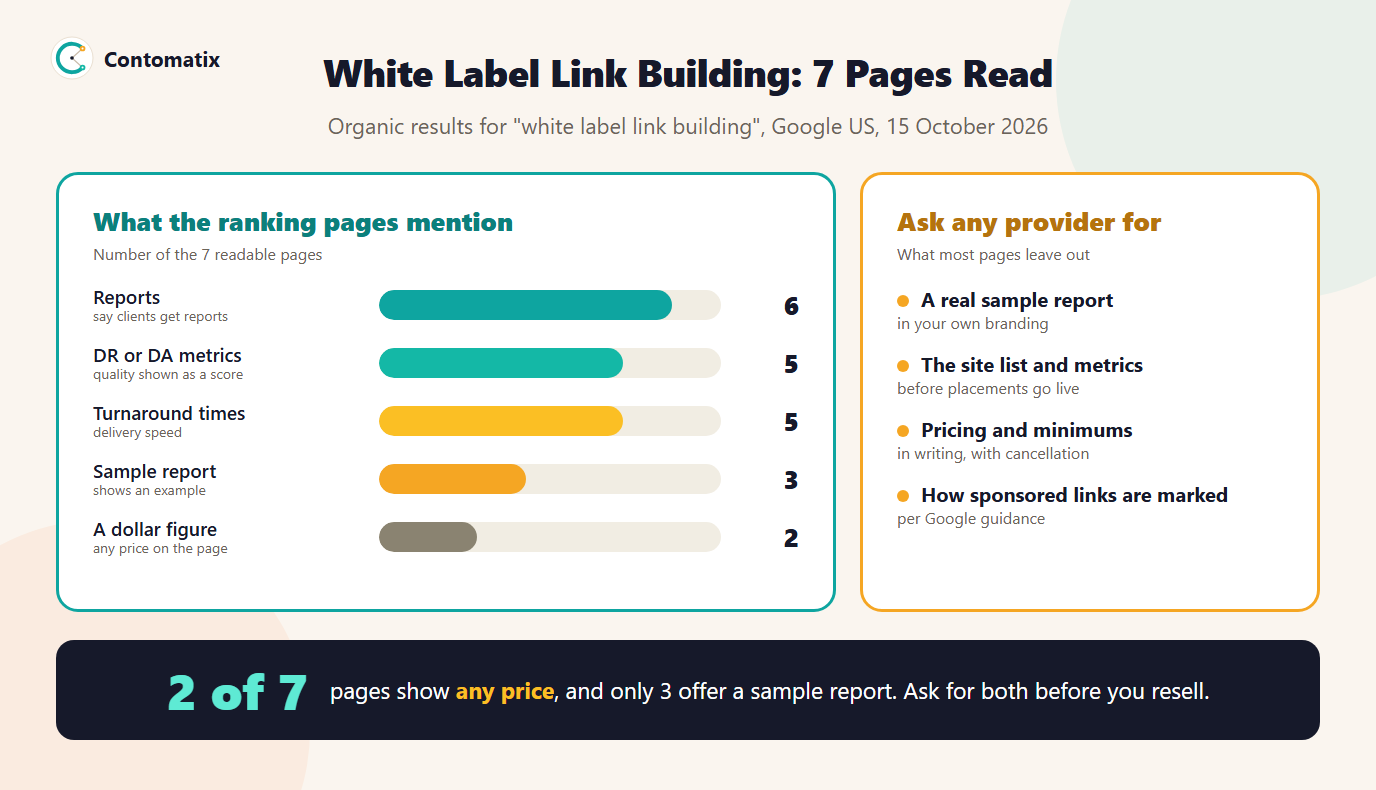
White label link building is link building done by a specialist partner and sold to the end client under your agency's name. Before writing this guide we read the 7 readable pages that rank for the term on Google US. They run a median of 2,674 words, yet only 2 show any dollar figure and only 3 offer a sample report. That gap is the reason this guide exists: the details an agency most needs before reselling are the details the pages leave out.
Below you will find what you actually resell, what to ask any white label link building agency, how pricing works, which risks sit under the label, and how to protect the client relationship. It builds on our overview of white label SEO.
What White Label Link Building Is
In a white label arrangement, the provider produces the work and you present it as yours. In link building that usually means the partner researches targets, runs outreach, secures placements and reports on them, while you keep the client, the invoice and the branding. People also call it white label backlinks, white label SEO link building or whitelabel link building, and some use private label link building for the same idea.
It is different from a plain list of links bought in bulk. A real white label link building solution includes strategy, vetting, outreach and reporting, and it protects your brand because the partner is invisible to your client.
What the Ranking Pages Say, and Do Not Say
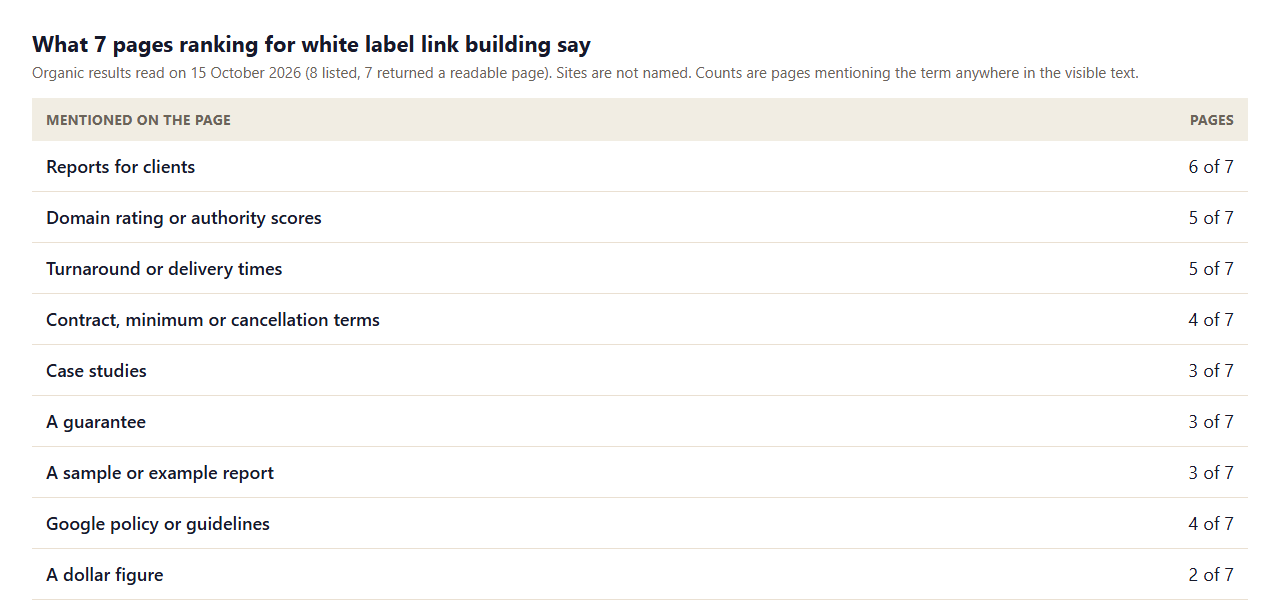
- Reports are standard. 6 of 7 pages mention client reports, so you can expect them.
- Quality is sold as a score. 5 of 7 mention DR or DA. A score is a starting point, not proof of relevance or real traffic.
- Price is rarely shown. Only 2 of 7 show a dollar figure, so you will have to ask.
- Proof is thin. 3 offer a sample report and 3 mention case studies.
- Google's rules are underplayed. 4 of 7 mention Google policy or guidelines. Those rules decide whether a resold link is safe.
What You Resell: Deliverables Worth Defining
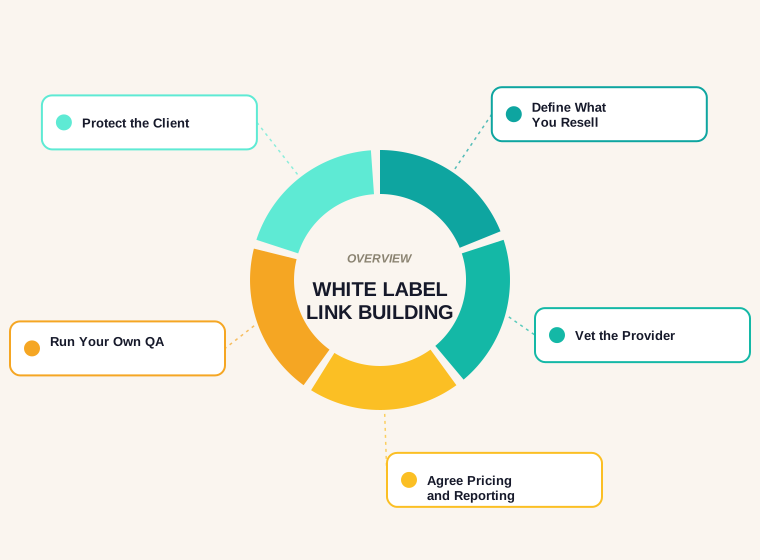
Write the deliverable down before you quote a client. A white label link building campaign usually contains these parts.
- A backlink gap or opportunity analysis that shows the client where competitors are linked and they are not.
- A target list with metrics shared before placements go live, so you can check relevance and traffic.
- Outreach and content, such as guest articles, link insertions or editorial mentions.
- A monthly report with live URLs, anchors, link attributes and dates, in your branding.
- A replacement or removal policy for links that disappear or fail your checks.
How to Choose a White Label Link Building Agency
Use the gaps in the table above as your checklist.
- Ask for a sample report with your logo and a real placement, not a template screenshot.
- Ask how targets are chosen. Look for manual review of relevance, real traffic and outbound-link history, not only a metric threshold.
- Ask to see the list first. You should be able to approve or reject sites before a link goes live.
- Ask how sponsored placements are handled. They should be marked, per Google's guidance.
- Ask about minimums and cancellation. Know what happens if a client leaves.
- Ask who talks to your client. The answer should be nobody but you.
The Google Rules Under Every Resold Link
You are responsible for the links you sell. Google's spam policies treat buying or selling links for ranking purposes as link spam, and its guidance asks for paid placements to be qualified.
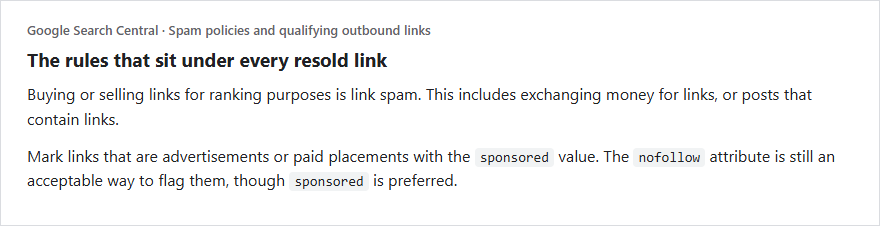
That does not make white label link building risky in itself. Earned editorial links are consistent with those rules. The risk is a provider that sells links as a product, builds them on networks, or hides that placements were paid for. Put the method in your contract and review samples before you promise results.
Pricing Models and Margin
Providers usually price in one of three ways: per link or placement, a monthly package with a set number of placements, or a custom retainer that includes strategy and reporting. Per-link pricing is simple to resell but encourages volume. Packages are easier to forecast. A retainer fits long campaigns but requires trust.
Your margin is a simple calculation: the client's monthly fee minus the provider's cost minus your account-management time. Do the arithmetic before you quote, and keep a buffer for replacements and reporting time. If the margin only works at the lowest possible link quality, the offer will not survive its first review.
White Label Reports That Clients Read
A good white label SEO link report is short. It lists new links with URL, anchor text, attribute and date, shows the referring domain count over time and says what happens next month. It uses your logo and your language. Add a line explaining what a nofollow or sponsored link is, because clients often ask. Our guide to checking backlinks shows how to verify each entry yourself.
Quality Control You Should Run Yourself
- Open a sample of live links each month and check the attribute and anchor.
- Check that the linking page is indexed and has readers.
- Compare the placements with the approved target list.
- Track the destination pages, since a link to a broken URL loses its value, as covered in our broken backlinks guide.
White Label Link Building Versus Doing It In-House
In-house gives you control and context but needs outreach staff, tools and time. White label gives capacity and a repeatable process without hiring. Many agencies mix both: they keep strategy and client relationships in-house and hand the placement work to a partner. The decision is mostly about volume and about how much of the process you want to own.
How Contomatix Handles It
Our white label SEO service and link building service follow the same principles described above: manual vetting of each site, a target list with metrics shared before placements go live, no PBNs, and reporting that carries your branding with no Contomatix mentions. We never contact your clients directly. If you want to start with one client or overflow work, get in touch.
Onboarding a Client Into a White Label Campaign
- Collect the basics. Priority pages, target terms, the client's competitors and any link history, including past penalties or disavow files.
- Run the gap analysis. Compare referring domains with the sites outranking the client, so the first placements target what is missing.
- Agree the targets. Share the shortlist with metrics and approve or reject sites before outreach starts.
- Set the reporting. Fix the date, the fields and the branding for the monthly report.
- Review the first placements. Open the live links and check anchors, attributes and relevance before you send the first report.
Anchor Text and Link Attributes in Resold Campaigns
The two details that most often go wrong are anchors and attributes. Agree an anchor policy up front: mostly brand, URL and descriptive phrases, with an occasional keyword-based anchor placed where it reads naturally. Agree also how paid or sponsored placements are marked. Your report should state the attribute of every link, so a client who reads a competitor's pitch about "dofollow only" understands that a healthy profile contains followed, nofollow, sponsored and ugc links, and that Google treats the attributes as hints.
What Happens When a Link Disappears
Links are lost. A publisher edits an article, a site is redesigned or a page is removed. Decide the policy in writing: how long a link must stay live, how you will detect removal and whether the provider replaces it. A monthly spot check catches most losses, and a quarterly check of every placement catches the rest. When you replace a link, replace it with one of equal or better relevance, not simply the cheapest available.
Contracts, Confidentiality and Ownership
Put four things in the agreement: the deliverables and standards, the confidentiality of your client list, who owns the content written for placements and what happens at termination. The partner should not use your client's name in case studies without permission, and should not contact the client or the publishers on the client's behalf in a way that exposes your agency. Clear terms protect both sides and make a later change of partner much easier.
Who White Label Link Building Suits
It suits agencies that sell SEO, web design or content and want to add link building without building a team; consultants who need capacity for a few clients; and in-house teams that need extra hands on a campaign. It suits less well an agency that wants to buy a handful of links with no strategy, or one that cannot spend time reviewing samples. The model works best when the agency treats the partner as part of the team and reviews its work.
Reporting Cadence and Communication
Set a rhythm: one monthly report, one short call or message thread for questions and a quarterly review of strategy. Keep the channel between you and the partner direct and documented. When a client asks something you cannot answer, you should be able to get a clear answer from the partner within a working day. That responsiveness is something to test during the trial, before you move more clients across.
Red Flags When Comparing Providers
- Promises of a guaranteed domain rating or a fixed ranking outcome.
- A price so low that no manual work could be happening.
- No way to see the sites before they go live.
- Reports that show only a total, with no URLs, anchors or attributes.
- Reluctance to explain the method, or answers that reduce it to "high DA".
What to Tell Your Clients
Clients usually ask three things: how many links, how fast and what will it do for rankings. Answer honestly. Link building is gradual, because Google has to find and process each link, and results depend on competition and on the quality of the pages being linked. Explain that you review every placement, that links come in different attributes and that the aim is a relevant, natural profile rather than a high count. That honesty is also what keeps a client for years.
Common Mistakes
- Reselling without seeing a sample. Never promise a client what you have not reviewed.
- Buying on metric alone. A score does not show relevance or traffic.
- Skipping the attribute. Sponsored placements need to be marked.
- No exit terms. Know the cancellation rules before the first client.
- Letting the partner talk to the client. It breaks the white label model.
Limits of This Research
- We read the 8 organic results for one query on one day; 7 returned a readable page.
- Counts show whether a page mentions a term, not how well it explains it.
- A page without a price may still give one on request.
- Results in other countries or at other times will differ, so rerun the check on your own market before you rely on it.
- The page counts are a reading aid for what to ask providers, not a ranking of the providers themselves.
Key Takeaways
- Define the deliverable and the report before you quote a client.
- Ask for what ranking pages leave out: a sample report, the site list, pricing and Google policy handling.
- Check a sample of live links yourself every month.
- Mark paid placements as sponsored or nofollow.
- Work out your margin before you sign.
Frequently Asked Questions
What is white label link building?
It is link building done by a partner and delivered under your agency's brand. You keep the client relationship and the margin, and the partner does the research, outreach and reporting.
How is white label link building different from buying backlinks?
Buying backlinks means paying for a placement where the link is the product. White label link building is a service: strategy, vetting, outreach and reporting, delivered in your name.
What should a white label link building agency provide?
An opportunity analysis, a target list with metrics, outreach and content, a branded monthly report and a policy for lost or failed links.
Is white label link building safe for my clients?
It can be, if links are earned editorially on relevant sites and paid placements are marked. Link networks and undisclosed paid links carry risk, whoever sells them.
How much does white label link building cost?
It varies by provider and model: per link, per package or a retainer. Few providers publish prices, so ask for written terms including minimums and cancellation.
What are white label backlinks?
They are backlinks placed by a partner and reported to the end client as your agency's work. The partner remains invisible to your client.
What is the difference between white label and private label link building?
The terms are used interchangeably. Both describe service delivered by a third party under another company's brand.
Can I try white label link building on one client first?
Yes. A single client or a piece of overflow work lets you review the sample reports, the target lists and the quality before you scale.
How do I check the links a white label provider builds?
Open a sample of live links each month, check the link attribute, anchor text and whether the page is indexed, and compare them with the approved target list.


