Last updated: September 2026
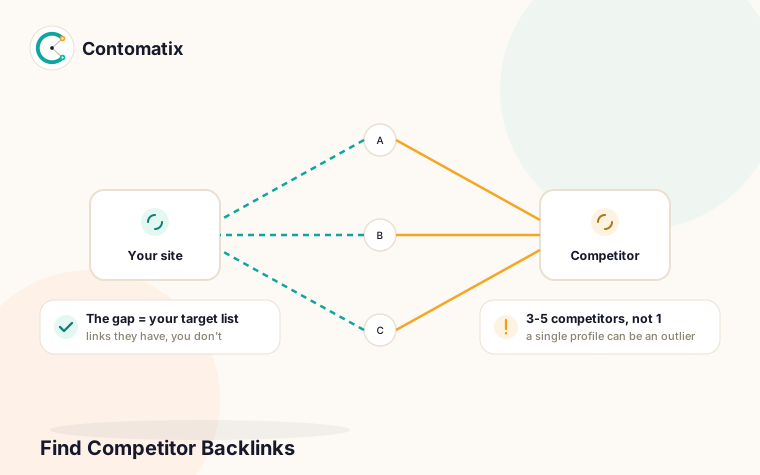
The fastest way to find competitor backlinks isn't scrolling through their referring-domains report one link at a time — it's asking a much narrower question: which sites link to them but not to me? That single filter, not raw backlink volume, is what turns competitor research into an actual to-do list instead of a spreadsheet nobody acts on.
Most guides on this topic stop at "here's how to open a backlink checker." This one covers the specific gap-analysis tools built for exactly this comparison, the manual free method that works without a subscription, how to filter the resulting list down to links actually worth chasing, and what to do with that list once you have it.
Why Competitor Backlink Research Actually Pays Off
Backlinko's widely-cited analysis of roughly 11.8 million Google search results found that the #1 ranking result averages 3.8 times more backlinks than pages sitting in positions two through ten. That gap is rarely random — it usually traces back to a specific set of sites, directories, or publications the top result earned links from that lower-ranked pages never pursued.
Competitor backlink research shortcuts the discovery phase of link building. Instead of guessing which sites in your niche accept guest posts, list local businesses, or cover your industry editorially, you start from proof: a site that already linked to a direct competitor has already shown willingness to link to something like you.
It also shortcuts the validation problem that slows down a lot of outreach. A cold pitch to a site you've never interacted with is a guess about whether they'd ever link to something in your space. A pitch to a site that's already demonstrated it links to a direct competitor removes that guesswork entirely — you're not asking them to do something new, you're asking them to do something they've already shown they're willing to do.
Pick the Right Competitors Before You Start
This step gets skipped constantly, and skipping it wastes the entire exercise. There are two different kinds of "competitor," and they produce very different backlink lists:
- SERP competitors — sites ranking for the exact keywords you're targeting, regardless of whether they sell the same thing you do. These show you what Google currently rewards for that specific query.
- Business competitors — companies you actually compete with for customers, who may rank for entirely different keywords than you do. These show you where your real market gets its authority from.
Analyze 3-5 competitors from each category rather than one or two overall. A single competitor's backlink profile can be an outlier — a few competitors analyzed together reveal the actual pattern of where your niche's links come from.
The Fastest Method: Backlink Gap Tools
This is the one feature most "how to find competitor backlinks" guides skip past, and it's the single most efficient method available. Every major platform has a version of the same tool, usually called a backlink gap or link intersect report: you enter your own domain plus one or more competitor domains, and the tool returns only the sites linking to at least one competitor but not to you.
- Ahrefs calls this Link Intersect — enter up to 200 competing domains and your own, and it surfaces sites linking to them but not you, sortable by Domain Rating.
- Semrush calls this the Backlink Gap tool — compare up to five domains at once and filter results to referring domains with the strongest authority.
- SE Ranking and Moz both offer comparable competitor gap reports inside their backlink modules, though naming and filter depth vary by plan tier.
The output of a gap report is already sorted by relevance to your specific situation — it's not "here are all of a competitor's backlinks," it's "here are the ones you're missing," which is the actual list worth working from.
Real example: running Ahrefs' free Backlink Checker on backlinko.com (checked September 2026)
Domain Rating 90 • 482K backlinks (82% dofollow) • 58K linking websites (84% dofollow)
| Referring page (DR) | Anchor text & target |
|---|---|
| YouTube via Wikipedia (DR 97) | "YouTube Stats: How Many People Use YouTube in 2024?" → backlinko.com/youtube-users |
| SEO Review Tools' Rank Checker (DR 75) | "the Google Ranking Tool" → backlinko.com/best-free-seo-tools |
| Salesforce's social media guide (DR 92) | "Active Users: 1.04 billion" → backlinko.com/tiktok-users |
This is exactly the kind of result a gap report surfaces at scale — individual pages, on real sites, with the specific anchor text and target URL that earned the link.
The Free Method: Manual Research Without a Subscription
A paid platform isn't required to get started. This works with nothing but Google and a spreadsheet:
- Search-operator combing. Search
"competitorname" -site:competitorname.comto surface mentions and links across the web that a subscription tool would otherwise index for you. Google's own advanced search operators documentation covers the full set, includingintitle:andinurl:, both useful for narrowing results to pages actually about your niche rather than passing mentions. - Free-tier backlink checkers. Ahrefs' free Backlink Checker shows up to 100 backlinks per domain at no cost — enough to spot obvious patterns (a directory, a guest post host, a sponsorship page) even without full access.
- Google Search Console (for your own gaps). While GSC only shows your own site's links, cross-referencing what it does and doesn't show against a competitor's public backlink mentions helps confirm which opportunities are genuinely open to you.
- Direct inspection. Visit a competitor's "As Featured In," partners, or press page directly — these are often the easiest, most replicable links since the competitor is actively advertising how they got them.
Filtering the List: Which Links Are Actually Worth Chasing
A raw gap report can return hundreds of rows. Most of them aren't worth pursuing. Filter for these before doing any outreach:
- Relevance over authority score. A moderate-authority site that's genuinely on-topic for your industry is worth more outreach effort than a high-authority site with no topical connection.
- Replicability. A guest post or a directory listing can realistically be replicated. A link from an acquired company's press release or a one-off news mention generally can't — don't spend outreach time chasing links nobody can actually recreate.
- Real traffic, not just a score. A site can carry a decent authority number while sending almost no actual visitors. Check whether the linking page appears to get organic traffic, not just whether the domain scores well.
- Link type. Confirm whether the competitor's link is dofollow before prioritizing outreach to replicate it — a nofollow mention on a high-profile site is still good for visibility, but it won't do the same ranking work.
From List to Outreach: What Happens Next
Finding the list is the easy half. The sites that actually see ranking movement from this exercise are the ones that follow through with real outreach, not just a saved spreadsheet. Once you've filtered down to a realistic prospect list:
- Group prospects by the type of opportunity (guest post, directory, resource page, sponsorship, expert quote) so your pitch matches what actually worked for the competitor.
- Personalize each pitch around why your specific page or resource fits that specific site — a copy-pasted pitch mentioning the competitor by name is the single fastest way to get ignored or flagged as spam.
- Use outreach software to manage sending and follow-ups at scale, while keeping the actual relevance judgment and pitch personalization human — the same hybrid principle covered in our guide to automated link building.
- Track which prospects convert by opportunity type, not just overall reply rate — this tells you which competitor tactic is actually worth repeating next time.
Free vs. Paid Methods Compared
| Method | Cost | Best for |
|---|---|---|
| Search-operator manual research | Free | One-off checks, very small budgets |
| Ahrefs free Backlink Checker | Free (100 links/domain) | Spotting obvious link patterns quickly |
| Ahrefs Link Intersect / Semrush Backlink Gap | Paid (bundled with platform) | Full multi-competitor gap analysis |
| Moz Link Explorer | Free tier + paid | Anchor text and domain authority alongside gaps |
| Direct competitor page inspection | Free | Finding easily replicable, self-advertised links |
How Long This Actually Takes
Set realistic expectations before starting, since this is a research-then-outreach process, not an instant win. Running a gap report across 3-5 competitors and filtering the results down to a realistic prospect list typically takes half a day to a full day, depending on how many competitors and how deep the resulting list is. Outreach itself moves slower — expect a 5-15% reply rate on well-targeted, personalized pitches, and a smaller fraction of replies converting into an actual placement. A batch of 50 filtered prospects reasonably produces somewhere between 2 and 8 real links over the following few weeks, not 50.
This is also not a one-time exercise. Competitors keep building links after you've analyzed them once, so the sites that treat this as a recurring quarterly process consistently outperform the ones that ran it once, got a handful of links, and moved on to something else — the same referring-domain gap Backlinko's ranking-factors study found at the top of the SERP tends to widen over time between sites that keep at it and sites that don't.
Common Mistakes in Competitor Backlink Research
- Analyzing only one competitor. A single profile can be an outlier; patterns across 3-5 competitors are far more reliable.
- Chasing every result in the gap report. An unfiltered list wastes outreach time on irrelevant or unreplicable links. Filter first, then pitch.
- Copying tactics wholesale instead of adapting them. A competitor's specific angle worked for their brand and content — borrow the tactic, not the exact pitch.
- Stopping at "found," never reaching "pitched." A saved spreadsheet of opportunities produces zero rankings on its own — this is the single most common failure mode, since the research phase feels productive even when it produces nothing.
- Ignoring your own gaps in reverse. A competitor gap report only shows what you're missing. Periodically flip the comparison and check what you have that they don't — those are the links you're already leveraging well, worth understanding so you don't accidentally lose them.
The tools that make this comparison practical are the same ones covered in our backlink analysis tools guide — competitor gap analysis is one specific, high-value use case inside the broader backlink-tool category.
Frequently Asked Questions
How do I find a competitor's backlinks for free?
Use Ahrefs' free Backlink Checker for up to 100 links per domain, search operators like "competitorname" -site:competitorname.com to surface mentions, and check a competitor's own "featured in" or partners page directly for self-advertised, easily replicable links.
What is a backlink gap analysis?
A backlink gap (or link intersect) analysis compares your domain against one or more competitors and returns only the sites linking to them but not to you — a prioritized list of realistic link-building targets rather than every backlink a competitor has.
Which tool is best for finding competitor backlinks?
Ahrefs' Link Intersect and Semrush's Backlink Gap are the two most widely used purpose-built tools for this specific comparison. Moz and SE Ranking offer comparable features inside their backlink modules. The free method works too, just more slowly.
How many competitors should I analyze for backlink research?
3-5 is a reasonable range, mixing direct SERP competitors (ranking for your target keywords) with business competitors (competing for the same customers). A single competitor's profile can be an outlier and doesn't reveal a reliable pattern on its own.
Should I try to get every backlink my competitor has?
No. Filter for relevance, replicability, and real traffic first. Many competitor links — acquisition press releases, one-off news mentions, links from now-defunct partnerships — can't realistically be recreated and aren't worth outreach time.
What's the difference between SERP competitors and business competitors?
SERP competitors rank for the same keywords you're targeting, regardless of what they sell. Business competitors compete for the same customers but may rank for entirely different terms. Analyzing both gives a fuller picture than either alone.
Can I find competitor backlinks without any paid tools?
Yes, though it takes more manual effort. Combine free-tier backlink checkers (capped at a limited number of results), targeted Google search operators, and direct inspection of a competitor's own site for self-advertised links and partnerships.
How often should I re-run competitor backlink research?
Quarterly is a reasonable baseline for an active link-building program, since competitor link profiles shift gradually. Re-run it sooner if a competitor suddenly jumps in rankings, since that's often driven by a recent link-building push worth understanding.
What should I do after finding a competitor's backlink opportunities?
Group the filtered list by opportunity type (guest post, directory, resource page, sponsorship), personalize outreach to each site specifically, and track conversion by opportunity type rather than only overall reply rate, so you know which tactic to repeat.
Is it plagiarism or unethical to pursue a competitor's backlinks?
No. Pursuing a link from the same site that already links to a competitor is standard, widely accepted SEO practice, provided your own outreach is genuine and your content or offer independently earns the placement rather than copying the competitor's material.
Disclaimer: This article is for informational purposes only. Tool features and free-tier limits change frequently and should be verified directly with each vendor. Nothing here constitutes a specific SEO recommendation for any individual site.
Contomatix runs competitor gap analysis as the starting point for every new link-building engagement — then does the outreach and relevance vetting by hand, not on autopilot.
Get a free competitor backlink gap report →