Last updated: September 2026
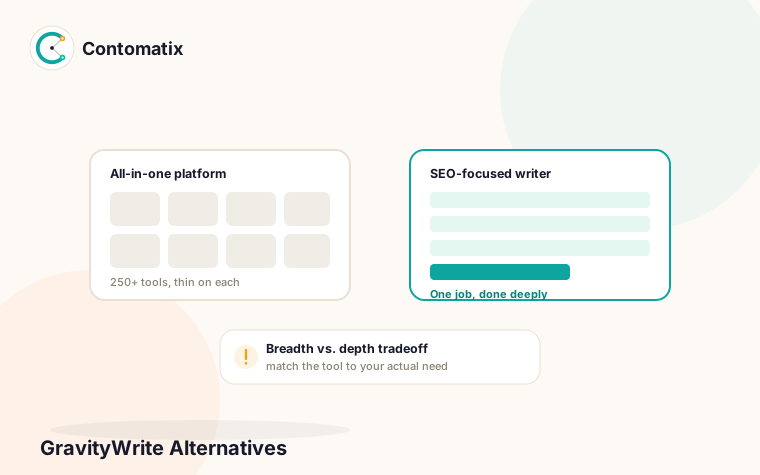
Most searches for GravityWrite alternatives come down to one issue: a tool that promises 250+ features across blogs, video, and social media ends up mastering none of them particularly well, and the actual blog output needs heavy editing before it's publishable. That's a real, common pattern with all-in-one AI content platforms — breadth comes at the cost of depth in any single format.
This guide breaks down what to actually look for in a replacement depending on whether your core problem is output quality, SEO depth, or overall workflow coverage, with real, independently checked 2026 pricing for every tool covered and an honest, direct note about what these tools can and genuinely cannot do for you, regardless of which one you end up choosing.
Why "All-in-One" AI Content Tools Struggle With Blog Quality Specifically
A platform built to generate images, videos, social captions, and blog posts from one unified system is, by design, optimizing for breadth of format coverage rather than depth in any single one of those formats. Long-form SEO blog content has specific requirements — a coherent argument across 2,000+ words, accurate claims, natural keyword placement, a structure that actually answers search intent — that a general-purpose content generator often handles as one feature among 250, rather than as its core competency. If blog content is genuinely your primary and most important need, a tool built specifically around long-form writing and SEO structure will generally out-perform a broader platform that treats blogging as just one module among many others.
How These Alternatives Were Evaluated
Each tool listed here was assessed against four separate criteria: how close the resulting first-draft output actually gets to publishable without a heavy editing pass, real SEO and AI-search (GEO) optimization depth rather than just a surface-level keyword-stuffing pass, how much of the genuine end-to-end workflow it covers (research through final publishing, not drafting alone), and current, independently verified 2026 pricing rather than a stale figure. Tools that only handle the initial drafting step and leave research, on-page optimization, and final publishing entirely to the user scored noticeably lower on overall workflow coverage in this evaluation, even in cases where the raw draft quality itself was genuinely reasonable on its own.
2026 Pricing at a Glance
| Tool | Best for | Starting price/mo |
|---|---|---|
| Frase | Research-first SEO writing, content refreshes | ~$49 |
| Surfer SEO | SEO teams wanting writing + analysis together | ~$119 |
| Scalenut | Template-driven SEO blog structure | ~$59 |
| Jasper | Larger teams needing brand-voice consistency | ~$69/seat |
| Writesonic | Combined SEO + content platform | ~$99 |
| KoalaWriter | Solo creators on a tight budget | ~$9 |
| Machined | Agencies building large content clusters | ~$19 |
Pricing and plan structures change often across this category — confirm current rates directly with each vendor before subscribing.
Research-First and SEO-Depth Tools
Frase leads with SERP-analysis-driven briefs before any drafting happens — it studies what's actually ranking for a target query and builds an outline from that competitive gap, which suits content refreshes and research-heavy topics better than pure speed-drafting.
Surfer SEO pairs a content editor with live on-page optimization scoring against top-ranking competitors, at a materially higher price point, aimed at teams that want writing and technical SEO analysis in one interface rather than switching tools mid-workflow.
Scalenut leans on ready-made content templates and structure, which suits teams that want a faster path from topic to a well-organized draft without building an outline from scratch every time.
Brand Voice and Team-Scale Tools
Jasper is priced per seat and built around maintaining consistent brand voice across multiple writers and channels, which matters more for larger marketing teams than solo operators — the per-seat model makes it comparatively expensive for a single user.
Writesonic combines SEO tooling with broader content generation in one platform, positioned as a single subscription covering more of the content-and-optimization workflow than a pure drafting tool.
Budget and Solo-Creator Options
KoalaWriter is the cheapest option here by a wide margin, aimed squarely at solo creators who need functional long-form drafts without agency-level budget — expect fewer workflow-coverage features at this price than the higher tiers above.
Machined targets SEO agencies producing large content clusters at scale, priced low per seat but designed around bulk topical-cluster production rather than single, highly-polished flagship pieces.
A Note on Tools That Rank Themselves First
Several "alternatives to X" roundups in this space are published by one of the tools being compared, and that tool consistently appears at the top of its own list — without disclosing the conflict. That doesn't automatically make the recommendation wrong, but it does mean the ranking can't be treated as neutral. A genuinely independent comparison should be able to name a tool's real limitations alongside its strengths, including when it isn't the publisher's own product. Worth checking who actually owns any "alternatives" page before treating its #1 pick as an objective conclusion, in this category and any other.
The same discipline applies to backlink and SEO-data tools, not just content platforms — our breakdown of backlink analysis tools covers a parallel version of this same evaluation problem in a different tool category.
How to Choose Based on Your Actual Need
- Publish-ready drafts with minimal editing: prioritize tools with strong SEO-depth scoring (Frase, Surfer SEO) over ones that generate quickly but need heavy rewriting.
- Tight budget, solo operation: KoalaWriter or Machined, both priced well under $20/month.
- Large team needing consistent brand voice: Jasper, despite the higher per-seat cost, since voice consistency across multiple writers is its core design focus.
- Content refreshes and competitive gap analysis: Frase, built specifically around SERP research before drafting.
- Bulk content-cluster production for client sites: Machined, designed around scale rather than single polished pieces.
What No AI Writing Tool Actually Replaces
Worth stating plainly: none of these tools replace real subject-matter expertise, original research, or the editorial judgment to know when a generated claim needs a citation or a fact-check before publishing. The best use of any tool in this category is compressing the mechanical parts of drafting — structure, initial phrasing, basic optimization — so a human can spend more time on the parts that actually require expertise: accuracy, a genuine point of view, and details a generic model has no way to know. Publishing AI output without that human pass is exactly the pattern search engines have gotten better at identifying and discounting.
Google has been explicit that the production method itself isn't the issue — its own spam policies apply "no matter whether content is produced through automation, human efforts, or some combination," and AI-assisted content that's genuinely helpful is treated no differently than any other helpful content. What actually triggers a penalty is scale without editorial oversight: sites that published hundreds or thousands of AI-generated pages with no human review have reportedly seen traffic drops in the 50-80% range following recent quality-focused updates, (per reporting on Google's scaled-content-abuse enforcement), while sites using AI as one step inside a genuine editorial process — where a human still checks facts, adds real expertise, and decides what's worth publishing — showed no such impact. The tool isn't the risk. Skipping the human step is.
Workflow Coverage Matters More Than Feature Count
It's worth returning to the original complaint that sends people looking for GravityWrite alternatives in the first place: a tool with 250 features that masters none of them. The fix isn't necessarily finding a tool with even more features — it's finding one whose core workflow (research, draft, optimize, publish) is actually built around long-form SEO content specifically, rather than treating blogging as one output format among many alongside video, images, and social captions. A narrower tool that does four things well for exactly your specific use case will consistently outperform a broader one that does forty things only adequately, particularly for content meant to genuinely rank and hold a stable position over time rather than simply exist somewhere on the internet.
This same principle — narrow and deep beats broad and shallow for a specific job — shows up across adjacent tool categories too. Our comparison of guest posting versus niche edits covers a parallel tradeoff in link building: a tool or tactic built specifically for one job usually outperforms a generalist approach trying to cover several jobs loosely.
Signs an AI Content Tool's Output Needs More Editing Than Advertised
- Em dashes and connector phrases repeated across every paragraph. A generic AI writing style leans hard on the same handful of transitional patterns, which becomes obvious once you've read more than a few outputs from the same tool back to back.
- Confident claims with no source. A model will state a statistic or fact with full confidence whether or not it's actually verifiable — always fact-check anything that looks like a specific number or study before it goes live on your site.
- Generic, interchangeable openings. If the first two sentences could be swapped into an article about a completely different topic with minimal changes, the hook isn't doing any real work for that specific piece.
- Images that don't quite make sense. AI-generated in-article images sometimes contain garbled text, incorrect labels, or visuals that only loosely relate to the actual content — always review generated images individually rather than assuming they're publish-ready by default.
- Structure that technically covers the topic but says nothing specific. Content that hits every expected subheading without ever making a concrete, checkable claim is optimized for looking complete to a skimming reader, not for being genuinely useful to one who reads closely.
None of this means the underlying tool itself is broken or not worth using — it simply means the draft it produces should be treated as a genuine starting point, not a finished, publish-ready article, no matter which specific platform generated it in the first place.
Frequently Asked Questions
What is the best free alternative to GravityWrite?
Most tools in this category offer a limited free trial rather than a permanent free tier — KoalaWriter and Machined are the lowest-cost paid options if budget is the main constraint, though neither is fully free long-term.
Why does GravityWrite content need heavy editing?
Platforms built to cover many content formats (blogs, video, images, social) at once tend to treat long-form blog writing as one feature among many rather than a core specialty, which often shows up as generic phrasing, structural issues, or content that needs a substantial edit pass before publishing.
Which tool is best for SEO-focused blog content specifically?
Frase and Surfer SEO both build their core workflow around SEO research and on-page optimization scoring, rather than adding it as a secondary feature to a general content generator.
Is Jasper worth it for a solo blogger?
Usually not — Jasper's per-seat pricing and brand-voice-consistency focus are built for teams with multiple writers. A solo creator typically gets better value from a lower-cost, single-user-focused tool.
Can these tools handle GEO (AI-search) optimization?
Several newer tools in this category do include some GEO-style optimization (structuring content for citation inside AI answer engines), though depth varies significantly — check specifically for this feature rather than assuming it's included, since it's a newer addition across the category.
Do I still need a human editor if I use one of these tools?
Yes. None of these tools reliably replace fact-checking, subject-matter accuracy, or editorial judgment — the realistic use case is compressing the mechanical drafting work so a human can focus review time on accuracy and original insight.
What's the difference between Scalenut and Frase?
Scalenut leans on pre-built content templates for faster structure; Frase builds its process around live SERP analysis to inform the outline before drafting. Frase suits competitive gap analysis better; Scalenut suits faster templated output.
Are cheaper tools like KoalaWriter actually usable for professional content?
They can be for straightforward content needs, but typically with less workflow coverage (research, optimization scoring, publishing integrations) than higher-priced options — evaluate based on how much of the surrounding workflow you need automated versus how much you're comfortable doing manually.
How often should I re-evaluate my AI writing tool?
Roughly every 6 to 12 months is generally reasonable, since this category moves quickly — GEO/AI-search features in particular have been added or significantly upgraded across most tools within the past year.
Will switching tools fix inconsistent content quality on its own?
Only partially. A more capable tool reduces the amount of editing needed, but the editorial review step — fact-checking claims, adding real expertise, deciding what's actually worth publishing — still has to happen somewhere in the process regardless of which platform produces the first draft.
Does using an AI writing tool at all put my site at risk with Google?
No. Google's own policies state that the production method — human, AI, or a mix — is not itself the issue. Risk comes from publishing large volumes of low-value content with no editorial oversight, not from using AI assistance as part of a genuine, reviewed content process.
Disclaimer: This article is for informational purposes only. Pricing and features change frequently — verify current details directly with each vendor. This is not a paid or sponsored comparison.
Contomatix pairs AI-assisted drafting with human research, fact-checking, and editorial review on every piece we publish — never AI output shipped unreviewed.
Get a free content strategy review →