Last updated: October 2026
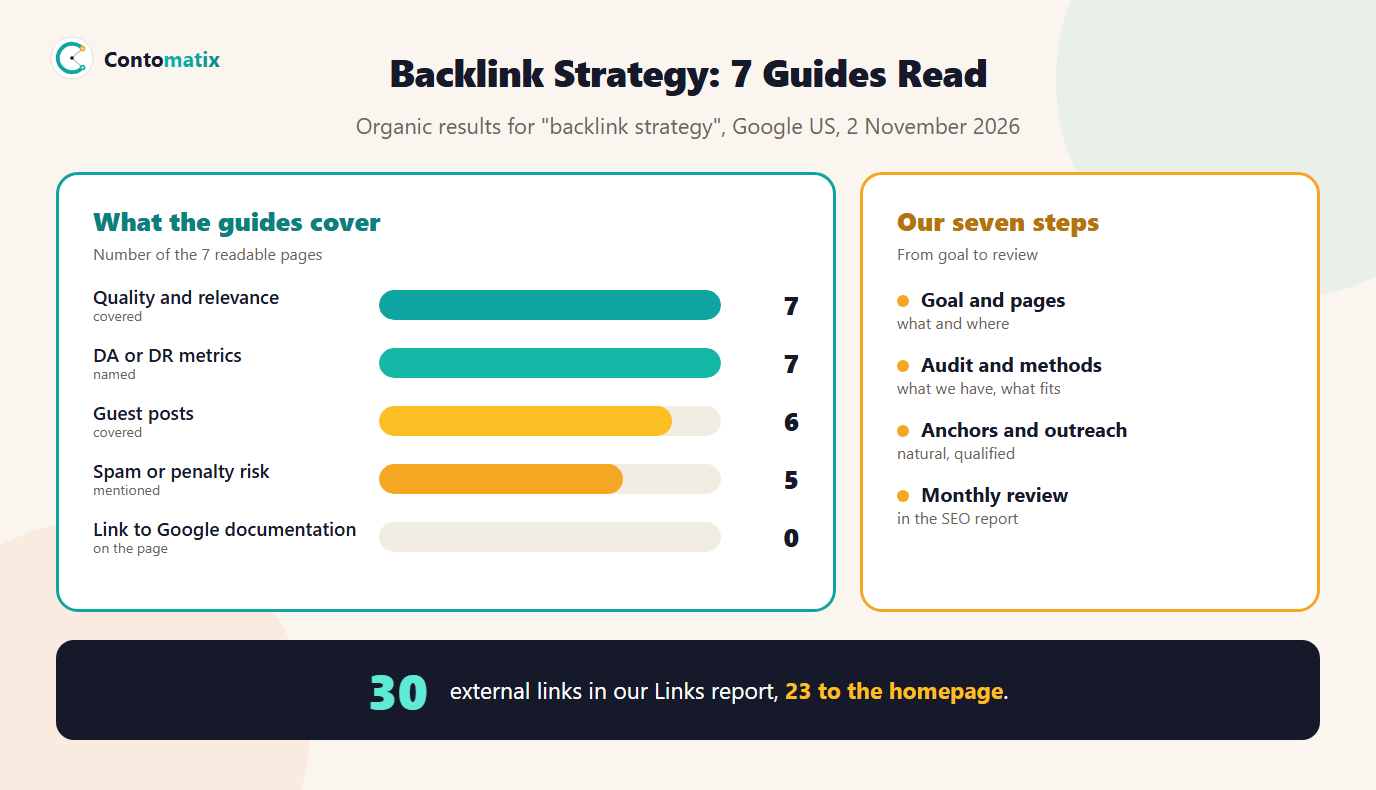
A backlink strategy is a written plan for which pages you want links to, who might link to them and how you will ask, with a way to measure whether it worked. We read 7 pages that rank for "backlink strategy" on 2 November 2026. All 7 talk about quality or relevance and 7 about DA or DR metrics, 6 cover guest posts and 6 cover linkable content, but only 1 gives numbered steps, 1 gives a template and none links to Google's documentation.
This guide gives seven steps and a template, with our own Links report as the test: 30 external links to our site, 23 of them to the homepage. It also covers what Google's rules say about how links may be built. For the outreach side, see our guides to blogger outreach, white hat link building and PR link building.
What Is a Backlink Strategy? (And What It Is Not)
A backlink strategy answers four questions: which pages need links, why those pages, how you will earn links to them and how you will know it worked. It is not a list of sites to get listed on, and it is not a promise of a number of links per month. The best strategies in the guides we read start from the pages and the goal, not from the tactics, but only 4 of 7 mention goals or KPIs.
Backlink Strategy: What 7 Ranking Guides Say
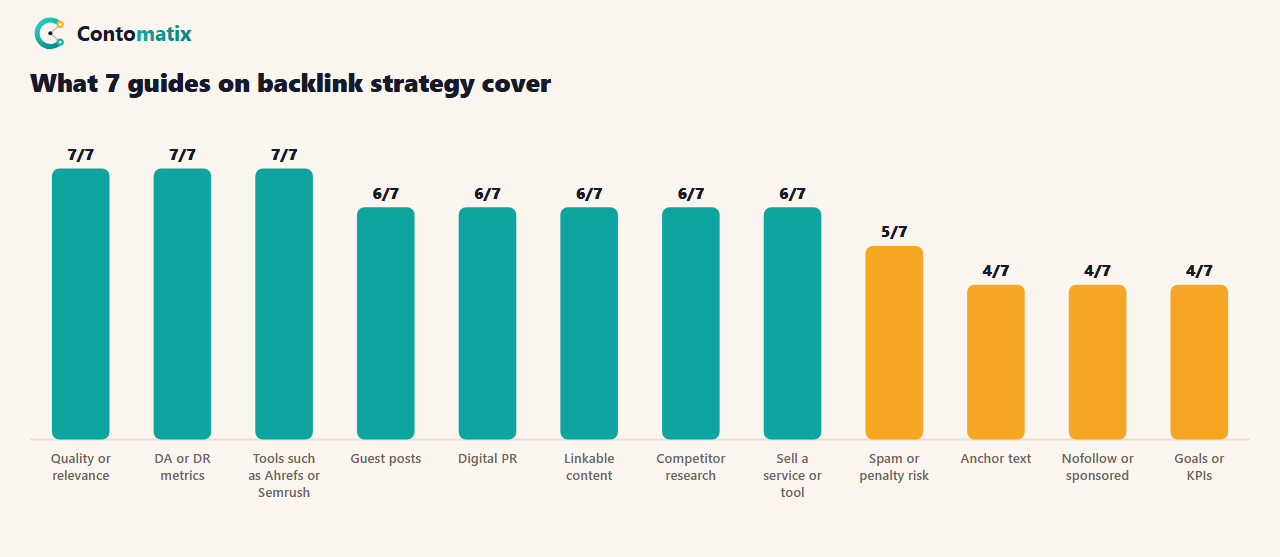
The median guide has about 3,066 words, and 6 of 7 also sell a service. 6 of 7 recommend competitor research, 3 broken link building, 4 discuss anchor text and 4 mention nofollow or sponsored links. 5 touch on spam or penalty risk, but none of them link to Google's documentation, which is where the actual rules are. Only 1 shows a date, and 7 lean on third-party metrics such as DA or DR: useful for comparing sites, but Google does not use them.
Our Starting Point: 30 Links, 23 to the Homepage
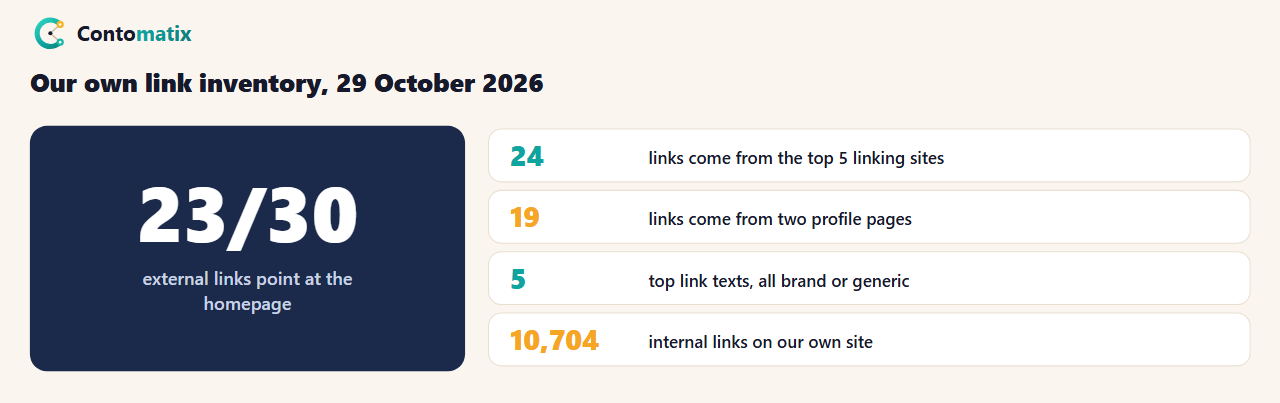
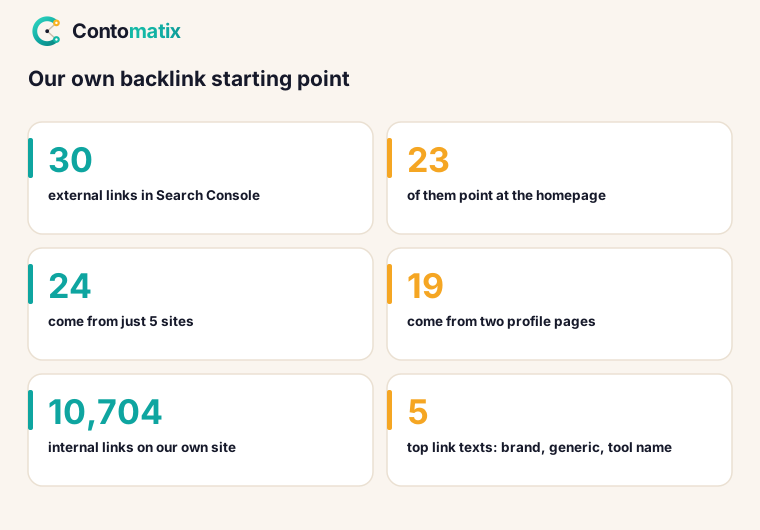
The first step of any strategy is knowing what you have. On 29 October 2026, our Search Console Links report listed 30 external links. 23 (77%) point at the homepage. 24 (80%) come from just five sites, and 19 (63%) come from two profile pages on directories. The most common link texts are "visit website", "contomatix", "llms txt generator", "(empty)" and "contomatix com": brand names, generic words and a tool name. That is a natural-looking set, with no commercial keywords, but it is thin. Our site also has 10,704 internal links, so the structure is there; the outside votes are not.
Step 1: Set a Goal and a Measure
Write one sentence: "Get links to these pages so they rank for these searches, and measure it by this number." The number can be linking sites to the page, impressions at positions 1 to 10, or clicks. Avoid "more backlinks" as a goal: it counts links, not results. Our goal is to move pages that sit far down the results toward page one, and our measure is the position and click data in Search Console, in the monthly report.
Step 2: Audit the Links You Already Have
Open the Links report in Search Console and read three lists: top linked pages, top linking sites and top linking text. Note how many links go to the homepage and how many to inner pages, which sites account for most links, and whether any anchors look forced. Open a few linking pages and check the link is still there and which rel attribute it carries. This is the audit we describe in our guide to checking backlinks of a website.
Step 3: Choose the Pages Worth Linking To
Links help most where a page already has the content to rank. From our own 28 October 2026 export, these are the five non-local pages with the most impressions that sit below position 30:
| Page | Impressions | Average position |
|---|---|---|
| /blog/check-backlinks-of-website | 5,313 | 75.94 |
| /tools/seo-report-generator | 2,092 | 79.92 |
| /blog/ai-tools-for-seo-keyword-research | 1,243 | 63.84 |
| /tools/dofollow-link-checker | 961 | 72.22 |
| /blog/ai-powered-seo-tools | 770 | 65.69 |
Google shows these pages to many searchers, but far down the results. A few relevant links could be worth more here than links to a page nobody sees. Pick five to ten pages like this, not your whole site.
Step 4: Pick Methods That Fit Those Pages
- Linkable assets. 6 of 7 guides recommend content others want to cite, such as original data. Every post of ours includes data from our own site for this reason.
- Digital PR. 6 of 7 cover it: a data story or expert quote pitched to journalists. See our PR link building guide.
- Guest posts and outreach. 6 of 7 cover guest posts. Do them for relevant sites with real readers. See blogger outreach.
- Broken link building. 3 of 7 mention it: find a dead link on a relevant page and offer a replacement.
- Competitor gaps. 6 of 7 suggest finding sites that link to competitors but not to you. Use it as a source of ideas, not a list to copy.
Step 5: Plan Anchor Text and Link Qualification
Keep anchors natural: your brand, the page's name or a descriptive phrase. Google's spam policies define link spam as creating links to or from a site primarily to manipulate search rankings, and give as an example links with optimized anchor text in articles, guest posts or press releases distributed on other sites. They also list excessive link exchanges and buying or selling links for ranking purposes. Google says such links are acceptable when qualified: its page on qualifying outbound links says to mark advertisements and paid placements with the sponsored value, and that nofollow is still acceptable although sponsored is preferred. 4 of 7 ranking guides mention these attributes.
Step 6: Do the Outreach
Choose a short list for each page, write a specific offer for each site and follow up once or twice. The details, including an email template, are in our blogger outreach guide. Track each contact in a sheet with the site, the page you want linked, the date, the reply and the link URL when it goes live.
Step 7: Measure and Review Monthly
Take a baseline before you start and compare monthly: external links, linking sites, links to inner pages, and the impressions, clicks and position of the pages you targeted. Our own baseline is the 30 links above and the position data in our monthly SEO report. Links take time to show an effect, so review after at least a few weeks and avoid judging on a single month. If a page you targeted does not move, look at the page before you build more links to it.
Backlink Strategy Template
| Field | What to write |
|---|---|
| Goal | The searches and the measure |
| Target page | The URL and why it deserves links |
| Link asset | The data, tool or guide others would cite |
| Method | Outreach, digital PR, guest post, broken link |
| Prospects | Sites, with the reason each is relevant |
| Anchor and rel | Planned anchor, and whether the link is paid |
| Status and date | Asked, replied, live, with dates |
| Result | Position and clicks next month |
Use our link prospect scorer to rank prospects, and the backlink monitor to track whether links stay live.
Backlink Strategy Example: How We Would Run It
This is an illustration of how we would apply the steps to our own site, not a result. Goal: lift the five pages in the table above toward page one. Audit: the 30 links above, with 23 on the homepage. Method: pitch the data in each page to relevant sites and offer a replacement for broken links where we find them. Anchors: brand or page name. Measure: the position and clicks of those five pages in each monthly report, compared with the 28 October baseline. We will report what happens in our reports rather than promise it here.
Backlink Strategy for an Ecommerce Site
The steps are the same, but the target pages differ. Category pages and a few product guides usually earn links more easily than individual product pages, so start by asking which pages already earn impressions and could convert. Do not send every link to the home page, and be careful with free products offered in exchange for links: Google lists sending someone a product in exchange for them writing about it and including a link as an example of buying or selling links for ranking purposes, and says such links should be qualified with sponsored or nofollow.
Finding Linkable Assets on Your Own Site
A linkable asset is something another site has a reason to cite. Look through your own pages for three kinds: original numbers, free tools and clear explanations that save a reader time. Our own examples are the data in each post, such as the scans and tests we run on our own pages, and our free tools, like the dofollow link checker, which sits on the list of pages above. When you pitch a page, lead with the asset, not with the request: "we measured this, you might want it for your article on that" is easier to say yes to than "please link to us".
How Many Links Per Month? Why We Do Not Set a Number
Many plans start with a target such as ten links a month. The trouble is that a number of links says nothing about whether the right pages are earning them from the right sites, and a target can push you toward easy, low-value links. We set the target on pages and positions instead: which pages should move, and by when we will review them. If the review shows a page has gained relevant links but has not moved, the next step is to improve the page, not to chase more links.
What to Do With the Links You Earn
- Check each link once it is live: the page loads, the link is in the body and the rel attribute is what you agreed.
- Note it in your sheet, with the date, the page and the anchor.
- Link to the target page from your own pages, so visitors from the new link have somewhere to go.
- Update the target page if it is out of date, since a link to a stale page wastes the visit.
- Thank the person, and keep the relationship: a good contact can lead to the next piece.
Backlink Strategy Consulting: When to Hire Help
Hire help when you have the pages and the goal but not the time to run outreach, or when you want a second opinion on a plan. Before you sign, ask what the first month will produce, which sites the links will come from and whether you can see them before they go live, how paid placements are marked and how results will be reported. These are the same questions we list for blogger outreach agencies. We offer link building ourselves, so judge us by them as well.
A Backlink Strategy Checklist Before You Start
- I have a written goal and a measure.
- I have read my Links report and know where my links point.
- I have chosen five to ten target pages and checked each one is worth linking to.
- I know which method fits each page.
- I know which links might be paid and how I will qualify them.
- I have a baseline in my monthly report to compare against.
Common Backlink Strategy Mistakes
- Starting with tactics instead of pages.
- Sending every link to the homepage, as our own report shows: 23 of 30.
- Chasing DA or DR. They are third-party scores, not Google's.
- Buying links without qualifying them. Google asks for sponsored or nofollow.
- Judging after one month. Review after a few weeks, with a baseline.
Key Takeaways
- A backlink strategy is a plan for which pages need links, how you will earn them and how you will measure the result.
- All 7 ranking guides discuss quality, but only 1 gives a template and none links to Google.
- Our own report shows 30 external links, 23 on the homepage and 19 from two profile pages.
- Choose pages that already have impressions but sit far down the results.
- Keep anchors natural, qualify paid links and review monthly against a baseline.
Frequently Asked Questions
What is a backlink strategy?
A written plan for which pages need links, who might link to them, how you will ask and how you will measure the result.
What is a good backlink strategy?
One that starts from pages and goals, earns relevant links with content others want to cite, keeps anchors natural and is reviewed monthly.
How many backlinks do I need?
There is no fixed number. What matters is that the pages you want to rank have links from relevant sites, and that you measure results.
Should I send all backlinks to my homepage?
No. Send links to the pages you want to rank. In our report, 23 of 30 links point at the homepage, which we want to change.
Are DA and DR important for a backlink strategy?
They help compare sites, but they are third-party scores. Google does not use them.
Is it safe to buy backlinks?
Google lists buying or selling links for ranking purposes as link spam, unless they are qualified with sponsored or nofollow.
What is the best way to get backlinks?
It depends on the page. Guides most often recommend linkable content, digital PR, guest posts and outreach.
How long does a backlink strategy take to work?
Weeks to months. Review monthly against a baseline and avoid judging on one month.
Do you have a backlink strategy template?
Yes. The table above lists the fields: goal, target page, link asset, method, prospects, anchor, status and result.


