Last updated: September 2026
Almost every agency sells local SEO services, and almost none of them will tell you what the work actually is. You get a proposal with words like "citation building" and "GBP optimisation", a monthly retainer, and a dashboard nobody reads.
This guide is the version we wish existed when clients ask us what they are paying for: what the work covers, what Google itself says decides local rankings, what a fair price looks like in 2026, and the three numbers that tell you whether it is working.
What Local SEO Services Actually Cover
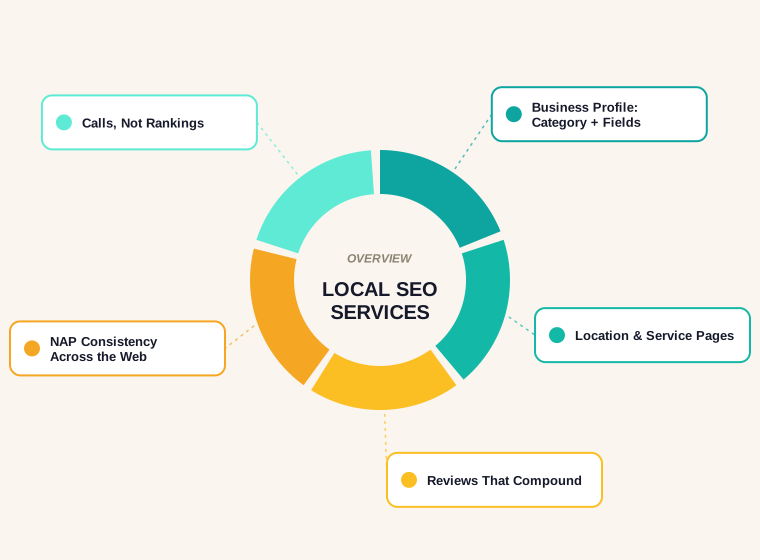
Strip away the jargon and a local engagement is five workstreams.
- The Business Profile. Categories, services, hours, attributes, photos, products, and the posts and Q&A that sit on the profile. This is the single asset that decides map results.
- The website. Location and service pages that actually say where you work, internal links between them, LocalBusiness schema, and page speed on a phone.
- Reviews. A repeatable way to ask, a habit of replying, and a process for the bad ones. Not buying them, ever.
- Consistency across the web. Name, address and phone number matching everywhere they appear, starting with the directories your customers actually use.
- Measurement. Calls, direction requests, form fills and booked jobs, separated by location, not a ranking screenshot.
If a proposal does not name all five, ask which one is missing and why. Most thin retainers quietly drop the website work, which is the part that takes actual time.
What Google Says Decides Local Rankings
You do not have to guess at this. Google publishes it.
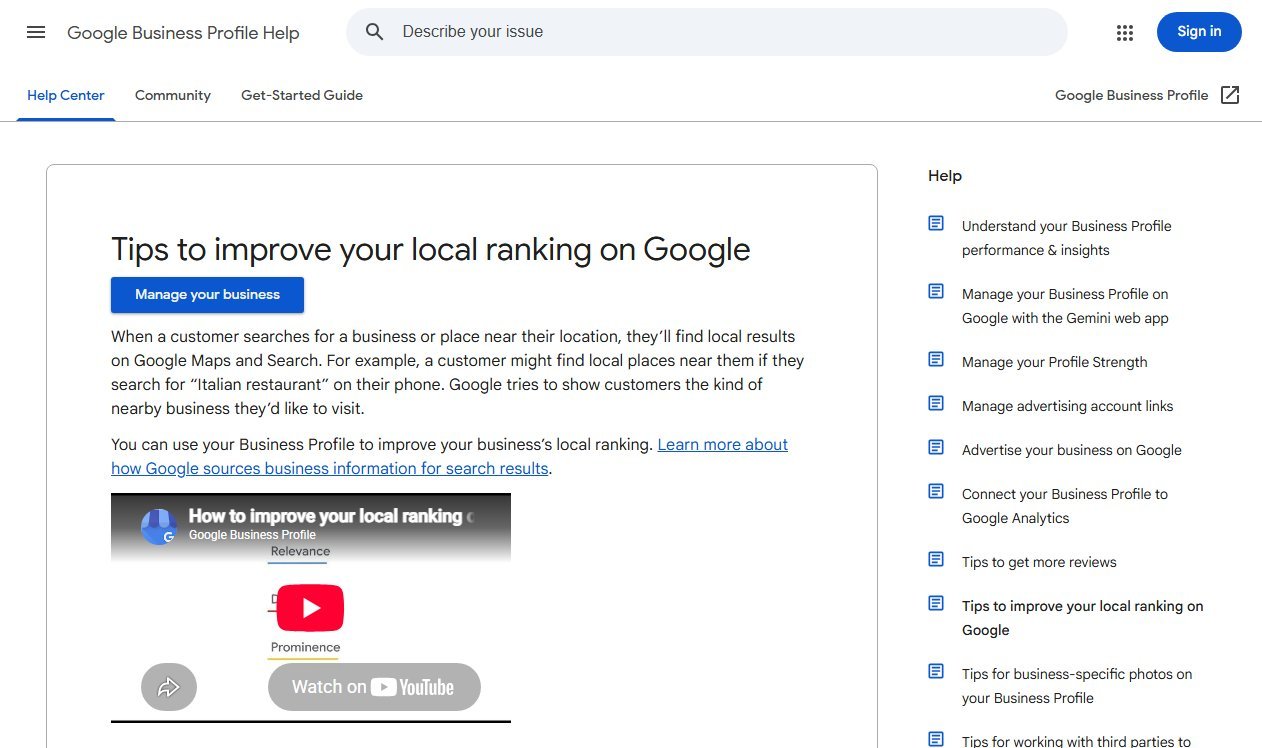
Google's page on improving your local ranking states that local results are based mainly on relevance, distance and prominence.
- Relevance is how well your profile matches what someone searched. Your primary category and the services listed on the profile do most of this work.
- Distance is how far you are from the searcher. You cannot change it, which is why a service-area business needs pages and profiles that make its actual coverage obvious.
- Prominence is how well known the business is, and Google explicitly mentions links to your business and the number of reviews you have.
The same page lists the actions Google recommends: verify the business, complete every field, keep hours accurate including special hours, respond to reviews, add photos and videos, and add products where the category supports it. It also says plainly that there is no way to request or pay for a better local ranking.
That last sentence is the one to keep in mind when someone offers you a guaranteed map pack position.
The Map Pack Is the Product
For a local business, the three results Google shows on a map are worth more than a page of blue links. Here is what the competition looks like for a single query in one American city.
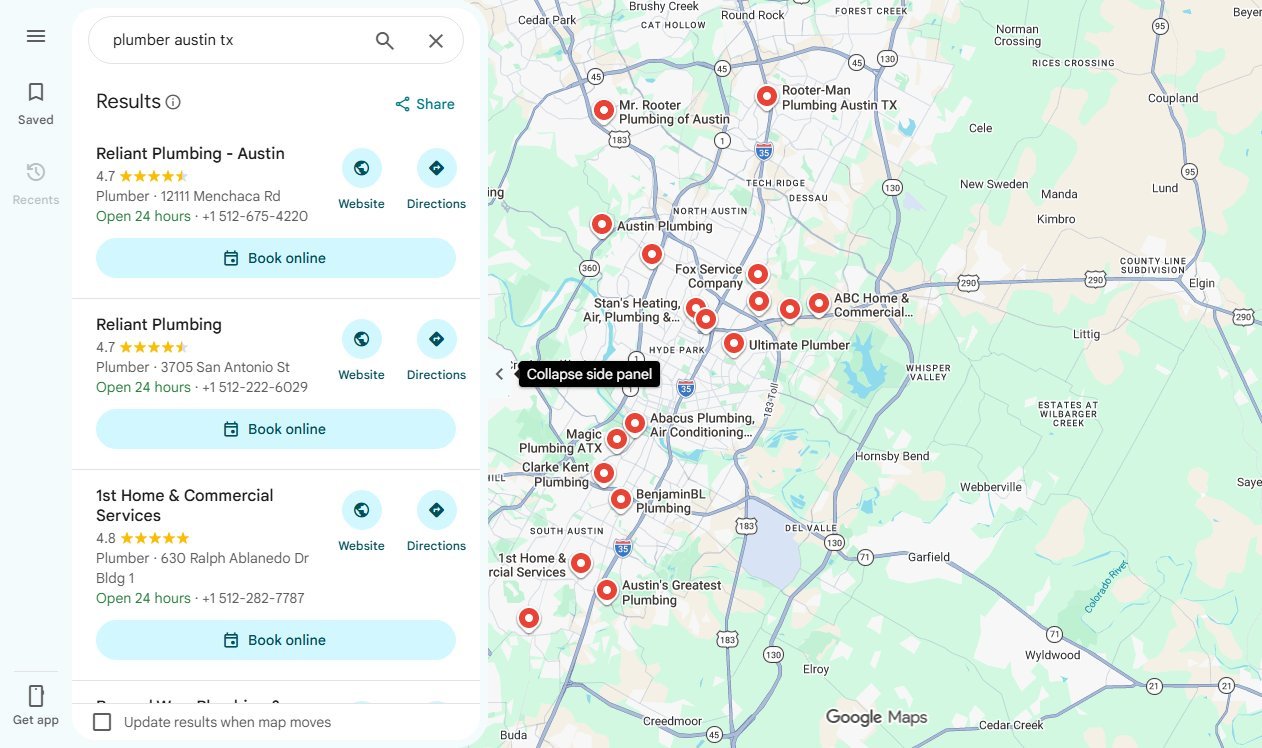
Look at what a searcher can compare without visiting a single website: star rating, number of reviews, whether you are open now, how far away you are, and whether you can be booked in one tap. Three of those five are fields on your profile, and one is a review programme.
This is why good local SEO services spend more time on the profile than on the website. The profile is the shop window; the website is the back office.
A Realistic 90-Day Scope of Work
Serious local work has a shape. If an agency cannot tell you what happens in month one versus month three, they are selling hours rather than a plan.
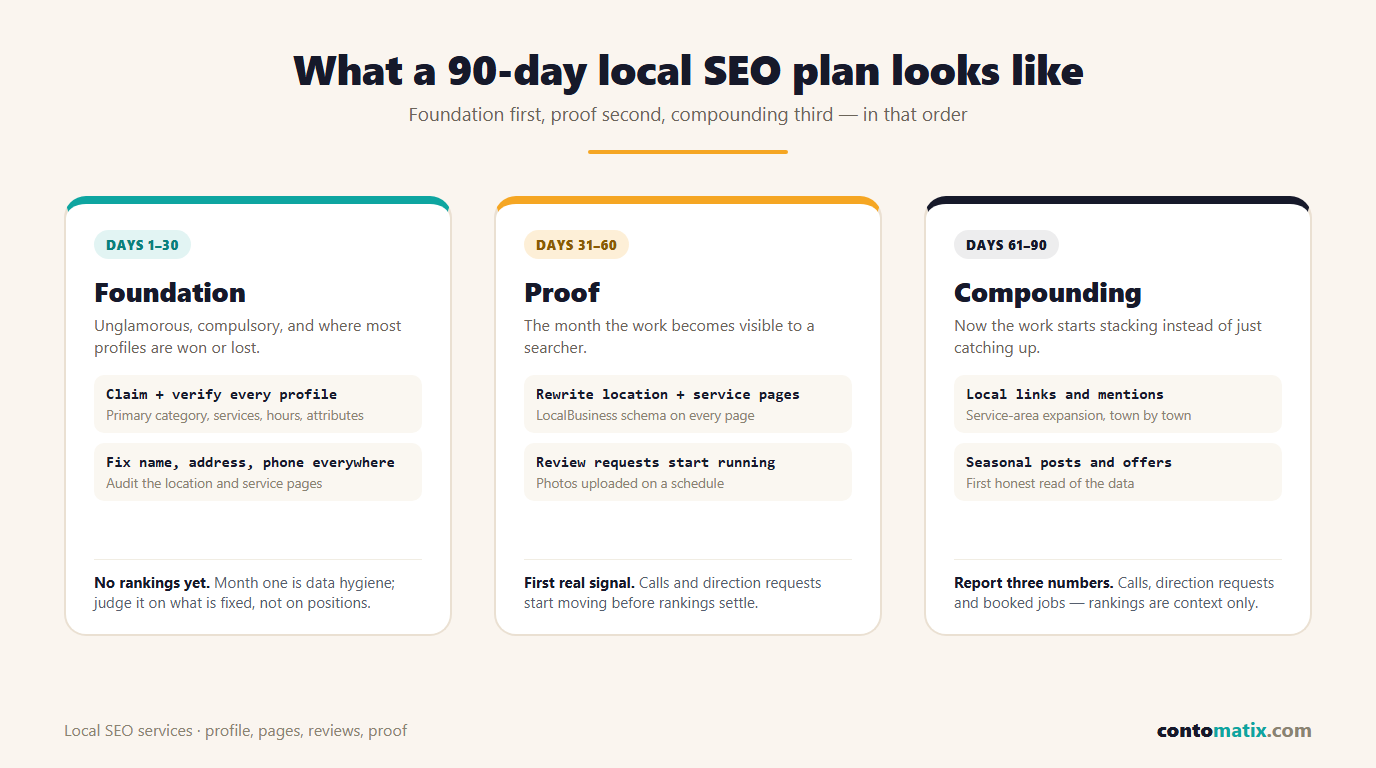
Days 1 to 30 are foundation work. Claim and verify every profile, fix the category, fill every field, correct the hours, standardise the name, address and phone, and audit the website's location pages. Nothing here is exciting and all of it is compulsory.
Days 31 to 60 are proof work. Location and service pages get rewritten so they answer the question a local searcher actually has, schema goes on, the review request process starts running, and photos go up on a schedule rather than in one dump.
Days 61 to 90 are compounding work. Local links and mentions, service-area expansion, seasonal posts, and the first honest read of the data: which pages earned calls and which did not.
Anyone promising map pack dominance inside thirty days is describing a foundation month and hoping you do not notice.
What Local SEO Services Cost in 2026
Prices vary by market and by how much of the work is yours to do. These are the bands we see most often for retained work in the US and UK.
| Type of business | Typical monthly range | What that usually buys |
|---|---|---|
| Single location, low competition | $400 – $900 | Profile management, review programme, light page work |
| Single location, competitive city | $900 – $2,000 | All of the above plus content, links and conversion work |
| Service-area business, several towns | $1,500 – $3,500 | Multiple service-area pages, per-town tracking, links |
| Multi-location (5+ sites) | $2,500 – $8,000+ | Profile governance at scale, location page templates, reporting |
| One-off setup or rescue project | $1,000 – $4,000 once | Fixing a suspended or duplicated profile, rebuilding pages |
Two things are worth saying plainly. A retainer under a few hundred dollars a month buys someone logging in, not a strategy. And a large retainer is only justified if the work list grows with it, which is why the scope matters more than the number.
If you are weighing up proposals right now, our guide to vetting a local SEO company has the questions that separate the two.
How to Tell Whether It Is Working
Three numbers, reported monthly, against the same month last year where the business is seasonal.
- Calls and direction requests from the profile. These are the actions a local searcher takes. They live in the profile's own performance data, and they are the closest thing to a sale you can measure for free.
- Organic clicks to your location and service pages. Not sitewide traffic. If the pages built for a town are not gaining clicks, the work has not reached them.
- Booked jobs, by source. The only number the owner cares about. Ask your team to record it even roughly; a tally on a whiteboard beats a dashboard nobody trusts.
Rankings belong in the report as context, not as the headline. Local positions change with the searcher's distance, so two people on the same street can see different results.
Multi-Location and Service-Area Businesses
These two cases break most templates, and they are where retainers are usually mispriced.
Multi-location businesses need governance more than creativity: one owner account, consistent categories, a page per location that is genuinely different from the others, and a way to stop branch managers editing hours at random. The work scales with the number of profiles, not with the number of keywords.
Service-area businesses, such as trades, cleaners and mobile services, have no storefront to rank. Their leverage is coverage clarity: a profile with the right service areas, pages for the towns they truly serve, and reviews that mention those places naturally. Building thin pages for fifty towns you have never worked in is the fastest way to look like spam.
Structured data helps in both cases. Our free schema markup generator will produce LocalBusiness markup for a location page in about a minute.
What Is Not Local SEO
- Paid ads. Useful, often necessary, but a separate budget and a separate skill. It should never be inside a local SEO line item without being named.
- Posting on social media. It may support the brand. It does not move map rankings.
- Buying citations by the hundred. A handful of directories your customers use is worth more than 300 listings nobody visits.
- Review gating. Asking only the happy customers for reviews breaches platform policies, and the prohibited and restricted content rules cover incentivised reviews too, so a discount in exchange for five stars is also out.
- Keyword-stuffed business names. Adding "Best Plumber Austin" to your name violates Google's representation guidelines and gets profiles suspended.
Every one of those appears in real proposals. Two of them can cost you the profile.
Red Flags in a Local SEO Proposal
- A guaranteed position. Google says outright that ranking cannot be bought or requested.
- No access to your own assets. The profile and website must be owned by you, not by the agency.
- Reporting that starts and ends with rankings. Ask for calls, direction requests and form fills.
- A fixed package with no discovery. A dentist in a saturated city and a roofer covering four counties do not need the same work.
- Vague deliverables. "Ongoing optimisation" is not a deliverable. "Twelve location pages rewritten, schema added, review flow installed" is.
- Silence about the website. If nobody has asked who edits your site, nobody plans to edit it.
For a wider comparison of providers and what separates them, see our rundown of local SEO companies in the USA.
DIY or Hire: Where the Line Sits
A single-location owner with a few hours a month can do most of the foundation work themselves. Verifying the profile, fixing categories and hours, uploading photos and asking every happy customer for a review costs nothing but attention, and it is the majority of the early gain.
Hiring makes sense when one of three things is true: you have more than one location, you are competing in a city where the top three results all have hundreds of reviews, or the website work needs someone who can actually edit the website. That last one stops more local projects than competition ever does.
Whichever route you take, do the profile first. Everything else compounds on top of it.
Quick Recap
- Local SEO services cover five things: the profile, the website, reviews, consistency and measurement.
- Google says local results rest on relevance, distance and prominence, and that rankings cannot be bought.
- The map pack is the product; the profile is where most of the visible decision happens.
- Expect foundation work in month one and movement in months two and three, not a transformed map pack in thirty days.
- Typical retainers run from a few hundred dollars for a simple single location to several thousand for multi-location work.
- Judge the work on calls, direction requests and booked jobs, with rankings as context.
- Walk away from guaranteed positions, keyword-stuffed business names and review gating.
Frequently Asked Questions
What are local SEO services?
They are the ongoing work of getting a business found in map and local results: managing the Google Business Profile, building location and service pages on the website, running a review programme, keeping business details consistent across the web, and reporting on calls and enquiries.
How much do local SEO services cost?
Most single-location retainers sit between a few hundred and two thousand dollars a month depending on competition, while multi-location programmes run higher because the work scales with the number of profiles. One-off rescue projects are usually priced as a fixed fee.
How long does local SEO take to work?
Profile fixes such as categories, hours and photos can show up within weeks. Page work, reviews and links usually need two to three months before the pattern is clear, and competitive cities take longer.
What actually decides local rankings?
Google states that local results are based mainly on relevance, distance and prominence. Your category and profile content drive relevance, distance is fixed by geography, and prominence is influenced by reviews and links.
Can anyone guarantee a top map pack position?
No. Google's own documentation says there is no way to request or pay for a better local ranking, so a guarantee is either a misunderstanding or a sales tactic.
Do I need a website for local SEO?
You can rank a profile without one, but you will lose ground to competitors whose pages answer the searcher's question. A small site with one clear page per service and per location is enough to compete in most markets.
How many reviews do I need?
There is no threshold. What matters is being in the same range as the businesses currently ranking for your query, and continuing to collect reviews steadily rather than in bursts.
Are citations still worth paying for?
A small number of accurate listings on sites your customers use is worth having. Bulk citation packages that place you on hundreds of directories add little and are hard to correct later.
What is the difference between local SEO and regular SEO?
Local SEO optimises for results tied to a place, which means the Business Profile, maps and location pages. Regular SEO targets national or global queries where distance plays no part.
Can I do local SEO myself?
Yes, especially for a single location. Verify the profile, choose the right primary category, complete every field, keep hours accurate, add photos regularly and ask for reviews. Hire help when you add locations, face a competitive city, or need website changes you cannot make yourself.
How do I report local SEO results to an owner?
Three lines: calls and direction requests from the profile, organic clicks to location and service pages, and booked jobs by source. Keep the same three every month so the trend is readable.