Last updated: September 2026
Moses Lake, Washington is a Large Town by population classification, but it doesn't behave like one competitively. With roughly 37,774 residents and over 3,492 active businesses in professional services, construction, and entertainment alone, the local market has a genuinely competitive density most small cities don't. For a Moses Lake business, search engine optimization isn't a nice-to-have marketing line item — it's the difference between showing up when someone searches for a local service and losing that call to a competitor a few positions higher in the map pack.
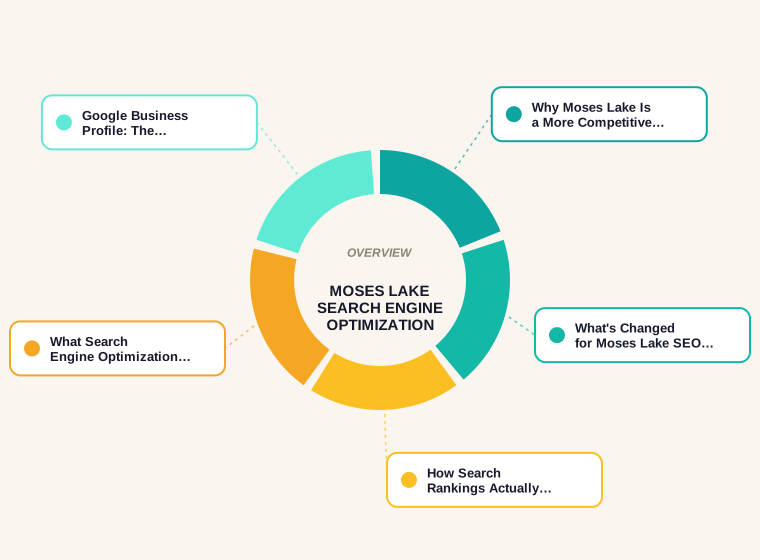
This guide covers what search engine optimization in Moses Lake actually involves in 2026, why this specific market rewards a locally-tailored approach over a generic small-city SEO template, and the concrete steps that move a business up the rankings and into real, booked business.
Why Moses Lake Is a More Competitive Market Than It Looks
The Moses Lake Chamber of Commerce exists specifically to "create and maintain a prosperous local economy, community and quality lifestyle" — and it backs that mission with real infrastructure, including the Catalyst Center, a business incubator that opened just over a year ago and already houses tenants ranging from an art gallery to a spin studio to an established copier and print business. That kind of active small-business support system signals a market where new competitors are launching regularly, not a sleepy town with a fixed, unchanging set of local businesses.
With over 3,492 businesses already active across professional services, builders and contractors, and entertainment agencies, the practical result is that a Moses Lake business competing purely on price or word-of-mouth referral is competing against a growing number of newer, more digitally-savvy entrants. Search engine optimization is one of the few channels where an established local business can defend its position against exactly that kind of new competition.
There's also a density effect worth naming directly. In a large metro area, a mediocre SEO setup can still generate some traffic simply because total search volume is enormous. In a market the size of Moses Lake, search volume for any given service is much smaller, which means the businesses ranking in the top three map-pack results capture a disproportionate share of the calls — and everyone else gets close to nothing. Being "pretty good" at search engine optimization in a market this size isn't good enough; the gap between position one and position five in the map pack is the gap between a full schedule and an empty one.
What's Changed for Moses Lake SEO in 2026
The mechanics of search engine optimization for Moses Lake businesses haven't changed at their core, but two things are worth naming directly for anyone evaluating a Moses Lake SEO company or planning their own approach this year.
First, AI-generated answers are now a real part of how local searches get resolved, not just a Google feature for national queries. A searcher typing "best [service] in Moses Lake" increasingly sees a synthesized answer above the traditional map pack, and the businesses that get named in that answer tend to be the ones with the clearest, most specific online information — not necessarily the ones with the most reviews. We've covered how to structure content for that shift in our guide to answer engine optimization, and the same principles apply at the local level.
Second, the gap between a well-optimized Moses Lake SEO setup and a neglected one has widened, not narrowed. As more of the roughly 3,492 active local businesses invest in at least basic Google Business Profile maintenance, a genuinely abandoned profile now stands out more, not less — which cuts both ways depending on which side of that gap a given business is on.
How Search Rankings Actually Work for a Local Business
For any Moses Lake business targeting local customers, search visibility comes down to three factors Google actually weighs: relevance (does the business match what was searched), distance (how close is it to the searcher), and prominence (how well-known and well-reviewed it is, online and off). Almost everything in an effective local SEO strategy is really about deliberately improving those three inputs, rather than chasing disconnected tactics.
Relevance is mostly about accurate categorization and content that actually matches search intent. Distance is largely fixed by the business's real location, though incorrect service-area settings are a surprisingly common self-inflicted problem. Prominence is the slowest to build and the easiest to let slide — it accumulates through reviews, citations, local links, and consistent visibility over time, not a single campaign.

What Search Engine Optimization Actually Involves
- Google Business Profile optimization — accurate categories, service areas, and regularly updated photos and posts, not a profile set up once and forgotten
- Consistent NAP data (Name, Address, Phone) across the website, directories, and any local listings — inconsistency here quietly undermines otherwise solid work
- Locally-relevant keyword research — targeting how people actually search in and around Moses Lake, not just generic "[service] + Moses Lake" combinations
- Proper on-page SEO — clean site structure, schema markup, and content genuinely built around local search intent
- A real review pipeline — steady, ongoing reviews rather than a single push that goes stale
Google Business Profile: The Highest-Leverage Fix
For most Moses Lake businesses, the fastest realistic improvement is a properly maintained Google Business Profile. That means the correct primary category rather than the broadest one available, accurate service-area settings for businesses that travel to customers, real and recent photos rather than a handful uploaded once at setup, and prompt responses to every review — not only the negative ones.
A few specific, often-skipped elements are worth checking directly: whether secondary categories are filled in, whether the "services" section is populated with actual offerings rather than left blank, and whether Google Posts are used at all. Most local competitors ignore Google Posts entirely, which makes them a comparatively easy way to stand out — a biweekly post about a promotion, a completed project, or a community event keeps a profile looking active rather than abandoned.
Photos deserve more attention than they typically get, too. Profiles with a steady stream of real, recent photos of the actual location, staff, and completed work measurably outperform profiles with a handful of stock-like images uploaded once at setup and never touched again. A genuine photo of a real jobsite or storefront reads as more trustworthy to a local searcher than a generic stock interior that could be anywhere in the country.
Local Citations and Getting the Basics Right
Every directory listing, local mention, and Chamber of Commerce page should list the exact same business name, address, and phone number. This sounds like a minor detail until an actual citation audit turns up three different phone number formats and two address variations across a dozen listings — which happens more often than most owners assume, and which measurably confuses the location-matching signals Google relies on for local rankings.
Being listed with the Moses Lake Chamber of Commerce and relevant industry directories does double duty: it's a legitimate citation source, and it's a genuine local relationship that can generate real referrals independent of search rankings entirely.
It's worth doing a full citation audit at least once, even for an established business: search the business name across the major directories, note every variation of the name, address, and phone number that turns up, and correct or remove anything inconsistent. Old listings tied to a previous address or a discontinued phone number are more common than owners expect, especially for businesses that have relocated within the area or changed numbers at some point.
Building a Real Review Pipeline
Reviews function as both a ranking signal and the biggest single factor in whether a searcher actually calls once they've found a business. The common mistake isn't neglecting reviews entirely — it's treating review requests as an occasional afterthought rather than a built-in step after every completed job.
A workable system asks for a review at the moment customer satisfaction is highest — right after a job is completed, not days later in a generic follow-up that gets ignored — with a direct link to the review form rather than a vague request. Responding to every review, positive and negative, within a reasonable window also matters: a thoughtful response to a negative review often builds more trust with future customers reading it than a long string of five-star reviews with no owner engagement at all.
Consistency beats volume here. A business generating two or three genuine reviews every month builds a stronger long-term signal than one that gets twenty in an initial push and then goes quiet for a year.
Handling negative reviews well matters more in a market this size than owners often expect. In a smaller, tighter-knit business community like Moses Lake, a poorly handled public dispute in a review response tends to circulate faster than it would in a larger city — word travels through the same Chamber of Commerce networks and community channels that make local SEO valuable in the first place. A calm, professional response that acknowledges the issue and offers a real resolution path does more for long-term reputation than deleting, ignoring, or arguing with a negative review ever will.
Content That Matches How Moses Lake Searchers Actually Search
Generic "[service] in Moses Lake, WA" landing pages consistently underperform content that reflects real local specificity — actual neighborhoods, proximity to the lake itself, or seasonal patterns tied to the area's agricultural and recreational economy. This is where proper keyword research earns its cost: finding the specific, lower-competition phrases real local searchers use instead of guessing at generic city-plus-service combinations.
Businesses serving Moses Lake alongside nearby communities should build genuinely distinct pages for each area rather than one templated page with the city name swapped in and out. Google's algorithms are good at detecting thin, duplicated location pages, and a handful of properly differentiated pages will consistently outperform a dozen near-identical ones.
Blog-style content also earns its place here beyond direct ranking value. Answering real local questions — seasonal demand patterns tied to the area's agricultural calendar, considerations specific to the lake and surrounding recreation areas, or practical guidance relevant to local homeowners and businesses — builds the kind of topical depth that supports E-E-A-T signals and gives a business more entry points for organic traffic beyond its core service pages alone.
Measuring Whether It's Actually Working
Map-pack position for a single keyword is an incomplete picture on its own. A more reliable set of metrics includes Google Business Profile insights (views, search queries, and the ratio of calls to direction requests), organic traffic to location-specific pages, the trend in review count and average rating, and — most importantly — actual booked jobs that can be traced back to a local search or map listing. Rankings that never show up in one of these downstream metrics aren't delivering real value, regardless of how they look in a rank tracker.
It's also worth tracking these numbers over a consistent time window rather than checking sporadically. A single month of data is easily skewed by a seasonal dip, a competitor's temporary ad campaign, or even a Google algorithm update unrelated to anything the business did. Reviewing the same core metrics monthly, over a rolling six-month window, gives a far more honest picture of whether search engine optimization work is actually compounding or merely holding steady.
DIY vs. Hiring It Out
A Moses Lake business owner with the time can realistically handle the basics — claiming and completing a Google Business Profile, fixing obvious citation inconsistencies, and asking happy customers for reviews. Where DIY efforts typically stall is the ongoing, never-finished nature of the work: maintaining rankings requires more or less continuous attention to citations, content, and reviews, not a one-time setup.
For an owner already running the actual business, that ongoing maintenance is usually where SEO gets deprioritized — right up until a competitor visibly overtakes them in the map pack. That's typically the point where bringing in dedicated help, even on a modest and clearly defined scope, pays for itself against the cost of continuing to lose calls to a better-optimized competitor.
A reasonable middle path also exists between fully DIY and fully outsourced: handling the Google Business Profile and reviews in-house, since those benefit from an owner's direct, authentic voice, while bringing in outside help specifically for the more technical and time-intensive work — keyword research, on-page structure, and ongoing content. That split lets a business capture the parts of local SEO that are genuinely better done by the people who know the business best, without losing momentum on the parts that require dedicated, continuous attention.
Common Search Engine Optimization Mistakes in Moses Lake
- Underestimating local competition because the town's overall population looks small, while ignoring that thousands of active local businesses are already competing for the same searches
- Inconsistent NAP data across directories, quietly undermining otherwise solid on-page work
- An abandoned Google Business Profile — set up once, never updated with current photos, hours, or posts
- No link building from genuinely local sources — chamber listings, local news, and community organizations carry more local-relevance weight than generic national directories
- Ignoring reviews until a bad one shows up, instead of building a steady, ongoing pipeline
Choosing a Moses Lake SEO Company
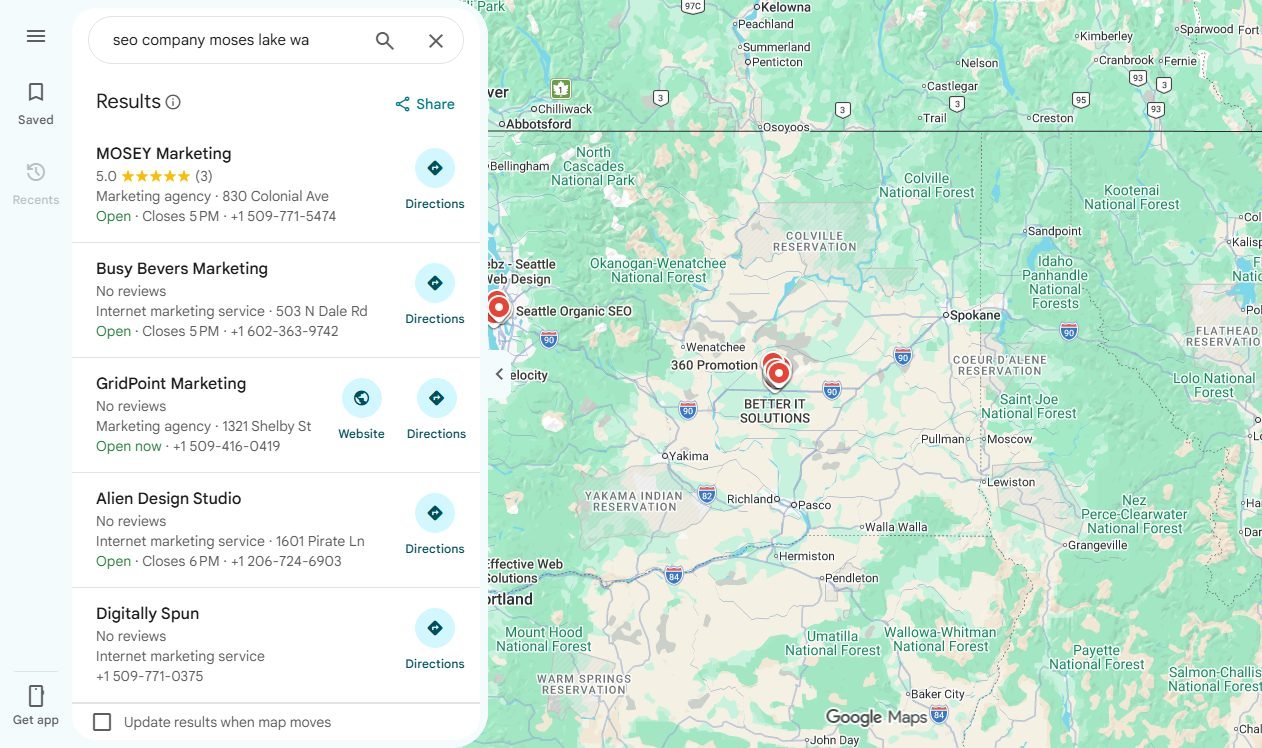
If you decide to hire help, the local field is small. The Maps search above shows only a few marketing businesses with a Moses Lake address, and several more that serve the town from Seattle, Spokane or further away. Neither is automatically better, but you should know which one you are talking to.
Before you sign with any SEO company for a Moses Lake business, check four things:
- Where they are based. A real local address and phone number, not just a "Moses Lake SEO" landing page.
- What they would fix first. Ask for a 90-day plan that starts with your Google Business Profile, citations and reviews, the same order this guide follows.
- Who owns the accounts. Your Business Profile, Search Console and analytics should stay in your name.
- How they report. Calls, form fills and direction requests matter more than a list of keyword positions.
We checked the local options by hand in our list of verified digital marketing agencies in Moses Lake, which covers who has a genuine local office and what each one offers.
Is Search Engine Optimization Worth It for a Moses Lake Business?
Given a local economy actively supporting new business formation through resources like the Catalyst Center, the businesses that invest in proper search engine optimization build a real, compounding advantage over competitors who don't. SEO is also considerably cheaper per lead than paid ads once it's established, since rankings keep generating calls without an ongoing per-click cost.
The comparison to paid ads is worth spelling out directly. A Google Ads campaign can generate calls immediately, but the moment the budget stops, so does the traffic — nothing carries over. A well-built organic position keeps generating calls for months or years with only ongoing maintenance cost, not continuous per-click spend. That doesn't make paid ads a bad idea — many Moses Lake businesses run both, using ads for immediate volume while SEO compounds in the background — but treating SEO as optional because ads produce faster initial results misses that the two solve different problems on different timelines.
Conclusion
Search engine optimization in Moses Lake isn't about generic small-town tactics — it's about recognizing a genuinely active, growing local business community and building the fundamentals that actually compound over time: a properly maintained Google Business Profile, consistent citations, locally-specific content, and a real review pipeline. Businesses that get this right consistently outperform competitors treating Moses Lake as a sleepy market with nothing to compete against.
The same dynamic shows up in other Washington markets we've covered — see our guides to search engine optimization in Yakima and Bellingham for how it plays out in an agricultural hub and a college-town-plus-tourism market respectively. If hiring is on your mind alongside marketing, our roundup of top recruiting companies in Moses Lake, WA covers the local staffing landscape. We also have honest roundups of the top digital marketing agencies and top graphic design companies in Moses Lake.
Related Reading
- For a Seattle-metro market facing the opposite problem, see our guide to Renton search engine optimization.
How much does search engine optimization cost for a small business in Moses Lake?
Costs vary by scope, but most SEO work is priced as an ongoing monthly retainer rather than a one-off project, since maintaining rankings requires continuous citation, content, and review management.
How long does SEO take to show results in a market like Moses Lake?
Google Business Profile improvements can shift map-pack visibility within a few weeks. Broader keyword rankings across a full service area typically take a few months of consistent work to build out.
Is Google Business Profile or a website more important for local rankings?
Both matter, but for "near me" searches, Google Business Profile signals often carry the most immediate weight. A strong website still matters for content depth, trust, and converting traffic once someone clicks through.
How many local businesses are actually competing in Moses Lake?
Over 3,492 active businesses are reported across the area, with professional services, builders and contractors, and entertainment agencies among the largest categories — a genuinely competitive base for a town this size.
Do online reviews really affect local rankings?
Yes — review count, recency, and response rate all factor into local ranking signals, alongside their obvious effect on whether a searcher actually chooses to call.
Can a Moses Lake business handle SEO without hiring an agency?
Yes, especially the basics like claiming a Google Business Profile and fixing citation inconsistencies. The challenge is usually sustaining the ongoing work — reviews, content, and competitive monitoring — alongside running the actual business.
Which is the best SEO company in Moses Lake?
There is no single "best" Moses Lake SEO company, and any list that names one without showing how it checked is selling placement. Use the checks in this guide — a real local address, a written explanation of how links and content are earned, and access to your own Google Business Profile and Analytics — and shortlist two or three Moses Lake or Grant County providers against them. Most of the value in a market this size comes from Google Business Profile and citation work, which a smaller local provider can do well.
Contomatix helps Moses Lake businesses build the Google Business Profile, citation, and content foundation that actually drives calls — not just rankings for their own sake. Want a free SEO audit for your business?
Get a free audit →