Yakima, Washington is the largest city in the Yakima Valley and the seat of Yakima County, with a 2026 population of roughly 97,500 and a local economy that looks nothing like the stereotype of a small agricultural town. Agriculture, forestry, fishing, and hunting is genuinely the single largest employment sector here — the Yakima Valley grows around three-quarters of the country's hops and a large share of its apples — but healthcare and social assistance employs nearly as many people, and retail trade isn't far behind. For a Yakima business, search engine optimization means competing across all of those categories at once: growers and ag-service companies, medical and dental practices, and a fast-growing wine tourism trade built around the Yakima Valley AVA, Washington's first officially recognized wine region.
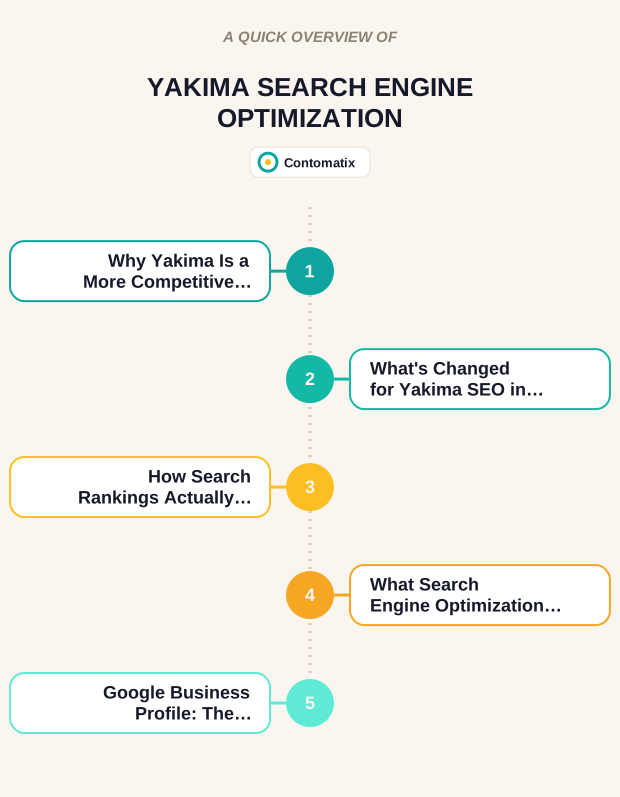
Why Yakima Is a More Competitive Market Than It Looks
A city of this size sitting at the junction of I-82 and Highway 12 draws searches from well beyond its own city limits — from the smaller towns throughout the valley, from wine-country day-trippers, and from the broader Yakima County population that treats the city as its commercial center. That pulls in more competing businesses per category than the population alone would suggest, especially in healthcare, home services, and anything tourism-adjacent like tasting rooms, restaurants, and lodging. Ranking well in Yakima means competing against businesses that draw customers from a genuinely regional catchment area, not just the city proper.
What's Changed for Yakima SEO in 2026
The fundamentals of search engine optimization in Yakima haven't changed, but AI-generated answers are now a real factor in how local searches resolve. A search for "best [service] near Yakima" increasingly surfaces a synthesized answer before the map pack, and the businesses that get named there tend to be the ones with the clearest, most specific information online — service pages, business descriptions, and reviews that state exactly what they do and where. We've covered how to structure content for that shift in our guide to answer engine optimization, and it applies just as directly at the local level as it does nationally.
The second shift is more mundane but just as real: as more Yakima Valley businesses invest in basic Google Business Profile upkeep to capture wine-tourism traffic, a profile that hasn't been touched in years now stands out for the wrong reasons. The gap between a maintained listing and a neglected one has gotten wider, not narrower.
How Search Rankings Actually Work for a Local Business
Google ranks local results using a mix of relevance, distance, and prominence. Relevance is whether your business profile and website actually describe what someone searched for. Distance is straightforward proximity to the searcher or the area they specified. Prominence is the reputation signal — reviews, links, and how consistently your business is described the same way across the web. A Yakima orchard-equipment supplier and a Yakima dermatologist are optimizing for completely different keywords, but both are judged against the same three factors.
What Search Engine Optimization Actually Involves
In practice, search engine optimization for a Yakima business breaks into three connected pieces: technical health (a site that loads fast and is easy for Google to crawl), on-page relevance (pages that clearly match what people search for, including neighborhood- and valley-specific phrasing), and off-page authority (reviews, citations, and links that vouch for the business). Skipping any one of the three caps how far the other two can take you — a fast, well-written site with no reviews will still lose to a slower competitor with fifty five-star ratings.
Technical health matters more here than owners often assume, because a meaningful share of local searches in the valley happen on mobile connections outside dense coverage areas — along orchard roads, at wineries, or in the smaller towns surrounding Yakima proper. A site that loads slowly on a weak connection loses visitors before it ever gets a chance to convert them, regardless of how well it ranks.
Google Business Profile: The Highest-Leverage Fix
For most Yakima businesses, an unclaimed or half-finished Google Business Profile is the single biggest gap between where they rank and where they could rank. Complete every field — categories, service areas, hours, attributes — and add real photos rather than a stock logo. Businesses that serve the wider valley (mobile services, contractors, ag suppliers) should list every town they actually serve as a service area rather than leaving it blank, since that directly affects which searches the profile is eligible to appear in.
Local Citations and Getting the Basics Right
Name, address, and phone number consistency across directories, the Chamber of Commerce, industry associations, and review sites is a small, unglamorous task that still matters. A business listed as "Yakima Valley Plumbing" on one directory and "Yakima Valley Plumbing LLC" on another sends a weak, inconsistent signal. Cleaning up citation inconsistencies is rarely exciting work, but it's cheap, one-time, and it removes a genuine drag on rankings.
Building a Real Review Pipeline
Reviews are one of the clearest ranking and conversion signals available to a local business, and the businesses that win them consistently are the ones that ask systematically — a text or email after every completed job or appointment, rather than hoping customers volunteer one. Responding to every review, including negative ones, matters almost as much as the review count itself: it's public evidence that someone is actually running the business.
Content That Matches How Yakima Searchers Actually Search
Generic service pages rarely rank as well as pages written around how people in the Yakima Valley actually phrase things — searches that reference specific neighborhoods, nearby towns like Union Gap or Selah, or valley-specific context like harvest season timing for agricultural services. A tree service that writes a page about storm cleanup timed to actual Yakima Valley wind patterns will consistently outperform a copy-pasted generic version of the same page.
Seasonality is worth planning content around directly rather than treating as background noise. Harvest season brings a spike in demand for agricultural equipment repair, seasonal labor housing, and transportation services; wine tourism peaks in a different window tied to tasting-room season; and home services see their own predictable swings around the valley's hot, dry summers and cold winters. Publishing or refreshing the pages tied to each of those windows a few weeks ahead of demand consistently outperforms writing everything once and leaving it static.
Measuring Whether It's Actually Working
Track Google Business Profile calls, direction requests, and website clicks; organic traffic and keyword position for the terms that actually drive revenue; and, most importantly, how many of those leads turn into paying customers. Ranking #1 for a phrase nobody searches, or that doesn't convert once they land, isn't a win — tie the metrics back to actual business outcomes, not vanity rankings.
Set a baseline before making any changes and revisit it monthly rather than reacting to day-to-day ranking noise, which fluctuates constantly and rarely reflects a real shift. A three-to-six-month view is usually the shortest window that reliably separates genuine progress from normal variance.
DIY vs. Hiring It Out
A single-location Yakima business with time to spend can realistically handle Google Business Profile optimization, citation cleanup, and a review-request habit on its own. Where it gets harder to DIY is technical SEO, content built around genuine local search demand, and link building — work that takes specialized time most owners don't have. We've written a fuller breakdown of that trade-off in our SEO agency vs. freelancer guide, which applies just as directly to a Yakima business deciding whether to hire out.
Common Search Engine Optimization Mistakes in Yakima
The recurring mistakes we see locally: an abandoned or duplicate Google Business Profile listing, a website that hasn't been updated in years, targeting only "Yakima" as a keyword while ignoring the smaller valley towns that actually generate calls, and treating SEO as a one-time project instead of ongoing maintenance. Any one of these is enough to keep a genuinely good business well below where it should rank.
Is Search Engine Optimization Worth It for a Yakima Business?
For almost any Yakima business that depends on local customers finding it — trades, healthcare, hospitality, retail, professional services — the answer is yes, and increasingly so as the valley's wine tourism trade brings in more out-of-area searchers with no existing brand loyalty to lean on. The businesses winning those searches today are the ones that treated their online presence as seriously as their physical one.
Conclusion
Yakima's economy is more layered than its small-city reputation suggests, and that means the businesses competing for search visibility here are more varied — and often more serious about their online presence — than in a comparably sized market elsewhere. The same density dynamic shows up in other Washington markets we've covered, just with different local details — see our guide to search engine optimization in Moses Lake for how it plays out in a market built around agriculture and recreation rather than wine tourism. Getting the fundamentals right — a complete Google Business Profile, consistent citations, a real review pipeline, and content that matches how people actually search — is what separates the Yakima businesses that show up from the ones that don't.
How much does search engine optimization cost in Yakima?
Broadly in line with US averages — agencies around $99 an hour and roughly $3,200 monthly, freelancers around $72 an hour and $1,350 monthly. Yakima's lower competition means a smaller budget usually goes further here than the same spend would in Seattle or Portland.
How long does SEO take to work in Yakima?
Google Business Profile fixes can show movement within weeks. Broader organic rankings typically take three to six months, and lower competition in the valley often means faster results than the same work in a large metro.
What should a small Yakima business do first?
Claim and complete the Google Business Profile, fix name-address-phone inconsistencies across directories, and start asking customers for reviews systematically. These fundamentals move the needle further here than a broad national-style campaign.
Does seasonality really matter for Yakima SEO?
Yes. Harvest season drives demand for agricultural equipment repair and transport, wine tourism peaks separately, and home services swing with the valley's hot summers and cold winters. Publishing or refreshing pages a few weeks ahead of each window consistently outperforms static content.
Should I target nearby towns like Union Gap and Selah?
If you serve them, yes. Pages written around how people actually search — referencing specific neighborhoods and nearby towns — consistently outperform generic "Yakima" pages, and the competition for those terms is even lower.
Is AI search worth worrying about for a local business?
It is becoming relevant. Searches like "best [service] near Yakima" increasingly surface a synthesised AI answer above the map pack, and the businesses named there tend to have the clearest, most specific information online rather than the most reviews.
Can I do Yakima SEO myself or should I hire someone?
Google Business Profile upkeep, citation cleanup and review requests are genuinely doable in-house. Technical SEO, content built around real local demand, and link building are where outside help usually pays for itself.
How do I know if my SEO is actually working?
Track Google Business Profile calls, direction requests and website clicks, plus how many of those leads become paying customers. Ranking first for a term that never converts is not a win — tie every metric back to business outcomes.
Contomatix helps Pacific Northwest businesses turn local search visibility into actual calls and appointments — technical fixes, content built around real local search demand, and a review and citation strategy that holds up over time. Want a free audit of where your Yakima business stands right now?
Get a free audit →