Bellingham, Washington sits about twenty miles south of the Canadian border, with a 2026 population of roughly 97,300 and one of the more layered small-city economies in the Pacific Northwest. Western Washington University anchors a genuine college-town identity, PeaceHealth and the broader healthcare sector are among the county's largest employers, and the city doubles as the commercial and tourism gateway to the San Juan Islands and Mt. Baker. Almost 7,000 firms operate across Whatcom County, providing more than 85,700 jobs. For a Bellingham business, search engine optimization means competing for attention from students, healthcare patients, outdoor tourists, and cross-border shoppers from Canada — often within the same search results.
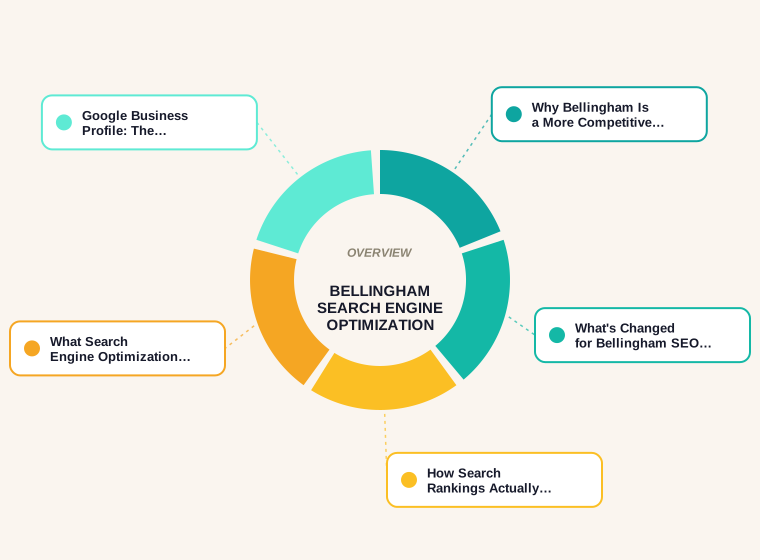
Why Bellingham Is a More Competitive Market Than It Looks
A city this size wouldn't normally carry heavy search competition, but Bellingham's mix of a large student population, a steady stream of tourists heading to the San Juans or Mt. Baker, and regular cross-border traffic from Canadian shoppers means local businesses are effectively competing for several distinct audiences at once. A restaurant or outdoor retailer here isn't just competing with other Bellingham businesses — it's competing with businesses in nearby Ferndale, Lynden, and even Vancouver, BC for the same searchers.
What's Changed for Bellingham SEO in 2026
The core mechanics of search engine optimization in Bellingham are unchanged, but AI-generated answers now play a real role in how local searches get resolved. A search for "best [service] in Bellingham" increasingly surfaces a synthesized answer above the map pack, and the businesses that get named tend to be the ones with clear, specific information — not just the ones with the most reviews. We've covered how to structure content for that shift in our guide to answer engine optimization, and it applies as directly to a Bellingham business as it does anywhere else.
The other shift worth naming: as more Bellingham businesses invest in maintaining their Google Business Profile to capture tourist and student traffic, a stale or unclaimed listing now stands out more, not less, against a field of well-maintained competitors.
How Search Rankings Actually Work for a Local Business
Google ranks local results on a mix of relevance, distance, and prominence. Relevance is whether your business profile and site actually match what was searched. Distance is straightforward proximity to the searcher or the location they specified. Prominence covers reputation signals — reviews, links, and consistent information about the business across the web. A Bellingham coffee shop near campus and a Bellingham urgent care clinic are optimizing for entirely different searches, but both are judged against the same three factors.
What Search Engine Optimization Actually Involves
In practice, this breaks into three connected pieces: technical health (a fast, easily crawlable site), on-page relevance (pages that clearly match what people search for, including neighborhood and campus-adjacent phrasing), and off-page authority (reviews, citations, and links that vouch for the business). A site that's technically solid but has no reviews will still lose to a slower competitor with a strong review profile — all three pieces need to work together.
Google Business Profile: The Highest-Leverage Fix
For most Bellingham businesses, a half-finished Google Business Profile is the biggest gap between current and possible rankings. Complete every category, service area, and attribute field, and add real photos. Businesses that draw tourist or student traffic should make sure their hours, seasonal changes, and any student-discount attributes are current — inconsistent hours during the school year versus summer break are a common, avoidable source of lost trust.
Local Citations and Getting the Basics Right
Consistent name, address, and phone number listings across directories, the Bellingham/Whatcom Chamber, and review platforms remain a foundational, if unglamorous, task. A business listed under slightly different names or old addresses across different directories sends a weaker trust signal than one that's identical everywhere — a cheap, one-time fix with a real payoff.
Building a Real Review Pipeline
Reviews are one of the clearest signals available to a local business, and the ones that accumulate them consistently ask systematically — a text or email after every appointment or completed job, rather than hoping customers volunteer one unprompted. Responding to every review, including negative ones, is public proof that someone is actively running the business.
Content That Matches How Bellingham Searchers Actually Search
Generic service pages underperform pages written around how people in Bellingham actually search — references to specific neighborhoods, nearby towns like Ferndale or Lynden, campus-area landmarks, or seasonal context tied to tourist season and the school calendar. A gear shop that writes a page around actual Mt. Baker trail conditions will consistently outperform a generic, copy-pasted version of the same page.
Seasonality is worth planning around directly. Tourist season brings a spike in demand for outdoor gear, lodging, and dining content; the start and end of the academic year drive searches tied to student housing and moving services; and cross-border shopping patterns shift with currency exchange rates and Canadian holidays. Publishing or refreshing the relevant pages a few weeks ahead of each window consistently outperforms writing everything once and leaving it static.
Measuring Whether It's Actually Working
Track Google Business Profile calls, direction requests, and website clicks; organic traffic and keyword position for terms that actually drive revenue; and, most importantly, how many of those leads convert into paying customers. Set a baseline before making changes and review it monthly rather than reacting to day-to-day ranking noise — a three-to-six-month window is usually the shortest that reliably separates real progress from normal variance.
DIY vs. Hiring It Out
A single-location Bellingham business with time to spare can reasonably handle Google Business Profile upkeep, citation cleanup, and a review-request habit in-house. Technical SEO, content built around real local search demand, and link building are where it gets harder to DIY — that work takes specialized time most owners don't have. We've written a fuller breakdown of that trade-off in our SEO agency vs. freelancer guide, which applies just as directly here.
Common Search Engine Optimization Mistakes in Bellingham
The recurring mistakes we see locally: an abandoned or duplicate Google Business Profile listing, hours that don't reflect the academic-year and summer schedule shift, targeting only "Bellingham" while ignoring the surrounding towns that generate real calls, and treating SEO as a one-time project instead of ongoing maintenance. Any one of these can keep a genuinely good business well below where it should rank.
Is Search Engine Optimization Worth It for a Bellingham Business?
For nearly any Bellingham business depending on local customers finding it — trades, healthcare, hospitality, retail, professional services — the answer is yes, and increasingly so given how much of the city's traffic comes from tourists and cross-border shoppers with no existing brand loyalty to fall back on. The businesses winning those searches today are the ones treating their online presence as seriously as their physical one.
Conclusion
Bellingham's economy is more layered than a typical city its size, and that means the businesses competing for search visibility here are more varied than in a comparably sized market elsewhere. The same density dynamic shows up in other Washington markets we've covered, just with different local details — see our guides to search engine optimization in Moses Lake and search engine optimization in Yakima for how it plays out in markets built around agriculture and recreation rather than a college-town and tourism-gateway mix. Getting the fundamentals right — a complete Google Business Profile, consistent citations, a real review pipeline, and content that matches how people actually search — is what separates the Bellingham businesses that show up from the ones that don't.
How much does search engine optimization cost in Bellingham?
Broadly in line with US averages — agencies around $99 an hour and roughly $3,200 monthly, freelancers around $72 an hour and $1,350 monthly. Bellingham's lower competition means a smaller budget usually goes further here than the same spend would in Seattle.
How long does SEO take to work in Bellingham?
Google Business Profile fixes can show movement within weeks. Broader organic rankings typically take three to six months, and lower competition here often means faster results than the same work in a larger metro.
What should a small Bellingham business do first?
Complete the Google Business Profile properly, fix name-address-phone inconsistencies across directories, and build a systematic review request habit. These fundamentals outperform a broad national-style campaign in a market this size.
How do I handle the academic-year and summer swing?
Keep hours accurate across both, and plan content around the calendar. The start and end of the school year drive student housing and moving searches, while tourist season drives outdoor gear, lodging and dining demand — publishing a few weeks ahead of each window works better than reacting.
Do Canadian cross-border shoppers affect my SEO?
They can. Bellingham businesses compete for searchers from Vancouver, BC as well as locals, and that traffic shifts with exchange rates and Canadian holidays. It is worth factoring into content timing if a meaningful share of your customers cross the border.
Should I target nearby towns like Ferndale and Lynden?
If you serve them, yes. Pages referencing specific neighborhoods and nearby towns consistently outperform generic "Bellingham" pages, and competition for those terms is lower still.
Is AI search worth worrying about for a local business?
Increasingly, yes. Searches like "best [service] in Bellingham" often surface a synthesised AI answer above the map pack, and businesses named there tend to have the clearest, most specific information online rather than simply the most reviews.
Can I do Bellingham SEO myself or should I hire someone?
Google Business Profile upkeep, citation cleanup and review collection are genuinely doable in-house. Technical SEO, content built around real local demand, and link building are where outside help usually pays for itself.
Contomatix helps Pacific Northwest businesses turn local search visibility into actual calls and appointments — technical fixes, content built around real local search demand, and a review and citation strategy that holds up over time. Want a free audit of where your Bellingham business stands right now?
Get a free audit →