Last updated: September 2026
Hiring an orthodontic SEO company is harder than it should be, because most of the market sells the same package it sells to dentists, plumbers and chiropractors with the nouns swapped out.
Orthodontics does not work like general dentistry. The patient takes months to decide, a parent often makes the call, a rival general dentist is advertising aligners against you, and one signed case is worth more than a year of cleanings. This guide covers what the work should actually include, what it costs, and how to tell in ninety days whether it is working.
Why Orthodontics Is Not Just Dental SEO
Four differences change the whole plan.
- The decision window is long. A toothache is a same-day search. Braces are researched for weeks, often by two people who disagree about the price.
- The buyer is frequently not the patient. A parent searches, a teenager objects, and the website has to answer both.
- Your competitors are not only orthodontists. General dentists market clear aligners, and direct-to-consumer brands market the idea that no practice is needed at all.
- Case value is high and countable. With treatment typically priced in the thousands, a handful of extra starts per month pays for any sensible marketing budget, which means the reporting has to reach starts rather than stopping at clicks.
If a proposal you are reading would work unchanged for a dental practice, it is a dental proposal. For the general version, we wrote a separate guide to SEO for dentists; this one assumes you are a specialist.
The Market Has Moved Towards Adults
This matters for keyword strategy more than anything else in the plan.
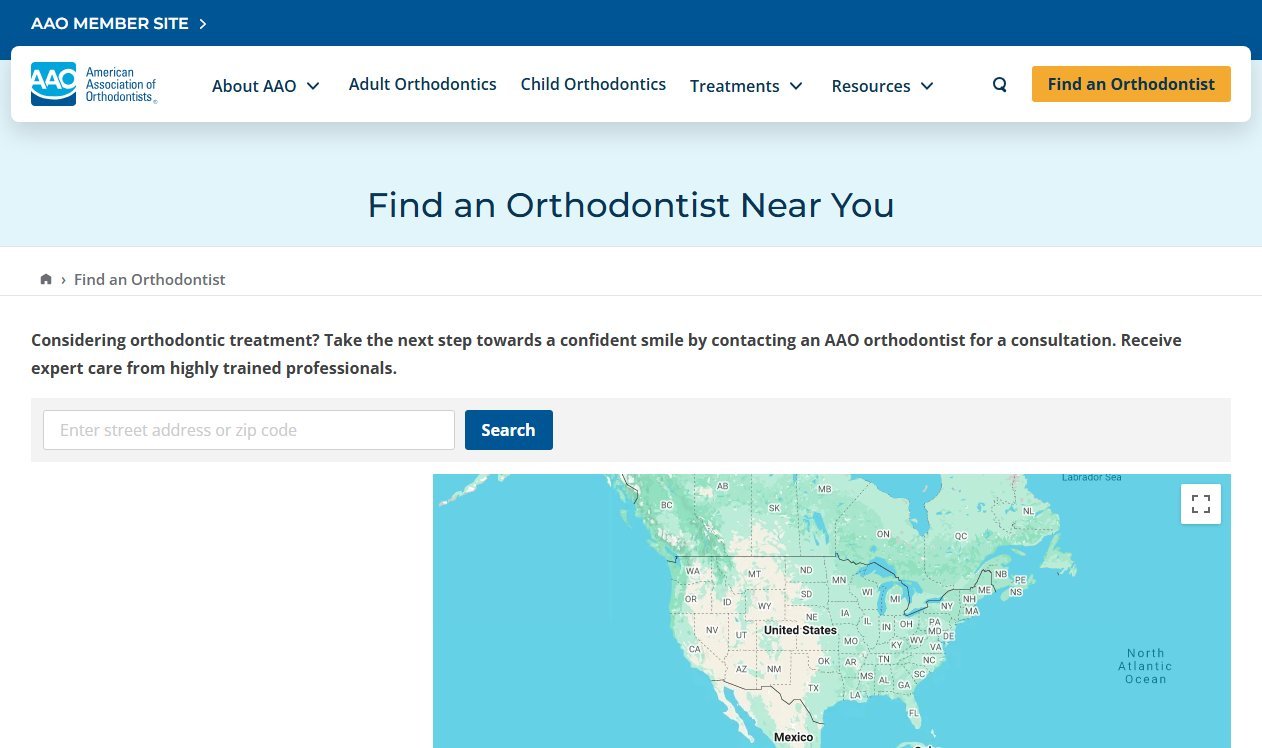
The AAO's 2025 Economics of Orthodontics and Patient Census Survey, covering 2024 practice data, reported that patients in active treatment per member rose from 574 in 2022 to 696 in 2024, and that adult patients in the United States reached roughly 1.91 million, up from 1.64 million in 2022.
Two practical consequences:
- Adult-intent queries deserve their own pages. "Invisalign for adults", "braces at 40", "clear aligners cost" and "how long do adult braces take" are different searches from anything a parent types, and they convert on different reassurances.
- The AAO directory is a real channel. The same survey found 24% of responding orthodontists now list the AAO's Find an Orthodontist tool among patient referral sources, up from 20% in 2022 and 17% in 2018, with an estimated 44,000 patients examined and 28,000 starting treatment through it in 2024. Your profile there should be as complete as your Google listing.
What the Search Results Actually Look Like
Before buying anything, look at what a patient sees. Here is a live result for a single query in one American city.
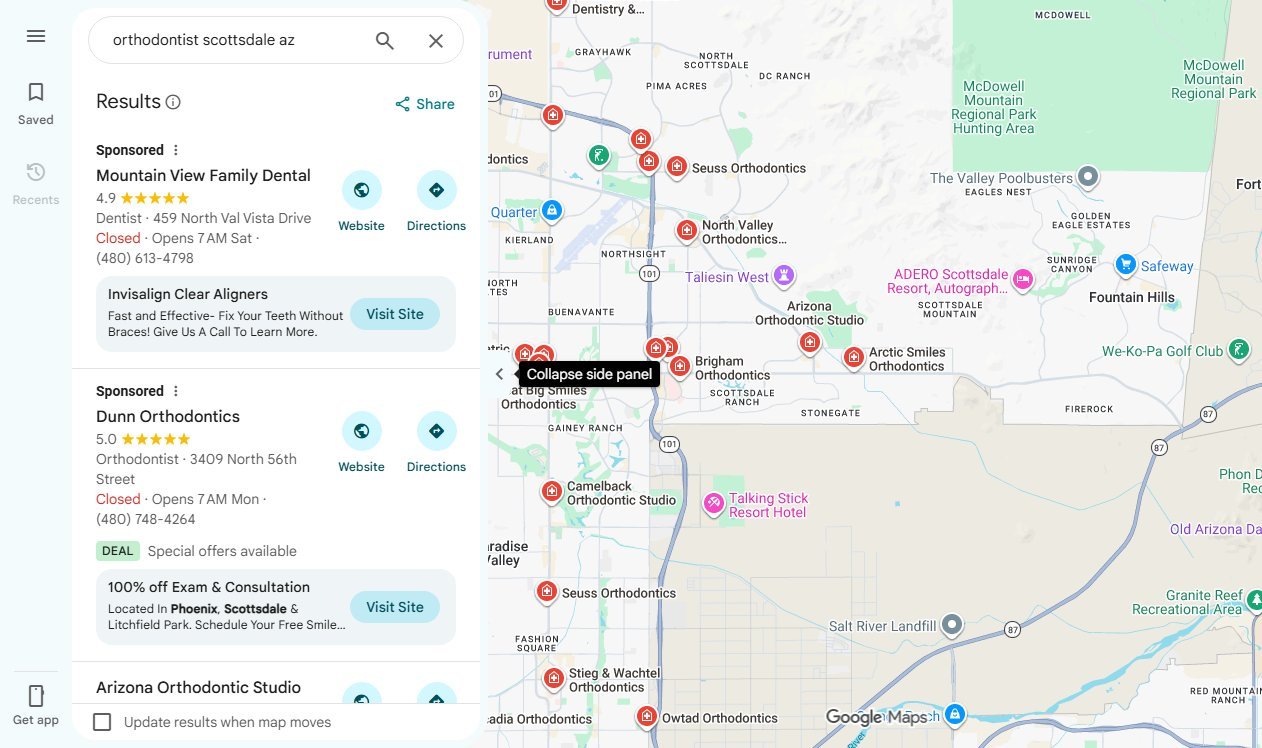
Three things worth noticing, because they shape what the SEO work has to achieve.
Paid results sit above the map pack. Ranking first organically still puts you below two ads. That is an argument for doing both, not for abandoning either.
A general dentist is bidding on "orthodontist". Specialist positioning is not automatic; your pages have to say what a specialist qualification means in plain language, because the ad above you will not.
The visible decision happens before the click. Rating, review count, opening state, distance and an offer are all on screen. Half of an orthodontic SEO programme is really profile and review work.
What an Orthodontic SEO Company Should Deliver
A scope that fits this market looks like this. If several rows are missing, ask why.
| Workstream | What it means for an ortho practice | How it is judged |
|---|---|---|
| Google Business Profile | Orthodontist as primary category, services listed, photos of the actual office and team, booking link | Calls, direction requests, booking clicks |
| Treatment pages | One page per treatment: metal, ceramic, clear aligners, early treatment, surgical cases | Organic clicks and consult form starts per page |
| Adult vs teen content | Separate journeys, separate objections, separate pages | Query coverage and time on page |
| Location pages | One per physical office, with genuinely different content, not a town swap | Impressions and calls by location |
| Reviews | A request process that runs after bonding and after debond, plus replies | Review velocity and average rating |
| Referral support | A page for referring dentists, plus AAO and insurance directory accuracy | Referral volume, tracked by the front desk |
| Measurement | Call tracking, form tracking and consult-to-start reporting | Consults booked, cases started |
The last row is where most agreements fall apart. Without call tracking, an orthodontic SEO company can only report clicks, and clicks do not pay for a treatment chair.
The Pages That Actually Book Consults
In our experience five page types do most of the work, and three of them are usually missing.
- A cost page that gives real ranges. Price is the first question and the most-searched modifier. A page that refuses to discuss money sends the patient to a competitor who will.
- A treatment comparison page. Metal against ceramic against aligners, with honest trade-offs on visibility, duration and compliance.
- A "what happens at the first visit" page. Removes the fear that stops people booking, and it ranks for a surprising number of long-tail queries.
- Financing and insurance. Monthly payment options change the decision more than any clinical claim.
- Before-and-after cases, with consent. The only proof that matters to a patient, and the page most likely to be shared with a spouse.
Add MedicalBusiness or Dentist structured data to those pages so the practice details are unambiguous; our free schema markup generator produces the markup in about a minute.
The Referral Loop Most Practices Under-Use
Orthodontics is one of the few local businesses with two entirely separate demand channels, and most marketing plans only address one.
Patients who search. This is the channel everything above is about: maps, treatment pages, reviews, ads.
Dentists who refer. A general dentist sending five cases a year is worth more than most keywords, and the work to support that channel is different. It needs a referring-dentist page with a simple form, a clear statement of what you treat and what you send back, and case updates that make the referring practice look good to its own patient.
The two channels feed each other. A practice with strong local visibility gets asked for by name at the general dentist, and a practice with strong referral relationships gets the reviews that improve local visibility. Neither is a substitute for the other, and an up-to-date professional directory listing supports both at once.
Ask any prospective agency what they plan to do for the referral side. If the answer is nothing, that is not disqualifying, but the scope and the price should reflect that they are covering half the demand.
What Orthodontic SEO Costs
Ranges we see in this specialty, for retained work rather than one-off projects.
- Single location, quiet market: $1,000 – $2,000 a month. Profile management, review process, two to four pages of content per month, local link work.
- Single location, competitive metro: $2,000 – $4,000 a month. The above plus conversion work on the site, adult-specific campaigns and stronger link acquisition.
- Multi-location group: $4,000 – $10,000+ a month. Profile governance, per-location pages and reporting, and a content programme that does not duplicate itself across offices.
- One-off website rebuild: $6,000 – $25,000. Usually necessary when the existing site cannot be edited or has no consult path.
Judge those numbers against case value rather than against other marketing invoices. If a programme reliably produces a few extra starts a month, the arithmetic is straightforward. If nobody can tell you how many starts it produced, the price is irrelevant because the return is unknown.
How to Tell Whether It Is Working
Four numbers, reported monthly, in this order.
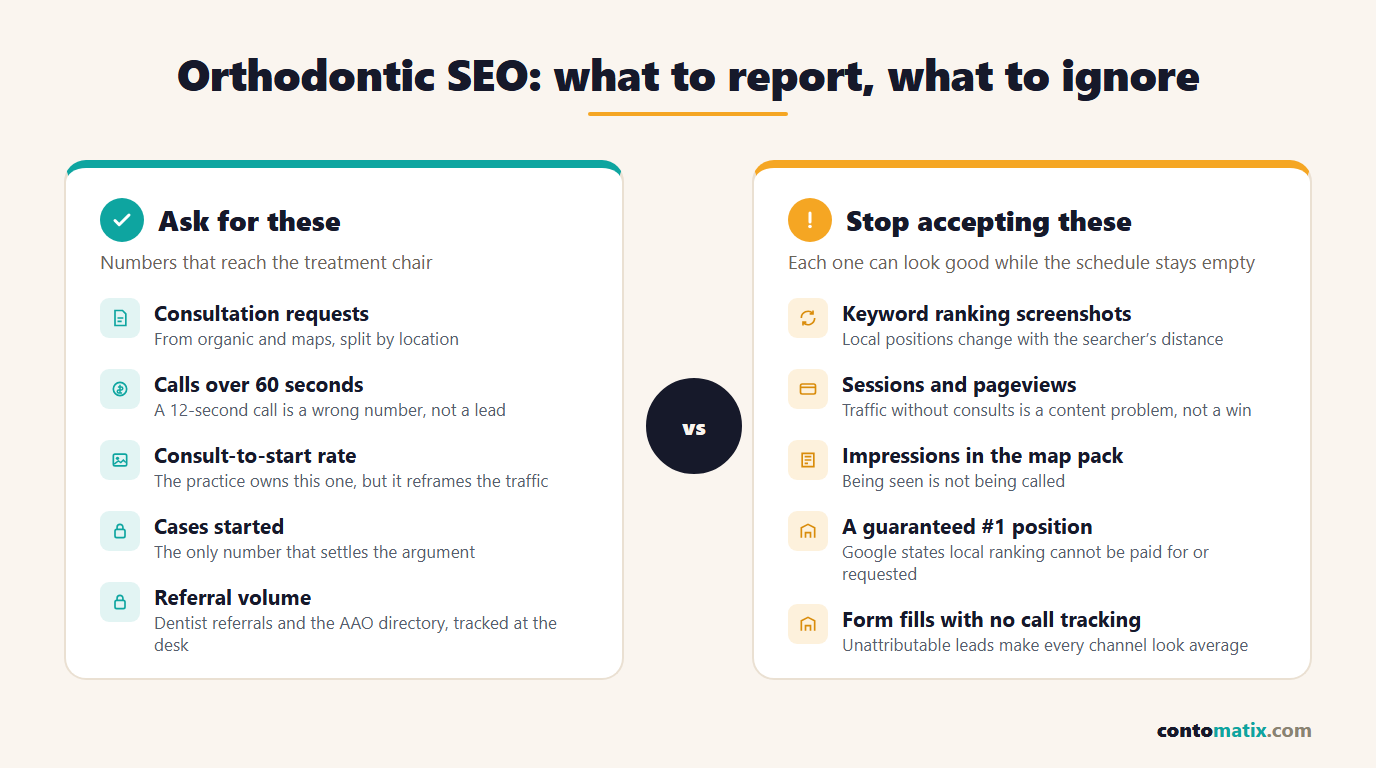
Consultation requests from organic and map traffic, separated by location. Calls over 60 seconds, because a 12-second call is a wrong number. Consult-to-start rate, which the practice owns rather than the agency, but which changes how the traffic should be read. And cases started, which is the only number that settles the argument.
Rankings belong in the appendix. Local positions vary with the searcher's distance, so two families on the same street can see different results for the same query.
Multi-Location Groups and DSOs
Groups break the single-practice playbook in three predictable places.
- Duplicate content across locations. Ten offices with the same treatment pages and a swapped town name is the pattern that suppresses all ten. Write treatment content once at group level and make the location pages genuinely local: the team, the parking, the schools nearby, the offers.
- Profile governance. One owner account, consistent categories and a rule about who may edit hours. Branch-level edits are the most common cause of a listing quietly going wrong.
- Attribution by location. Tracking numbers per office, not one group number, or nobody can tell which location the marketing is actually filling.
Pricing should scale with the number of profiles and pages, not with the number of keywords, because that is where the work actually is.
Red Flags in an Orthodontic SEO Proposal
- A guaranteed number-one position. Google's own local ranking documentation says there is no way to pay for or request a better local ranking.
- The same content sold to several practices. Ask whether the treatment pages are written for you or assembled from a template library other clients also received.
- No call tracking. Without it, nobody can attribute a consult to a channel, and reporting collapses into clicks.
- Review gating or incentives. Filtering for happy patients or paying for reviews breaches platform policies and risks the profile that generates your calls.
- Before-and-after images used without consent. A marketing convenience that becomes a compliance problem.
- Ownership held by the agency. The website, the profile, the domain and the tracking numbers must be in the practice's name.
What to Do Yourself First
Three things a practice can do this week without hiring anyone.
- Fix the primary category on your Business Profile to Orthodontist, add every treatment as a service, and upload ten current photos of the real office.
- Complete your AAO directory listing, since a quarter of practices now name it as a referral source.
- Ask every finishing patient for a review on debond day, when satisfaction is highest and the photo is already being taken.
Those three cost nothing and usually move calls before any agency work has been signed. For the wider local framework behind them, see our guide to local SEO services.
Quick Recap
- Orthodontics needs its own plan: long decision windows, parent buyers, aligner competition from general dentists, and high case value.
- Adult patients in the US reached about 1.91 million in 2024, so adult-intent pages deserve equal weight.
- Sponsored results sit above the map pack, and a general dental practice may be bidding on your specialty.
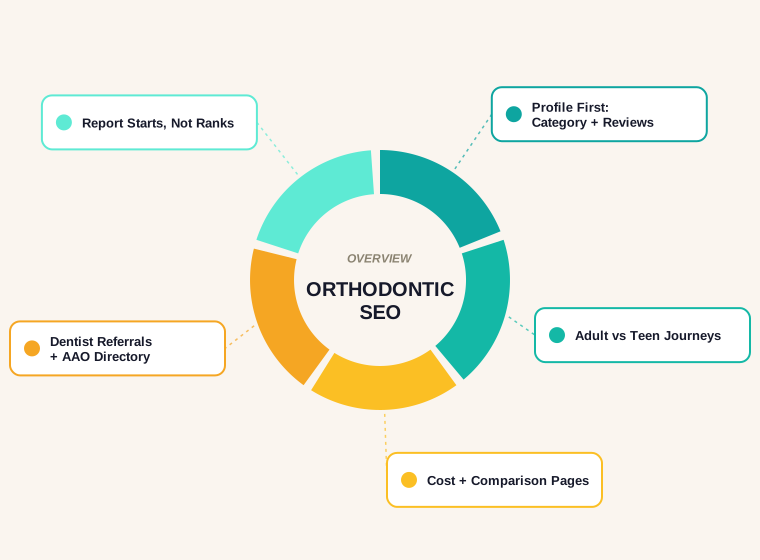
- Scope should cover the profile, treatment pages, adult and teen journeys, location pages, reviews, referrals and measurement.
- Cost pages, comparison pages and first-visit pages book more consults than anything clever.
- Expect $1,000 to $4,000 a month for a single location, more for groups, and judge it against cases started.
- Report consults, long calls, consult-to-start rate and starts. Rankings are context.
Frequently Asked Questions
What does an orthodontic SEO company do?
It manages the practice's Google Business Profile, builds treatment and location pages that answer patient questions, runs a review process, keeps directory listings accurate, earns local links and reports on consultations and cases started rather than only on rankings.
How much does orthodontic SEO cost?
Commonly $1,000 to $2,000 a month for a single location in a quiet market, $2,000 to $4,000 in a competitive metro, and $4,000 or more for multi-location groups. Website rebuilds are usually quoted separately.
How long before orthodontic SEO produces new patients?
Profile fixes can move calls within weeks. Content and link work usually take two to four months to show clearly, and longer in saturated metros. The decision window in orthodontics is itself long, so attribution lags the work.
Is orthodontic SEO different from dental SEO?
Yes. The buyer is often a parent, the decision takes weeks, general dentists compete for aligner searches, and case value is high enough that reporting has to reach consultations and starts rather than stopping at traffic.
Which pages matter most for an orthodontic website?
A cost page with real ranges, a treatment comparison page, a first-visit page, a financing and insurance page, and consented before-and-after cases. Those five answer the questions that decide whether someone books.
Should an orthodontist run ads as well as SEO?
Usually yes, because sponsored listings appear above the map results for these queries. Ads buy immediate visibility while the organic and profile work compounds.
How important are reviews for an orthodontic practice?
Very. Rating and review count are visible in the map results before anyone clicks, and Google names reviews as part of local prominence. Collect them steadily and reply to all of them.
Does the AAO directory bring patients?
The AAO's 2025 survey reported that 24% of responding orthodontists name the Find an Orthodontist tool among their referral sources, with an estimated 28,000 patients starting treatment through it in 2024. It is worth keeping the listing complete and current.
What should an orthodontic SEO report include?
Consultation requests by source and location, calls longer than sixty seconds, consult-to-start rate, and cases started. Rankings, impressions and clicks belong underneath those, as supporting context.
Can a practice do its own SEO?
The first layer, yes: correct the primary category, complete the profile, add real photos, claim the AAO listing and ask every finishing patient for a review. Hire help when you need content at volume, multi-location governance or changes you cannot make to your own website.