Petaluma local SEO gets treated as a smaller version of Santa Rosa's by most agencies pitching this market, and that is a genuine mistake. With 59,609 residents and a median household income of $115,430 — well above the California average — this is a market where buyers research carefully, and a generic North Bay template misses what actually makes it different.
Petaluma is also home to a food-and-beverage manufacturing cluster most local guides never mention, which matters more for local search strategy here than in almost any comparably sized California city.

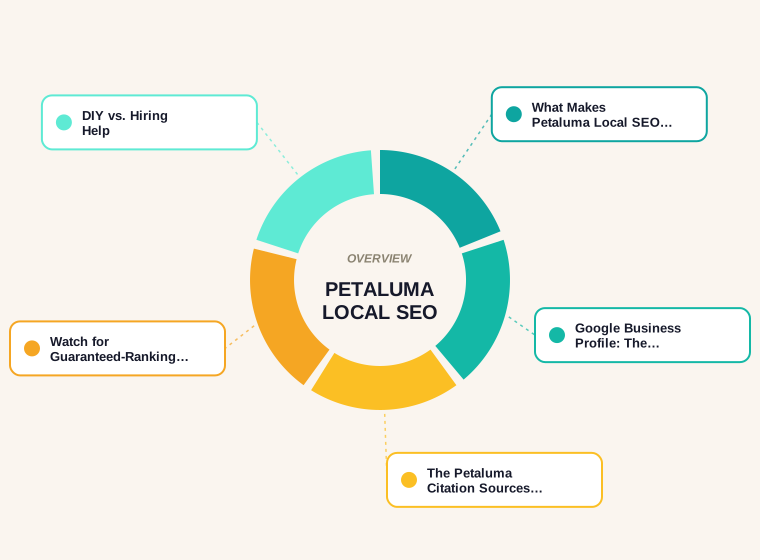
What Makes Petaluma Local SEO Different
Real headquarters, not just storefronts. Amy's Kitchen, Lagunitas Brewing Company, and Clover Sonoma are all headquartered in Petaluma, alongside Calix Inc. in telecom technology. That is a genuine food, beverage and tech manufacturing base sitting inside a city of under 60,000 people — and it means B2B and supply-chain search behavior exists here alongside ordinary local consumer search.
Santa Rosa-Petaluma is one labor market. The Bureau of Labor Statistics tracks this area as a single metro economy, and a meaningful share of local search crosses that boundary. A business optimizing only for "Petaluma" and ignoring Santa Rosa-adjacent searches is missing real volume.
High income means comparison shopping, not impulse decisions. At $115,430 median household income with a 6.49% poverty rate, Petaluma buyers read reviews, compare multiple options, and are unusually likely to check whether a site actually answers their question before calling. Thin, generic pages get skipped here more than in lower-income markets.
Manufacturing and retail are the real employment base. Beyond the well-known food brands, Data USA lists Manufacturing and Retail among Petaluma's leading industries, with roughly 30,500 people employed across the city's 2,400+ businesses. A local SEO strategy built only around downtown retail and hospitality misses this entire layer of the economy.
Google Business Profile: The Field-by-Field Setup
For most Petaluma businesses, the map pack produces more calls than the website alone. The fields carry very different weight:
- Primary category — outweighs every other field combined. Choose the single most specific category matching your core service.
- Service areas — list Petaluma plus the parts of Santa Rosa, Rohnert Park, Novato and wider Sonoma and Marin County you genuinely serve. A profile that only says "Petaluma" misses a real share of nearby demand.
- Services with descriptions — each service gets its own text field. Most local competitors leave this blank, which is free keyword surface left unclaimed.
- Business description — 750 characters. Name the specific area — downtown, the Waterfront district, East Petaluma — rather than just the city.
- Photos — geotagging is not a real ranking factor, but a fresh monthly set correlates with measurable engagement.
- Hours, including seasonal hours — Sonoma County's tourism and events calendar genuinely shifts foot traffic through the year. Keep hours current around it.
Google's own guidelines for representing your business are the authority on what belongs in each field.
The Petaluma Citation Sources That Actually Exist
Skip generic, auto-submitted directory lists. These are real, local, and worth the time:
- Petaluma Area Chamber of Commerce — 6 Petaluma Blvd N, Ste B-11, Petaluma, CA 94952, (707) 762-2785. The most relevant general local citation available, and the body most connected to the wider downtown business community.
- Petaluma Downtown Association — directly relevant for any retail, food or hospitality business in the historic downtown core.
- Sonoma County Tourism — worth engaging with for any visitor-facing business, given the county's tourism draw.
- California Secretary of State business registration — the legal entity name every other citation has to match exactly.
- Sonoma County business records — the correct county for licensing and property citations.
Five accurate citations from real, checkable local bodies outperform fifty auto-submitted directory entries.
Watch for Guaranteed-Ranking Pitches
Some providers pitching into this market lead with lines like "guaranteed rankings in 90 days" or "if we don't rank you, you don't pay." Nobody controls Google's algorithm, and a guarantee like that is a reliable signal to keep looking. A more useful question for any Petaluma provider: which local citations do you actually use, and can you name a real client result with a URL you can verify yourself?
DIY vs. Hiring Help
A single-location Petaluma business can genuinely handle the Google Business Profile setup, the Chamber listing, name-address-phone consistency, and a review request built into how jobs close. That covers a meaningful share of the available benefit before paid help is needed.
Paid help earns its place once you need sustained content, technical work, or you're competing against Santa Rosa-based agencies with larger budgets. Our agency versus freelancer comparison covers what each model realistically delivers, and if you're building your own client base as an SEO provider here, our guide to how to get SEO clients covers the channels that actually convert.
Common Mistakes in This Market
The recurring ones: treating Petaluma as a smaller Santa Rosa instead of its own search market, leaving service areas blank, ignoring the manufacturing and B2B layer entirely, and publishing thin content in a market where high-income buyers genuinely compare options before calling.
The most costly mistake is generic content that could describe any Sonoma County city. In a market this specific — real headquartered brands, a defined historic downtown, a distinct income profile — genuinely local detail is what separates a page that converts from one that gets skipped.
Is It Worth It for a Petaluma Business?
Yes. A city with median household income well above the state average, a real manufacturing and food-and-beverage base, and buyers who research before calling is a market where a properly built Google Business Profile and a handful of genuinely useful local pages produce real enquiries.
How to Read a Local SEO Proposal Before Signing
Two proposals can look nearly identical on price and still be very different in substance. Look past the total and check for specifics: does the proposal name which service areas beyond Petaluma it will target, does it describe an actual content plan rather than "ongoing optimization," and does it specify what the first thirty days include. A proposal that reads the same as one written for a completely different California city has probably been recycled from a template rather than built for this market.
Also check what's promised versus what's measured. If the proposal talks about rankings but the reporting section only mentions traffic, or vice versa, ask how the two connect before you sign, not after the first invoice arrives.
Content That Converts Comparison-Shopping Buyers
A market with median household income well above the state average behaves differently than a price-sensitive one, and the content that wins here reflects that. Buyers who research carefully respond to specificity: detailed service pages that explain exactly what's included rather than vague marketing language, transparent pricing ranges where the industry allows it, and reviews that mention concrete details rather than generic praise.
Comparison-oriented content — pages that honestly walk through what to consider when choosing between service tiers or approaches — tends to perform well with this kind of buyer, because it matches how they're already evaluating the decision. Thin pages that assume a fast, low-consideration purchase get skipped by exactly the audience Petaluma has more of than most comparably sized cities.
Working the Sonoma County Calendar Into Your Content
Sonoma County's tourism and events calendar creates real, predictable shifts in local search behavior that a static content plan misses. Petaluma's own annual Butter and Egg Days festival, along with the broader county's wine-country tourism season, shifts foot traffic and search intent for a meaningful stretch of the year in ways that a business planning content once and leaving it unchanged won't capture.
A practical approach is to map your content and Google Business Profile hours updates against the two or three points in the year that most affect your specific business — not a generic tourism calendar, but the actual weeks that move foot traffic or search volume for what you sell. A restaurant, a boutique, and a B2B manufacturer will each care about different parts of that calendar, and treating them the same misses the point of doing this at all.
How to Read a Local SEO Proposal Before Signing
Two proposals with nearly identical pricing can be very different in what they'll actually deliver. Look for specifics rather than descriptions: does the proposal name the neighboring cities and counties it will target in service areas, does it describe concrete content topics rather than "ongoing SEO," and does it say plainly what happens in the first thirty days.
Check how reporting is described, too. A report that only shows ranking positions without connecting them to traffic or enquiries tells you the provider is tracking activity, not outcomes. Ask to see a redacted sample report before you sign, not just a description of what a report typically contains.
Evaluating Content Samples for Real Quality
Writing samples from a prospective provider are worth reading closely rather than skimming. The test that matters most: could this content apply to a business in any other Sonoma or Marin County city with the name swapped, or does it say something genuinely specific to Petaluma — its downtown, its manufacturing base, its actual customer base? Interchangeable content is a sign of a templated production process regardless of how polished it reads.
Also watch for unsupported precision — a specific percentage or dollar claim stated as fact with nothing backing it. In a market where buyers already research carefully before calling, content making claims it can't support is a liability to your credibility, not just a stylistic issue.
Asking the Petaluma Downtown Association for a Second Opinion
For any business in or near the historic downtown core, the Petaluma Downtown Association is a genuinely useful source of informal feedback beyond its role as a citation source. Downtown business owners who have already been through the process of hiring local marketing help are often willing to share which providers understood the area and which didn't, and that kind of candid, first-hand account is harder to get from a provider's own references.
This matters more here than in a larger city, because Petaluma's pool of businesses that have actually hired and evaluated local SEO help is small enough that word of mouth travels quickly and tends to be current.
Frequently Asked Questions
What makes Petaluma local SEO different from other Sonoma County cities?
A real headquartered food-and-beverage and tech manufacturing base (Amy's Kitchen, Lagunitas, Clover Sonoma, Calix), a median household income well above the California average, and buyers who research and compare before calling.
How much does local SEO cost in Petaluma?
A single-location local business typically sits in the low hundreds per month for Google Business Profile and citation work. Competitive or multi-location programmes usually run into the low thousands.
Should I target Petaluma or the wider Santa Rosa metro?
Both where relevant. The Bureau of Labor Statistics tracks Santa Rosa-Petaluma as one metropolitan labor market, and a meaningful share of local search demand crosses that boundary.
What are the best local citation sources in Petaluma?
The Petaluma Area Chamber of Commerce, the Petaluma Downtown Association, and California Secretary of State business registration are the most authoritative and genuinely local options.
Should I be suspicious of a "guaranteed rankings" pitch?
Yes. Nobody controls Google's algorithm, so a guarantee is a reliable signal to keep evaluating other providers rather than a mark of confidence.
Is local SEO relevant for Petaluma's manufacturing businesses?
Partly. B2B and supply-chain buyers search on capability rather than proximity, which needs different content than a local-service business, but the Google Business Profile and citation fundamentals still matter for visibility and credibility.
How long does SEO take to show results in Petaluma?
Google Business Profile improvements can show within weeks. Broader organic rankings typically take three to six months, longer where Santa Rosa-based competitors are actively targeting the same terms.
What should I fix first?
The Google Business Profile: correct primary category, service areas covering Santa Rosa, Rohnert Park and Novato where relevant, and every service filled in with a description. Highest return for the least effort.
Related Reading
- Want a hand-verified shortlist instead? See the top SEO companies in Petaluma, CA.
Contomatix works with businesses in high-income markets where buyers genuinely compare options — Google Business Profile work, local content, and citations that hold up against Santa Rosa-based competition. Want a free audit of where your Petaluma business stands right now?
Get a free audit →