Last updated: October 2026
Hiring a roofing SEO company is a different decision from hiring a general marketing agency, because a roofing lead behaves differently from almost any other lead. A homeowner with water coming through the ceiling wants a phone answered within minutes. A homeowner planning a full replacement may compare three contractors over several weeks, read dozens of reviews and look hard at photos of finished roofs. One search company has to serve both kinds of buyer, and most generic packages do not.
This guide is written for the roofing contractor who is deciding whether to pay for SEO at all, what a competent provider should actually do, how to question one before signing, and which parts you can reasonably handle yourself. It leans on Google's own published rules wherever they exist, and it avoids price numbers, because any figure quoted without knowing your market, crew size and competition is a guess.
Why Roofing Is a Different SEO Problem
Roofing searches split into two buyer types that need different pages. Emergency and repair searches ("roof leak repair near me", "storm damage roofer") are urgent, local and decided fast, usually from the map results and a phone call. Replacement searches ("new roof cost", "roof replacement company") are slower, more research-heavy and often start on the website. A provider who treats these as one keyword list will build one weak page that answers neither.
Roofing is also seasonal and weather-driven. Demand spikes after hail or wind events, and the contractors who show up in the map results during a spike are usually the ones who built their profile and pages well before the storm. That is the practical argument for treating SEO as groundwork done in quiet months rather than something you switch on after the damage is done.
Finally, trust weighs more here than in most trades. A homeowner is handing over a large payment for work they cannot easily inspect, so licensing, insurance, warranties and real project photos do much of the selling. A roofing-specific provider should understand that, and build it into the site rather than leaving it to a generic "About us" paragraph.
What a Roofing SEO Company Should Actually Cover
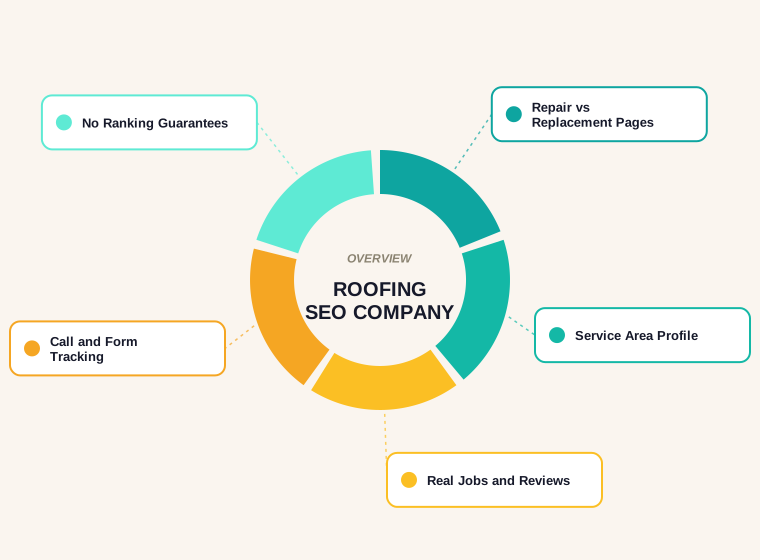
Ask any provider to list their deliverables in plain language. For a roofer, a sound scope usually includes the following areas, and the best proposals tie each one to a result you can check.
- Google Business Profile setup and upkeep: the right address or service-area setup, correct categories, services, hours, photos and a review process.
- Service pages by job type: separate pages for repair, replacement, storm damage, and the roof types you install, rather than a single "Services" page.
- Service-area pages: pages for the towns you genuinely work in, with local substance rather than a swapped place name.
- Trust content: licence and insurance details, manufacturer certifications you hold, warranty terms and real project galleries.
- Local citations and links: consistent listings and a small number of relevant local links.
- Call and form tracking: a way to see which searches produce actual enquiries.
- Reporting: plain monthly reporting that ties work done to calls, not only to rankings.
If a proposal is mostly a list of "SEO packages" with keyword counts and nothing about your profile, your pages or your call tracking, it is a template, not a plan. A roofing SEO company worth hiring will be able to show you what each line of the scope looks like on a real roofing site.
Google Business Profile for Roofers
For most roofing companies the profile is the single most valuable piece of the work, because the map results are where a homeowner in a hurry makes a choice. The first question is whether you show an address at all. Google's help page on service areas says, "If you don't serve customers at your business address, remove your address from your Business Profile." A roofer who works out of a yard or home office and travels to every job generally fits the service-area business pattern, which the same page describes as a business that visits customers directly but does not serve them at its own address.
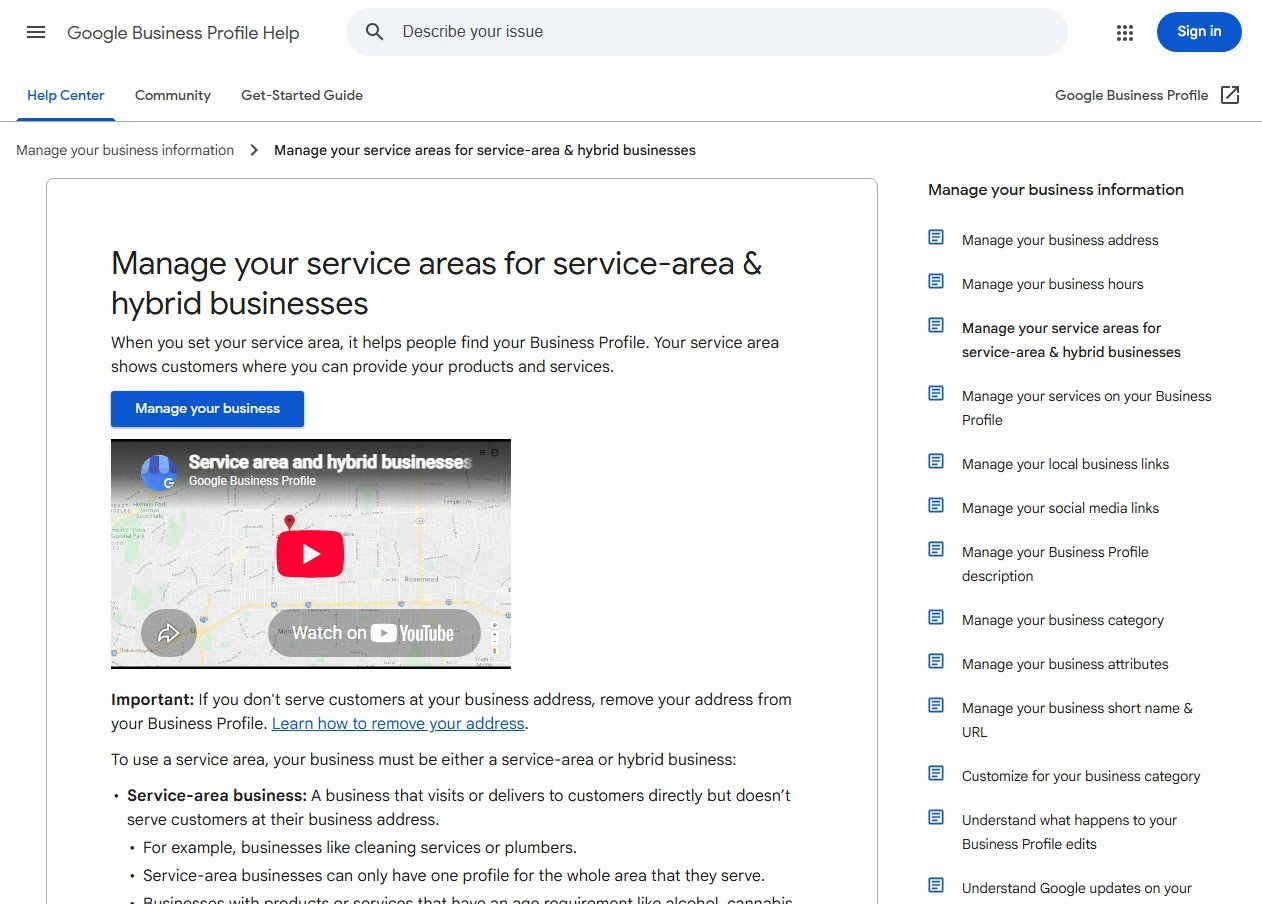
The same page states that you can list areas by city or postal code and that the boundaries should not be more than about two hours of driving from where your business is based. For a roofer that is a useful reality check on any provider who proposes claiming coverage of an entire state. Only list the places your crews will actually drive to for a repair call.
Names and categories are the next place to check. Google's guidelines for representing your business ask you to "choose the fewest number of categories it takes to describe your overall core business" and to use the name recognised in the real world on your signage and stationery. A provider who suggests adding "Best Roofing Company" or a city name to your listing name is proposing the kind of change that invites a suspension. Let the primary category, the services list and your website carry the keywords instead.
Repair Intent and Replacement Intent Need Different Pages
The clearest sign of a roofing-aware provider is that they plan content around the two buyer types. A repair page should lead with the phone number, response time, the kinds of leaks and storm damage you handle and what happens on the first visit. A replacement page should lead with materials, the process from inspection to cleanup, warranty terms and finished-project photos, because that visitor is comparing you with others.
Storm work needs its own care. Insurance-related searches are common after hail, and a page that explains how an inspection works, what documentation you provide and what you can and cannot promise about a claim is more useful, and more trustworthy, than a page that hints at guaranteed approvals. Do not let a provider write claims about insurance outcomes that you cannot stand behind.
For the city-level version of this planning, our walkthrough of roofing SEO in Wichita shows how those pages come together for one market.
Reviews and Photos of Real Jobs
Roofing reviews carry unusual weight because the buyer cannot judge the work themselves. A good provider helps you build a repeatable review request that goes to every customer at job completion, in the same words each time. They should not pay for reviews, offer discounts for them or write them on your behalf, and you should ask directly how reviews will be collected before you sign.
Photos matter just as much. Before-and-after images of finished roofs, crew on site and material close-ups show a homeowner that you do the work yourself. Stock photography does the opposite. Ask whether the provider will help you set up a simple routine for your crew to upload job photos, and keep customers identifiable only where they have given permission.
Licensing, Insurance and Other Trust Signals
Requirements for contractor licensing differ by state and sometimes by county, so a roofing SEO provider should ask you what applies to you rather than assume. Wherever your licence number is required to be displayed, or is simply a mark of credibility, it belongs in your site's footer and on your service pages. The same goes for proof of insurance, manufacturer certifications you actually hold, warranty terms and any association memberships.
Think of these as answers to questions the homeowner has not yet asked aloud: are you real, are you covered if something goes wrong, and will you be around in five years. A site that answers them plainly, with details a visitor can verify, converts better than one that only claims to be "trusted" and "professional".
Pages, Citations and Call Tracking
Service-area pages are where many roofing campaigns turn into thin content. One page per town is fine when each has something particular to say: neighbourhoods you have worked in, typical roof ages and styles, local weather patterns, permit or inspection notes where relevant. Dozens of identical pages that differ only by the place name add little and can look like exactly what they are.
Structured data is a smaller piece. Google's documentation on local business markup states that it does not guarantee that features using structured data will show up in search results, so treat it as housekeeping rather than a ranking lever. Citations work the same way: a modest set of accurate listings with the same name, address and phone number as your profile is enough, and chasing hundreds of directories is not.
Tracking is where good providers separate from weak ones. Ask how calls will be counted, whether tracking numbers will be used without breaking the consistency of the number on your profile, how form submissions will be logged and how a lead is traced back to a search or page. Without that, a report about rankings tells you very little about whether your phone is ringing more. Our link building for roofers guide covers the off-site side in more depth.
Seeing the Map Results as Your Customer Does
Before talking to any provider, search for your own service the way a homeowner would and look at what is actually there.
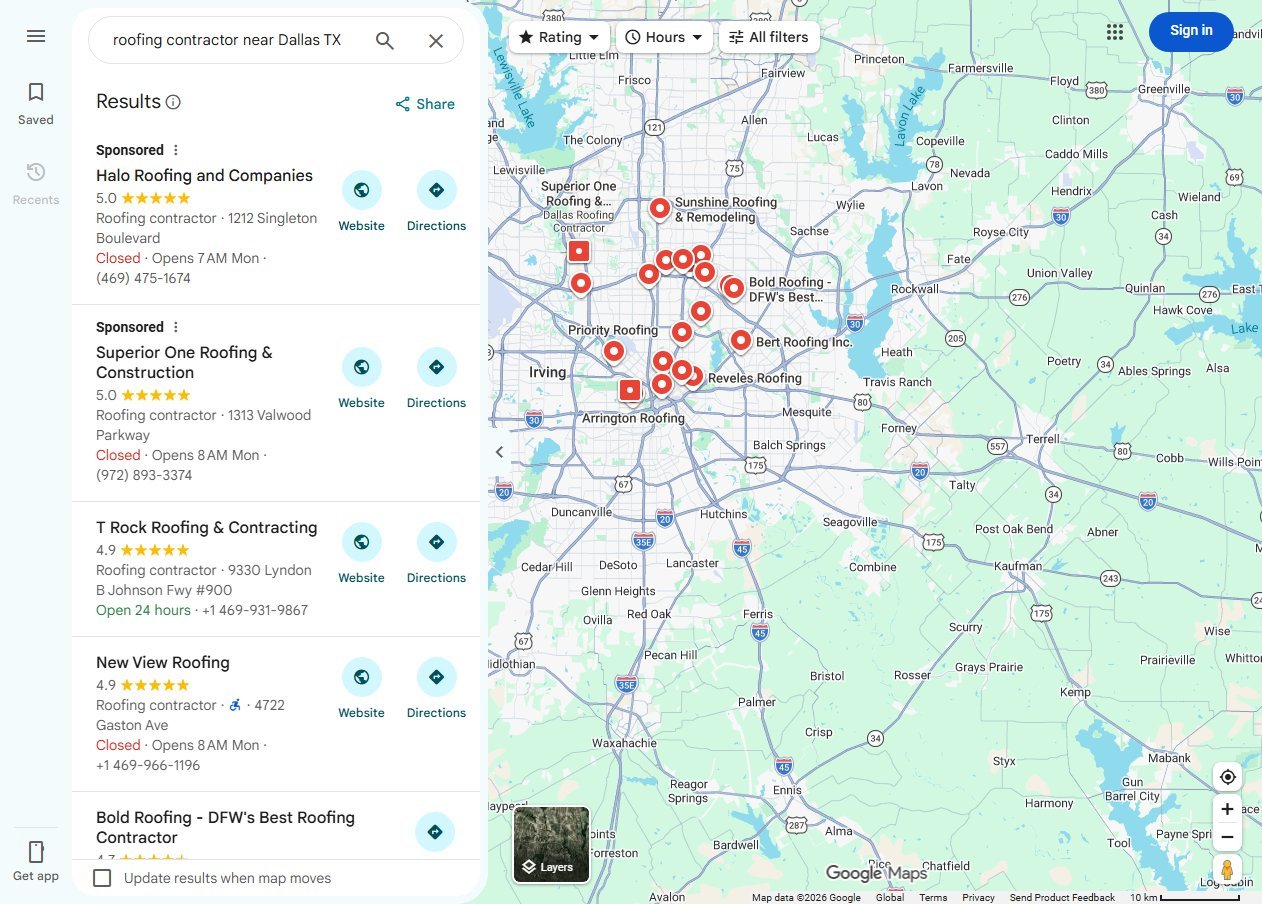
A few things are worth noticing. Paid placements sit at the top and are labelled as sponsored, which is advertising rather than SEO. Below them, each listing shows a star rating, a category, an address and whether it is open, so a profile with the wrong hours loses a customer before the website is ever opened. And the pins spread across the metro area, which shows why distance from the searcher is part of how results are ordered. A provider cannot move your office closer to the customer, but a good one will tell you honestly how competitive your area is.
How to Vet a Roofing SEO Company
Google publishes its own advice on whether you need an SEO and how to choose one, and it is a good script for a first call. Its suggested questions include asking for examples of previous work, whether they follow Google Search Essentials, what results they expect and in what timeframe, their experience in your industry and city, and whether they will share every change they make to your site. Add roofing-specific questions on top of those.
- Which roofing clients can you show me, and may I speak to one?
- How will you handle my Business Profile, and who owns it? You should remain the owner and manager.
- How do you separate repair pages from replacement pages?
- How will calls and forms be tracked, and who owns the tracking accounts?
- What will you do if a competitor or a bad review affects my profile?
- What happens to the website content if I leave?
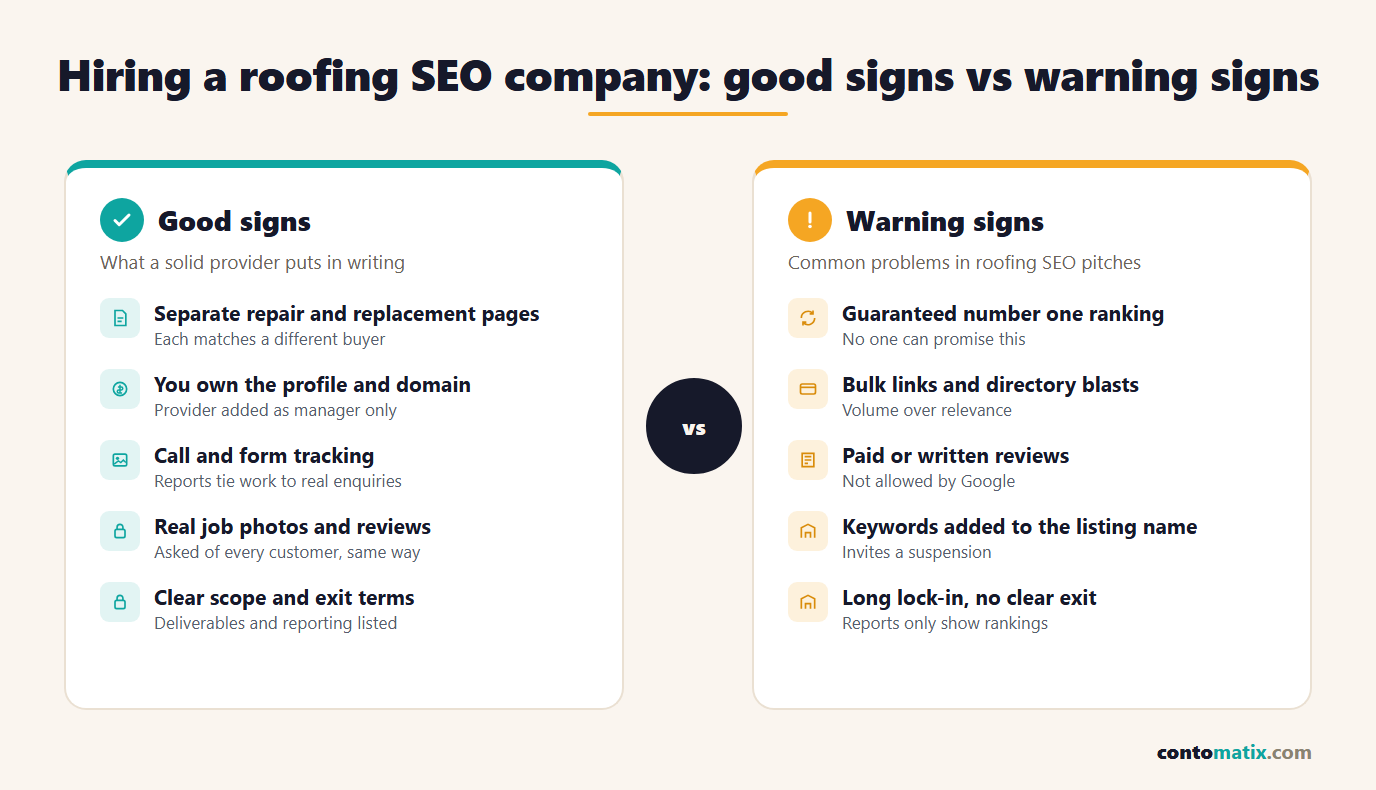
Insist on ownership of your Business Profile, your domain, your analytics and your content. If a provider holds the keys, leaving them becomes expensive, and that is often the point.
Red Flags in a Roofing SEO Pitch
Google's own guidance is blunt on the most common one: no one can guarantee a number one ranking on Google, and anyone claiming a special relationship with Google should be treated with suspicion. Watch for these as well.
- A guarantee of first-page or first-position results, or a promised number of leads from search.
- Vague answers about methods, or reluctance to share what has been changed on your site.
- Bulk link packages, mass directory submissions or a private network of sites.
- Fake or purchased reviews, or any offer to remove a genuine negative review for you.
- An address change or a name change on your profile that does not match your real business.
- A contract that locks you in for a long period without a clear exit if reporting stops.
- Reports made only of impressions and rankings, with no calls or leads.
Realistic Timing
Nobody can honestly say exactly how long it will take, and Google itself does not publish a fixed timeline. In practice, profile corrections and fresh job photos can change how a listing looks within weeks, while new pages, links and review volume build slowly and depend on how crowded your market is. A provider who frames the first few months as groundwork, with defined milestones such as a completed profile audit, live service pages and call tracking switched on, is being more honest than one who promises a quick surge.
Expect the strongest results where you started with little. A contractor with a half-finished profile and one thin website page has much more to gain than one with years of reviews and a complete site.
How Roofing SEO Is Priced: Models, Not Numbers
Pricing varies too much by market for a figure to be useful, but the models are worth understanding, because each creates different incentives.
- Monthly retainer: a recurring fee for an agreed scope of work. It suits ongoing content, profile management and reporting, as long as the scope is written down.
- One-off project: a fixed fee for a defined piece of work, such as a profile cleanup and site restructure. It works well when you plan to maintain things yourself afterwards.
- Hourly or consulting: a good fit for a review of your current setup, with you carrying out the work.
- Per-lead or pay-for-performance: appealing because it ties cost to results, but it deserves close scrutiny. Check how a lead is defined, whether the provider owns the pages and numbers that generate it, and what you keep if you stop.
Whatever the model, ask for the scope in writing, the reporting schedule, the contract length and the cancellation terms. Pay attention to what is excluded, such as content writing, photography or link work, since those are the items that quietly turn a modest quote into a large one.
DIY or Hire: Where the Line Usually Falls
Many roofers can do a good share of this themselves, and that is a reasonable first step. Claiming and completing your profile, answering every review, uploading job photos weekly and keeping your hours and service area accurate cost time rather than money. Our local SEO for small business guide walks through those basics.
Hiring starts to make sense when the work moves into areas that need steady time and skill: building and writing a set of service and area pages, fixing a site that is technically slow or hard to crawl, running a clean review process across several crews, and reading call data to decide what to do next. A sensible middle path is a one-off audit followed by a smaller ongoing arrangement, so you pay for judgement rather than for activity.
A Short Checklist Before You Sign
- Decide whether your profile should show an address or use a service-area setup, and confirm the provider agrees.
- Get the deliverables listed in writing: profile work, service pages, area pages, citations, tracking and reporting.
- Confirm you own the Business Profile, domain, analytics and content from day one.
- Ask how repair and replacement searches will be handled separately.
- Ask how reviews will be collected, and confirm none will be paid for or written for you.
- Ask how calls and forms will be tracked and what the monthly report will show.
- Check for a ranking guarantee, bulk link packages or a long lock-in, and walk away if you find one.
- Ask for references from other roofing or home-service clients and call one.
Quick Recap
- A roofing SEO company has to serve two buyers: the urgent repair caller and the slower replacement shopper.
- Google says to remove your address from the profile if you do not serve customers there, and to keep service areas within about two hours of driving.
- Keep the listing name as it appears on your signage, and choose the fewest categories that describe your core work.
- Real job photos, honest reviews and visible licence and insurance details carry much of the sale.
- Insist on call and form tracking, plus ownership of your profile, domain and analytics.
- Be wary of ranking guarantees, bulk links, paid reviews and long lock-in contracts.
- Compare pricing models by scope and exit terms, not by a headline number.
- Do the basics yourself first, and hire for the work that needs steady time and skill. Contomatix can help with that second part if you want a second opinion.
Frequently Asked Questions
What does a roofing SEO company do?
It manages your Google Business Profile, builds service and area pages, supports reviews and photos, handles citations and links, and sets up tracking so you can see which searches produce calls and forms.
Should a roofer show a business address on Google?
Only if customers are served at that address. Google says that if you do not serve customers at your business address, you should remove it from your profile and use a service area instead.
How far can my roofing service area extend?
Google's guidance says the boundaries of your overall area should not be more than about two hours of driving time from where your business is based.
Can anyone guarantee a number one ranking for a roofer?
No. Google's own guidance says no one can guarantee a first-place ranking, and treats such promises as a warning sign.
How long does roofing SEO take to work?
Google does not publish a fixed timeline. Profile fixes can show effects within weeks, while pages, links and review volume build more slowly and depend on how competitive your market is.
Do I need separate pages for roof repair and roof replacement?
Yes, in most cases. Repair searchers want speed and a phone number, while replacement shoppers want materials, process, warranty and finished-job photos, so one page rarely serves both well.
Is it acceptable to pay for reviews or offer discounts for them?
No. Google's policy does not allow offering payment or discounts in exchange for reviews. Ask every customer in the same way and accept the mix of ratings you receive.
Should I own my Google Business Profile and website?
Yes. You should be the owner of the profile, domain, analytics and content, with the provider added as a manager. If they hold the accounts, leaving becomes difficult.
How are roofing SEO services priced?
Common models are monthly retainers, one-off projects, hourly consulting and per-lead arrangements. Compare them on written scope, reporting and exit terms rather than on a headline fee.
Can I do roofing SEO myself?
Much of the profile work can be done in-house: complete the listing, reply to reviews, add job photos and keep details accurate. Page building, technical fixes and tracking are where outside help tends to pay off.