Last updated: September 2026
Local SEO for small business gets sold as something complicated. It mostly is not. Most of what decides whether a bakery, a plumber or a bookkeeper shows up in a local search is unglamorous and free, and most of what agencies charge thousands for is a handful of fields you can fill in yourself in an afternoon.
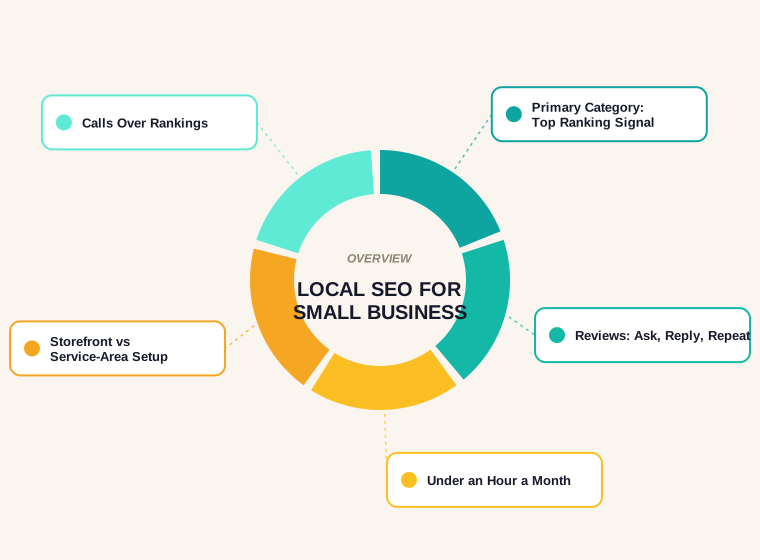
This guide covers what actually moves the needle for a small, single-location business: the profile fields that matter most, what a real local pack looks like, the difference between a storefront and a service-area setup, a realistic monthly routine, and where paying for help actually starts to earn its cost rather than just its price tag.
What Local SEO Actually Means for a Small Business
Strip away the jargon and local SEO for a small business is really three things working together: a Google Business Profile that accurately represents the business, a website that backs it up, and a steady flow of genuine reviews. None of the three is optional, but they are not equally weighted, and most owners spend their limited time on the wrong one.
The mistake we see most often is a business that redesigns its website twice while never once checking whether its Google Business Profile category is still correct. The profile decides whether you show up at all; the website decides what happens after someone finds you.
The One Signal That Matters More Than the Rest
If you do nothing else, get this right: your Google Business Profile's primary category.
Local SEO experts surveyed for Whitespark's 2026 Local Search Ranking Factors report rank primary category as the single most important individual signal for local pack rankings, ahead of reviews, links, or on-page content. The logic is simple: if your category does not match what someone searched, nothing else you do can fully make up for it.
Specificity beats generality here. "Bakery" is fine. "Custom Cake Bakery" is better if that is genuinely most of your business, because it matches a narrower, more specific search directly. Pick the category a first-time customer would use to describe you, not the broadest one that technically fits.
What a Small Business Profile Actually Needs
Beyond category, five fields do most of the remaining work.
- Complete, accurate hours, including holiday and seasonal hours kept current. A wrong "Closed" during business hours turns away exactly the customer who was ready to visit.
- Real photos, updated regularly. Interior, exterior, product, and team — not stock images. Profiles with recent photos get more direction requests and calls than ones that have not been touched in a year.
- A complete business description that says what you do in plain language, without keyword stuffing.
- Services or products listed individually, where your category supports it, rather than left blank.
- A steady flow of reviews, replied to consistently, good and bad.
Here is what that looks like on real, current listings for a small local category.
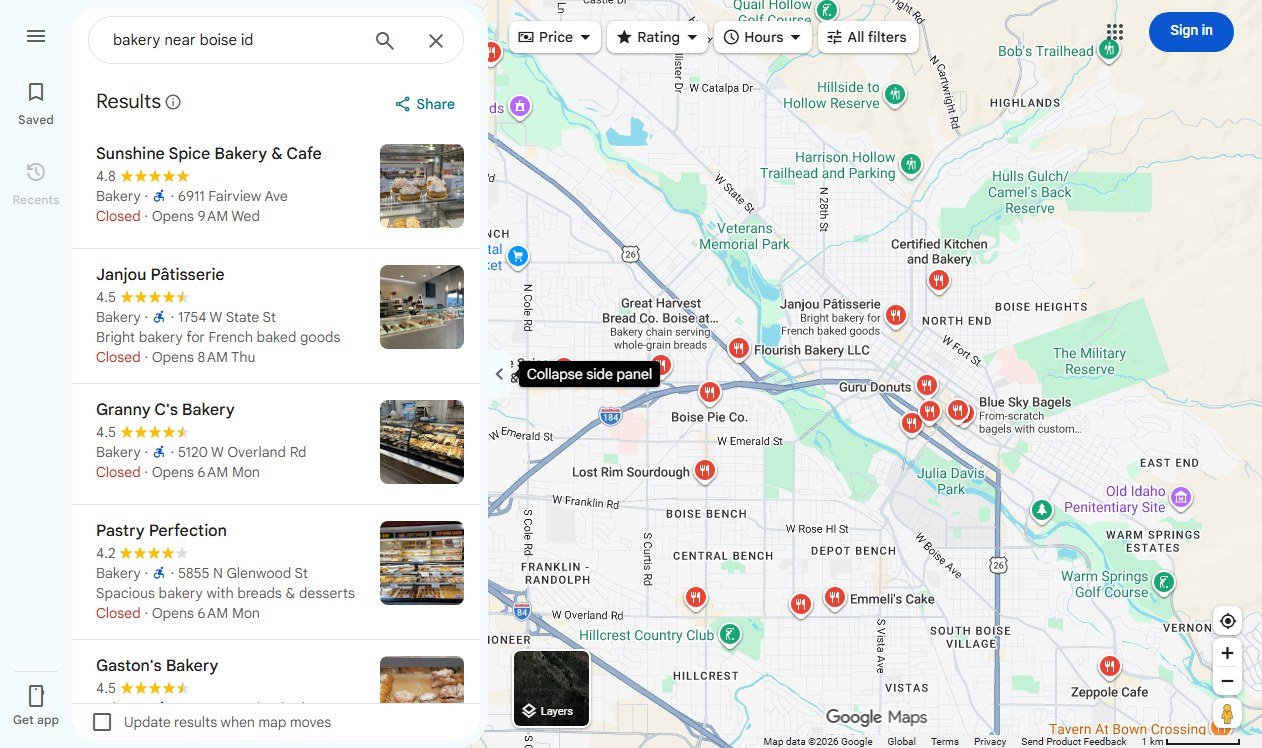
None of these businesses are large chains. They are one-location shops that filled in their profile properly and kept it current, and it shows in what a searcher sees before clicking anything.
The Website Still Matters, Just Less Than People Think
A small business does not need fifty pages. It needs a handful of pages that answer the questions a local searcher actually has.
- A homepage that states what you do and where you are within the first screen, not buried under a slideshow.
- One page per service or product line that genuinely differs, not ten thin variations of the same offering.
- A contact page with your address, phone number and hours matching your Business Profile exactly.
- LocalBusiness schema on the homepage, so the details are unambiguous to a crawler. Our free schema markup generator produces this in about a minute.
Consistency between the website and the profile matters more than either one being elaborate. A mismatch in address format or phone number between the two is a small thing that quietly costs trust signals over time.
Service-Area Businesses vs a Storefront
Not every small business has a location customers walk into, and the profile setup differs for the two.
A storefront — a shop, a restaurant, a clinic — shows its exact address and benefits from foot traffic and proximity to the searcher. Distance is a ranking factor here, and there is nothing to do about it except be genuinely close.
A service-area business — a plumber, a cleaner, a mobile groomer — hides the exact address and instead lists the towns or postcodes it serves. The mistake to avoid is listing an unrealistic service area covering an entire state to appear everywhere; Google's own tips for improving local ranking point toward accurate representation over broad coverage, and an inflated service area is one of the patterns Google's automated review increasingly catches.
List the areas you can genuinely reach within a reasonable drive, not the areas you would like to reach.
Reviews: The Habit That Compounds
Reviews are the second-heaviest ranking signal after category, and they are also the one small businesses most often leave to chance.
A repeatable process beats a one-off push. Ask at the moment satisfaction is highest — right after the job, the sale, or the appointment — with a direct link, not a vague "please review us" mentioned once. Reply to every review, positive and negative, briefly and without defensiveness. A thoughtful reply to a bad review often does more for trust than the negative review does damage.
What not to do: filtering who gets asked based on how happy they seem, offering a discount in exchange for a review, or posting reviews for your own business. All three breach platform policies and put the whole profile at risk for a gain that rarely lasts.
A Realistic Monthly Routine
Local SEO for a small business is mostly maintenance, not a one-time project. A routine that takes under an hour a month:
- Check and correct hours, especially around holidays.
- Add two or three new photos.
- Respond to any new reviews.
- Post one update if your category supports Google Posts — an offer, an event, or news.
- Check your Business Profile Insights for calls, direction requests and website clicks, and note anything unusual.
Consistency beats intensity. A profile touched lightly every month outperforms one that gets an elaborate overhaul once a year and is then ignored, and it takes less willpower to maintain a habit than to schedule an occasional big push you keep postponing.
Citations: Worth a Little Time, Not a Lot
A citation is any mention of your business name, address and phone number on another site — a directory, an industry association, a local chamber of commerce listing. They used to be a bigger part of local SEO than they are now, and small businesses still get pitched hundreds of them as a package.
What actually matters is consistency, not volume. Your name, address and phone number should match exactly across every place they appear — no "St." on one listing and "Street" on another, no old phone number lingering on a directory nobody has touched in years. A handful of accurate, relevant citations on sites your actual customers use beats three hundred generic ones nobody visits.
Start with the free, high-value ones: your industry's main directory if one exists, your local chamber of commerce, and any platform specific to your category. Everything beyond that has rapidly diminishing returns.
A Simple DIY vs Paid Comparison
Before paying for anything, it helps to see what each path actually buys.
| Task | Doing it yourself | Paying for it |
|---|---|---|
| Profile setup and category | Free, roughly 30 minutes | Rarely worth paying for on a single location |
| Monthly maintenance | Free, under an hour a month | $100–$300/month if you have no time at all |
| Review generation system | Free with a simple link and habit | $20–$80/month for automated request tools |
| Website build or rebuild | Free if you can build it; otherwise a one-off cost | $1,000–$5,000 for a small business site done properly |
| Ongoing local SEO strategy | Time-intensive to learn from scratch | $400–$1,500/month once you need to compete seriously |
For most single-location businesses, the free column covers almost everything that moves the needle. The paid column starts to earn its cost only once time, competition, or complexity genuinely outgrows what an owner can manage alongside running the business itself.
What Small Businesses Get Wrong
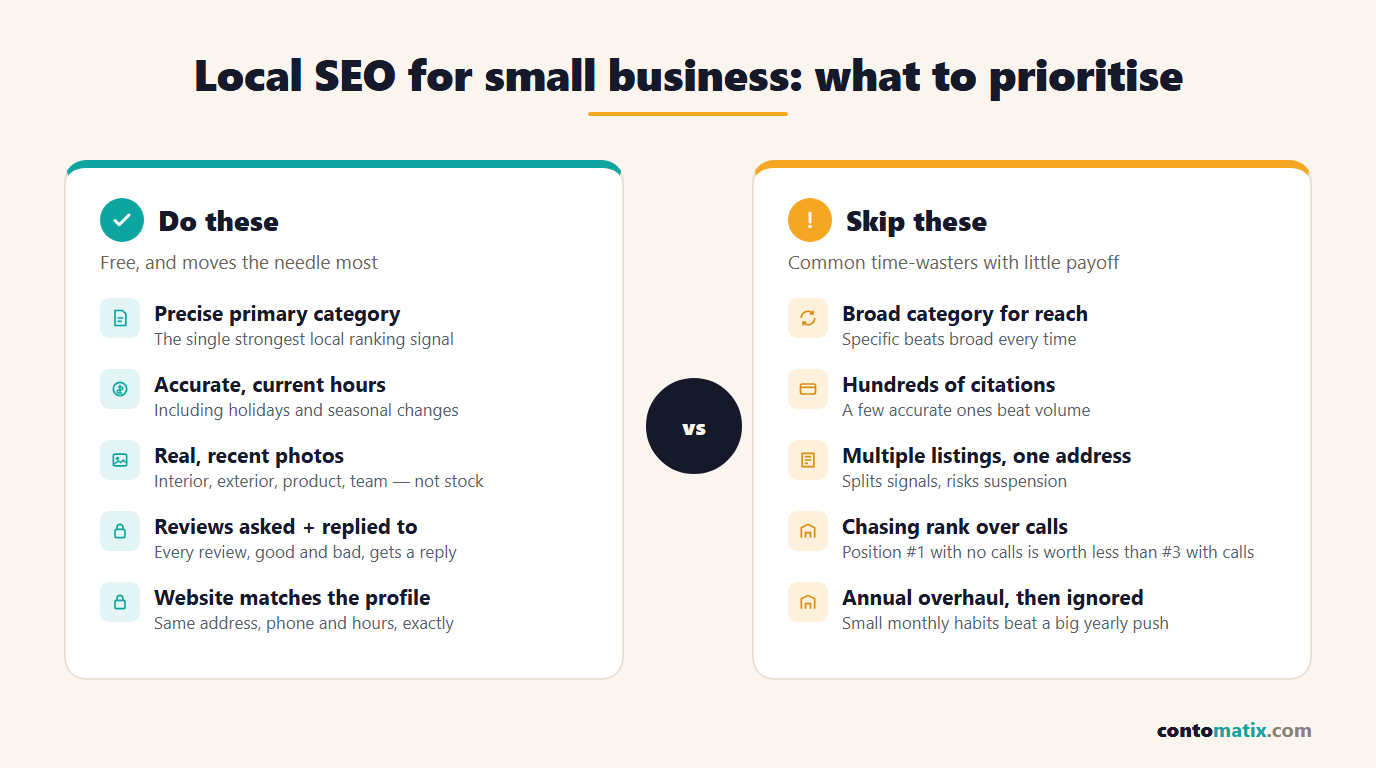
- Choosing a broad category to "cover more searches" instead of the specific one that actually matches.
- Multiple listings for one location, created by accident through different sign-ins or a move that was never consolidated.
- Copy-pasted descriptions that read like every other business in the category, adding nothing distinctive.
- Ignoring the website entirely because "the profile is what matters." The profile gets you found; the website is what convinces someone to actually call.
- Chasing rankings instead of calls. A number one position that produces no calls is worth less than a number three that does.
When to Bring in Help
A single-location business with an owner who can spend an hour a month rarely needs an agency. Hiring makes sense once one of these is true: you operate more than one location, you compete in a genuinely saturated market where the top results all carry hundreds of reviews, or nobody on your team can make changes to your own website.
If you are evaluating providers, our guide to local SEO services covers what a fair scope of work and price actually look like, and what to walk away from.
Measuring What Actually Matters
Skip the ranking screenshot. Three numbers tell you whether local SEO is working for a small business: calls from the profile, direction requests, and website clicks that lead to a contact form or a booking. Compare month to month, and compare the same month against last year if your business is seasonal, since a month-on-month dip in December often just means the calendar, not a problem.
Quick Recap
- Primary Google Business Profile category is the single strongest local ranking signal — pick the most specific one that genuinely fits.
- Accurate hours, real recent photos, a plain description and listed services do most of the remaining work.
- The website needs to be consistent with the profile, not elaborate.
- Reviews are the second-heaviest signal; ask consistently, reply to all of them, never buy or filter them.
- A light monthly routine beats an annual overhaul.
- Measure calls, direction requests and website contact clicks — not rankings alone.
Frequently Asked Questions
What is local SEO for a small business?
The ongoing work of making a single-location business easy to find in Google's map results and local search: an accurate, complete Business Profile, a consistent website, and a steady flow of genuine reviews.
What is the most important local SEO factor for a small business?
The primary category on your Google Business Profile. Local SEO surveys consistently rank it as the strongest individual local ranking signal, ahead of reviews and links.
Can a small business do its own local SEO?
Yes, in most cases. A single location with accurate hours, current photos, a proper category and a steady review habit covers most of what decides local visibility, and takes under an hour a month to maintain.
How many reviews does a small business need?
There is no fixed number. What matters is being in a similar range to the businesses currently ranking for your category and location, and adding reviews steadily rather than in bursts.
Does a small business need a website for local SEO?
Yes, though it does not need to be large. A homepage, a page per genuine service line, and a contact page with details matching the Business Profile exactly is enough for most small businesses.
How often should a Google Business Profile be updated?
Lightly, every month: check hours, add a couple of photos, reply to reviews, and post an update if your category supports it. Frequent small updates outperform an occasional large one.
Should a small business hire a local SEO agency?
Usually not for a single location with time to spare. It becomes worthwhile with multiple locations, a highly competitive market, or when nobody can make changes to the business's own website.
What should a small business measure to know if local SEO is working?
Calls from the Business Profile, direction requests, and website clicks that lead to a contact form or booking. Rankings are useful context but do not by themselves indicate revenue impact.
Can multiple Google Business Profiles hurt a small business?
Yes. Duplicate listings for the same location, often created accidentally through different logins or an unconsolidated move, split reviews and signals and can trigger suspension review. Consolidate to one verified listing per physical location.
Is paid advertising necessary alongside local SEO?
Not necessary, but it can help visibility while organic local signals build, particularly in competitive categories where paid results sit above the map pack.