Last updated: October 2026
SEO for accountants looks like a simple local job until you try it. A firm sells a service most people only search for under pressure, to clients who care a great deal about who they trust with their money, and in a profession where a page full of confident claims can do more harm than good. The firms that win online are rarely the ones with the cleverest tactics. They are the ones whose websites and profiles make it obvious who they are, what they do and where they do it.
This guide is about the choices that actually shape results for accounting and bookkeeping firms, CPAs and tax preparers: which searches to target, how to set up the Google Business Profile, how to build service and location pages without tripping a spam policy, how to show real credentials, and how to plan content around a calendar that is busy for part of the year and quiet for the rest. Nothing here depends on tax rules, so none are stated. For anything involving rates, limits or deadlines, the official tax authority is the only source to trust.
Start With the Searches People Actually Make
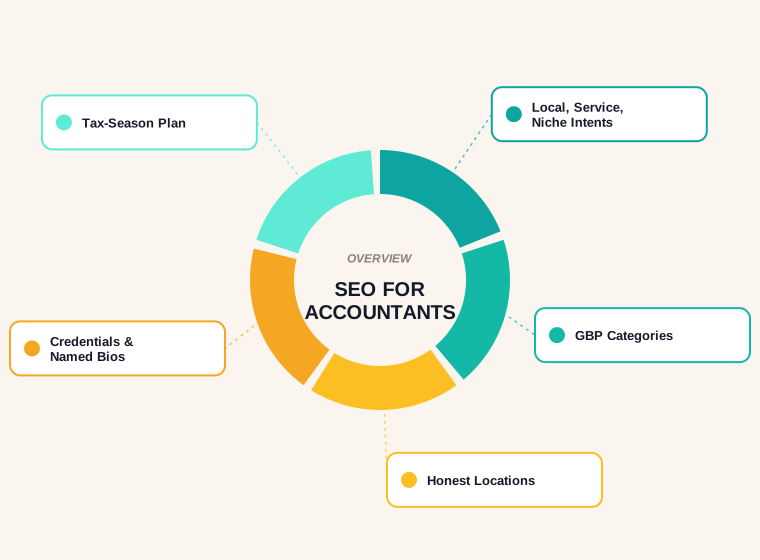
Most firms begin by asking how to rank for "accountant," and that is the wrong starting point. A single broad word is contested, ambiguous and often not what the searcher wants. It helps to sort accounting searches into three groups and decide which ones your firm can honestly serve.
- Local intent. Searches like "accountant near me" or a town name plus the word accountant. The searcher wants a nearby office, and Google answers mainly with the map results. These are won through the business profile, reviews and proximity.
- Service intent. Searches for tax preparation, bookkeeping, payroll or advisory work. These are won with a dedicated page for each service you sell, written around the questions a buyer of that service asks.
- Niche intent. Searches from a specific kind of client, such as accountants for online sellers, for contractors, for freelancers or for creators. These tend to be less crowded, and the person searching is usually closer to hiring someone who already understands their kind of business.
A firm with ten staff and a full book of local small businesses does not need the same plan as a solo bookkeeper who serves clients across several states. The first leans on local intent. The second may do better building depth in one niche and treating geography as secondary. Our guide to local keyword research walks through how to check which of these groups your market actually searches in, and the same method works here.
Set Up the Google Business Profile First
For local intent, the Google Business Profile does more work than the website does. Three decisions matter most: the name, the category and the address.
On the name, Google asks that it reflect "your business's real-world name, as used consistently on your storefront, website, stationery, and as known to customers." That rules out adding "Tax Preparation and Bookkeeping" to a firm called Hartwell & Co just to match searches. Put the services in the category and service fields instead.
On categories, Google's guidance is to choose the fewest it takes to describe your overall core business, and its help page on categories tells owners to pick a specific option for the primary category and not to add a category for every product or service. In the dashboard's category list, names like Accountant, Tax preparation service and Bookkeeping service are the kind of options you will see, though the exact list changes, so search it from inside your own profile rather than relying on any article, this one included. The practical rule is to make the primary category the one that describes the work most of your revenue comes from. A firm that mostly does annual returns for individuals and a firm that mostly keeps books for small companies should not share a primary category just because both can be called accountants.
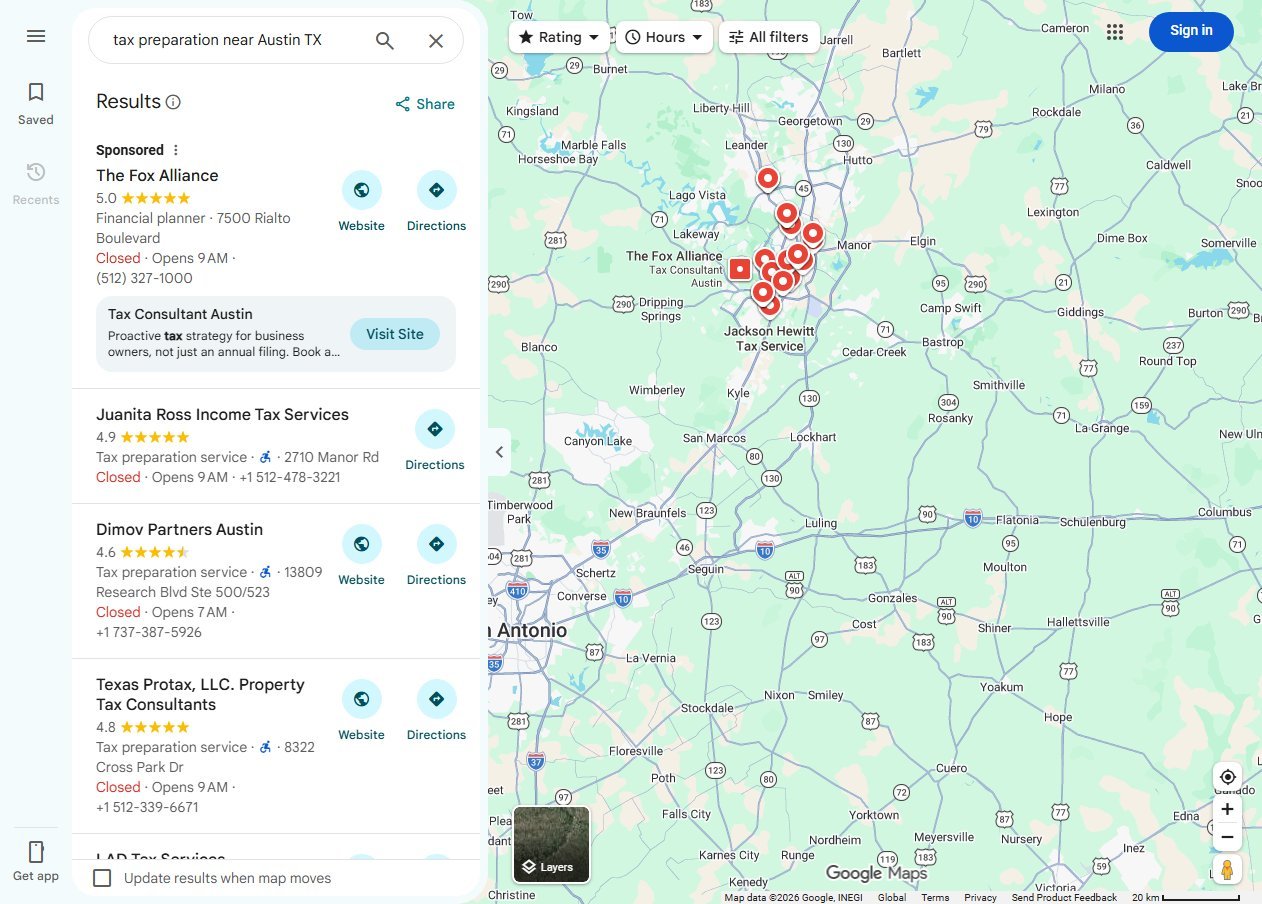
A live search shows what the category does. In the results above, each listing carries a category label under its name, a rating, an address and hours. A searcher scanning that list decides in a few seconds, so the label, the number of reviews and a complete profile are doing the first round of persuasion before anyone visits a website.
On the address, the rules are strict. In its guidelines for representing your business, Google states that if you are a service-area business, you should hide your business address from customers, and that a rented mailing address where you do not operate, known as a virtual office, is not eligible for a profile. An accountant who works from home and meets clients by video or at their premises should be set up as a service-area business with the home address hidden. A firm with a staffed office should show it. There is only one profile per business, so check that no duplicate from an old address or a former partner is splitting your reviews. The wider mechanics are covered in our local SEO for small business guide.
Build Service Pages Around What You Actually Sell
Service pages are where SEO for accountants either becomes specific or stays vague.
A single "Services" page with a bulleted list cannot answer a specific question, and specific questions are where the booked consultations come from. Give each service that matters its own page: tax preparation, bookkeeping, payroll support, advisory and any other work you want more of.
A useful service page does more than name the service. It says who the service is for, what a client has to provide, what happens in what order, how you communicate, and what the next step is. It answers the questions a nervous first-time client would ask before calling. Avoid padding the page with generic definitions of what bookkeeping is. Searchers already know, and a page that mostly repeats a dictionary entry is a page nobody finishes.
Niche pages deserve the same treatment. If a meaningful share of your clients are online sellers, a page titled for them, describing the kinds of records and platforms you handle and how you work with them, is far more likely to reach the right person than a general page that mentions ecommerce in one line. Write it only if you genuinely serve that group. A page claiming expertise you do not have is worse than no page.
Location Pages Without the Doorway Trap
Firms that serve several towns often create one page per town with the place name swapped in. Google has a name for this when it goes wrong. Its spam policies define doorway abuse as sites or pages created to rank for specific, similar search queries, and list pages "targeted at specific regions or cities that funnel users to one page" among the examples. You can read the exact wording in Google's spam policies for Google web search.
The line is between a page that is genuinely useful to someone in that place and a page that exists only to catch a search. A location page earns its place if it has content that would not apply anywhere else: an actual office address and directions if you have one, the people who work there, the kinds of local businesses you serve, and details a resident would recognize. A town page that says the same thing as the page for the next town, with the name changed, is the pattern to avoid.
A good test is simple. If you removed the town name and the page still read as true for any town, it is not a location page. Create pages only for places where you have a real presence or a real client base, and make each one differ in substance, not just in label.
Show Who You Are: Credentials and Named Professionals
Accounting is a field where trust decides the sale, and Google's own documentation says the same about how its systems read content. In its guidance on creating helpful, reliable, people-first content, Google explains that it looks for signals of experience, expertise, authoritativeness and trustworthiness, and says that "trust is most important." The same page notes that E-E-A-T is not a specific ranking factor, but that systems give more weight to strong signals for topics that could affect financial stability, which is a fair description of money and tax advice.
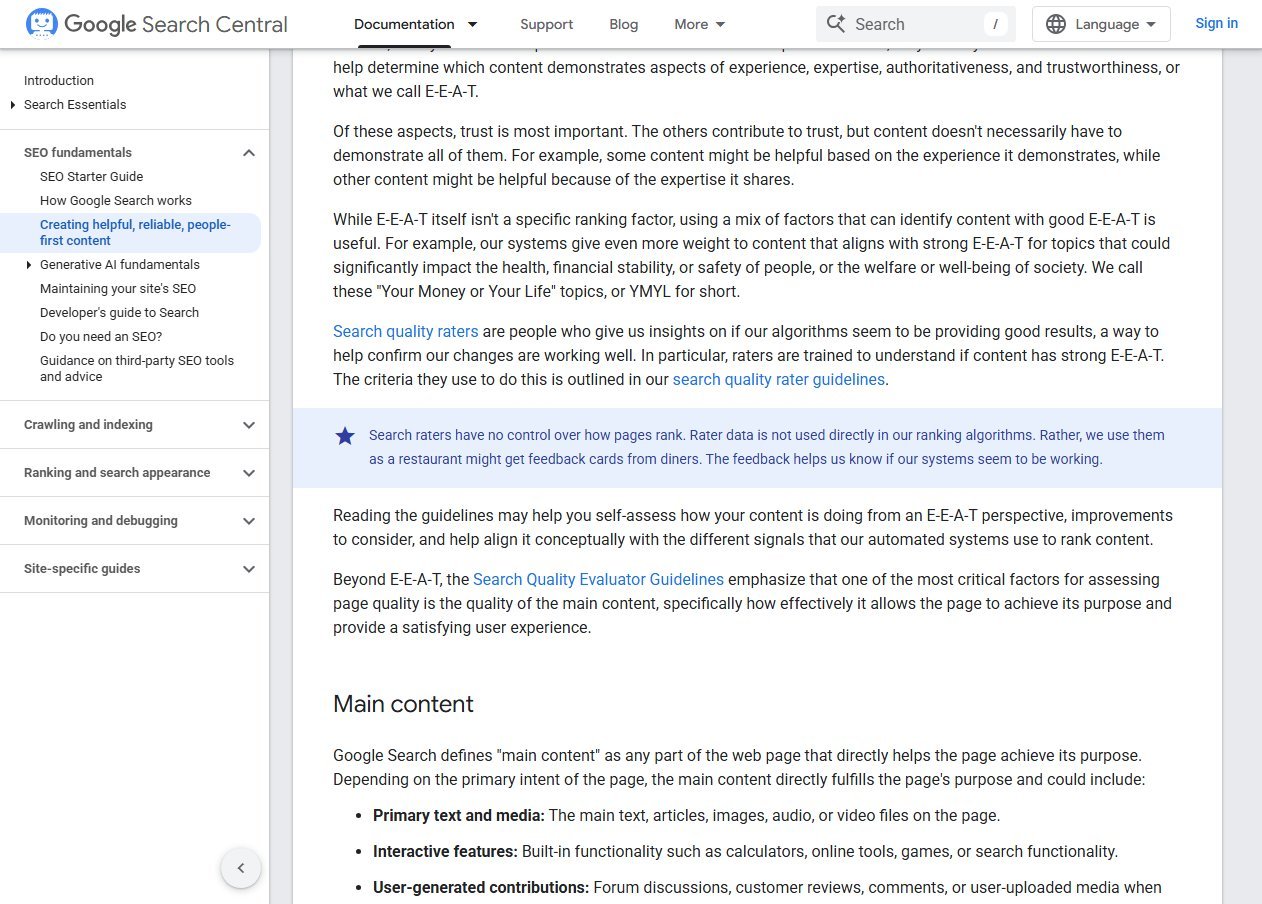
For a firm, this turns into plain website work. The same guidance asks whether it is self-evident who wrote the content and whether pages carry a byline where one would be expected. Put it into practice with these steps.
- A page for each professional. A real name, a real photo, the licence or credential they hold, the kinds of clients they work with and how to reach them.
- Bylines on advice content. Each article should say who wrote or reviewed it, with a link to that person's page.
- Only credentials that exist. Never invent a title, a designation or an author. Google's guidance specifically warns against fake author profiles, and a client who checks a credential and finds nothing will leave for good.
- Clear firm details. Address, phone, hours and how the firm is regulated or registered, placed where a visitor can find them without searching.
Whatever you publish about your services, check your licensing board and professional association rules on advertising and on how credentials may be described before it goes live. Those rules are set by the bodies that license you, differ between places, and sit outside what an SEO guide can settle.
Reviews: Ask Everyone and Offer Nothing
Reviews are the clearest proof a small firm can offer, and Google's policies are firm on how to collect them. Its contribution policy on incentivized or biased reviews says businesses must not offer payment, discounts or free services in return for reviews. A "free consultation for a five-star rating" offer is exactly the sort of thing that gets reviews removed and can put a profile at risk.
Review gating, where only happy clients get the link, is the other trap. It distorts the rating, and it conflicts with Google's rules against manipulating ratings. The cleaner approach is to ask every client, in the same words, at a sensible moment, such as right after a piece of work is delivered. Reply to every review in plain, short language. Do not reveal anything about a client's finances or affairs in a public reply, even when defending the firm. Move any detail to a private channel, and check your professional body's rules on confidentiality and on how you may respond.
Citations and Links From Professional Bodies
Off-site signals matter in SEO for accountants because clients check who vouches for a firm.
Local rankings lean on prominence as well as proximity. For accountants, the most credible prominence comes from places that match the profession and the area: your professional association's member directory, your local chamber of commerce, business groups you actually belong to, and local organizations you work with or sponsor.
Keep the firm's name, address and phone number identical everywhere it appears. Inconsistent details across directories create doubt about which listing is real. Focus on a short list of sources a prospective client might plausibly look at, not on submitting to hundreds of directories nobody reads. A handful of accurate listings and a few links from bodies that vouch for you carry more weight than a long list of low-quality ones. A link from a body that has verified your membership is worth more than any number of directory entries you paid for.
Local partnerships also produce links naturally. A firm that speaks at a small-business event, contributes advice to a local business group's newsletter or works with a nearby bank or law practice on referrals tends to be mentioned on websites that readers trust.
A Seasonal Content Calendar That Respects Tax Season
Search interest for accounting services moves through the year. Individuals look for tax help in one stretch, and small businesses look for bookkeeping, payroll and planning help at other times. The mistake is to plan content in the same weeks you are busiest with client work, then to publish nothing for months.
- Publish early. Write and publish seasonal content well before the busy period, so pages have time to be crawled and to build any visibility before demand rises.
- Update, do not replace. Keep one page per recurring topic and refresh it each year, instead of creating a new page every year that competes with the old one.
- Use the quiet months for deeper work. Service pages, niche pages, professional bios and explanations of how you work are slow to write and suit the weeks when client work eases.
- Link to the official source. Where a page touches a tax rule, rate, limit or date, tell readers to check the official tax authority source and link to it, and do not state the figure yourself. Rules change, and a wrong number on your site is a trust problem and a risk.
- Be ready for the surge. Before the busy period, check that your hours, holiday closures and phone numbers are correct on the profile, and that your contact forms reach a person who will answer.
Staff capacity matters here more than in most trades. A page that promises quick response and a form that goes unanswered for a week costs more than it earns. Plan how many new enquiries you can take before you try to generate them.
Measuring Leads, Not Just Rankings
Good SEO for accountants is judged by clients won, not by position reports.
Rankings are a means. The number that matters to a firm is the number of enquiries that turn into clients. Set up measurement before you change anything, so you can tell later what moved.
- Business Profile insights. Calls, direction requests and website clicks from the profile show how local visibility turns into action.
- Search Console. Look at which queries bring impressions and clicks to each service page, and which pages get impressions but few clicks.
- Tracked enquiries. Record how every new client heard about you. Ask on the first call or in the contact form. A simple "how did you find us" field gives more honest data than any dashboard.
- A monthly review. Compare enquiries by source and by service, then decide which page or profile section to improve next.
Treat the first three months as a baseline. Local profile changes can show effects within weeks, while content and links usually take longer, and the pattern depends on your market and how competitive it is. No honest provider can promise a ranking or a number of leads in advance.
Common Mistakes Accounting Firms Make
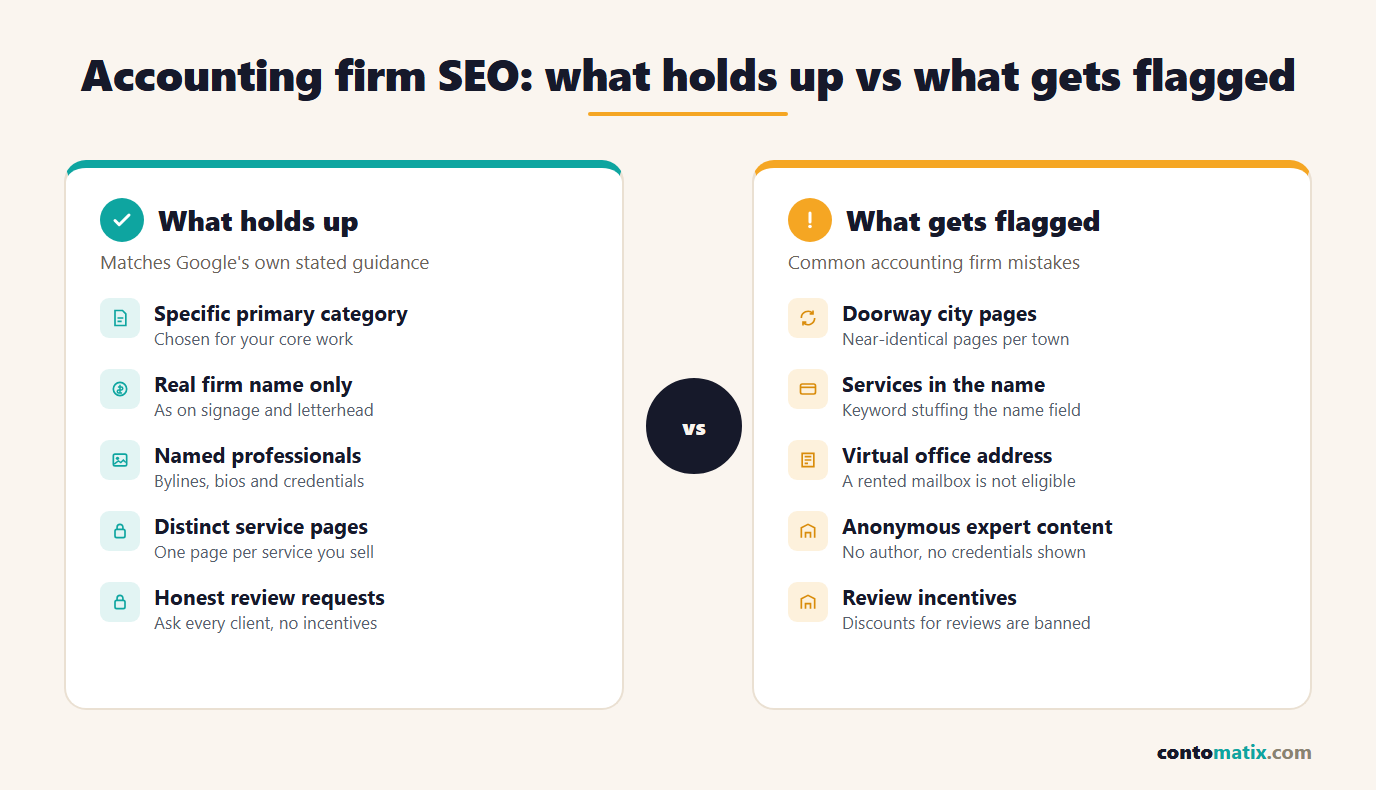
Most of the damage in this field comes from a short list of avoidable habits. Putting services in the business name is one, and a virtual office address is another. Publishing the same page for ten towns is a third. Add to that anonymous articles with no named author, review offers that break the platform's rules, and a website that was last updated before the firm hired its current partners. None of these needs a specialist to fix. They need someone to read Google's published guidance and compare it with what the firm has done so far.
The other common mistake is chasing every service at once. A firm that tries to rank for tax preparation, payroll, bookkeeping, advisory and five niches in the same quarter usually ends up with thin pages across the board. Pick two or three priorities, build them properly and move to the next group once those are working. Our guide to local SEO for contractors shows the same pattern in another service trade, and the lessons about profile discipline and honest service pages carry over directly to SEO for accountants too.
A Short Checklist Before You Start
- Confirm the profile name matches your signage and letterhead exactly, with no services added.
- Choose one specific primary category for your core work and add others only for separate lines of work you genuinely offer.
- Decide whether your address is staffed. If not, switch to a service-area setup and hide it.
- Search Maps for your firm to confirm there is only one profile, and merge or remove duplicates.
- Build or tighten one page per priority service, and one per niche you genuinely serve.
- Create a page for each professional with real credentials, and add bylines to advice content.
- Create location pages only where you have a real presence, each with content that differs in substance.
- Write a review request that goes to every client with no incentive, and review your professional body's rules before using it.
- Check that every tax-related statement links to the official source and states no figure of its own.
- Set up tracking for calls, form enquiries and the source of each new client.
Quick Recap
- For SEO for accountants, sort target searches into local, service and niche intent, and choose the groups your firm can honestly serve.
- Keep the profile name equal to your real firm name, and pick the fewest categories, starting with a specific primary one.
- Hide the address if you are a service-area business, and never use a virtual office or rented mailbox.
- Give each priority service its own page, and write niche pages only for clients you really serve.
- Avoid doorway-style town pages; location pages need content that is true of that place alone.
- Show named professionals with real credentials, and byline advice content, in line with Google's people-first guidance.
- Ask every client for a review and offer nothing in return, and check your licensing board and professional association rules.
- Do not state tax rules or figures in your content; direct readers to the official tax authority source.
- Measure calls, enquiries and client source, not just rankings.
If you want a second pair of eyes on a profile or a set of service pages, Contomatix can review them against the guidance above.
Frequently Asked Questions
What is SEO for accountants?
It is the work of making an accounting or bookkeeping firm easier to find and trust in search. It covers the Google Business Profile, service and location pages, professional bios, reviews and local citations, with the goal of producing enquiries from the right clients.
Which Google category should an accounting firm choose?
Google advises choosing a specific primary category and the fewest categories that describe your core business. Pick the one that matches the work most of your revenue comes from, and search the category list inside your own profile to see the exact options.
Can I add "tax preparation" to my firm's Google name?
No. Google asks for the real-world name used on your storefront, website and stationery. Use the category and services fields to show what you offer.
I work from home. Should I show my address?
Google says service-area businesses should hide their business address from customers. If you do not meet clients at a staffed office, set the profile up as a service-area business and keep your home address private.
Do I need a separate page for every town I serve?
Only where you have a real presence or a real client base, and only if each page has content that is true of that place alone. Near-identical town pages risk falling under Google's doorway abuse policy.
Do credentials and bios help rankings?
Google says E-E-A-T is not a specific ranking factor, but its systems favor content showing experience, expertise and trust, especially on financial topics. Named professionals with real credentials also reassure clients, which helps conversions.
Can I offer a discount to clients who leave a review?
No. Google's policy does not allow businesses to offer payment, discounts or free services in exchange for reviews. Ask every client the same way and accept the ratings you receive.
Should I write about tax rules and deadlines?
Be careful. Rules and dates change, and errors cause real harm. Explain how your service helps, and tell readers to check the official tax authority source for current figures instead of stating them yourself.
How do advertising rules for accountants affect my website?
Licensing boards and professional associations often set rules on advertising and on how credentials are described. Those rules vary by place, so check your licensing board and professional association rules before publishing.
How long does SEO take to work for an accounting firm?
Profile fixes can show effects within weeks, while service pages, reviews and links build more slowly. Competitive cities take longer, and no one can honestly promise a set ranking or lead count.