Last updated: October 2026
Local SEO for contractors is less about clever tricks and more about proving, in three or four places at once, that you are a real crew that does real work in a specific area. Someone with a leaking roof, a dead furnace or a half-demolished kitchen does not read ten websites. They look at the map results, glance at star ratings and photos, and call one or two names. Everything in this guide is aimed at making you one of those names.
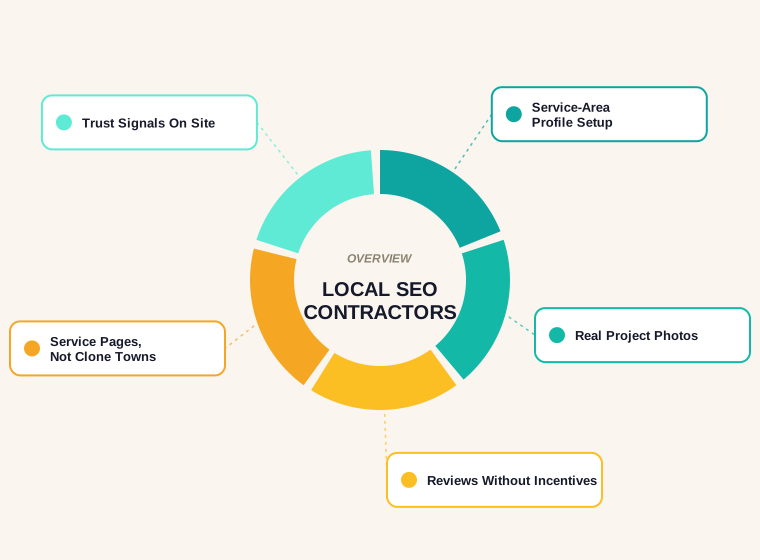
The advice here covers general contractors, remodelers and the home-service trades together, because the machinery is the same: a correctly set up Google Business Profile, service pages that match how people search, honest service-area pages, reviews you can show off, trust signals on the site, and a way to tell which calls came from where. Trade-specific detail lives in separate guides; this one is the foundation under all of them.
How Local SEO for Contractors Fits Into Local Search
When a homeowner types a phrase such as "kitchen remodeler near me" or "emergency plumber," Google tends to answer with a map block and a list of nearby businesses before any ordinary website results. Google has described three broad factors for those local results: relevance, distance and prominence. Relevance is how well your profile and site match the search. Distance is how far you are from the searcher, or from the location they named. Prominence is how well known you are, which draws on reviews, links, mentions and the general strength of your web presence.
You cannot change distance, and a contractor in the next town cannot fake it either. That leaves relevance and prominence, which is where almost all of the practical work in local SEO for contractors sits. Relevance comes from accurate categories, clear service descriptions and pages that answer specific searches. Prominence comes from reviews, local links and a consistent footprint across the web.
One more point specific to contractors: much of your work happens at the customer's address, not yours. That changes how you set up the profile, and it is the first thing to get right.
Set Up Your Google Business Profile for a Contractor
Start with the basics, because errors here undo everything else. Use your real business name exactly as it appears on your truck, invoices and website. Add the phone number a person will actually answer, a primary website URL and the hours you really keep. If you take emergency calls out of hours, say so in the profile rather than stretching the standard hours.
The decision that matters most is whether you show an address at all. Google separates businesses that serve customers at their location from those that travel to customers. Its help documentation defines a service-area business as one that "visits or delivers to customers directly but doesn't serve customers at their business address." Most plumbers, electricians, roofers, painters and HVAC crews fit that description. A remodeler with a showroom where clients come in and browse samples may be both. If you work from a home office and nobody visits, you would normally hide the address and list the areas you serve instead.
Google's help page on service areas sets out the limits. You can list up to 20 service areas, based on cities, postal codes or other areas, and the boundaries of your overall area should not be more than about two hours of driving time from where the business is based. It also states that a service-area business can have only one profile for the whole area it serves, which rules out opening a new profile in every neighboring town.
Categories, Services and the Description
Pick the primary category that describes what you are mostly hired to do. A company that does whole-house renovations belongs under a contractor or remodeler category, not under "painter" because painting is one of twenty tasks it performs. Add secondary categories only where they describe genuinely separate lines of work you want calls for. A long list of loosely related categories tends to dilute the signal rather than widen your reach.
Next, fill in the services section. This is where trade detail goes: panel upgrades, tear-off and re-roof, bathroom remodels, drain cleaning, furnace replacement. Use the names customers use, write one or two plain sentences under each, and include a price range only if you can honor it. The business description is worth a few careful sentences covering what you do, who for and where, without a keyword list and without links or promotional offers that Google may reject.
Keep the profile and your website describing the same things. If the profile says you do decks and fences and the site never mentions them, you have created a relevance gap and a trust gap at the same moment.
Project Photos That Do Real Work
For a contractor, photos are proof of workmanship, and homeowners treat them that way. A profile full of stock images or a single logo tells a visitor nothing. A profile with before-and-after shots of finished jobs, your crew at work and your vehicles on site tells them you exist and you are busy.
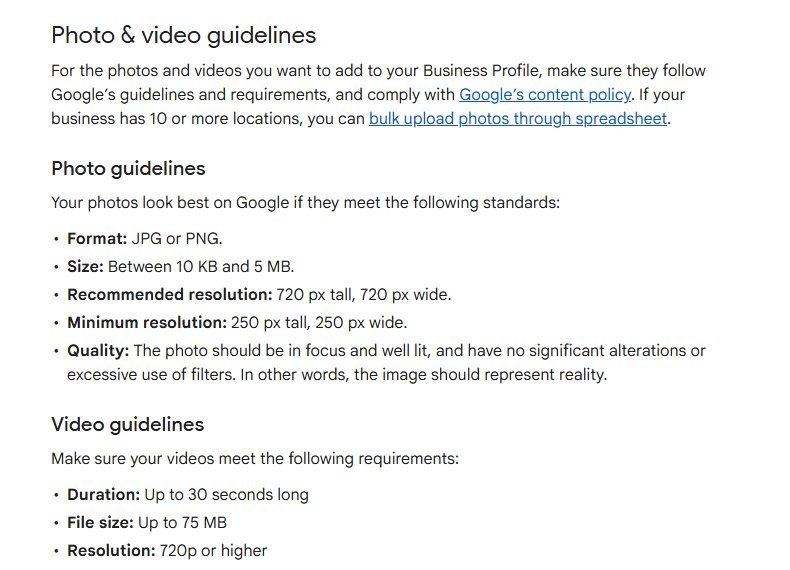
Google publishes technical standards for what it accepts. Per its photo and video guidelines, photos should be JPG or PNG, between 10 KB and 5 MB, with a recommended resolution of 720 by 720 pixels and a minimum of 250 by 250. The quality line is the one contractors should remember: the image should be in focus, well lit, and without significant alterations or heavy filters, so it represents reality.
A practical routine is to have the crew lead photograph every job at three points: before work starts, mid-project, and the finished result. Upload a handful each week rather than a hundred in one afternoon. Name the files sensibly before they go on your own website, and keep the best of them for project pages, which we come to below. Never upload another company's work as your own; it is both dishonest and the kind of thing customers and competitors report.
Service Pages: The Core of Local SEO for Contractors
The profile gets you into the map block. The website decides whether the visit turns into a quote request. A single page headed "Our Services" with a bulleted list cannot answer a homeowner who wants to know whether you do exactly what they need.
Build one page for each service you want more work from. A general contractor might have pages for kitchen remodeling, bathroom remodeling, additions, basement finishing and whole-home renovation. An HVAC company might separate furnace replacement, AC installation, repair and maintenance plans, an approach we cover in our guide to SEO for HVAC companies. Each page should explain, in plain terms:
- What the job involves from first visit to cleanup, including the stages a homeowner will notice.
- What affects cost and timeline, such as access, permits, materials and the age of the home, even if you do not publish exact prices.
- Who it is for and when it is not, which builds credibility faster than claiming you do everything.
- Proof: two or three real photos of your own work and, where you have them, a review that mentions the job.
- A clear next step: a phone number that is tappable on mobile and a short form that asks only what you need to give a quote.
Write these pages from the questions your estimators hear on the phone. If customers always ask about permits, disruption or how long the kitchen will be out of use, answer it on the page. That is original, useful content, and it is what separates a page that earns calls from one that just exists.
Service-Area Pages Without Doorway Spam
This is where many contractor sites get into trouble. The tempting move is to take one service page, duplicate it forty times, and swap the town name in each copy. It looks like coverage; in practice Google's spam policies call it doorway abuse. The policy defines it as sites or pages "created to rank for specific, similar search queries" that lead users to intermediate pages less useful than the final destination.
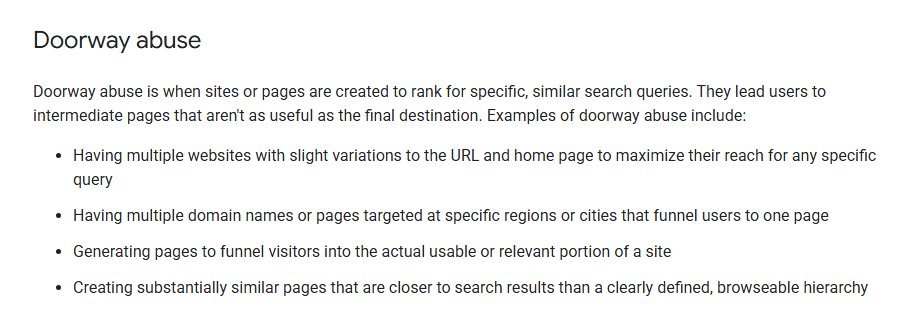
The examples on Google's spam policies page include multiple domain names or pages targeted at specific regions or cities that funnel users to one page, and substantially similar pages that sit closer to search results than to a clearly defined, browsable site hierarchy. A town page that says the same paragraph as every other town page, with a different name, fits that description.
That does not mean you should never have location pages. It means each one has to deserve to exist. A good test is whether the page would still be useful if the town name were removed from the title. Pages that pass usually contain things like:
- Real jobs completed in that area, with photos and a short description of what was done.
- Local conditions that change the work: older housing stock, flood zones, HOA rules, permit office quirks, soil, climate.
- Which of your services you actually perform there, and honest limits on travel time.
- Reviews from customers in that place.
- Links to the specific service pages, so the location page is part of a logical structure and not a dead end.
If you cannot write something specific and true about a town, do not create a page for it. List it in your service-area profile and on one general "areas we serve" page instead. Fewer, better pages for the places where you have actually worked will outperform a hundred thin ones, and they will not put the site at risk.
Reviews: Getting Them and Answering Them
Reviews are probably the strongest prominence signal you control, and for a contractor they carry extra weight because a customer is about to let you into their home or hand over a large deposit. Volume, recency and the content of reviews all matter. A steady trickle of new reviews looks healthier than twenty arriving in one week and then silence.
Make asking part of the job rather than an afterthought. Send the request when the customer is happiest, usually at final walkthrough or when the invoice is paid, by text or email with a direct link to your review form. Ask every customer in the same way. Do not offer discounts or gifts in exchange for a review, and do not filter who gets the link based on how you think they feel; Google's review policies prohibit incentivized reviews and attempts to manipulate ratings, and the risk to your profile is not worth it.
Reply to reviews, positive and negative, within a day or two when you can. A short, specific thank-you that names the project reads as genuine. For a negative review, stay factual and calm: acknowledge the problem, say what you will do or have done, and offer to continue by phone. Future customers read the reply more closely than the complaint. Never argue, never reveal private details of the job, and never write fake reviews of your own business or of competitors.
Licensing, Insurance and Other Trust Signals
Homeowners worry about being scammed, and they check for proof you are legitimate. Show it on the site instead of making them ask. Requirements differ by state, province and trade, so confirm what applies to you with your licensing authority, then display it accurately.
- Licence number where your jurisdiction requires or allows it, in the footer and on relevant service pages.
- Insurance and bonding, stated plainly and kept current. Never claim coverage you do not carry.
- Manufacturer certifications and trade association memberships that you actually hold.
- Years in business and the names and photos of real team members, which separate an established firm from a lead-generation site.
- Warranty terms written in simple language, including what is and is not covered.
- A physical or service-area statement that matches your profile, so nothing contradicts anything else.
These details do double duty. They reassure the visitor, and they give search engines consistent, checkable facts about the business behind the website.
Project Galleries and Case Pages
A gallery of loose photos is fine, but a project page is better. Pick your strongest jobs and give each its own page with a short story: the problem, what you built or repaired, the materials, how long it took, and a quote from the client if they have agreed to it. Use real photos taken on site, descriptive file names and alt text that says what the image shows, such as a finished basement bathroom with a walk-in shower.
These pages serve three purposes. They provide proof to visitors comparing you with other bids. They give you honest, location-specific content to link from service and area pages, which is the right answer to the thin-page problem above. And they supply a natural place for the review that mentions the project. Do not invent case studies or inflate results; describe what happened and let the photos carry it.
Always get the customer's permission before publishing identifiable details such as a full street address or photos that show the inside of their home. Naming the neighborhood or town is usually enough.
NAP Consistency and Citations
NAP stands for name, address and phone number. The idea is simple: every place that lists your business should show the same details. Differences such as "Ltd" versus "Limited," a tracking number on one site and the main line on another, or an old address on a directory create doubt about which version is correct.
Decide on one exact form of your business name, one phone number and, if you show an address, one formatting of it. Then check the places that matter most: your Business Profile, your website footer and contact page, major map and review platforms, and the directories that serve your trade. If you use call-tracking numbers, keep the main number as the primary on your profile and website and put tracking numbers elsewhere only where your tool supports it properly.
Concentrate on accuracy rather than volume. A dozen correct, relevant listings are worth more than a hundred copied from a bulk submission list. If a listing is wrong and you cannot edit it, claim it and correct it, or ask the platform to merge duplicates. Our broader guide to local SEO for small business covers the citation basics in more detail.
Local Links Contractors Can Actually Earn
Links remain part of prominence, and contractors have more natural opportunities than they think. The ones worth pursuing are the ones a real person would find believable:
- Suppliers and manufacturers that list approved or certified installers.
- Trade and business associations, including local builders, home-improvement and chamber-of-commerce bodies.
- Local sponsorships of youth teams, school events, charity builds and community clean-ups, which often come with a page naming sponsors.
- Local press and community blogs when you complete a notable project, donate labor or share a seasonal maintenance checklist.
- Partners such as architects, interior designers, real-estate agents and property managers who can refer or mention you.
The approach to avoid is buying bundles of links or swapping with unrelated sites. If you want to go deeper on outreach for a specific trade, see our guide to link building for plumbers, whose principles apply equally to electricians, roofers and remodelers.
Tracking Calls, Forms and Directions
If you cannot say where your leads come from, you cannot decide where to spend. Set up measurement before you change anything big, so you have a baseline.
- Use your Business Profile performance data to see calls, website clicks and direction requests over time.
- Add tracking links with campaign parameters to the website link on your profile, so profile visits are separable from ordinary organic visits in your analytics.
- Track form submissions and tap-to-call clicks on the site as conversion events.
- Ask every new caller how they found you and record the answer in your job system. Self-reported source data is imperfect but it catches phone calls that no tool sees.
- Review monthly: which services and which areas produce booked jobs, not just enquiries.
Pay attention to job value, not only lead count. Fifty calls for small repairs may be worth less than five for a full renovation, and your pages and profile can be adjusted to attract more of the work that pays.
Common Local SEO Mistakes for Contractors
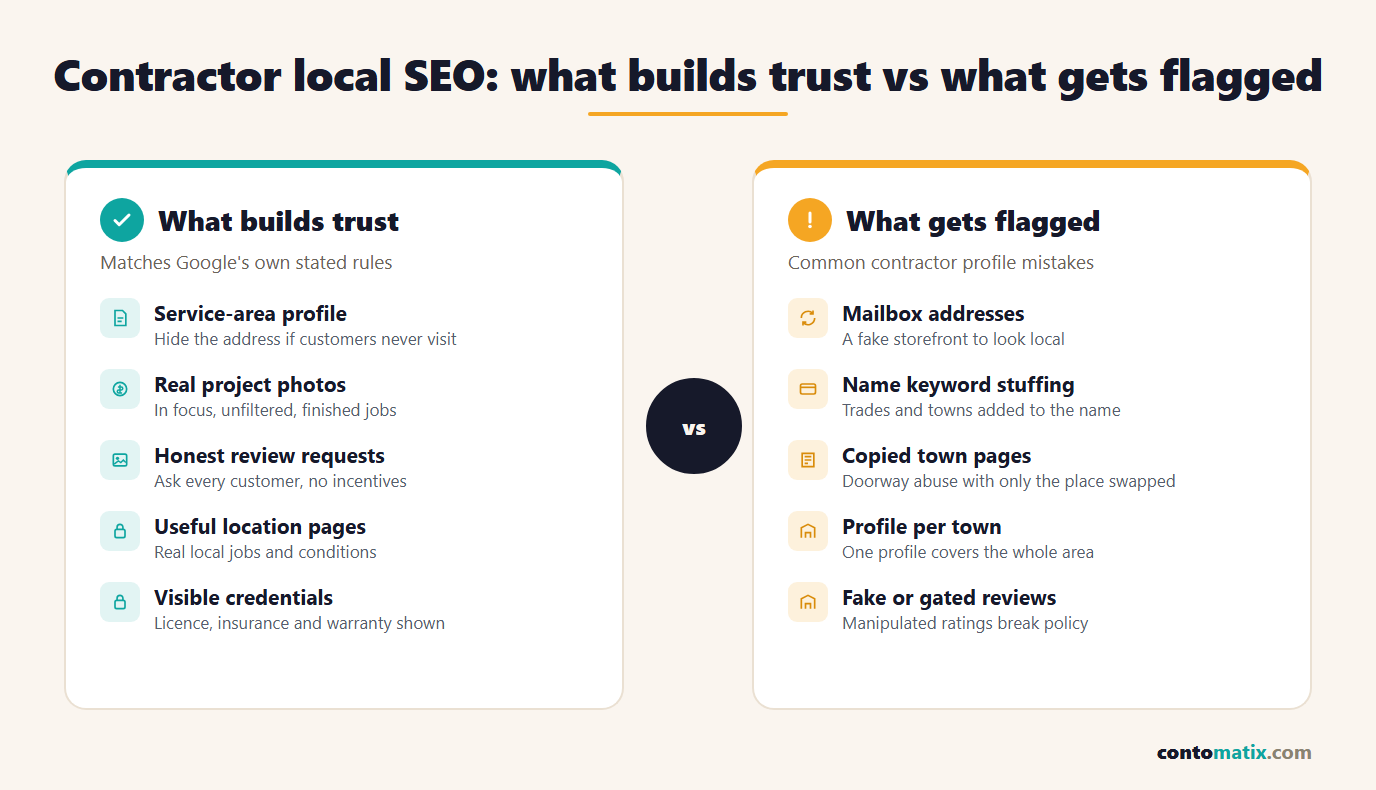
- Keyword-stuffing the business name with trades and towns, which can lead to edits or suspension.
- Using a fake or mailbox address to appear local instead of setting up a service-area profile.
- Opening multiple profiles for one business in different towns when the rules allow one profile per service-area business.
- Cloning town pages with only the name changed.
- Ignoring reviews, leaving complaints unanswered for weeks.
- Uploading stock photos or heavily filtered images in place of real job photos.
- Letting details drift between the profile, site and directories after a phone or address change.
- Treating it as a one-off task instead of a monthly habit.
A 30/60/90-Day Plan for Local SEO for Contractors
Days 1 to 30: fix the foundation. Audit and correct the Business Profile: name, categories, service areas, hours, services and description. Search for duplicates and merge them. Record your NAP and fix the biggest inconsistencies. Set up call, form and profile tracking. Start the review-request routine on every finished job.
Days 31 to 60: build the pages. Write or rewrite service pages for your top three or four job types. Add trust details: licence, insurance, warranty and team. Publish two or three project pages with real photos. Create location pages only for places where you have genuine local work to show, and fold the rest into a single areas page.
Days 61 to 90: widen prominence. Pursue supplier, association and sponsorship links. Add more projects and reviews to the site. Review your numbers: which pages bring calls, which areas convert, which categories drive the best jobs. Adjust where you put effort and keep the weekly photo and review habits going.
A Short Checklist Before You Start
- Decide whether your profile should show an address or hide it as a service-area business.
- Confirm the business name matches your signage, invoices and website exactly.
- Select the primary category and only the secondary ones that reflect real work.
- List up to 20 service areas that you genuinely serve, within a realistic drive.
- Upload real, unfiltered photos of finished jobs, and keep adding them.
- Write one page per priority service, with real photos and answers to common questions.
- Create location pages only where you have specific, true local content.
- Set up a review-request message for every customer and reply to each review.
- Display licence, insurance and warranty details accurately on the site.
- Track calls, forms and directions, and review the numbers monthly.
Quick Recap
- Local SEO for contractors comes down to a correct profile, useful pages, honest reviews and visible trust signals.
- Local results depend on relevance, distance and prominence; you control relevance and prominence.
- Most contractors are service-area businesses: Google allows up to 20 service areas and one profile for the whole area.
- Use real, unedited project photos that follow Google's photo guidelines.
- Build one page per core service and treat location pages as content that must stand on its own; copied town pages risk falling under doorway abuse.
- Ask every customer for a review, offer nothing in return, and reply to all of them.
- Show licence, insurance and warranty details accurately and keep NAP identical everywhere.
- Earn local links from suppliers, associations and community involvement, and measure leads by source.
If you want help applying this to your own trade and service area, the team at Contomatix works through the same steps with local service businesses, starting with a profile and site audit.
Frequently Asked Questions
What is local SEO for contractors?
It is the work of making a contracting or home-service business visible in map results and local searches. It covers the Google Business Profile, service and area pages on the website, reviews, trust signals, citations and local links.
Should a contractor hide their address on Google?
If you visit customers and do not serve them at your premises, Google treats you as a service-area business and you would normally hide the address. If customers visit a real showroom or office during stated hours, showing it can be appropriate.
How many service areas can a contractor list?
Google's help documentation says up to 20 service areas, with the overall boundary within about two hours of driving time from where the business is based. Only list areas you really serve.
Can I make a separate Google profile for each town I serve?
No. Google states that a service-area business can have only one profile for the whole area it serves. Use the service-area setting and your website pages to cover multiple towns.
Are city landing pages allowed?
Yes, if each page is genuinely useful. Google's spam policies target doorway abuse, such as substantially similar pages aimed at specific cities that funnel users to one page. Add real local jobs, conditions and reviews, or skip the page.
What photos should a contractor upload?
Real, in-focus, well-lit images of finished work, crews on site and vehicles, in JPG or PNG. Google says photos should represent reality without significant alterations or excessive filters.
How do I get more reviews as a contractor?
Ask every customer at the end of the job, with a direct link by text or email. Do not offer discounts or gifts for reviews, and do not only ask customers you expect to be happy.
How should I respond to a bad review?
Reply promptly, stay calm and factual, acknowledge the issue, and offer to resolve it by phone. Do not argue or share private job details. Future customers judge you by how you respond.
Do licensing and insurance details help SEO?
They mainly help trust and conversion, and they give consistent, checkable business facts on your site. Confirm local requirements and display only credentials you actually hold.
How long does local SEO take for a contractor?
Profile corrections can show effects within weeks, while reviews, project content and links build more slowly. A 90-day plan sets a foundation, but local SEO for contractors works best as an ongoing monthly habit.


