Last updated: October 2026
SEO for solar companies is unusual because the buyer's questions change faster than the product does. A homeowner who searched "is solar worth it" two years ago was weighing a federal tax credit that has since ended for homeowners, and a lot of installer websites still talk as if nothing has changed. Pages like that cost leads twice: they mislead the reader, and they signal to everyone, including Google, that nobody is maintaining the site.
This guide is for residential and commercial installers who want more qualified enquiries from search. It covers the kinds of searches that bring in solar buyers, how to set up a Google Business Profile for a company that works at customers' roofs rather than at a shop counter, how to build location and service pages without drifting into spam, and how to talk about incentives without stating something that is out of date by the time it is read.
The Six Kinds of Solar Searches
Solar buyers do not search in one step. They move through stages, and each stage is served by a different type of page. Treating all of it as one keyword, "solar panels," is the quickest way to rank for nothing in particular.
- Is it worth it? Early, research-stage searches about payback, savings and whether a particular roof or state suits solar. These readers are weeks or months from a decision, and they reward honest, balanced pages.
- Incentives and rules. Searches about credits, utility rebates, net metering and local permits. Volume here jumps whenever a rule changes.
- Installers near me. Local, commercial-intent searches that are answered by the map results and by city or region pages.
- Paying for it. Cash versus loan versus lease versus power purchase agreement. This is where people get confused and where a clear explainer earns trust.
- Battery storage and add-ons. Searches from owners adding a battery, or buyers who want backup power as part of the project.
- Commercial and industrial. Longer, lower-volume searches from business owners and facility managers, usually involving several people on the buyer side.
Good SEO for solar companies starts by mapping each of these to a page you actually own. Most installer sites have a services page and a contact page and very little in between, which leaves every research-stage search to someone else.
Get the Incentive Content Right First
Incentive pages are the most dangerous content on a solar site, because they are both the most searched and the most likely to be wrong. The federal rules for homeowners changed recently. According to the IRS page on the Residential Clean Energy Credit, reviewed on 4 July 2026, the credit "is not available for any property placed in service after December 31, 2025."
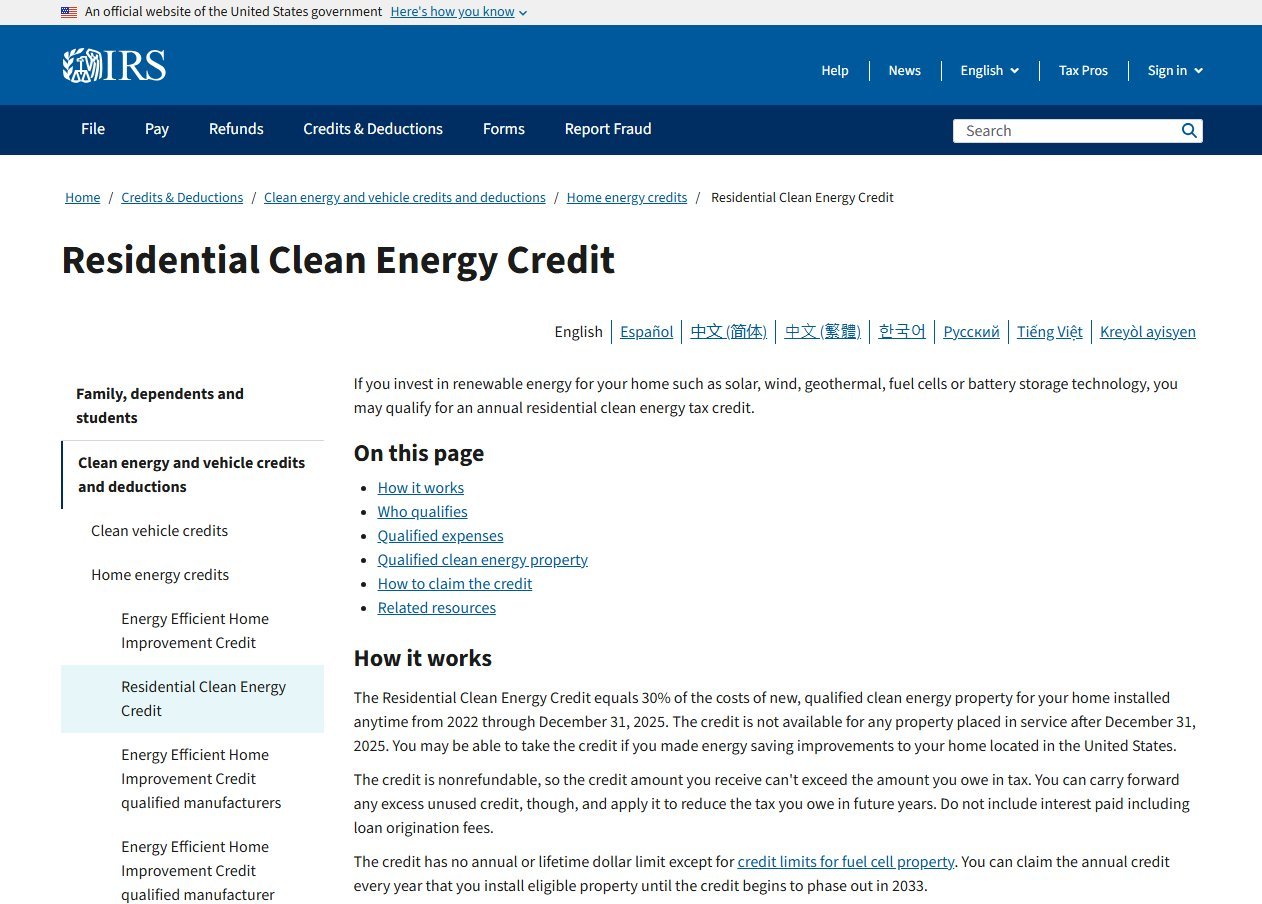
That single sentence invalidates a large number of pages that still tell homeowners to "claim the 30% credit." If your site has one, update it now. Do not just swap one number for another and move on. Say what the official source says, name the date you checked it, and send readers to the primary source before they make a financial decision.
The same caution applies to everything else in this category. Business tax treatment, state credits, utility rebates, net metering terms and local permit fees all vary and all change. A reliable pattern for incentive pages is:
- State only what you have verified on an official government or utility page, with the date you checked it.
- Describe the rest qualitatively, for example "your state or utility may offer a separate program," and link to the official page.
- Put an "as of" date at the top, and put a review reminder in your calendar.
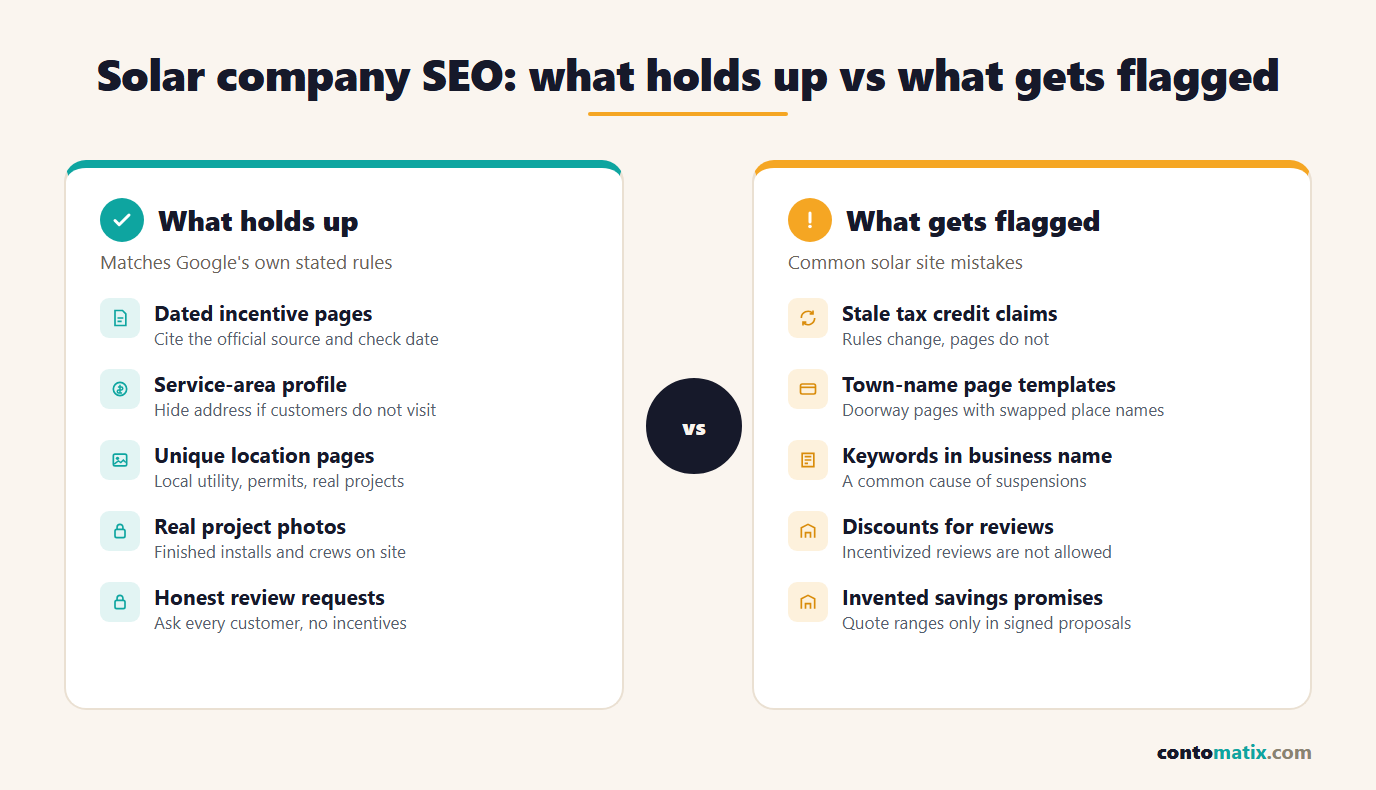
- Never promise a customer a specific saving or payback on a public page. Quote ranges only when a signed proposal backs them.
An honest, dated page that says "this changed, here is the official source" will outperform a confident page that is wrong, both with readers and over time, because the readers who find the wrong one tend to leave and not come back.
Google Business Profile for an Installer
A solar company is a service-area business in the way Google defines one: you go to the customer rather than the customer coming to you. Google's guidance for those businesses is plain. In its guidelines for representing your business, it says "if you're a service-area business, you should hide your business address from customers," and that a service-area business should have one profile for its central office with a designated service area.
That affects how an installer should set up the listing.
- Address. If customers do not visit your office, hide the address and define the service area. If you run a real, staffed showroom or office, show it. Do not list a rented mailbox or a warehouse nobody staffs as if it were a branch.
- Service area. Google describes the area as roughly two hours of driving time from where the business is based. List the areas you genuinely install in. Adding distant cities you have never worked in will not help and can draw attention.
- Categories. Google asks for as few categories as possible to describe your core business, as specific as possible. A company that installs panels should pick the category that matches, and avoid stacking in adjacent trades such as electrician or roofer unless that is a real separate line of work.
- Name. Use the real-world business name. Keywords added to the name field are a common cause of suspensions.
- Services and photos. Fill in the services list in plain terms: residential installation, battery storage, system monitoring, maintenance. Upload photos of finished, real installations, crews on site and the equipment you actually install.
The map results for installer searches are worth studying before you touch your own listing. Here is Google Maps for a solar installer search around Phoenix.
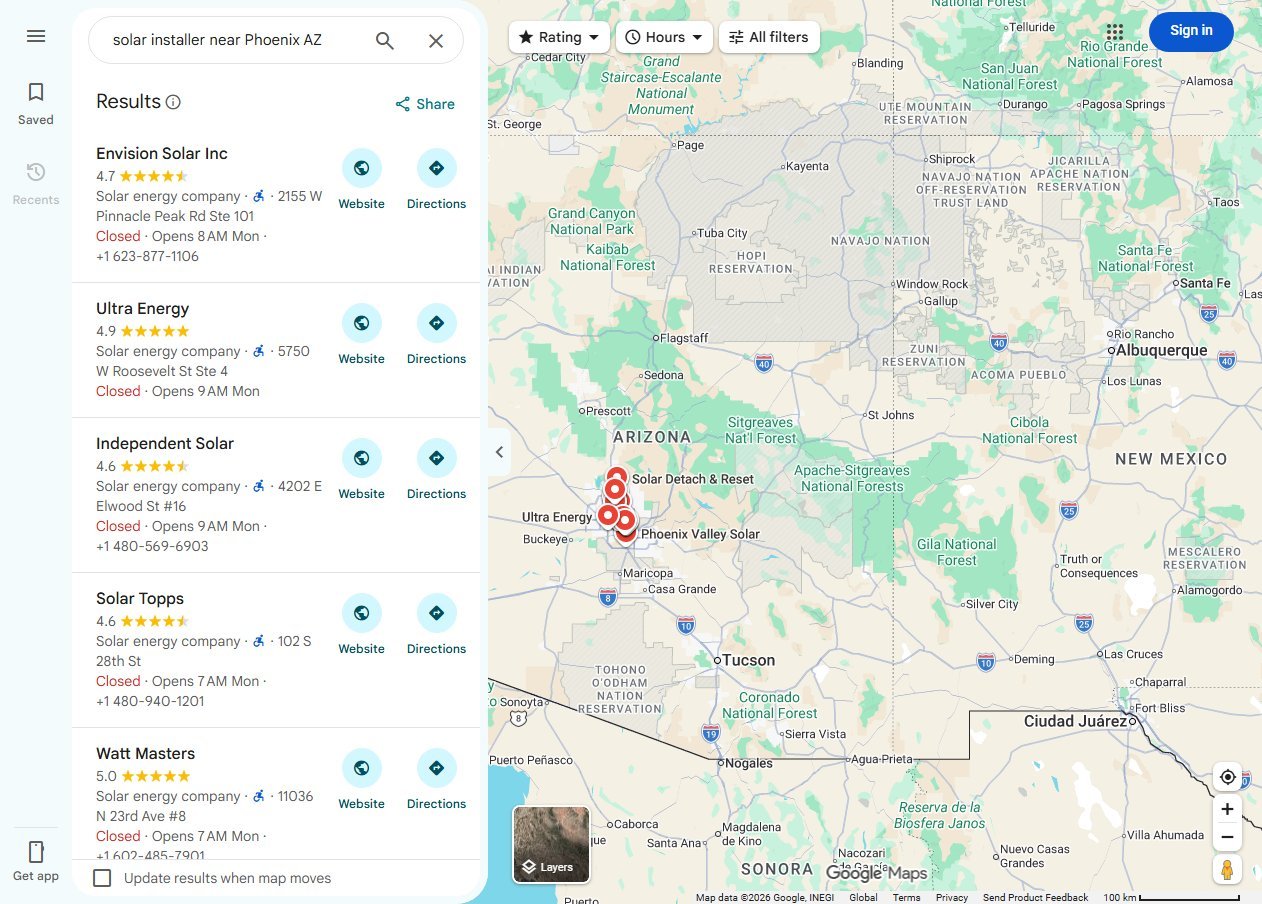
Every result carries a star rating, a category label, a contact route and opening hours. None of those is exotic. They are the basics filled in properly, and a surprising number of installer profiles are missing hours, services or recent photos. A profile that is complete and current is cheap to build and hard for a lazy competitor to match.
Location Pages Without Doorway Spam
Location pages are where SEO for solar companies most often goes wrong. The temptation in solar is to publish "solar installers in [town]" for every town in the territory, swapping only the place name. Google treats that pattern as a problem. Its spam policies define doorway abuse as sites or pages "created to rank for specific, similar search queries," and give pages targeted at specific regions or cities that funnel users to one page as an example.
That does not mean you cannot have location pages. It means each one has to stand on its own. A page earns its place when it contains something a reader in that area can use and could not get from the neighbouring page:
- The local utility and how interconnection works there, described in general terms and linked to the utility's own page.
- The permitting authority for that area and what the process usually involves, without inventing timelines you cannot support.
- Roof and climate considerations that really differ, such as snow load, hail, wildfire exposure or shading from mature trees.
- Photos and short write-ups of real projects you have completed nearby, with the owner's permission.
- Reviews from customers in that area.
If you cannot fill a page with that kind of material, you do not have enough to say about that town yet. Cover it from a broader regional page instead. The same discipline applies to other trades, and our guide to SEO for HVAC companies covers how a sibling home-services business handles it.
Content That Earns Trust Before the Quote
Trust is the real work in SEO for solar companies, because solar is a large purchase with a long relationship attached; so buyers look for reasons to trust before they ask for a quote. The strongest pages answer questions installers would rather not be asked.
- How a site survey works. Describe what happens: roof inspection, shade analysis, electrical panel review, and what could stop a project. Visitors who know the process are more likely to book it.
- What a system quote contains. Equipment, labour, permitting, monitoring and warranty terms, listed so a homeowner can compare like with like.
- Warranties explained. Equipment warranties from the manufacturer are different from the workmanship warranty from you. Say which is which, who stands behind each, and what happens if the installer closes.
- Permitting and timelines. Describe the stages in order and note that approval times depend on the local authority and the utility. A general description is honest. A promised number of days is a risk.
- Credentials. If your installers hold industry certifications, say which and link to the issuing body. For example, the North American Board of Certified Energy Practitioners (NABCEP) offers board certifications including PV Installation Professional and an Energy Storage Installation Professional credential. Only claim a credential someone on your team actually holds, and give the individual's name where you can.
Licensing requirements differ by state and sometimes by county, so state your contractor licence number the way your jurisdiction expects and keep it consistent everywhere it appears.
Money Pages: Loans, Leases and Power Purchase Agreements
Few topics cause more confusion than how to pay for solar, which is exactly why a plain-language page performs. Explain the main structures in neutral terms: buying outright, financing through a loan, and third-party arrangements such as leases and power purchase agreements, where someone else owns the system. For each, cover who owns the equipment, who maintains it, what happens if the home is sold, and which incentives, if any, may depend on ownership.
Be careful with rates and payments. Financing terms depend on the lender and the buyer's circumstances, so quote none on the page. State that terms vary and show the questions a buyer should ask a lender. If you offer financing through partners, say so and name the partner type rather than implying you set the terms yourself.
Battery Storage and Commercial Pages
Battery storage deserves its own page rather than a paragraph on the services list. Cover what a battery does and does not do, how backup behaves in an outage, what a typical household might choose to back up, and how installation differs when the battery is added to an existing system. Searches around storage often come from people who already own panels, so they are specific and ready to act.
Commercial and industrial work needs its own section of the site, written for a different reader. Business buyers want to know about load analysis, project management, installation schedules that avoid interrupting operations, and how ownership and incentive treatment might differ for a company. Because those rules are different from the residential ones and change independently, link to the official tax guidance and tell readers to confirm treatment with their accountant. A case-study page with real, permissioned project details is the best asset here, so build one when a project completes.
Reviews and Reputation
Reviews decide who gets the call on installer searches, and they work best when they describe the project. Ask every customer after commissioning, when the system is switched on and the novelty is fresh, and again after the first full billing cycle if you want a review that mentions savings. Offer nothing in return: Google's policy does not allow incentives for reviews, and asking only the happy customers is a form of rating manipulation.
Reply to every review. For positive ones, a short, specific thank-you is enough. For negative ones, which in solar are often about delays, billing or communication, reply once, calmly, offer to resolve the issue offline and then do so. Prospective buyers read the replies as carefully as the complaints.
Structured Data: What Still Works
Structured data is worth adding, but only the types that still do something. The FAQ rich result is a good example of why to check. Google's FAQ documentation states that the rich result "is no longer shown in search results" on desktop or mobile, after being limited in 2023 to well-known government and health sites. So do not add FAQ markup in the hope of extra space in the results. Keep the visible questions on the page for readers, because they still help people.
Local business markup is still documented. Google's LocalBusiness structured-data page says it lets you describe business hours and other details, and lists the business name and address as required properties. If your business hides its address under the service-area rules, think carefully about what you publish in markup and keep it consistent with what your profile shows. Add it to your main contact or about page in JSON-LD, make it match the visible page, and test it with Google's Rich Results Test before you ship.
Local Links and Citations
The links that matter for an installer are local and specific. Think of the state solar or clean-energy trade association member directory, the chamber of commerce, the manufacturers whose installer-locator pages list certified partners, local sustainability groups, and any utility program that publishes a list of participating contractors. Community projects, such as a school or a community-centre installation, tend to attract local news coverage and a genuine link.
Keep your name, address and phone number consistent wherever you are listed, and match it to the profile. The general method is the same as for any local business, covered in our local SEO for small business guide.
Seasonality and Lead Tracking
Any plan for SEO for solar companies has to respect that demand is not flat. Interest tends to rise when energy bills climb, when weather events cut the power, and when incentive rules are in the news. Use Search Console to see your own pattern by month rather than assuming one, and plan content a few weeks ahead of your busy periods so pages are indexed in time.
Tracking matters more here than in most trades because the sales cycle is long. A lead can enquire in autumn and sign in spring. Record the source of every enquiry at the first contact, using a form field or a unique tracking number per channel, and keep that source attached to the deal through to the signed contract. Judge your SEO by signed projects and booked site surveys, not by form fills alone.
A Short Checklist Before You Start
Use this list to audit your current approach to SEO for solar companies in an afternoon.
- Search your site for any page that mentions a federal tax credit, check it against the IRS page, and rewrite it with an "as of" date.
- Decide whether your address should show or be hidden, and set the service area to places you genuinely install.
- Choose the fewest categories that describe your core work, and fill in services, hours and real project photos.
- Audit location pages: merge or improve any that differ only by the town name.
- Write the site-survey, quote and warranty pages in plain language.
- Add a battery storage page and, if you do commercial work, a separate commercial section.
- Set up a review request that goes to every customer with no incentive attached.
- Track the source of every lead through to signed contract.
Quick Recap
The short version of SEO for solar companies:
- Solar searches fall into six types: worth it, incentives, installers near me, financing, battery storage and commercial. Build a page for each.
- The IRS says the Residential Clean Energy Credit is not available for property placed in service after 31 December 2025, so update any page that still promotes it, with an "as of" date.
- Installers are service-area businesses: hide the address if customers do not visit, list only areas you serve, and keep categories to a minimum.
- Location pages must carry something unique per area, or they become doorway pages.
- Explain site surveys, quotes, warranties and permitting generally and honestly, and claim only credentials your team holds.
- FAQ rich results no longer show in Google Search, while LocalBusiness markup is still documented.
- Ask every customer for a review, offer nothing, and track each lead through to signed contract.
If you would rather have help auditing a solar site against this list, Contomatix works with local service businesses on exactly this kind of review.
Frequently Asked Questions
What is SEO for solar companies?
It is the work of making an installer visible for the searches buyers make, from research questions to "installer near me." It combines a well-managed Google Business Profile, accurate service and location pages, trustworthy educational content and a steady stream of genuine reviews.
Is the federal solar tax credit still available to homeowners?
According to the IRS Residential Clean Energy Credit page, reviewed on 4 July 2026, it is not available for property placed in service after 31 December 2025. Check the IRS page for your own situation and speak to a tax adviser, since rules can change.
Should a solar installer show its address on Google?
Only if customers can actually visit a staffed location. Google tells service-area businesses to hide their address from customers and define a service area instead.
How far can my service area extend?
Google describes the service area as about two hours of driving time from where the business is based. List only the places you genuinely work.
Can I create a page for every town I serve?
You can, but each page needs something unique, such as the local utility process, permitting details, real nearby projects or reviews. Near-identical pages with only the town name changed fit Google's description of doorway abuse.
Does FAQ schema still help solar websites?
Not for rich results. Google says the FAQ rich result is no longer shown in search results. Keep FAQ sections on the page for readers, but do not expect extra visibility from the markup.
Is LocalBusiness structured data worth adding?
Yes, as a clean way to describe the business details already on your page. Google documents it, with name and address as required properties. Keep it consistent with the visible page and your profile, and test it before publishing.
Should I list NABCEP or other certifications on my site?
Only if someone on your team holds them. NABCEP is the North American Board of Certified Energy Practitioners and offers certifications such as PV Installation Professional. Name the credential and link to the issuer.
Can I offer a discount for a Google review?
No. Google's review policy does not allow merchants to offer payment, discounts or free services in exchange for reviews. Ask every customer in the same way and offer nothing.
How long does SEO take to bring solar leads?
Profile fixes can show effects within weeks, while content and reviews build more slowly. Because solar sales cycles are long, judge results over quarters by signed projects and booked site surveys, not just by form submissions.