SEO for HVAC companies has a structural challenge most local businesses don't: the same customer base searches completely differently depending on the season and the urgency. A homeowner whose air conditioning fails on the hottest day of the year searches nothing like someone comparing furnace replacement quotes over a few weeks. Getting HVAC SEO right means building for both of those searches at once, not picking one and hoping the other follows.
Why SEO for HVAC Companies Is Seasonally Split in a Way Most Businesses Aren't
An HVAC company's search demand swings hard between "AC repair near me" in July and "furnace installation cost" in November — often for the exact same customer base, just months apart. A site built only around one season loses half the year's opportunity. That means the SEO strategy itself needs a seasonal structure: content, ad spend emphasis, and even Google Business Profile attributes should shift ahead of each season rather than staying static year-round.
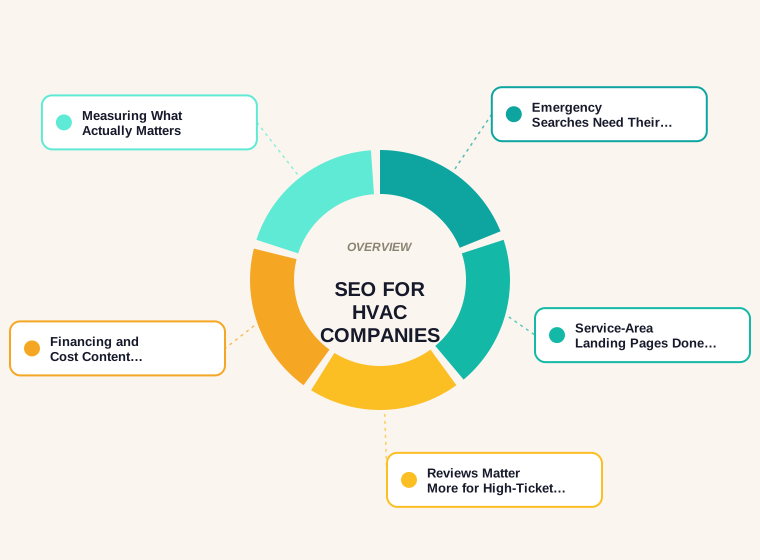
Emergency Searches Need Their Own Pages, Built for Urgency
"AC not cooling," "furnace won't turn on," "emergency HVAC repair" — these searches carry genuine urgency, and the page that answers them needs to communicate speed above everything else: same-day availability, after-hours contact information, and a phone number that's impossible to miss, ideally click-to-call on mobile. A generic "HVAC Services" page buried under a dozen other services will not convert this kind of high-urgency search nearly as well as a dedicated emergency page built specifically around it.
Google Business Profile: Get the Service Area and Categories Right
Most HVAC companies serve a genuine multi-city or multi-county area rather than a single town, and the Google Business Profile service-area settings need to reflect that precisely — every city or region actually served should be listed, not just the city where the office happens to sit. Categories matter too: "HVAC Contractor" as the primary category, with secondary categories for anything else genuinely offered (Air Conditioning Repair Service, Furnace Repair Service, Duct Cleaning Service). Seasonal attributes and posts — announcing AC tune-up specials in spring, furnace inspection offers in fall — keep the profile active and relevant exactly when demand is shifting.
Service-Area Landing Pages Done Properly
A company covering ten towns needs a genuine, distinct page for each — not ten near-identical pages with the city name swapped, which Google increasingly treats as low-value duplicate content, but pages with real local specificity: which neighborhoods are covered, typical response times for that area, and ideally a testimonial or completed job specific to that town. Thin, templated location pages are one of the most common HVAC SEO mistakes, and they can do more harm than good if Google flags the pattern as doorway-page behavior.
Reviews Matter More for High-Ticket Decisions
A furnace or full system replacement is a multi-thousand-dollar decision, and customers researching one read reviews far more carefully than they would for a small repair. Reviews that mention specific outcomes — the technician's name, how quickly they arrived, whether pricing matched the estimate — do more for both rankings and trust than a high review count with generic five-star ratings and no detail. Requesting a review immediately after job completion, while the relief of a working system again is fresh, consistently outperforms following up days later.
Content Built Around a Seasonal Calendar, Not Written Once and Left Alone
The highest-performing HVAC content maps directly to the seasonal demand curve: AC maintenance and efficiency content published a few weeks before the first genuinely hot stretch, furnace and heating content ahead of the first cold snap, and energy-efficiency content timed to when utility costs are most top-of-mind for homeowners. Publishing or refreshing that content proactively, rather than reactively once a season has already started, consistently outperforms a static content library that never changes.
Financing and Cost Content Genuinely Helps
HVAC replacement is expensive, and "how much does a new AC unit cost" is a real, high-intent search. A page that gives honest cost ranges, explains what drives the price up or down (unit size, brand, ductwork condition), and covers financing options directly addresses the biggest objection standing between a customer and a booked estimate — far more effectively than a page that avoids pricing entirely and just asks for a phone call.
Measuring What Actually Matters
Track phone calls and booked estimates by source — organic search, Google Business Profile, and paid — separately, and split emergency-repair conversions from higher-value installation and replacement leads, since those have very different sales cycles and lifetime values. Ranking well for a keyword that generates calls but never converts to a booked job isn't success; tie the metrics back to actual scheduled service visits and closed installations.
DIY vs. Hiring an HVAC-Specific SEO Partner
A single-location HVAC company with some administrative capacity can reasonably manage Google Business Profile seasonal updates, review requests, and basic citation consistency in-house. Where it gets genuinely harder to DIY is the service-area page structure across multiple towns, the seasonal content calendar, and technical SEO for a site with dozens of location and service page combinations. We've covered the broader agency-versus-freelancer trade-off in our SEO agency vs. freelancer guide, and the same considerations apply here, with extra weight on whether a prospective partner actually understands the seasonal demand pattern specific to HVAC.
Common HVAC SEO Mistakes
The recurring mistakes we see: near-duplicate location pages with the city name swapped and nothing else changed, no dedicated emergency-repair page despite genuinely offering emergency service, seasonal content written once and never refreshed ahead of the next season, and an incomplete Google Business Profile service-area list that misses towns the company actually serves and could be ranking in.
Is SEO Worth It for an HVAC Company?
Given how directly "near me" and emergency searches translate into booked service calls, and how much a single system replacement is worth compared to the cost of the SEO work itself, the return is usually visible within a season or two on Google Business Profile and emergency-page improvements, with broader organic rankings building over six-plus months. The HVAC companies winning the search results today are the ones that built for both the emergency call and the planned replacement, not just one or the other.
How much does SEO for HVAC companies cost?
Broadly in line with US averages — agencies around $99 an hour and roughly $3,200 monthly, freelancers around $72 an hour and $1,350 monthly, with costs running higher in saturated metros than in mid-sized markets.
How long before an HVAC company sees results?
Google Business Profile and emergency-page improvements often show movement within a season. Installation and replacement rankings typically take three to six months, which is why the work belongs in the shoulder months.
Why does HVAC SEO need a seasonal approach?
Because demand swings hard between "AC repair" in summer and "furnace installation" in winter — often from the same customers months apart. A site built around one season quietly loses half the year's opportunity.
Do I need a separate emergency repair page?
Yes. Emergency searches are urgent and high-value, and a dedicated page leading with same-day availability, after-hours contact and click-to-call converts far better than a general services page that mentions emergencies in passing.
How should I build service area pages?
One genuinely distinct page per town, with real local detail — response times, completed jobs, local housing stock. Near-identical pages with only the city name changed are treated as thin doorway content and can hurt rankings.
When should seasonal content be published?
Weeks before demand arrives, not during it. Google needs time to crawl and rank, so content published mid-heatwave usually misses the spike. Refresh the same pages each year rather than writing new ones.
Should I publish pricing information?
Ranges, yes. "How much does a new AC unit cost" is a high-intent search, and a page explaining what drives price up or down removes the main objection standing between a homeowner and a booked estimate.
What should I measure?
Booked jobs by source, with emergency repairs tracked separately from installations since their values and sales cycles differ completely. Ranking well for terms that generate calls which never convert is not success.
Related Reading
- For a regional look at these same HVAC tactics, check our guide to HVAC SEO in Boise.
Contomatix works with HVAC and home service companies on exactly this — seasonal content calendars, service-area pages built for real local relevance, and a review pipeline that turns completed jobs into future bookings. Want a free audit of where your HVAC company stands online right now?
Get a free audit →