Last updated: October 2026
SEO for injury lawyers is a different job from SEO for most other trades. Someone searching "car accident lawyer near me" may be standing on a roadside, sitting in an emergency room waiting area or lying awake three nights after a crash. The searches are urgent, the stakes are high, and the person is often comparing several firms on a phone within the same hour. A page that wins that moment has to load fast, answer the exact situation, show who is behind it, and make the next step easy.
This guide to seo for injury lawyers covers the parts that are specific to personal injury practices: the kinds of searches clients make, how to build case-type pages without sliding into doorway spam, what Google says about trust on sensitive topics, how to handle reviews and local links, and why intake speed often decides the result more than rankings do. It is general marketing guidance, not legal advice, and anything touching advertising should be checked against your own state bar's rules.
The Searches Injury Clients Actually Make
Most injury searches fall into three groups, and each wants a different page.
- Hire-now searches such as "car accident lawyer near me" or "truck accident attorney Houston". These trigger the local map pack, and the person is close to calling. The result they click needs a phone number, an office location, and proof the firm handles this exact case type.
- Situation searches such as "what to do after a car accident" or "hit by a car while walking". The person is not ready to hire yet, but a clear, calm and accurate page can earn trust that turns into a call a few days later.
- Process searches such as "how does a personal injury claim work" or "do I need a lawyer after a minor crash". These sit in the middle. They are informational, but the reader is usually already thinking about hiring someone.
Mapping every page on the site to one of these groups is the simplest way to avoid thin or overlapping content. If a page cannot be labelled as one of the three, it probably does not need to exist. Our guide to local keyword research walks through how to find these phrases for your own city and check what Google actually shows for each.
Build One Page Per Case Type
The backbone of seo for injury lawyers is a set of case-type pages. A single "Practice Areas" page that lists car accidents, truck accidents, motorcycle crashes, slip and falls and wrongful death in a bulleted block cannot compete with a page written for one of those searches.
A strong case-type page usually covers:
- who the page is for, in plain words, such as someone injured as a motorcyclist or a family member after a death;
- what typically happens after that kind of event, described in general terms and not as advice for a specific situation;
- what the firm does at each stage, such as gathering records and speaking to insurers;
- how to reach a person right now, with a visible number and a short form;
- the attorney who handles these cases, with a link to their bio.
Different case types raise different questions. A truck crash page can explain in general terms why commercial vehicles involve more parties than a typical two-car collision. A slip and fall page can explain what kinds of records tend to matter. A wrongful death page needs a gentler tone and more patience than any other page on the site. Writing each from the reader's actual situation keeps them distinct, and distinct pages are what Google wants to see.
City Pages Without Doorway Spam
Every injury firm eventually asks whether to publish a page for each town in its service area. This is where a lot of legal sites get into trouble. Google's spam policies define doorway abuse as sites or pages created to rank for specific, similar search queries, and the examples include pages "targeted at specific regions or cities that funnel users to one page."
A set of forty pages that read "Car Accident Lawyer in [Town]" with the same paragraphs and only the place name changed matches that description closely. Google's spam policies also cover scaled content abuse, where many pages exist mainly to manipulate rankings and not to help people.
That does not mean a firm can never have a location page. The test is whether the page would be useful to someone who landed on it from that town. A page earns its place if it contains things the other pages cannot:
- a real office, with its address, parking and hours, if the firm genuinely works there;
- the courts and counties the firm appears in, described accurately;
- attorneys who actually work from that office, with their own bios;
- local facts a reader would care about, such as the main hospitals nearby or the busiest roads the firm sees cases from, but only where you can state them accurately without guessing.
If you cannot fill a page with details like that, do not publish it. A better structure for most firms is one strong page per case type, plus a real location page for each staffed office. For a single profile and address, our guide to local SEO for lawyers explains the Google Business Profile rules on staffed offices and virtual addresses, which apply to injury firms just as they do to any other practice.
Reading a Real Injury Lawyer Map Pack
A live search shows what firms are competing against. Here is Google Maps for a car accident query in Houston.
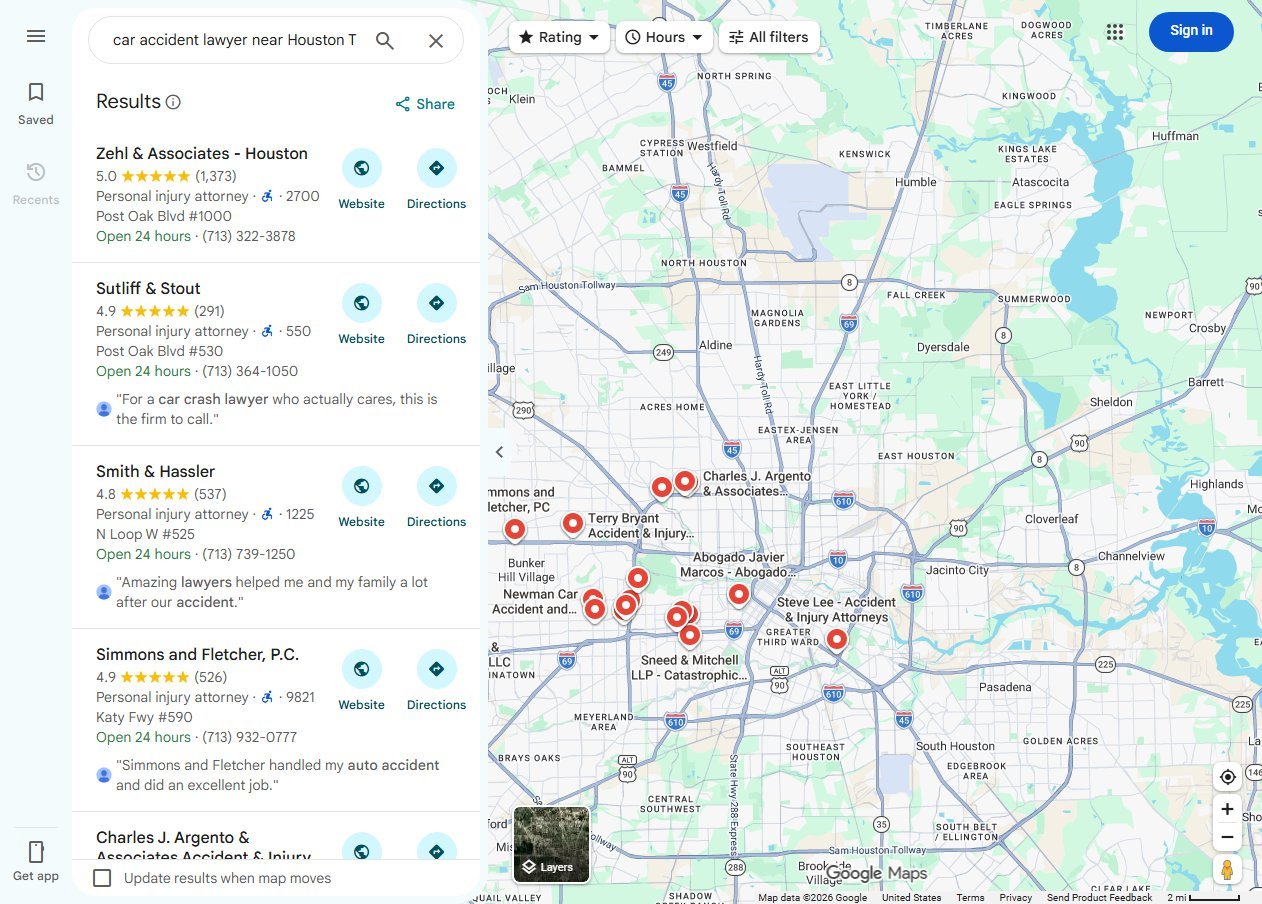
Four things stand out. Every listing carries a star rating and a review count, so a searcher can compare track records at a glance. Each shows a category label, a street address, a phone number and open hours, which is why a complete, accurate profile matters. Several listings show a review snippet that echoes the search words, such as "car crash lawyer" or "auto accident", which is a quiet reason to let clients describe their experience in their own words. And the map pins cluster around a handful of office districts, so proximity to those areas is part of what the searcher sees.
None of that is something a website alone can change. It does show that the map pack and the website have to work as one system: the profile earns the first look, and the page behind it earns the call.
Trust, Expertise and Sensitive Topics
For seo for injury lawyers, trust is the part competitors skip. Injury law sits in the territory Google calls topics that could significantly affect a person's health, financial stability or safety. Google's guidance on creating helpful, reliable, people-first content says its systems give "even more weight" to content that aligns with strong E-E-A-T on those topics. The same page asks whether content is "written or reviewed by an expert" who demonstrably knows the subject, and whether it is self-evident to visitors who wrote it.
For a law firm, putting that into practice is straightforward:
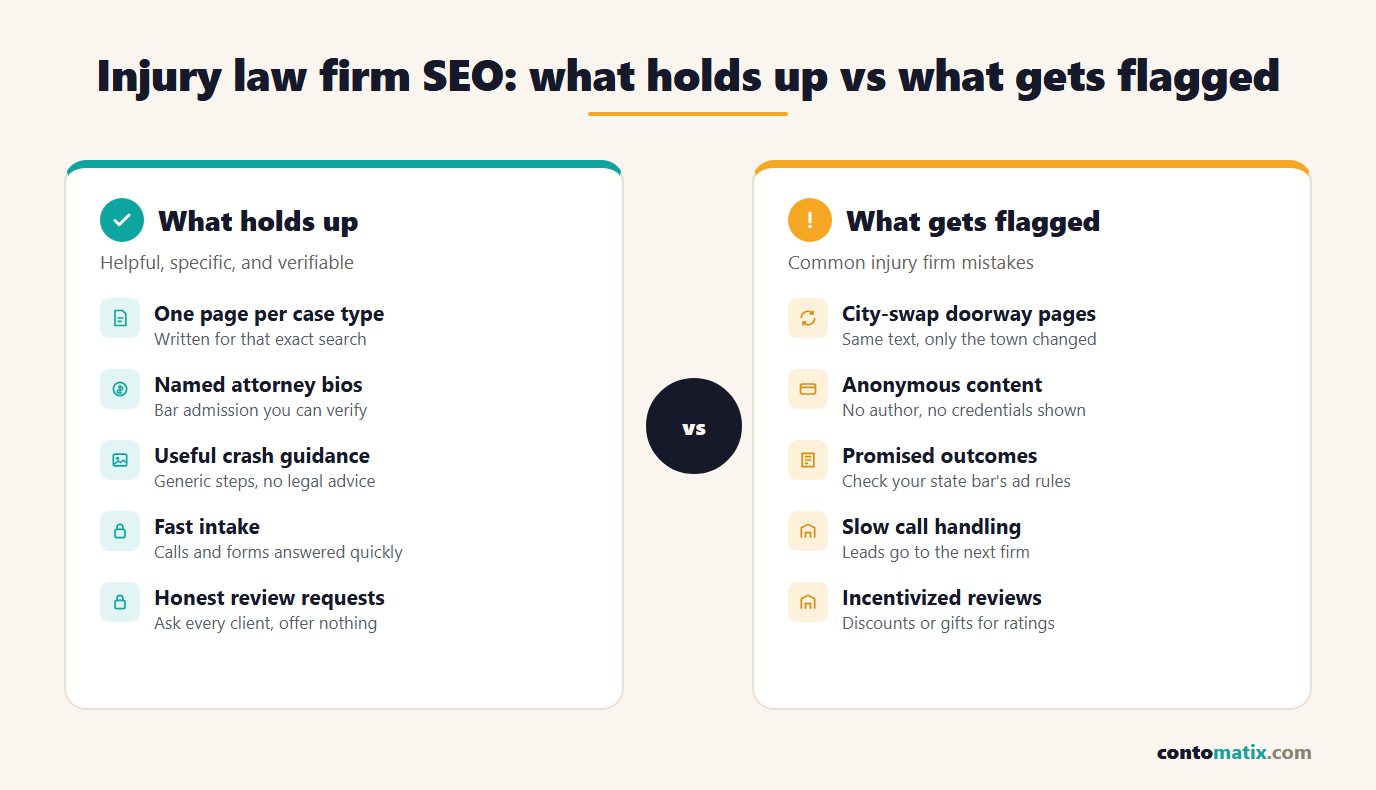
- Show the author. Every guide and case-type page should name the attorney who wrote or reviewed it, with a link to their bio.
- Write real bios. A useful attorney bio lists the states where the lawyer is admitted, the practice focus, education and professional associations. Verify each detail against the state bar's public lawyer lookup before you publish it, and keep it current as admissions or titles change.
- Say how the page was produced. If a paralegal drafted a page and an attorney reviewed it, a short line saying so is honest and helpful.
- Keep it generic and accurate. Educational pages should explain how things generally work, and say plainly that every case is different and that the page is not legal advice. Avoid specific deadlines, dollar ranges or outcome promises unless you can source and maintain them.
Rules on what a lawyer's website may say about results, specialties, testimonials and comparisons differ from state to state. Check your state bar's advertising rules before publishing anything that mentions outcomes or credentials, and have a lawyer at the firm sign off.
Useful Educational Content That Earns Its Place
Situation searches are where most firms either shine or waste effort. A page titled "What to Do After a Car Accident" exists on thousands of sites, and most are nearly identical lists of obvious steps. To stand out, a page has to be more careful and more useful than the rest, not longer.
Some principles that work:
- Lead with safety and medical care. The reader may be reading this right after a crash.
- Describe categories of information worth collecting, such as photographs of the scene and the exchange of contact details, without pretending to know the facts of their case.
- Explain what a lawyer's role generally is, so the reader understands what a first call involves.
- Link to the case-type page that matches their situation, so interested readers have a clear next step.
- Leave out anything that reads as a legal opinion about a particular case, and avoid numbers you cannot defend. Deadlines and compensation rules vary by state and by case, and an out-of-date figure on a legal site is worse than none.
Write these pages once, properly, and review them on a schedule. A firm with six good educational pages that are checked every year will usually do better than one with sixty quickly produced ones. It also keeps the site clear of the scaled content problem described above.
Intake Speed Is Part of SEO
Injury clients often contact several firms and tend to go with whoever responds first and sounds helpful. That makes call handling and forms part of the ranking strategy, because a rank that produces unanswered calls is wasted.
- Put the phone number where thumbs can reach it, as a tap-to-call link at the top of mobile pages.
- Keep forms short. Name, phone number, best time to reach them and a short description is usually enough. Each extra field costs submissions.
- Answer calls live where you can, and have a clear plan for evenings and weekends, whether that is a trained answering service or a published call-back promise you actually keep.
- Respond to form submissions in minutes, not days, and measure how long it really takes.
- Be careful what you say in automated replies. A confirmation message should say that the firm received the request and when someone will call, and should not discuss the merits of the case.
Track the entire route. Use a dedicated tracking number for the website, separate from the one on the Business Profile, so you can tell where calls come from. Record which pages produced forms and calls, and count how many were answered, qualified and signed. Search Console shows which queries bring people to a page, but only the firm's own intake log shows which of those became clients.
Reviews Without Incentives
In a market where listings show review counts side by side, reviews matter a great deal. They are also governed by two sets of rules. Google's policy on incentivized or biased reviews describes incentivized reviews as ones influenced by a payment, discount, free goods or services, or any other benefit offered to the reviewer. A firm that gives gift cards, or offers anything in return for a rating, is on the wrong side of it.
The clean approach is to ask every client at a natural point, such as when a matter closes and they are satisfied with the service, using the same wording each time and offering nothing in return. Do not screen out unhappy clients before sending the link. Separately, lawyers have professional duties of confidentiality, so replies to reviews should be short and generic and should not confirm that the reviewer was a client. Rules on testimonials and replies differ across states, so check your state bar's guidance before setting up a standard process.
Local Links That Fit a Law Firm
The links that tend to look natural for an injury practice are the ones a real firm in a real community would collect: the local and state bar association directories where the attorneys are members, legal aid and pro bono programs the firm supports, sponsorships of local charities or school events, and local news coverage where an attorney is quoted on a public matter. These are links earned by being part of the community, and they sit alongside the practices covered in our guide to link building for lawyers.
Your own internal links count as well. Google's link best practices say anchor text should be descriptive and relevant to the page it points to, and that paying attention to internal link anchors can help people and Google make sense of your site.
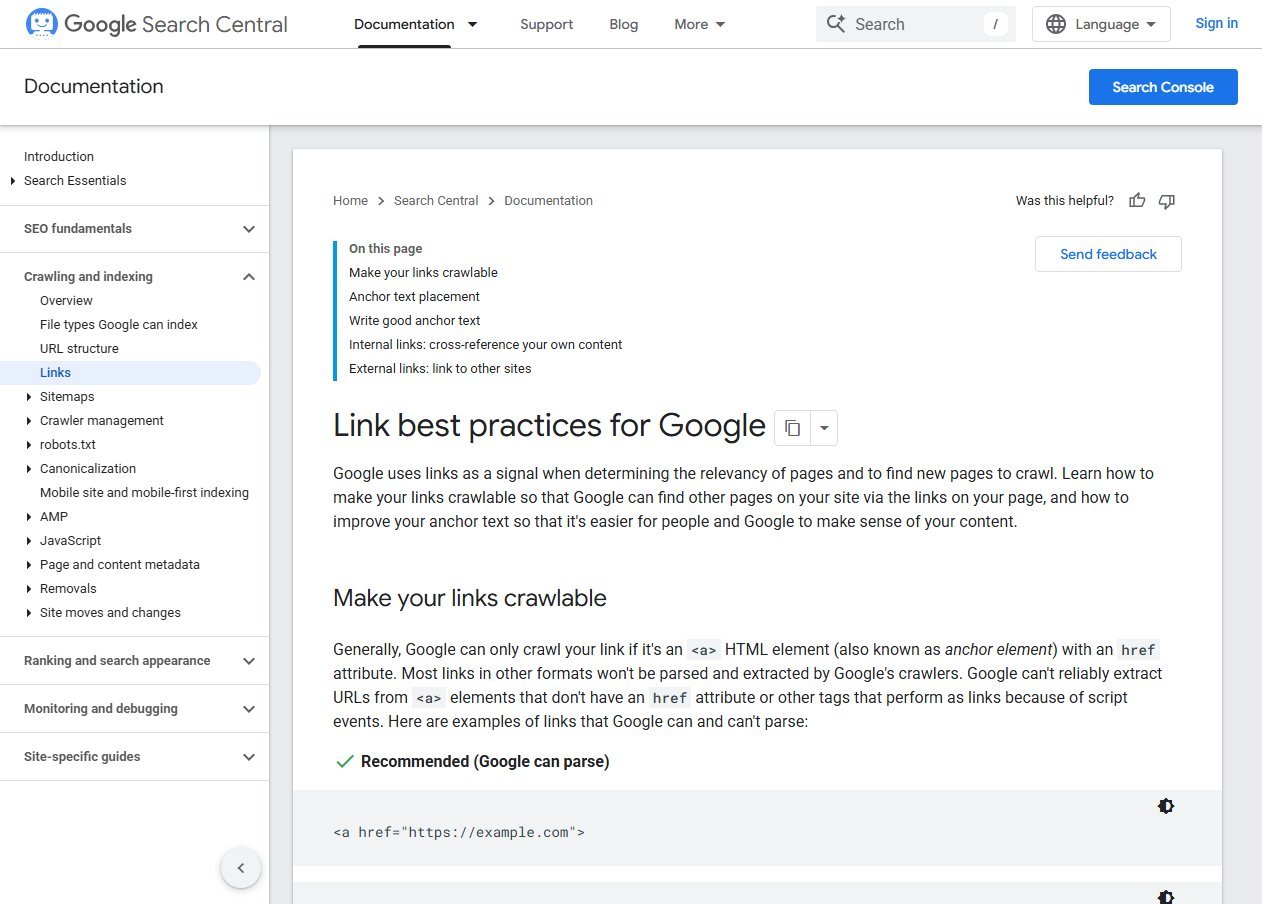
For an injury site, that means a "What to Do After a Truck Accident" guide should link to the truck accident page using words that describe it, and not a vague "click here". It also means every case-type page should be reachable from the main navigation and from at least one related guide.
Common Mistakes on Injury Law Sites
- Cloned city pages with only the place name swapped, which match Google's description of doorway pages.
- Anonymous content that has no named author, no bio and no way to check who stands behind it.
- Promises about results, which can run into state bar advertising rules and erode trust.
- Stuffing every case type onto one page, which leaves no page that matches a specific search.
- Slow mobile pages with heavy images, pop-ups over the phone number, or forms that do not submit properly.
- Unanswered calls and slow replies, which waste the traffic the other work brought in.
- Offering anything for reviews, or only asking clients likely to give five stars.
- Never reviewing old content, so that educational pages go stale.
A Practical Checklist for SEO for Injury Lawyers
- List the case types the firm wants more of, and create one page for each, written for that situation.
- Decide which offices are genuinely staffed, and create a real location page for those only.
- Add a named author and a linked bio to every page, with bar admissions checked against the state bar lookup.
- Write three to six educational pages for situation and process searches, and keep them general and accurate.
- Have a lawyer review every page against your state bar's advertising rules.
- Put a tap-to-call number and a short form on every case page, and set up call tracking.
- Decide who answers calls and forms outside office hours, and test it yourself.
- Create one review-request process that asks every client the same way and offers nothing.
- Join and use the local bar and community directories the firm already belongs to.
- Check Search Console monthly for queries per page, and compare with the intake log.
Quick Recap
- SEO for injury lawyers starts with the search: injury searches fall into hire-now, situation and process groups, and each needs its own kind of page.
- Build one page per case type and avoid near-identical city pages, which Google's spam policies describe as doorway abuse.
- For sensitive topics, show the author, link a verified bio and keep educational content generic and accurate.
- Check your state bar's advertising rules before publishing anything about results, credentials or testimonials.
- Ask every client for a review, offer nothing in return, and keep replies confidential.
- Treat call handling, short forms and call tracking as part of the strategy, because they decide whether rankings turn into clients.
If you want a second pair of eyes on a legal site's structure or case-type pages, Contomatix can review the setup and point out where pages overlap or where trust signals are missing.
Frequently Asked Questions
What is SEO for injury lawyers?
It is the work of making a personal injury firm's website and map listing visible for searches like "car accident lawyer near me", and then turning those visits into calls. It covers case-type pages, trust signals, reviews, local links and intake.
Should an injury firm publish a page for every city it serves?
Only where the page offers something real, such as a staffed office, local courts and attorneys who work there. Near-identical pages with the town name swapped fit Google's description of doorway abuse.
How many case-type pages does an injury firm need?
One for each type of case the firm wants more of, such as car, truck, motorcycle, slip and fall, and wrongful death. Skip case types the firm does not handle well.
Do attorney bios matter for rankings?
Google does not give a ranking number for bios, but its guidance asks whether it is clear who wrote content and whether they know the topic. Named bios with verified bar admissions answer that directly.
Can a law firm website say what a case might be worth?
Be very careful. Rules on describing results and values differ by state, and numbers go stale. Check your state bar's advertising rules, and keep educational pages general.
Should injury lawyer sites explain what to do after an accident?
Yes, if the page is accurate, calm and clearly general. It reaches people before they are ready to hire, and shows how the firm communicates. It should not give advice about a specific case.
Can we offer a discount for Google reviews?
No. Google's policy treats reviews influenced by payment, discounts or free services as incentivized. Ask every client the same way and offer nothing in return.
How fast should an injury firm respond to a new lead?
As fast as realistically possible. Many people contact several firms, so the first helpful response often wins. Measure your actual response time instead of assuming it.
What local links help a personal injury firm?
Bar association directories, legal aid and pro bono programs, community sponsorships and local news coverage where an attorney is quoted. These reflect real involvement in the area.
How do we know which pages bring in actual clients?
Use a dedicated tracking number on the site and an intake log that records the source, whether the call was answered and whether the matter signed. Search Console shows queries but not signed clients.


