Last updated: August 2026
A personal injury attorney we spoke with had been burned before — a previous marketing vendor built dozens of low-quality directory links that did nothing for rankings and, worse, looked exactly like the kind of manipulative pattern Google's algorithm is built to catch. Link building for lawyers has to be approached differently than most industries, because the downside of a bad link isn't just wasted money — it's a rankings penalty on a site that depends entirely on being found. Recovering from that kind of penalty takes far longer than building the profile up carefully would have taken in the first place, which is exactly why the volume-first thinking that works reasonably well in other industries tends to backfire specifically in legal marketing.
Here's what actually works for a law firm, and why the usual volume-first playbook doesn't apply.
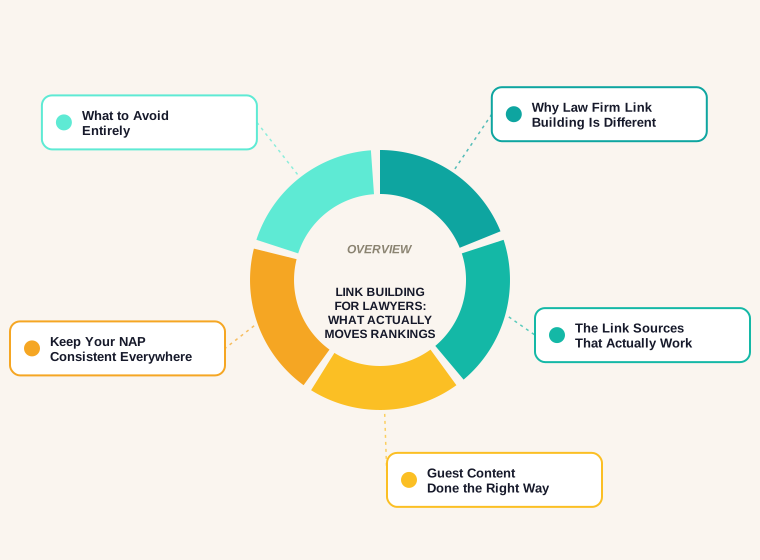
Why Link Building for Lawyers Is Different
Nearly every legal client starts their search online before ever calling a firm, which puts enormous weight on where your site ranks, and on how trustworthy that site looks to both a prospective client comparing several firms and to Google itself, in a heavily scrutinized industry where trust signals carry outsized weight. Clio's 2026 Legal Trends Report found that 96% of legal consumers begin their attorney search online, primarily through Google. That's not a marginal channel for a law firm — it's close to the entire top of the funnel, which is exactly why weak or spammy links are riskier here than in most other industries.
Relevance matters more than raw volume in this space. A single mention from your state's bar association or a respected legal publication carries more weight, and far less risk, than ten links from unrelated, low-quality sites.
The Link Sources That Actually Work
A handful of source types consistently produce results for law firms without raising any red flags:
- Legal directories: established platforms like Avvo, Justia, and Martindale-Hubbell carry genuine authority in the legal space and are widely trusted by both search engines and prospective clients.
- Bar associations and legal organizations: a link or mention from your state or local bar association signals legitimacy that's difficult to replicate any other way.
- Legal publications and law school sites: contributing genuine expertise to a recognized legal publication builds both authority and referral visibility.
- Local community organizations: sponsorships, local business associations, and community involvement produce natural, geographically relevant links.
Guest Content Done the Right Way
Guest posting remains one of the more effective tactics for law firms specifically because it lets an attorney demonstrate real expertise rather than just acquiring a link. A well-written piece for a legal publication or a relevant local business site positions the firm as a credible voice in its practice area, and the resulting link comes attached to genuine editorial context rather than a purchased placement.
Keep Your NAP Consistent Everywhere
Every link and mention should carry the same Name, Address, and Phone number details as your Google Business Profile. This consistency matters for two separate reasons: it helps local search algorithms confirm your firm is a legitimate, established local business, and it feeds the same consistent information to the AI systems now pulling from these same trusted legal platforms when answering client questions. A mismatched address on even one directory listing can quietly undercut an otherwise solid link profile.
What to Avoid Entirely
Bulk directory submissions, purchased link packages, and generic guest-post networks are all higher-risk for a law firm than for almost any other type of business. Legal is a heavily scrutinized vertical, and a link profile that looks manipulated can draw exactly the kind of algorithmic attention a firm depending on organic visibility can't afford. If an offer promises a large volume of links quickly for a flat fee, that's the pattern to walk away from.
How This Fits Into Broader Law Firm SEO
Link building works alongside the rest of a law firm's SEO foundation, not as a replacement for it. A firm with a slow, poorly structured site or thin practice-area pages won't see much benefit from even a strong link profile, since there's little for that authority to support. Prioritize genuine legal citations and mentions once the core site itself is solid, and the two compound each other rather than competing for attention. If you're weighing how to split effort between the two, our breakdown of ranking differences between PPC and SEO is a useful companion read for a firm deciding where marketing dollars go first.
A realistic timeline also matters here. Legal keywords are competitive, and a new or rebuilt link profile typically takes several months to show up clearly in rankings, especially in a practice area with established, well-linked competitors. Firms that expect a month-over-month spike often abandon a sound strategy just before it starts compounding — consistency over a two-to-three-quarter window is a far more realistic benchmark than any single month's movement.
What a Reasonable Monthly Cadence Looks Like
Rather than chasing a specific link count, a sustainable approach for most small and mid-sized firms is a handful of genuinely earned placements per month — one or two directory or bar association updates, one piece of guest content in a relevant publication, and ongoing NAP audits across existing listings. That pace is slow by volume-focused industry standards, but it's the pace that holds up under the kind of scrutiny legal sites regularly attract, and it compounds steadily without ever looking manipulated.
Practice-Area Content That Naturally Earns Links
Some of the strongest links a law firm earns come from content that never set out to be a link building asset in the first place. A genuinely thorough explainer on a specific, narrow legal question — something more detailed than the one-paragraph overview most competing firm sites offer — tends to get referenced by other sites discussing the same topic, cited by journalists covering a related story, and linked from forums or community sites where the exact question comes up. The firms that do this well pick a handful of specific, high-value questions in their practice area and go deep rather than producing broad, shallow content across every possible topic. Depth on a narrow set of pages consistently earns more links than breadth across many thin ones.
Evaluating a Legal Marketing Vendor's Link Building Claims
Legal marketing attracts a lot of vendors making bold placement claims, and a firm evaluating one should ask a few direct questions before signing anything:
- "Can you show the specific domains you place links on, before payment?" — a vendor unwilling to disclose sources in advance is a meaningful red flag regardless of what else they claim.
- "Are these links exclusive, or do you place the same links for other firms in my practice area and region?" — shared placements across competing firms provide little differentiated value to any single one.
- "How do you verify a directory or publication is genuinely reputable in the legal space, not just high-traffic?" — traffic alone doesn't establish legal-industry credibility, and a vendor should have a clear answer here.
- "What happens if Google flags or devalues a placement later?" — a serious vendor should have a stated approach to this, not just an assurance that it won't happen.
A vendor who answers these clearly, with specific examples, is a fundamentally different proposition than one selling a flat monthly link count with no visibility into where those links actually come from.
How to Track Whether Link Building Is Actually Working for a Firm
A law firm should watch a small, specific set of indicators rather than a single vanity metric. Ranking position for the firm's core practice-area terms in its actual market, checked consistently over time rather than as a one-off snapshot, is the clearest long-term signal. Referral traffic from specific placements — a bar association listing, a legal directory profile, a guest article — shows which sources are sending genuinely interested visitors versus which are sitting unused. And a periodic backlink audit, checking for any new links the firm didn't request, catches negative SEO attempts or scraped content early, which matters more for a heavily scrutinized industry like legal than for most other business types.
Working With In-House Counsel or Compliance on Marketing Content
Many firms, particularly larger ones, require marketing content to pass through a compliance or ethics review before publication, given bar association advertising rules that vary by state. Building that review step into the link building and content calendar from the start — rather than treating it as an afterthought once a piece is already written — avoids the common bottleneck where genuinely good content sits unpublished for weeks waiting on a review that could have started earlier. A realistic production calendar for a firm operating under this kind of oversight should budget for that review time explicitly, rather than assuming content moves from draft to published as quickly as it would for a business without the same regulatory considerations.
What Happens When a Link Building Effort Stalls
Even a well-run link building program can hit a quiet stretch — a bar association contact goes unresponsive, a planned guest article gets delayed, a local sponsorship opportunity falls through. The response that keeps momentum isn't to compensate with a burst of lower-quality placements, but to widen the search for the next genuine opportunity while maintaining the same standard. A firm that treats a slow month as a reason to lower its bar on link quality is exactly the pattern that leads to the manipulated-looking profiles discussed earlier in this guide — patience during a quiet stretch protects the profile more than any single placement would.
If it helps, we also wrote about SEO for injury lawyers: how personal injury firms compete in local search.
Frequently Asked Questions
Why does link building for lawyers need a different approach?
Legal is a heavily scrutinized industry where low-quality or purchased links carry outsized risk. A manipulated-looking link profile can trigger algorithmic scrutiny on a site that depends almost entirely on organic search for new clients.
What are the best link sources for a law firm?
Established legal directories like Avvo, Justia, and Martindale-Hubbell, bar association mentions, legal publications, law school sites, and genuine local community involvement all consistently work well.
Is guest posting effective for law firms?
Yes. It lets an attorney demonstrate real subject-matter expertise while earning a link tied to genuine editorial context, rather than a link that reads as purchased or manipulative.
Why does NAP consistency matter for link building?
Consistent Name, Address, and Phone details across every link and directory listing help both local search algorithms and AI systems confirm your firm is a legitimate, established business.
How many people search online before contacting a lawyer?
Clio's 2026 Legal Trends Report found that 96% of legal consumers begin their attorney search online, primarily on Google, making organic visibility a central part of how most firms get found.
Should a law firm buy bulk directory link packages?
No. Bulk or purchased link packages are a higher risk for law firms than for most other industries, since a manipulated-looking profile can draw unwanted algorithmic attention on a site the firm depends on for client intake.
Does link building alone improve a law firm's rankings?
Not on its own. Link building works best alongside a solid site foundation — fast pages, clear practice-area content, and good technical SEO. Without that foundation, even strong links have little to reinforce.
What's the risk of using a cheap link building vendor for a law firm?
Cheap, high-volume link vendors often rely on low-quality directories or spun content that can look manipulative to search engines, creating rankings risk rather than the growth the firm is paying for.
Disclaimer: This article is for informational purposes only and does not constitute legal or marketing advice specific to any jurisdiction or bar association's rules.
Contomatix builds compliant, relevance-first link profiles for law firms — the kind that hold up under scrutiny and actually move rankings. Want a free review of your firm's current backlink profile?
Get a free backlink review →

