Last updated: August 2026
If your plumbing website isn't generating calls, the problem is rarely the site itself — it's usually authority. Google needs a reason to trust a page before it sends customers there, and the clearest signal it uses for that trust is backlinks: links from other sites pointing to yours. Link building for plumbers is how a plumbing business earns that trust deliberately, instead of hoping years of word-of-mouth eventually shows up in search rankings.
This guide covers what actually counts as a backlink versus a citation, nine tactics a real plumbing business can run safely, what quality links cost, and the shortcuts that get sites penalised instead of ranked.
Backlinks vs. Citations: The Distinction That Changes Your Strategy
A backlink is a hyperlink from another site that passes ranking authority to yours and lifts organic, blue-link results. A citation is any online mention of your business name, address, and phone number (NAP) — with or without a link — and it works mainly to confirm your identity and location for Google's local-pack algorithm, the map results that show up above organic listings for "plumber near me" searches.
A high-authority directory listing that includes your URL delivers both signals at once, which is why directories are almost always the right place to start. One critical rule applies across every listing: keep your NAP exactly consistent — same business name, same address format, same phone number, everywhere. Inconsistencies confuse Google's local algorithm and can quietly suppress your map-pack visibility.
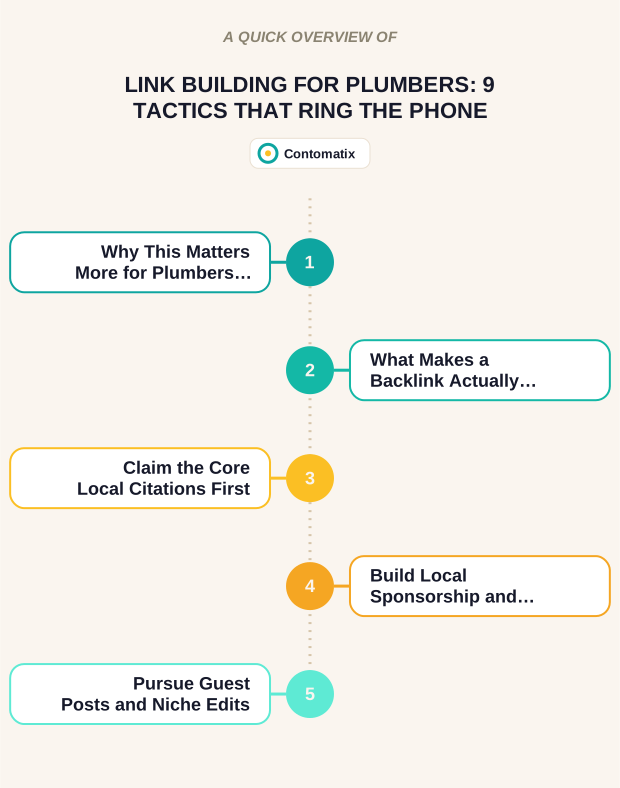
Why This Matters More for Plumbers Than It Looks
A large-scale study of Google ranking factors by Backlinko puts a number on the gap most plumbers underestimate: pages sitting in the #1 spot carry roughly 3.8 times more backlinks on average than pages ranked two through ten. For a plumbing business competing against five or six similarly-built local sites, that referring-domain gap is very often the real tiebreaker deciding who gets the call.
Local intent sharpens this further. A large share of "plumber near me" and "[service] near me" searches come from someone with an active leak or an emergency, and Google's local-pack algorithm leans heavily on citation consistency and Google Business Profile completeness alongside backlinks to decide who appears first. A plumbing site with a thin, inconsistent web presence is effectively invisible to exactly the searches most likely to convert into a same-day job.
What Makes a Backlink Actually Valuable
Not every link is worth the same. Three factors decide whether a backlink helps or does nothing:
Relevance. A link from a home-improvement site or local news publication carries far more weight than one from a completely unrelated niche — Google evaluates the topical context around a link, not just its existence.
Traffic and authority. Links from sites that actually have visitors and a reasonable domain rating move rankings; links from sites nobody reads or visits do not. A rough quality floor worth using when evaluating any link opportunity is a domain rating of 20 or higher with at least 500 monthly organic visitors.
Placement and anchor text. A link embedded naturally within the body of an article outranks one buried in a footer or sidebar widget. Descriptive anchor text — "emergency plumber in [city]" or "local plumbing services" — helps search engines understand the linked page, but over-optimised, keyword-stuffed anchors across many links look manipulative rather than earned.
1. Claim the Core Local Citations First
For most plumbing businesses, this is the fastest and most straightforward starting point. Claim and fully complete Google Business Profile before anything else, then Bing Places and Apple Maps. From there, work through the major US directories: Yelp, Angi, HomeAdvisor, Thumbtack, and the Better Business Bureau. Most of these are free; paid options like Angi's featured placements can be worth it in competitive metros since they send referral traffic alongside the citation value.
2. Join the Plumbing-Heating-Cooling Contractors Association (PHCC)
PHCC and its state chapters maintain member directories with links — a trusted .org-adjacent source that functions as both a citation and an editorial-quality backlink simultaneously. If you hold any manufacturer certifications (Rheem Pro Partner, Moen Pro, Kohler-authorized dealer, and similar programs), check each one for a "find a contractor" or "preferred partner" locator. These are links most plumbers are entitled to and never claim, because they are not the first thing that comes to mind when someone says "backlinks."
3. Build Local Sponsorship and Community Links
These hyper-local links carry real weight for map-pack rankings because they signal to Google that a business is genuinely embedded in the area it serves — something no directory-spam vendor can fabricate. Sponsoring a local youth sports team, a charity event, or a school program typically earns a link from the organiser's sponsors page. Always ask directly for the URL and your business name when confirming a sponsorship; it is rarely offered automatically but rarely refused when requested.
4. Pursue Guest Posts and Niche Edits
Citations build a foundation, but competitive local search terms usually require editorial backlinks — links from genuine content on established sites. Two methods dominate here.
Guest posting means writing an article for a relevant site — home-improvement blogs, property management sites, landlord forums, local trade publications — and earning a backlink within genuinely useful content, such as a guide on preventing frozen pipes or what to check before calling a plumber.
Niche edits (also called link insertions) work differently: instead of writing new content, you find an existing relevant article and ask the site owner to add your link naturally within it. This is often faster than guest posting and can carry strong authority, since the page already has its own established backlinks.
For both, apply the same quality floor mentioned earlier — DR 20 minimum, real traffic, topical or geographic relevance. If someone offers fifty links for a flat low fee, that is a red flag, not a bargain.
5. Create Content Worth Linking To
Content earns links passively when it solves a real problem better than what already exists. For plumbing, that means specific, detailed guides homeowners actually search for — "how to know when your water heater needs replacing" or "what to do if your pipes freeze overnight" — written with real expertise rather than generic filler. Local data works even better: average callout response times, the most common emergency plumbing issues in your area, or seasonal spikes in specific jobs give local publications and bloggers a genuine reason to reference and link to your site.
Comparison content — a tankless versus traditional water heater breakdown, or an explanation of pipe material options — and a genuinely detailed FAQ page both tend to attract natural references over time. None of this replaces active outreach, but it makes outreach dramatically more effective once you have something worth linking to.
6. Reclaim Unlinked Brand Mentions
Search your business name in Google periodically. Local news write-ups, supplier newsletters, or community blog posts that mention your company without linking to it are one polite email away from becoming a backlink. This costs nothing beyond the time to search and ask, and it is one of the most overlooked tactics on this list.
Which Tactics Trigger a Google Penalty
The market is full of services offering large volumes of links at very low prices, and most of them either do nothing or actively damage rankings. Google's spam policies explicitly name the tactics to avoid: private blog networks built solely to pass authority, bulk directory spam, paid placements without a rel="sponsored" tag, and irrelevant mass submissions. When evaluating any link-building service, ask directly what sites they use, what minimum authority and traffic thresholds they apply, and whether links come from topically relevant sites or generic link farms.
The consequence ranges from a silent algorithmic devaluation to a manual "unnatural links" action in Search Console, which requires formal remediation before rankings recover. If a previous vendor left behind a toxic link profile, request removal from site owners first and disavow only the domains that cannot be removed.
What Quality Links Actually Cost
Effective link building is not cheap, and that is by design — the price reflects real editorial work, not just a line in a spreadsheet. A single high-quality guest post or niche edit from a relevant, authoritative site typically runs $130–$200 or more depending on the site's authority and niche competitiveness. Full-service agency programs covering outreach, content, and digital PR generally run $1,500–$5,000+ per month for a local trade business. If someone offers twenty links for the price of a single quality placement, assume those links will not help and may actively set back your rankings.
Doing the foundational work yourself — citations, association listings, sponsorship outreach — costs mainly time and is realistic for a busy owner to complete in a focused week. Guest posting and niche-edit outreach take more sustained effort and relationship-building, which is where many plumbing businesses bring in outside help.
Anchor Text and Pacing: Two Habits That Keep You Safe
Two technical details separate a link profile that looks natural from one that reads as engineered, because the difference between them is exactly what Google's algorithms are built to spot.
Anchor text is the clickable wording of a link. A healthy profile is dominated by brand anchors ("Smith Plumbing"), bare URLs, and natural phrases, with exact-match anchors like "emergency plumber [city]" kept to a small minority. When every link uses the exact keyword a business wants to rank for, it stops looking like something people chose to link to and starts looking like something engineered — because real websites and real customers simply do not link that way on their own.
Pacing matters just as much. A sudden burst of ten links after two years of none is a pattern every link-buying vendor produces, and Google has seen it thousands of times. Spread the work across months — citations this month, association listings the next, a sponsorship after that. Steady, deliberate growth is both safer and, conveniently, easier to sustain alongside actually running a plumbing business. The same logic holds for any local trade; our guide to link building for roofers covers the identical pacing principle from a different angle if you want to see how it plays out in another vertical.
How Long Link Building for Plumbers Takes to Work
Most plumbers see meaningful movement in local search rankings within three to six months of a consistent link-building effort. Competitive metros with dozens of established plumbing businesses take longer; smaller towns and specific service niches can move faster. The important thing to understand is that link building is cumulative — every quality link adds to your site's authority, and that authority compounds. A business that builds links consistently for a year becomes significantly harder for a new competitor to displace than one that runs a single burst campaign and stops. Think of it less as a campaign and more as a reputation you are building.
Frequently Asked Questions
How do plumbers get backlinks?
The most reliable sources are local citations and directories (Google Business Profile, Yelp, Angi, HomeAdvisor), industry association listings (PHCC, state chapters), manufacturer "preferred contractor" pages, local sponsorships, guest posts on home-improvement blogs, and niche edits on existing relevant articles.
What is the difference between a backlink and a local citation?
A backlink is a hyperlink that passes ranking authority and lifts organic search results. A citation is any online mention of your name, address, and phone number, with or without a link, and it mainly supports local-pack and map visibility. A directory listing with your URL provides both at once.
How many backlinks does a plumbing website need?
There is no fixed number — relevance and referring-domain diversity matter more than raw count. Check what the top-ranking plumbers in your specific market have before setting a target, and prioritise a handful of genuinely relevant links over dozens of low-quality directory submissions.
How much does link building cost for a plumbing business?
A single quality guest post or niche edit typically costs $130–$200 or more depending on site authority. Full-service agency programs generally run $1,500–$5,000+ per month. Be cautious of any offer well below these ranges — it usually signals bulk, low-quality links that can harm rather than help.
Are paid backlinks safe for a plumbing website?
Paid links that pass ranking authority without a rel="sponsored" tag violate Google's spam policies and risk a penalty. Safe spending looks different: sponsorships, association memberships, and professional outreach, where the money buys the relationship and the work, not the link itself.
What are the best directories for plumbers?
Start with Google Business Profile, Bing Places, Apple Maps, Yelp, Angi, HomeAdvisor, Thumbtack, and the Better Business Bureau. Add your state PHCC chapter and any manufacturer certification directories you qualify for. Keep your name, address, and phone identical across every listing.
How long does link building take to work for a plumbing site?
Most plumbers see meaningful local ranking movement within three to six months of consistent effort. Competitive metro markets typically take longer, while smaller towns and specific service niches can move faster. Results compound the longer a consistent effort continues.
What's the fastest link-building win for a new plumbing business?
Fully completing your Google Business Profile and claiming the core citation platforms (Yelp, Angi, HomeAdvisor, BBB) with perfectly consistent NAP data. This is free, fast, and gives Google the identity signals it needs before editorial backlinks can do their best work.
Can I remove backlinks a previous SEO vendor built badly?
Yes. Contact site owners and request removal first, documenting every attempt. For links that genuinely cannot be removed, submit a disavow file in Google Search Console listing only the spammy domains — disavowing healthy links by mistake can hurt rankings more than leaving toxic ones alone.
Disclaimer: This article is for informational purposes only. Pricing figures are indicative and vary by market. Directory and association requirements are set by the respective organisations and may change.
Related Reading
- Service businesses in other fields face similar constraints — see our tactics for link building for dentists.
Contomatix builds white-hat links for plumbing and trade businesses through manual outreach — association directories, local press, and genuine industry placements, never spam. Want to know what your plumbing site's link profile is missing?
Get a free backlink review →