Last updated: August 2026
An agent we spoke with had spent months chasing links from national real estate blogs, only to watch a competitor's site outrank her using a fraction of the backlinks — all earned locally. Link building for real estate agents is a category where local relevance beats national volume almost every time, and it's also one of the most competitive local SEO niches around, since agents are competing directly against Zillow, Redfin, Homes.com, and national brokerages that publish and earn links at massive scale.
Here's what actually moves the needle for an individual agent or small brokerage that can't out-publish a national portal.
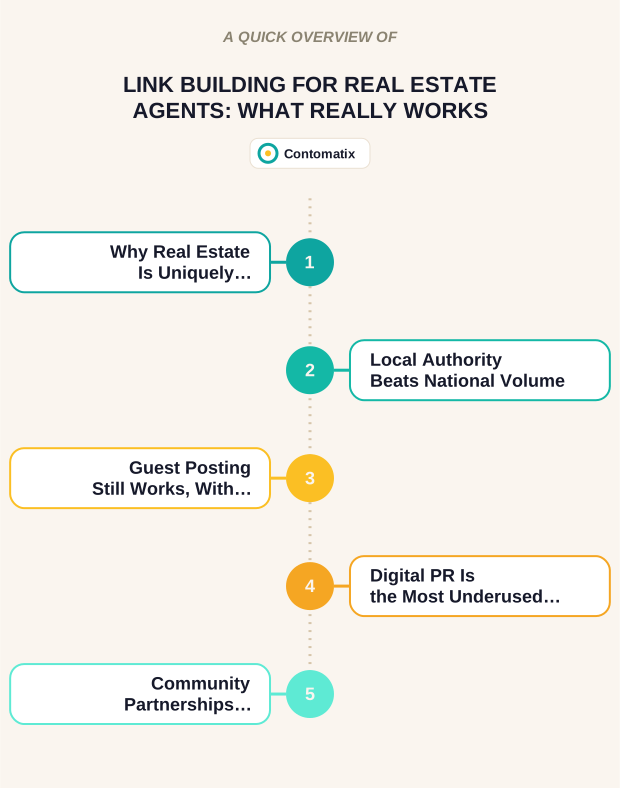
Why Link Building for Real Estate Agents Is Uniquely Competitive
National real estate portals and lead-aggregator sites earn thousands of links simply by existing at scale. An individual agent can't out-produce that volume, which is exactly why the strategy has to shift toward relevance and locality instead of trying to compete on raw numbers. Google's spam-detection systems have also gotten faster at catching manipulative link networks in this space, which raises the cost of shortcuts that might have worked a few years ago.
Local Authority Beats National Volume
One link from your city's chamber of commerce is worth more for local rankings than ten links from national real estate blogs. Local authority signals — chamber memberships, local business associations, community sponsorships — tell search engines you're a genuine, established presence in the specific market you serve, which is exactly the signal that matters most for local search results.
Guest Posting Still Works, With the Right Targets
Guest posting remains effective for real estate specifically because there's a wide range of genuinely relevant publishers: local newspapers, lifestyle magazines, finance blogs, and home-improvement sites all regularly need housing-market content. A well-written piece for one of these outlets earns a link that comes with real editorial context, rather than reading as a placement bought purely for SEO value.
Digital PR Is the Most Underused Tactic Here
Journalists constantly need expert sources for stories about housing market trends, mortgage rates, and home-buying advice, and most local agents never think to position themselves for that. A few genuine media mentions from responding to journalist queries can produce higher-authority editorial links than months of routine outreach, and they carry the added benefit of building real name recognition in your market.
Community Partnerships Produce Natural Links
Partnering with local businesses, sponsoring community events, and contributing to local publications all tend to produce links that look and behave exactly like what they are — genuine local involvement, not a manufactured SEO campaign. These links are also some of the hardest for a national competitor to replicate, since they depend entirely on an actual presence in the community.
Why This Also Matters for AI Search
The National Association of Realtors' Profile of Home Buyers and Sellers has consistently found that the large majority of buyers begin their home search online, which means link building now serves a dual purpose. The same local authority signals that support traditional rankings also influence whether AI tools like ChatGPT and Google AI Overviews cite a given agent as a trustworthy source when someone asks for a recommendation in a specific market.
What to Avoid
Bulk directory submissions and generic real-estate link networks tend to produce exactly the kind of link profile Google's spam systems are built to catch. If a vendor offers a large volume of real-estate-specific links for a flat monthly fee with no mention of where those links actually come from, that's a signal to look elsewhere. A smaller number of genuinely local, editorially earned links consistently outperforms a larger pile of generic ones.
A Realistic Approach for a Solo Agent or Small Team
Most individual agents don't have the bandwidth to run a large-scale outreach campaign, and they don't need to. A steady monthly cadence — one local partnership or sponsorship, one piece of genuinely useful content pitched to a local publication, and consistent, accurate directory listings across the platforms buyers actually use — builds a link profile that compounds over a year without requiring a dedicated marketing team. It's a slower path than chasing volume, but it's the one that actually holds up.
If you're deciding how to prioritize this alongside paid channels, our breakdown of how ranking differs between PPC and SEO is a useful companion piece for weighing where a limited marketing budget goes first.
Real Estate Link Building vs. Generic SEO Advice
A lot of general link building advice doesn't translate cleanly to real estate, because most industries aren't competing against a handful of billion-dollar national portals for the exact same searches. That's worth internalizing early: a strategy built around competing for national keyword volume is the wrong fight for an individual agent. The right fight is owning a specific neighborhood, city, or ZIP code so thoroughly that local search results and AI-generated answers alike default to naming you when someone asks about that specific market.
A Simple Local Content Angle Most Agents Skip
Neighborhood guides are one of the most reliably link-worthy content formats in real estate, and most individual agents never build one properly. A genuinely useful guide to a specific neighborhood — school zones, commute patterns, upcoming development, walkability, the kind of detail a buyer actually searches for before making an offer — gives local publications, community organizations, and even other local businesses a real reason to link to it, because it's useful independent of who wrote it. A generic "why choose our brokerage" page never earns links this way, because there's nothing in it worth referencing.
The same content also tends to perform well for AI-generated answers to hyper-local questions, since specific, well-organized neighborhood detail is exactly the kind of source material an AI tool can cite confidently when someone asks about a particular area.
Evaluating a Link Building Vendor Before Hiring One
Real estate attracts more than its share of low-quality link vendors specifically because there's obvious demand and a lot of agents with limited time to vet who they're hiring. A short set of questions filters out most of the risk:
- "Can you show examples of specific links you've placed, not just a portfolio of client logos?" — a vendor unwilling to show actual placements is usually hiding low-quality sources.
- "Are these links exclusive to my market, or do you place the same links for multiple competing agents?" — a link network selling the same placements to several agents in one market provides little differentiated value to any of them.
- "What's your process if a placement gets penalized or removed later?" — a vendor with no answer to this hasn't thought seriously about the risk side of link building.
- "Do you disclose the actual domains before or only after payment?" — transparency before payment is a reasonable baseline expectation, not an unusual ask.
A vendor that answers these clearly and specifically is a meaningfully different proposition than one offering a flat monthly link count with no detail behind it.
Building Relationships With Local Journalists and Editors
Digital PR for an individual agent works best as an ongoing relationship rather than a one-time pitch. Following the specific reporters at local outlets who regularly cover housing, mortgage rates, or neighborhood development gives an agent a much clearer sense of what those reporters actually need and when. Responding quickly and usefully to a journalist query — with a specific, quotable answer rather than a generic pitch about the agent's own services — is what turns a single mention into a recurring source relationship. Over time, a reporter who's used a quote once and found it genuinely useful is far more likely to reach out directly the next time a relevant story comes up, which produces exactly the kind of high-authority, hard-to-replicate link that a one-off outreach campaign rarely earns on its own.
A Sample Monthly Checklist for Consistent Link Growth
- Week one: check for open journalist queries relevant to housing or your local market and respond to any genuine fit.
- Week two: reach out to one local publication, community organization, or complementary local business about a genuine partnership or contribution opportunity.
- Week three: audit existing directory listings and citations for consistency, and update anything that's changed.
- Week four: review what worked and what didn't from the previous month, and carry forward one relationship worth deepening rather than starting from scratch each cycle.
This pace is deliberately modest. It's built to be sustainable alongside an agent's actual client work, not to compete head-on with a national portal's publishing volume — and sustained over a year, it produces a link profile that looks, and is, entirely organic.
Why Consistency Matters More Than Any Single Placement
It's tempting to measure link building success by the biggest single placement earned so far, but the more reliable predictor of long-term ranking improvement is whether the monthly cadence itself holds up over time. A single strong media mention is genuinely valuable, but one placement followed by three months of inactivity produces far less compounding benefit than a steady, modest pace maintained without interruption. Search engines and AI answer engines alike tend to reward a pattern of ongoing, genuine local relevance more than a single spike, which is exactly why the realistic, sustainable approach outperforms a short burst of intense outreach that isn't kept up.
Frequently Asked Questions
Why is link building for real estate agents so competitive?
Agents compete directly against national portals like Zillow, Redfin, and Homes.com, which earn thousands of links simply through scale. An individual agent has to compete on relevance and locality rather than volume.
What's the single most valuable type of link for a local agent?
Local authority links — a chamber of commerce membership, a local business association listing, or a community sponsorship — consistently outperform links from national real estate blogs for local search rankings.
Does guest posting still work for real estate SEO?
Yes, especially when targeted at genuinely relevant publishers like local newspapers, lifestyle magazines, and home-improvement sites that regularly cover housing content.
What is digital PR and why does it matter for agents?
Digital PR means positioning yourself as an expert source for journalists covering housing trends or home-buying advice. It's underused in real estate and can produce high-authority editorial links that are hard to earn any other way.
Do community partnerships actually help SEO?
Yes. Links from sponsoring local events or partnering with local businesses look and function as genuine community involvement, which is difficult for a national competitor without a local presence to replicate.
How many home buyers actually search online first?
The National Association of Realtors' research has consistently shown that the large majority of home buyers begin their search online, making local search visibility a central part of how most buyers find an agent.
Should a real estate agent buy bulk backlink packages?
No. Bulk or generic real-estate link networks are exactly the pattern Google's spam-detection systems are built to catch, and the risk isn't worth the shortcut compared to a smaller number of genuinely local, earned links.
Does link building for real estate also help with AI search visibility?
Yes. The same local authority and editorial signals that support traditional rankings also influence whether AI tools cite a given agent as a trustworthy local source when answering a buyer's question.
Disclaimer: This article is for informational purposes only and is not a guarantee of specific ranking outcomes.
Contomatix builds genuine local authority and editorial link profiles for real estate agents and small brokerages — the kind that hold up against national competitors. Want a free review of your current backlink profile?
Get a free backlink review →