Last updated: August 2026
The short version of how is ranking different when comparing PPC vs SEO: PPC position is decided by a live auction that re-runs every single time someone searches, and SEO position is decided by an algorithm evaluating your site against everyone else's over a much longer horizon. One you enter and can win in minutes. The other you earn and can lose slowly.
That difference sounds simple, but almost every practical question people have — why a competitor with a smaller budget outranks them, why rankings vanish overnight, whether paying Google helps organic position — traces directly back to it.
This guide walks through both ranking systems specifically, using Google's own documentation rather than agency interpretation, and covers where the two genuinely interact and where they don't at all.
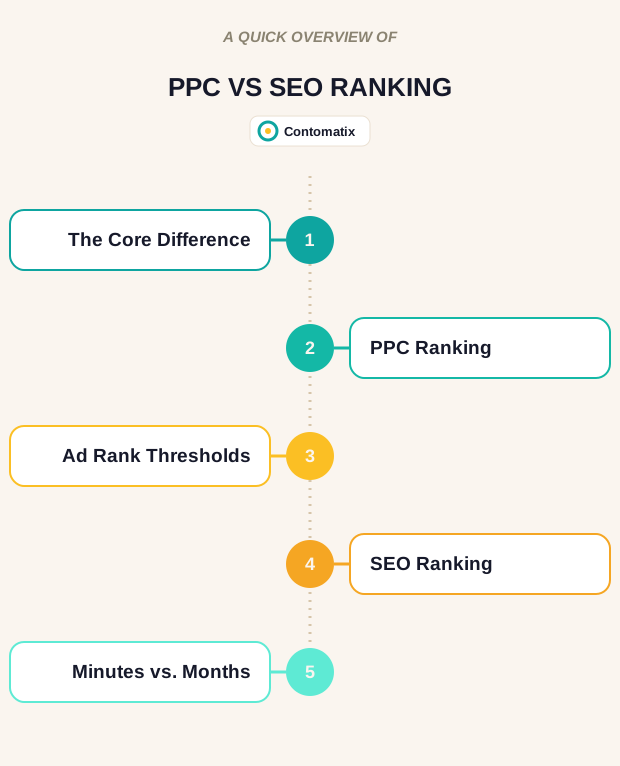
PPC vs SEO Ranking: The Core Difference in One Table
| PPC | SEO | |
|---|---|---|
| Mechanism | Real-time auction | Ranking algorithm |
| Decided | Every individual search | Continuously, updated over time |
| Main inputs | Bid, ad quality, thresholds, context | Relevance, quality, links, usability |
| Time to position | Minutes | Months |
| Cost model | Pay per click, ongoing | Pay for work, clicks free |
| If you stop | Position gone immediately | Decays gradually |
How PPC Ranking Actually Works
Paid position is determined by Ad Rank, and the most common misconception is that it simply means "highest bidder wins." It doesn't.
According to Google's own documentation on Ad Rank, it is calculated from your bid, your auction-time ad quality (expected click-through rate, ad relevance, and landing page experience), the Ad Rank thresholds, the context of the person's search, and the expected impact of your assets and ad formats. Critically, this is calculated twice in every auction — once to decide whether your ad is eligible to appear at all, and again to decide where it sits relative to other eligible advertisers.
The practical consequence is the part most advertisers underestimate: Google states plainly that even when a competitor bids more than you, you can still win a higher position at a lower cost by having genuinely relevant keywords, ads, and landing pages. Quality is not a tiebreaker bolted onto the bid — it's a multiplier inside the calculation.
Ad Rank Thresholds: The Part Nobody Explains
There's a second mechanism that catches people out. Ad Rank thresholds are minimum quality bars an ad must clear to show at all, and to show in a particular position on the page. Fail the threshold and your ad simply doesn't appear — regardless of budget.
This is why an advertiser can raise their bid repeatedly and still see no impressions. They're not losing the auction on price; they're failing to qualify for it on quality. Increasing the bid on a low-relevance ad is one of the most common and most expensive mistakes in paid search.
It's also the closest structural parallel between the two systems: both Google Ads and Google Search have a quality gate that money alone cannot open.
How SEO Ranking Actually Works
Organic ranking has no auction and no entry point you can pay for. Google uses a series of ranking systems that assess relevance, quality, and usability across an enormous number of signals, then orders results accordingly.
There are three sequential requirements, and skipping any one makes the others irrelevant. A page has to be crawled (Googlebot has to reach it), indexed (Google has to decide it's worth storing), and only then ranked against competing pages. A page that never gets indexed cannot rank no matter how good it is — which is a failure mode that simply doesn't exist in PPC, where an approved ad with adequate quality and budget will show.
The other structural difference is that organic ranking is comparative and relative. Your position depends not only on your page but on how every competing page is judged at that moment. You can improve a page meaningfully and still fall, because someone else improved more or a ranking system changed.
Speed: Minutes vs. Months
A PPC campaign can occupy the top of the page within minutes of activation. There's no waiting period, no discovery phase, no trust to establish.
SEO typically takes months, and the reason is mechanical rather than arbitrary. Pages must be discovered and crawled, then indexed, then accumulate enough signals for Google's systems to assess them confidently against established competitors. For a new site with no history, that sequence alone accounts for much of the delay before rankings stabilise.
The corollary matters just as much: PPC results appear instantly and disappear instantly, while SEO results appear slowly and disappear slowly. Neither is inherently better — they are different risk profiles.
What Happens When You Stop Paying
This is the most consequential asymmetry between the two.
Switch off a PPC campaign and your paid visibility ends with the last impression. There is no residual value; the position was rented, never owned. Every click for the rest of the campaign's life costs money again.
Stop active SEO work and rankings do not vanish that day. They erode — gradually, as competitors publish and improve, as content ages, as expectations shift. A page that ranked well can hold position for months with no attention at all. That decay curve is why SEO is usually described as an asset and PPC as an expense, though it's worth being precise: SEO is an asset that depreciates without maintenance, not one that holds value indefinitely.
Cost Mechanics Compared
In PPC you pay per click, indefinitely, and the cost scales linearly with traffic. Ten times the clicks costs roughly ten times as much. Cost per click is set by competition in your market, which means a competitive commercial keyword can be genuinely expensive per visitor.
In SEO you pay for work — content, technical fixes, links, strategy — and the clicks themselves are free. Cost does not scale with traffic in the same way, so the effective cost per visit falls as volume grows. That's the entire economic argument for organic search: the investment is largely front-loaded, and the returns compound if the position holds.
The trap in this comparison is treating SEO as "free traffic." It isn't free; it's prepaid. The bill just arrives before the traffic rather than alongside it.
Control and Predictability
PPC offers direct control. You choose the keywords, write the ad copy exactly as it appears, set the budget, target locations, devices, times of day, and switch any of it off in seconds. Testing is fast because feedback is immediate.
SEO offers influence, not control. You cannot dictate your position, guarantee which page Google chooses to rank for a query, or control how your title and description are rewritten in the results. You also cannot switch a ranking on when you need it.
For anything time-sensitive — a product launch, an event, a seasonal window, testing whether a market has demand at all — that difference in control usually settles the decision on its own.
Placement on the Page and How Users Respond
Paid results occupy prime positions at the top of the page, clearly labelled as ads. Organic results sit below them.
Being above the organic listings is a real advantage in visibility, but the "Ad" label changes user behavior: some searchers deliberately skip ads and scroll to organic results, associating them with editorial rather than commercial selection. Others click the first relevant thing regardless.
Which effect dominates varies heavily by query intent. For transactional searches where someone is ready to buy, ad placement above the fold is often decisive. For research and informational queries, organic results typically capture more of the attention, because the searcher is evaluating rather than purchasing.
Does Running Ads Improve Organic Rankings?
No. This is the single most persistent myth in search marketing, and Google has been unambiguous: participation in Google Ads does not affect organic search rankings. The systems are separate, and paid spend is not an input to the organic ranking algorithm.
What does exist is a set of genuine indirect effects, which is where the confusion comes from. Ads can increase brand awareness, which can produce more branded searches later. Ads can drive traffic that generates engagement, coverage, or links that do influence organic performance. And ads provide keyword and conversion data that can materially sharpen an SEO strategy.
The distinction is worth keeping sharp: paid spend does not buy organic position, but the intelligence generated by paid campaigns can meaningfully improve the work that does.
Why Your Competitor Outranks You Despite a Lower Bid
In PPC, the answer is almost always ad quality. Better expected click-through rate, tighter ad relevance, or a stronger landing page experience raises their Ad Rank enough to overcome a higher bid from you. It can also be the threshold mechanism — their ad qualifies for a position yours doesn't reach.
In SEO, the equivalent question has a wider answer set: stronger topical relevance, a better backlink profile, superior page experience, better search-intent match, or simply a longer track record on the topic. Unlike PPC, there is no single dial you can turn to correct it, which is precisely why organic work takes longer.
Where the Two Systems Genuinely Overlap
Despite operating independently, they share meaningful common ground worth exploiting.
Both reward relevance and landing page quality. A page that converts well and matches intent tends to perform better in both systems — for different technical reasons, but with the same practical fix. Both depend on understanding what people actually search for, which is why keyword research underpins both disciplines rather than belonging to one.
The most useful practical overlap is data. PPC tells you within days which keywords convert, which SEO would take months to reveal. Using paid data to decide where to invest organic effort is one of the highest-return ways to run both together, and it's covered further in our guide to search engine marketing.
When to Choose Each
Lean PPC when: you need traffic now, you're testing a new market or offer, you're promoting something time-limited, margins support a per-click cost, or you need precise control over messaging.
Lean SEO when: you're building for the long term, the cost per click in your market is prohibitive, you're targeting research and informational intent, or you want traffic that doesn't stop when spending stops.
Run both when you can, which is most established businesses. Occupying both a paid and an organic position on the same query increases total visibility, and each channel produces information the other can use. If you're deciding where to start, get in touch and we can look at what your specific market's competition and click costs actually justify.
How is ranking different when comparing PPC vs SEO?
PPC position is set by a real-time auction combining your bid with ad quality, recalculated on every search. SEO position is set by Google's ranking algorithms assessing relevance, quality and usability over time. PPC ranking is bought and instant; SEO ranking is earned and gradual.
Does bidding more always get a higher ad position?
No. Ad Rank combines your bid with auction-time quality signals, and Google states that a lower bid with higher relevance can outrank a higher bid. Ads must also clear Ad Rank thresholds to show at all, so raising a bid on a low-quality ad often changes nothing.
Does paying for Google Ads improve organic rankings?
No. Google has confirmed that participation in Google Ads does not affect organic search ranking — the systems are separate. Indirect benefits exist through brand awareness and data, but paid spend is not an organic ranking factor.
What decides PPC ad position?
Ad Rank, which is calculated from your bid, auction-time ad quality (expected click-through rate, ad relevance, landing page experience), Ad Rank thresholds, the context of the search, and the expected impact of your assets and ad formats.
Why is my ad not showing at all?
Most often because it isn't clearing the Ad Rank threshold — a minimum quality bar an ad must meet to be eligible to display. Budget alone won't fix this; the fix is improving relevance between keyword, ad copy and landing page.
How long does SEO take to rank compared to PPC?
PPC can reach the top of the page within minutes of a campaign going live. SEO typically takes months, because pages must be crawled, indexed, and then accumulate enough signals to be assessed confidently against established competitors.
What happens to my rankings if I stop?
PPC visibility ends immediately when the budget stops — there's no residual value. Organic rankings decay gradually rather than disappearing, often holding for months, though they erode over time as competitors improve and content ages.
Can I rank in both paid and organic results at once?
Yes, and for commercially valuable queries it's often worth doing. Holding both positions increases total visibility on the results page, and each channel generates data useful to the other.
Is SEO traffic actually free?
No — it's prepaid rather than free. You pay for content, technical work, and links up front instead of paying per click. The difference is that cost doesn't scale linearly with traffic, so effective cost per visit falls as volume grows.
Do users click ads or organic results more?
It depends heavily on intent. Transactional, ready-to-buy searches convert well from ads in prime positions. Research and informational queries tend to send more attention to organic listings, since some users deliberately skip anything labelled as an ad.
Which is cheaper, PPC or SEO?
Over a short window PPC is usually cheaper to start; over a long horizon SEO is usually cheaper per visit, because clicks are free once rankings hold. Which wins depends on your market's cost per click, margins, and time horizon.
Should a new business start with PPC or SEO?
Usually PPC first for immediate traffic and fast validation of which keywords actually convert, while SEO is built in parallel for durability. Starting SEO alone means months with little traffic; starting PPC alone means visibility that ends with the budget.