HR technology consulting is the practice of helping a business evaluate, select, and implement the software that runs its HR function — HRIS, payroll, applicant tracking, learning management, and people analytics tools. Done well, it turns a fragmented set of spreadsheets and disconnected systems into a coherent stack that actually gets used. Done poorly, it produces exactly what a lot of companies already have: an expensive system nobody logs into.
That gap between intention and reality is the whole reason this category of consulting exists. The global HR technology market is projected to grow from roughly $47 billion in 2026 to nearly $96 billion by 2034, and yet a striking share of the systems businesses buy within that market never deliver what they were bought to do. This guide covers what HR technology consulting actually involves in 2026, why so many implementations underperform, and how to structure a project that doesn't join that list.

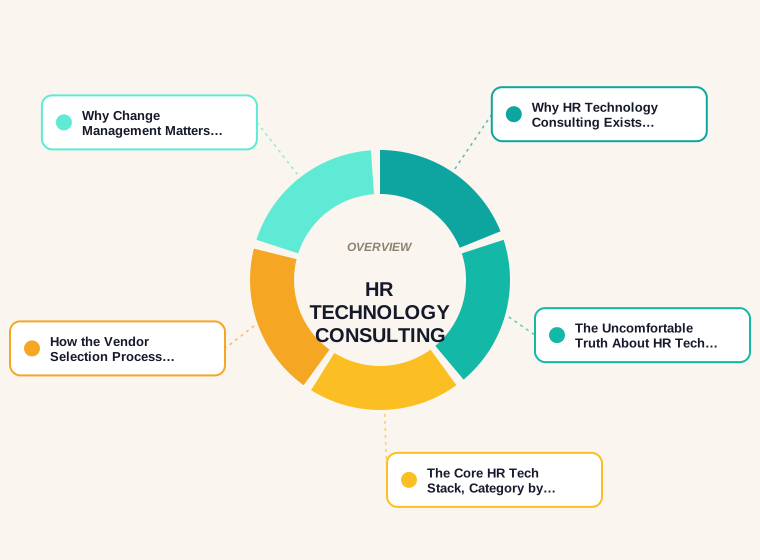
Why HR Technology Consulting Exists as a Category
The honest reason this field is growing isn't that HR software has gotten worse — if anything, it's gotten more capable. It's that the number of specialized systems a business now has to choose between, integrate, and get employees to actually adopt has expanded faster than most internal HR teams have the bandwidth or specialized expertise to manage alone. A modern HR tech stack typically spans eight core categories: applicant tracking, HRIS, payroll and benefits, performance management, learning management, employee engagement, people analytics, and increasingly AI-driven screening tools.
Evaluating even one of those categories properly means understanding integration requirements, data migration risk, vendor pricing structures, and how a given tool will actually get used day to day by managers and employees — not just HR staff. Multiplying that across eight categories is where most internal teams, however capable, run out of specialized bandwidth, which is the practical reason external HR technology consulting exists as a distinct discipline rather than something every HR department just handles in-house.
There's also a market-growth dimension worth naming directly. As more of the HR function moves onto specialized software rather than spreadsheets and paper processes, the number of vendors competing within each category has expanded significantly too — a company evaluating an ATS today isn't choosing between two or three established options the way it might have a decade ago, but between a genuinely large field of platforms at different price points, feature depths, and integration philosophies. That expanded choice is good for buyers in theory, but it also raises the research burden considerably, which is a large part of why specialized consulting has become more valuable rather than less as the market has matured.
HR consulting itself is also growing as a broader category — the human resources consulting market overall is projected to expand from roughly $79 billion in 2025 to nearly $119 billion by 2031, and HR technology work specifically is one of the fastest-growing segments within that broader consulting market, since technology decisions increasingly sit at the center of larger workforce strategy questions rather than being a purely operational afterthought.
The Uncomfortable Truth About HR Tech Failure Rates
This is the part of the conversation vendors don't lead with. Surveys indicate that 25% to 60% of HR-tech rollouts fall short of expectations due to missed timelines, cost overruns, low user adoption, or data migration issues — and nearly one in four organizations report their new HR tech implementation failed to meet basic adoption expectations. A separate Gartner survey found that the average HRIS is actually used by only 32% of employees, a strikingly low figure for a system meant to be the operational backbone of the HR function. Set against a market projected to roughly double by 2034, those failure rates represent an enormous amount of spend that never produces the outcome it was budgeted for.
What's most instructive here is the actual cause. Most failed HRIS implementations don't fail because the underlying software is broken — they fail because line managers simply don't log in. Limited stakeholder alignment, underinvestment in change management, and unclear success criteria consistently show up as the real drivers of failure, not technical defects in the platform itself. That reframes what good HR technology consulting is actually solving for: it's less a software selection problem and more a change management and adoption problem that happens to involve software.
It's worth sitting with the scale of that 32% adoption figure for a moment. A system used by less than a third of the people it was built for isn't a marginal underperformer — it's a business paying full licensing costs for a tool that's functionally failed for roughly two-thirds of its intended user base. That gap rarely shows up clearly in a project's official post-launch reporting, since "the system is live" and "the system is actually used" get reported as the same milestone far more often than they should be.
Cost overruns compound this problem rather than existing separately from it. A project that's already over budget creates internal pressure to declare success and move on the moment the technical rollout is complete, which is exactly the wrong moment to stop investing in the change management work that determines whether the tool gets used six months later. The businesses that get this right tend to treat go-live as roughly the midpoint of the project, not the finish line.

The Core HR Tech Stack, Category by Category
- HRIS (Human Resources Information System) — the central employee database and system of record; usually the foundation everything else integrates around
- Applicant Tracking System (ATS) — manages job postings, candidate tracking, and interview coordination for recruiting
- Payroll and benefits software — evaluated on multi-state tax compliance, direct deposit handling, and benefits administration
- Learning Management System (LMS) — delivers onboarding training, compliance courses, and ongoing professional development
- Performance management — structures goal-setting and review cycles with actual data behind them rather than a once-a-year form
- People analytics — turns the data sitting inside the other systems into workforce planning decisions rather than static reports nobody opens
Across those eight stack categories, the strongest setups tend to choose one genuinely best-in-class tool per category and integrate them through a central HRIS, rather than buying a single all-in-one suite that handles every category adequately but none of them particularly well. That's a real tradeoff, though — more best-in-class tools means more integration points, and every integration point is another place where a sync can silently break.
The HRIS deserves particular attention in this stack because it's rarely replaced once chosen — switching a core system of record is disruptive enough that most businesses live with an HRIS decision for years, even once it's clearly showing its age. That makes the initial HRIS selection disproportionately important relative to the other categories, since a payroll or LMS platform can usually be swapped out with far less organizational pain if it turns out to be the wrong fit.
Payroll and benefits software carries its own distinct risk profile, since errors here have immediate, visible consequences for every employee rather than a slow-building adoption problem. A late or incorrect paycheck is noticed by 100% of affected employees within a single pay cycle, which is a much faster and more painful feedback loop than a performance management tool nobody uses quietly sitting unused for months. That difference is part of why payroll migrations in particular tend to get more conservative testing and parallel-run periods than other HR tech categories.
How the Vendor Selection Process Actually Works
A properly run HR technology consulting engagement starts by gathering real business and user requirements before looking at a single vendor demo — a step that's easy to skip under time pressure but that determines almost everything downstream. From there, the typical process narrows the field to two to four realistic vendor candidates based on those requirements, coordinates demos or issues formal RFPs, and builds a structured scorecard so the eventual decision is based on documented criteria rather than whoever gave the most polished sales presentation.
Scalability, integration depth, user experience, and readiness for AI-driven features are the considerations that tend to separate a system that still fits three years later from one the business has already outgrown — a real concern given how quickly a fast-growing company's headcount and workforce complexity can outpace a system chosen for last year's needs rather than next year's. Skipping this structured comparison in favor of picking whichever vendor a leadership team happens to already recognize is one of the more common, avoidable mistakes in this process.
Reference calls with existing customers of a shortlisted vendor are consistently underused in this process, despite being one of the highest-value, lowest-cost steps available. A vendor's sales team will always present their own product favorably; a reference customer who's already gone through implementation, hit whatever edge cases exist, and dealt with the vendor's actual support quality after the contract was signed gives a far more honest picture of what the next twelve months will actually look like. Skipping reference calls to save a week or two on the buying timeline is a routinely poor trade given how much it can reveal.
Data migration planning is another step that gets compressed under deadline pressure more often than it should. Moving employee records, historical payroll data, and benefits elections from a legacy system into a new one is rarely a clean, automated process — data fields don't always map cleanly between systems, historical records are often incomplete or inconsistently formatted, and validating that the migration actually preserved data integrity takes real time that a rushed timeline tends to shortchange.
The underlying discipline here is similar to what we've covered in other back-office technology decisions — see our breakdown of B2B ecommerce ERP integration for how the same pattern of matching an integration approach to actual system complexity, rather than defaulting to the most flexible option by habit, plays out in a completely different part of the business.
Why Change Management Matters More Than the Software Itself
Given that adoption failure — not software failure — is the leading cause of HR tech projects falling short, the change management side of an implementation deserves at least as much planning as the technical rollout. That means training that goes beyond a single onboarding webinar, a clear internal communication plan explaining why the change is happening (not just how to use the new interface), and named internal champions in each department who can answer day-to-day questions without every issue escalating straight to HR or IT.
It also means setting realistic adoption targets and actually measuring against them after launch, rather than declaring the project complete the day the system goes live. A rollout that hits 100% technical deployment but 30% real usage six months later is not a successful implementation, regardless of how the initial go-live was reported internally.
Named internal champions deserve more emphasis than they typically get in project plans. A single department representative who's been trained ahead of the broader rollout, understands the reasoning behind the change (not just the mechanics), and can field routine questions locally does more for sustained adoption than an extra round of company-wide training emails. Employees are generally far more receptive to a peer they already trust walking them through a new system than to a generic help-desk ticket process, especially in the first few weeks when small frustrations are most likely to turn into outright avoidance of the new tool.
Measuring adoption after launch also needs a specific, pre-agreed definition rather than a vague sense of how things are going. Login frequency, completion rates for specific workflows (like self-service time-off requests or performance review submissions), and help-desk ticket volume tied to the new system are all concrete, trackable signals that tell a very different story than an informal "seems like people are using it" check-in a few weeks after go-live.
What This Means for Getting Found by the Right Clients
None of this operational expertise matters commercially if the businesses searching for HR technology consulting can't find the firm that has it. Buyers evaluating a technology decision this consequential typically research extensively — comparing vendor categories, reading implementation case studies, and researching consulting partners — before ever picking up the phone. Solid keyword research and content built around the real questions those buyers are asking earns its cost here, since a firm that doesn't rank for those research-stage searches simply never enters the conversation.
If you're evaluating your own HR technology strategy or need help structuring a vendor selection process, get in touch and we can walk through what a realistic approach looks like for your specific HR tech stack.
It's also worth asking any prospective HR technology consulting partner directly how they handle the adoption side of a project, not just the technical implementation — a partner who can only speak to configuration and data migration is solving half the problem this article has been describing throughout.
What is HR technology consulting?
It's the practice of helping a business evaluate, select, and implement HR software systems — HRIS, payroll, applicant tracking, learning management, and people analytics — including managing the change management work needed to get employees to actually use them.
Why do HR tech implementations fail?
Most failures come down to adoption, not broken software. Limited stakeholder alignment, weak change management, and unclear success criteria are the leading causes — one survey found the average HRIS is used by only 32% of employees.
What's the difference between HRIS and HCM?
HRIS typically refers to the core employee database and system of record. HCM (Human Capital Management) is a broader term that often includes HRIS plus talent management, performance, and workforce planning tools in one integrated platform.
How much does HR technology consulting cost?
Costs vary widely by project scope and company size, but they should be weighed against the cost of a failed implementation — surveys show 25-60% of HR-tech rollouts fall short of expectations, which carries its own significant cost in wasted licensing fees and lost productivity.
How long does an HR technology implementation take?
Timelines depend heavily on which systems are involved and how much data migration is required, but rushing the requirements-gathering phase to hit an arbitrary deadline is one of the more common causes of downstream adoption failure.
Do small businesses need HR technology consulting?
Even smaller HR tech stacks benefit from structured vendor evaluation and change management planning — the adoption failures that plague enterprise rollouts (unclear requirements, weak internal communication) affect small teams too, just at a smaller scale.
What is the vendor RFP process?
After gathering requirements, a business shortlists a small number of vendors, issues a formal Request for Proposal (RFP) or Request for Information (RFI), and evaluates responses against a structured scorecard rather than an informal comparison.
Related Reading
- CRM and automation choices often overlap with HR tech decisions — see our verified comparison of the best CRM and automation tools.