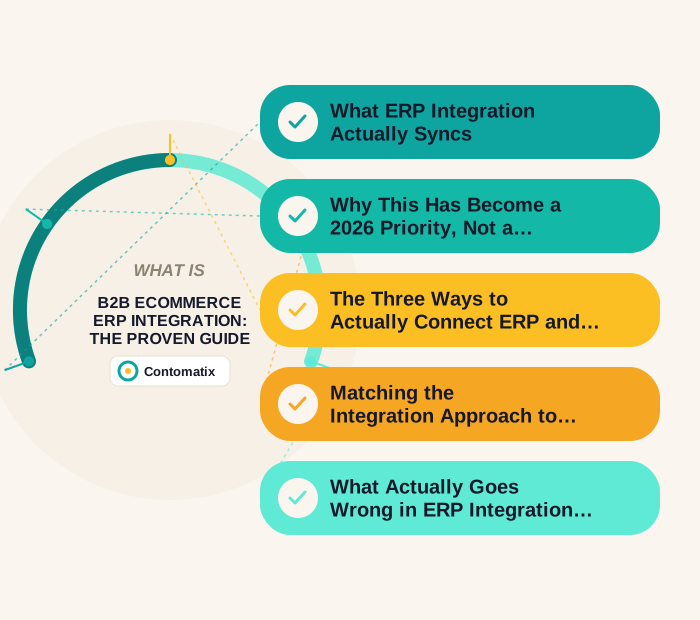
B2B ecommerce ERP integration is the connection between your online storefront and your enterprise resource planning system — the software that already manages your inventory, pricing, orders, and customer accounts. Without that connection, someone on your team is manually re-entering orders, checking stock levels by hand, or updating prices in two places every time they change. With it, a customer placing an order online triggers the exact same real-time data flow as an order taken over the phone.
The stakes here are bigger than they might look from a single storefront's perspective. The global B2B ecommerce market is now measured in the tens of trillions of dollars — roughly $28 trillion in 2026, growing at a compound annual rate of about 14.5% — and B2B transactions already account for a larger share of total ecommerce value than consumer retail does. At that scale, manual order entry and disconnected systems aren't a minor inefficiency; they're a direct constraint on how much volume a business can actually process.

What B2B Ecommerce ERP Integration Actually Syncs
At a functional level, ERP integration keeps a defined set of data points identical across your ecommerce platform and your ERP, updated automatically rather than by hand. That typically includes real-time inventory levels (so a storefront never sells stock that's already been allocated elsewhere), customer-specific and tiered B2B pricing, order status and fulfillment updates flowing back to the buyer, and customer account data — credit terms, tax exemptions, approved purchasing limits — that B2B buyers specifically expect to see reflected accurately online.
The reason this matters more for B2B than consumer ecommerce comes down to complexity: a B2C storefront usually has one price per product and one shipping flow. A B2B storefront often has different prices per customer or customer tier, negotiated contract pricing, credit-based payment terms, and multi-step approval workflows for large orders — all of which live in the ERP already, and all of which break down the moment the ecommerce layer isn't reading from the same live data.
That complexity compounds with order volume rather than staying flat. A handful of manually-entered orders a week is annoying but survivable; hundreds of orders a day with tiered pricing and credit checks manually verified against a separate ERP screen is where errors start reaching customers directly — the wrong price quoted, an order accepted for stock that's already been allocated, a customer's credit limit not actually checked before an order is confirmed.
Why This Has Become a 2026 Priority, Not a Nice-to-Have
The data on this is fairly direct. Roughly 87% of B2B suppliers are currently upgrading their ERP systems or planning to, which means the integration question is landing on a lot of desks at once, not as a hypothetical future project. That upgrade cycle is happening against a B2B ecommerce market measured in the tens of trillions, which is why integration budgets have moved from optional to expected. Where integration has already happened, the reported impact is substantial: about 91% of organizations report optimized inventory levels, 78% report improved productivity, 77% report reduced operational silos, and 62% report reduced operational costs after connecting ERP to their commerce layer.
Return on investment figures back this up at the platform level too — independent industry studies on ERP-integrated commerce have reported three-year returns in the 200-400% range with payback periods as short as 7 months, driven almost entirely by eliminating the manual work and error correction that disconnected systems create. None of this means integration is free or instant, but it does mean the businesses treating it as optional are increasingly the exception rather than the norm.
It's also worth sizing the opportunity cost of waiting. The global B2B ecommerce market added over $4 trillion in new digital transaction volume in a single year at its current growth rate — businesses that delay integration aren't just carrying manual work forward, they're doing it while the total addressable order volume moving through B2B ecommerce keeps expanding underneath them.
The Three Ways to Actually Connect ERP and Ecommerce
- Dedicated connector — a pre-built, purpose-made integration for a specific ecommerce platform and ERP pairing (for example, a connector built specifically for NetSuite plus a particular storefront). Fastest to deploy, but limited to the systems it was built for.
- iPaaS (integration platform as a service) — a general-purpose platform like Celigo, Boomi, MuleSoft, or Workato that can connect many different systems, not just ecommerce and ERP. More flexible and better suited to businesses running several connected tools, but it requires more setup and an IT team comfortable maintaining it.
- Native integration — a commerce platform with ERP connectivity built directly into the product, removing the need for a separate middleware tool entirely. Simplest to manage long-term, but only available if your specific ERP and commerce platform both support it out of the box.
What all three approaches are trying to avoid is point-to-point integration — custom code connecting one system directly to another with no middleware layer at all. It's often the cheapest option to build initially, but it's also the most brittle: if either system changes its API or internal logic, the entire connection can break, and there's no abstraction layer protecting the rest of your systems from that change.
The choice between these three approaches usually comes down to how many systems actually need to talk to each other, not just the ecommerce-ERP pair in isolation. A business running only a storefront and an ERP, with no other connected tools, is often well served by a dedicated connector or native integration — there's little benefit to the added flexibility of a full iPaaS if there's nothing else to connect. A business also running a separate CRM, a warehouse management system, and a shipping platform has a much stronger case for an iPaaS, since that same middleware layer can extend to those additional systems without starting from scratch each time a new tool gets added.

Matching the Integration Approach to Your ERP
The right integration path often depends heavily on which ERP you're actually running, since each major platform has developed a different ecosystem around it. NetSuite exposes SuiteTalk (available in both SOAP and REST) along with SuiteScript for custom logic, which means most of the data an ecommerce integration needs is reachable through a documented, first-party API — Celigo has become the most established iPaaS specifically for NetSuite-to-ecommerce integration, with APPSeCONNECT and Boomi as common alternatives for businesses running multiple systems.
SAP is a different story: there's no universal first-party ecommerce connector, so SAP integrations typically run through middleware, iPaaS, or custom development. SAP Integration Suite offers the deepest native connectivity for organizations already committed to SAP's own tooling, while APPSeCONNECT is a common mid-market choice specifically for SAP Business One. For Microsoft Dynamics 365 and Business Central, APPSeCONNECT again shows up frequently, alongside native-integration platforms like WizCommerce, Dynamicweb, and k-eCommerce that build the connection directly into the commerce layer rather than through a separate tool.
Smaller and mid-market ERPs — Odoo, Acumatica, Sage, and similar platforms — tend to fall somewhere between the NetSuite and SAP patterns: fewer dedicated, purpose-built connectors than NetSuite's ecosystem, but generally more accessible first-party APIs than SAP's typically closed, enterprise-oriented setup. For businesses on these platforms, the practical starting point is usually checking whether the ecommerce platform under consideration already lists a native or certified integration before defaulting straight to custom middleware development.
What Actually Goes Wrong in ERP Integration Projects
Most integration failures trace back to a small number of recurring mistakes rather than exotic technical problems. Treating the integration as a one-time project instead of an ongoing system is probably the most common — ERPs and ecommerce platforms both get updated independently, and an integration that isn't actively maintained tends to drift out of sync gradually rather than failing all at once, which makes the problem harder to notice until pricing or inventory data is visibly wrong.
Underestimating data mapping complexity is another frequent issue. A product SKU, a customer ID, or a tax code rarely means exactly the same thing in both systems by default, and skipping the work of properly mapping these fields creates silent data mismatches that look like integration bugs but are really unresolved definitional differences between the two systems. Point-to-point integrations built without any monitoring or error-alerting are the third common failure mode — when a sync silently stops working, the first sign is often a customer complaining about a wrong price or an out-of-stock item that should have been available, which is a costly way to discover a broken connection.
A fourth, less obvious failure mode is scope creep during the initial build. It's tempting to try syncing every field both systems technically expose the first time an integration project kicks off, rather than starting with the handful of data points that actually drive customer-facing accuracy — inventory, pricing, and order status. Projects that try to sync everything on day one tend to take longer, cost more, and introduce more edge cases to debug than projects that start narrow and expand the scope once the core sync is proven stable in production.
What Good ERP Integration Actually Delivers
When it's done well, the practical result is that pricing and inventory data are accurate everywhere, all the time, without anyone manually reconciling two systems. Around 95% of businesses report meaningful benefits after ERP deployment, specifically citing lower process times, stronger cross-team collaboration, and having a genuine single source of truth for business data instead of the ecommerce team and the operations team working from two different versions of reality.
For a B2B seller specifically, this also directly affects revenue capture, not just internal efficiency. A buyer who sees accurate real-time stock and their correct negotiated pricing online is far more likely to complete a self-service order than one who has to call and confirm details manually — and every order that moves from a phone call to a self-service checkout frees up sales and support staff for higher-value work.
There's a compounding effect here worth naming directly: reducing manual order handling doesn't just save the time spent on any single order, it changes what your sales team's time is actually spent on. A team no longer confirming stock levels and re-keying orders by phone has more capacity for the calls that genuinely need a human — negotiating a new contract, resolving a complex order issue, or pursuing a larger account — which is a different kind of return than the direct cost savings usually cited in ERP integration ROI figures.
Getting Your ERP Integration Discoverable and Trusted Online
None of this technical work matters if potential B2B buyers researching an ERP-integrated ecommerce solution can't find the business that built it. This is where solid on-page SEO and targeted keyword research around terms like "ERP integration for [industry] ecommerce" earn their cost — B2B buyers researching this kind of infrastructure decision typically read several detailed comparisons before ever reaching out, and a site that doesn't rank for those research-stage searches simply never enters the conversation.
Coverage from genuine industry publications and B2B trade press carries particular weight for exactly this kind of infrastructure decision, since buyers evaluating a technical purchase tend to trust third-party coverage more than a vendor's own marketing pages — generic directory links don't carry the same topical authority as a real mention on a site buyers already trust.
We've seen a similar pattern play out in other technically dense B2B research cycles — see our breakdown of B2B telemarketing for how the same "long research phase before contact" buying behavior shapes outreach strategy outside of ecommerce specifically.
Choosing an Integration Partner
Given how much of this hinges on ongoing maintenance rather than a one-time setup, the more useful question to ask a prospective integration partner isn't "can you build this" but "how do you monitor it after launch." A partner who can describe specific error-alerting, data reconciliation checks, and a plan for handling ERP or platform version updates is a fundamentally different proposition than one who treats the integration as a finished deliverable the day it goes live. If you're evaluating options for your own B2B storefront, get in touch and we can walk through what a realistic integration approach looks like for your specific ERP and platform combination.
It's also reasonable to ask a prospective partner for a straightforward answer about failure scenarios — what happens if the ERP vendor pushes a breaking API update, how quickly a broken sync typically gets caught and fixed, and whether monitoring alerts go to a real person rather than sitting in an unread inbox. A partner who's built and maintained integrations before will have concrete answers to these questions rather than general reassurances, and that difference tends to show up clearly in how the project actually holds up a year or two after launch.
What is ERP integration in B2B ecommerce?
It's the automated, real-time connection between your ecommerce storefront and your ERP system, keeping inventory, pricing, order status, and customer account data identical across both without manual re-entry.
Why do B2B ecommerce businesses need ERP integration?
B2B storefronts typically involve tiered pricing, negotiated contracts, credit terms, and approval workflows that already live in the ERP — without integration, that data has to be manually duplicated and kept in sync, which doesn't scale as order volume grows.
What's the difference between iPaaS and a dedicated connector?
A dedicated connector is purpose-built for one specific ecommerce-ERP pairing and is fast to deploy but limited in scope. An iPaaS (like Celigo, Boomi, or MuleSoft) is a general-purpose platform that can connect many systems, offering more flexibility at the cost of more setup and ongoing maintenance.
Which ERP works best with ecommerce integration?
It depends on your existing ERP rather than a single "best" answer. NetSuite has strong first-party API support (SuiteTalk) and an established iPaaS ecosystem led by Celigo. SAP typically requires middleware or custom development since there's no universal first-party connector. Microsoft Dynamics 365 has several native-integration options like WizCommerce and k-eCommerce.
How long does ERP integration typically take?
It varies significantly by approach and data complexity, but a dedicated connector or native integration is generally faster to deploy than a custom iPaaS build, which requires more upfront data-mapping and configuration work.
Is ERP integration expensive?
Costs vary widely by method and ERP, but the reported returns are strong where integration is done properly — independent studies have found three-year ROI in the 200-400% range with payback in as little as 7 months, driven mainly by eliminating manual order processing and error correction.
Can small B2B businesses benefit from ERP integration?
Yes. While large enterprises have more complex integration needs, even a small B2B business manually re-entering orders or checking stock by hand benefits from automated sync, since that manual work scales poorly as order volume grows regardless of company size.
What data should sync between ERP and ecommerce?
At minimum: real-time inventory levels, customer-specific and tiered pricing, order status and fulfillment updates, and customer account details like credit terms and approved purchasing limits.


