Last updated: September 2026
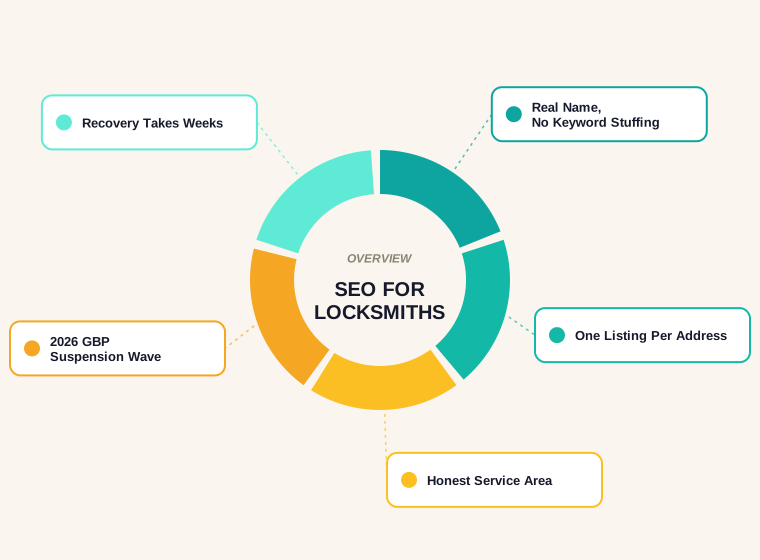
SEO for locksmiths has a problem most other local trades do not: the industry's own worst habits are now getting listings suspended at scale. 2026 has brought a sustained crackdown on exactly the tactics that used to be standard locksmith marketing advice, and a lot of that advice is still being repeated in guides written before the enforcement changed.
This guide covers what actually got locksmiths suspended this year, what Google's own naming rules say word for word, a scope that works within them, realistic pricing, and how to recover if a listing has already been flagged.
Why Locksmiths Specifically
Locksmithing sits in a cluster of trades — alongside movers, plumbers, HVAC and general contractors — where Google's 2026 enforcement has hit hardest. The reasons are structural to the industry rather than about any one company: high emergency-search intent, a history of call centres dispatching under many different local-sounding business names, and years of business names built entirely around keywords rather than the actual company identity.
That last point is the one costing listings this year. Google's automated detection is now flagging keyword-stuffed business names, duplicate listings at a single address, and service areas that claim coverage the business cannot realistically provide, and locksmiths have been disproportionately caught because those three practices were, until recently, close to industry standard.
What Google's Naming Rule Actually Says
This is worth reading directly rather than relying on secondhand summaries, because it is stricter than most locksmiths assume.
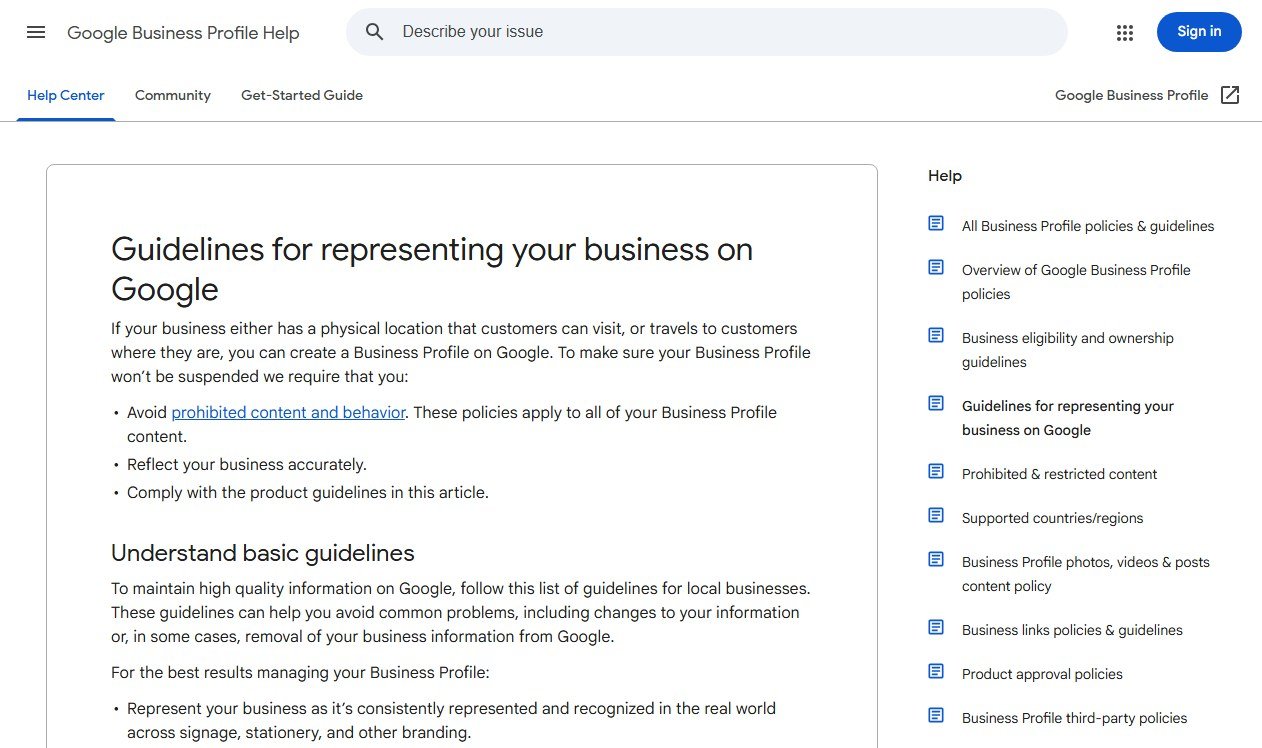
Google's guidelines for representing your business state that your name should reflect how it is "consistently represented and recognized in the real world across signage, stationery, and other branding," not how you want to market it. Marketing taglines are explicitly disallowed — Google's own example contrasts "TD Bank" with the unacceptable "TD Bank, America's Most Convenient Bank." Service descriptions in the name are also disallowed, with "Verizon Wireless" acceptable and "Verizon Wireless 4G LTE" not.
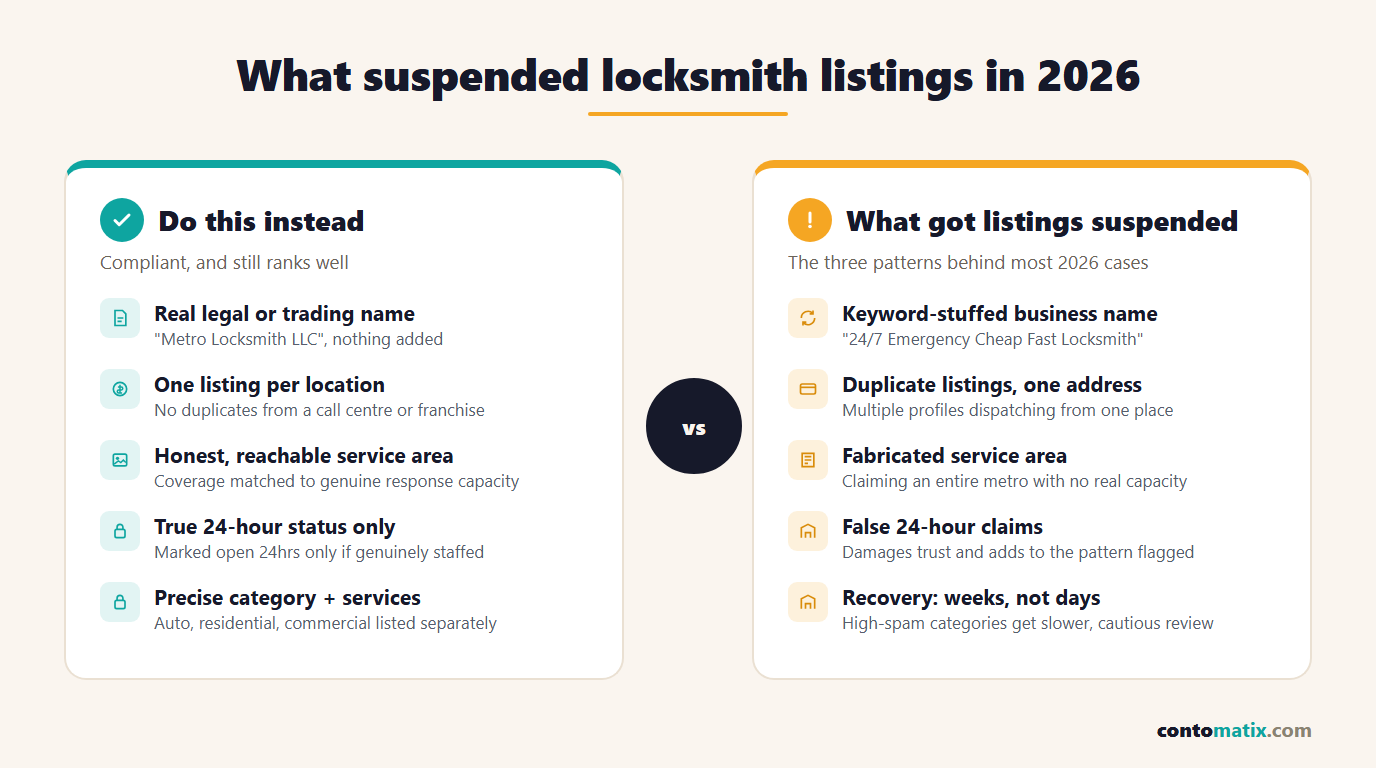
Translate that to a locksmith: "Metro Locksmith LLC" is your name. "Metro Locksmith 24/7 Emergency Cheap Fast" is not, and it is exactly this pattern that automated review is now catching at scale.
The Three Violations Behind Most 2026 Suspensions
- Keyword-stuffed names. Adding "24/7", "Emergency", "Cheap" or a service area name into the business name field rather than the real legal or trading name.
- Duplicate listings at one address, often created when a call centre or franchise operator spins up several profiles under different names dispatching from the same location.
- Fabricated or exaggerated service areas, claiming coverage across an entire metro or state from a single small operation with no genuine capacity to serve it.
Any one of these can trigger review on its own. Locksmith profiles frequently carry two or three at once, which is why reinstatement in this category now runs weeks rather than days.
What the Map Pack Actually Looks Like Now
After a year of enforcement, here is a genuine, current locksmith search.
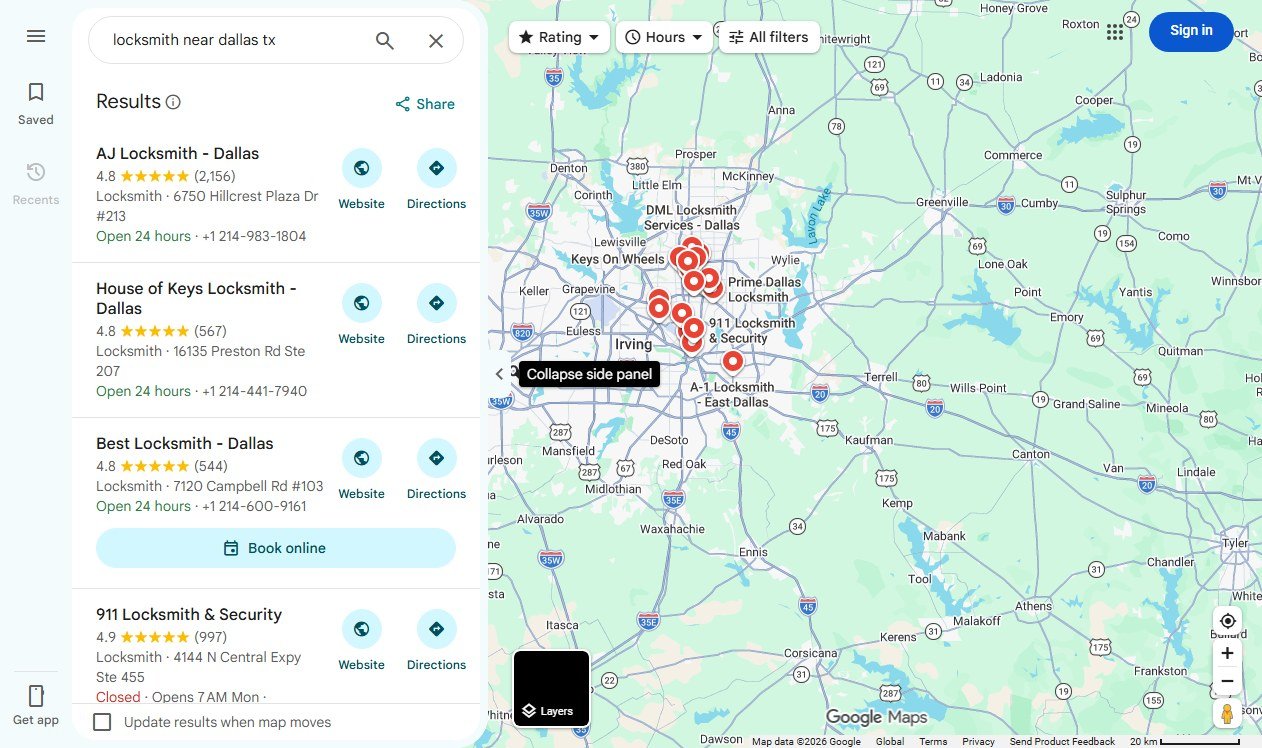
None of these are stripped-down or generic. They are specific, memorable business names that also happen to comply with the naming policy, which is the actual template to follow rather than anything more exotic.
A Scope That Works Within the Rules
Legitimate locksmith SEO in 2026 looks like this.
| Workstream | What it covers | Why it matters here specifically |
|---|---|---|
| Profile audit | Confirm the business name matches the legal entity, one listing per real location, service area realistic for capacity | Removes the three flags behind most suspensions before they happen |
| Category and services | Precise category, individual services listed (auto, residential, commercial, safes) | Category is the strongest ranking signal; vague categories underperform |
| Verified hours, including true 24-hour status | Only mark 24-hour if genuinely staffed around the clock | A false "Open 24 hours" is both a trust problem and a policy risk |
| Reviews by job type | Requests timed to residential, automotive and commercial jobs separately | Different customers search differently; review content should reflect that spread |
| Emergency-intent content | Pages built around real urgent queries — lockout, broken key, lost car key | These are the highest-intent searches in the category |
Emergency Search Intent, Handled Honestly
Locksmith search is unusually urgent: someone locked out of a car or a house is searching from their phone, often at an inconvenient hour, and wants an answer in seconds, not a browsing experience. Content should be built for that moment rather than around it.
- A dedicated page per genuine emergency scenario — locked out of house, locked out of car, lost keys, broken key in lock — each answering "can you help right now" in the first two sentences.
- The phone number visible without scrolling on mobile, which is where nearly all of this traffic arrives.
- Real response time stated honestly. "Usually within 30 minutes" beats an unverifiable "instant" claim, and it sets an expectation you can actually meet.
This is also where honesty about service area pays off directly: a customer who calls expecting a 15-minute response and gets a 90-minute one because you claimed coverage you do not have is a one-star review waiting to happen, independent of any Google policy question.
Pricing Transparency as an SEO Asset
Locksmith pricing has a reputation problem — inflated call-out quotes, bait pricing, hidden emergency surcharges — and that reputation shows up in search behaviour: "locksmith cost" and "how much does a locksmith cost" are searched constantly, and a page that answers honestly earns trust before the phone even rings.
Typical 2026 ranges worth publishing rather than hiding: residential lockouts and rekeying commonly run $75–$250, commercial work $100–$150 an hour with a higher call-out floor, and automotive key replacement $90–$350 depending on whether the key is a basic cut or a programmed transponder or smart key. Publishing real ranges, even wide ones, differentiates a page from the generic "call for a quote" competitors and directly addresses the fear that drives a lot of the searching in the first place.
Local Links That Actually Fit a Locksmith
Link building for a locksmith does not need to be complicated, and the generic "guest post outreach" pitch most agencies default to rarely fits this trade well. What does fit is local and trade-specific.
- Locksmith association membership, such as a state or national locksmith trade body, which typically comes with a member directory link.
- Local chamber of commerce and business association listings, which double as citations and links.
- Property manager and real estate agent relationships — locksmiths who handle lockouts and rekeying for a local property management company are a natural, genuinely earned mention on that company's vendor page.
- Local news coverage when there is a real angle: a community safety tip during a cold snap, a comment on a local break-in trend, or a charity job for someone in genuine need.
None of this requires a large budget, and all of it produces links a reviewer would recognise as genuine rather than manufactured, which matters more in a category already under this much scrutiny.
Seasonal Demand Worth Planning Around
Locksmith search volume is not flat across the year, and content and ad budgets should follow the pattern rather than stay static.
- Cold snaps spike car lockout and frozen-lock searches sharply and briefly.
- Moving season, concentrated in summer in most US markets, drives rekeying searches for new homeowners and renters.
- Holiday periods bring a rise in emergency lockouts tied to travel and family gatherings.
A rekeying page that ranks well in July and an emergency lockout page that earns attention during a January cold snap are doing different jobs for the business, and treating them as one generic "locksmith services" page usually undersells both.
What Locksmith SEO Costs
- Single location: $500 – $1,500/month. Profile management, review process, basic emergency-intent content, local link work.
- Multi-location or franchise group: $1,500 – $4,000+/month. Profile governance across locations, per-location pages, centralised reporting.
- Suspension recovery / one-off audit: $500 – $2,000. A full naming and duplicate-listing cleanup plus the reinstatement request itself.
Be wary of any provider whose plan leans on the exact tactics described above as violations. A cheaper retainer built on keyword-stuffed names and inflated service areas is not a bargain; it is a suspension with a delay attached.
If a Listing Has Already Been Suspended
Google's own guidance on fixing suspended or disabled profiles sets out the process, and the steps that matter most rarely change between cases.
- Fix the underlying issue first. Rename to the accurate legal or trading name, remove duplicate listings, correct the service area, before submitting anything.
- Submit one reinstatement request through Google's official process, with clear documentation of the legal business name and address.
- Do not submit multiple parallel requests hoping one gets through faster; it typically slows the review rather than speeding it up.
- Expect weeks, not days. High-spam categories like locksmiths, movers and contractors are reviewed more cautiously than average, and reinstatement timelines reflect that.
For the wider mechanics of how local ranking works once a profile is clean, our guide to local SEO services covers the fundamentals that apply across every trade, and our local SEO for small business guide is the shorter version if you are a single-location shop rather than a multi-van operation.
Vetting a Locksmith SEO Provider
Because this category has such a specific set of policy risks, the vetting questions differ from a generic local SEO checklist.
- Ask directly how they handle business names. Any provider recommending keyword insertion into the name field is recommending a suspension risk, not a growth tactic.
- Ask how many listings they manage at one address. A provider running several near-identical "locksmith" profiles for the same dispatch operation is building the exact pattern Google flags.
- Ask them to define your service area with you, based on genuine response capacity, rather than handing you a pre-set radius.
- Ask what happens if a listing gets suspended anyway. A provider with no clear process for that is not planning for the environment this industry actually operates in during 2026.
Quick Recap
- Locksmiths, movers, plumbers and contractors have seen the heaviest 2026 Google Business Profile suspensions.
- The three common causes: keyword-stuffed business names, duplicate listings at one address, and fabricated service areas.
- Google's own naming guidelines explicitly ban marketing taglines and service descriptions in the name field.
- A compliant profile with a precise category and honest hours outperforms a stuffed name in the current environment.
- Publish real pricing ranges to build trust before the call, and build content around genuine emergency scenarios.
- Recovery from suspension takes weeks in this category; fix the root cause before requesting reinstatement, and only submit once.
Frequently Asked Questions
Why are locksmith Google Business Profiles being suspended in 2026?
Mainly three reasons: keyword-stuffed business names such as "24/7 Emergency Cheap Locksmith", duplicate listings at the same address from call centres or franchises, and service areas that claim far more coverage than the business can genuinely provide.
What is Google's rule on business names for locksmiths?
The name must reflect the real, legally or commercially recognised name used on signage and branding. Marketing taglines and service descriptions are explicitly disallowed, so a name like "Metro Locksmith 24/7 Emergency" violates the policy even if the business genuinely operates 24 hours.
How much does locksmith SEO cost?
Around $500 to $1,500 a month for a single location, $1,500 to $4,000 or more for a multi-location group, and $500 to $2,000 for a one-off suspension cleanup and reinstatement request.
How do I recover a suspended locksmith listing?
Fix the actual violation first — rename to the accurate business name, remove duplicate listings, correct the service area — then submit a single reinstatement request with clear documentation. Submitting multiple requests at once usually slows the review.
Should I mark my locksmith business as open 24 hours?
Only if it is genuinely staffed and reachable around the clock. A false 24-hour claim damages trust with customers directly and adds to the pattern of inaccurate representation that triggers policy review.
Should locksmith pricing be published online?
Yes, as ranges rather than a single fixed number. Locksmith pricing has a reputation for inflated call-out quotes, so a page with honest, realistic ranges builds trust before the phone rings and differentiates you from competitors hiding behind "call for a quote".
What service area should a locksmith list?
The area you can genuinely reach within a reasonable response time, not the widest area you would like to serve. Overclaiming coverage is one of the patterns triggering suspensions in 2026.
Is it safe to run multiple locksmith listings from one location?
No. Duplicate listings at a single address, common with call centres and franchise dispatch models, are a direct trigger for Google's automated review and can result in all of them being suspended together.
What content should a locksmith website prioritise?
Pages built around specific, high-intent emergency scenarios — locked out of the house, locked out of the car, lost or broken keys — with the phone number visible immediately and a realistic response time stated.
How long does locksmith listing reinstatement take?
Typically weeks rather than days, since locksmiths sit in one of the categories Google reviews most cautiously due to historic spam levels. A clean-cut case with the underlying issue clearly fixed moves faster than an unclear or repeated submission.