Last updated: October 2026
Local SEO for lawyers runs on the same machinery as local SEO for a plumber or a bakery, and it breaks in different places. A law firm's most valuable listing detail, its office address, is also the detail most likely to get a profile suspended. Its best source of trust, client reviews, sits inside professional conduct rules that other trades never think about. And the searches that bring in the best clients are usually specific enough that a generic "law firm" page cannot answer them.
This guide covers the parts that are particular to legal practices: what Google actually says about law firm addresses and profiles, how to handle individual lawyer listings, how to ask for reviews without crossing a line, and how to structure practice-area pages so the right searcher lands on the right page.
Why Legal Is Treated Differently Online
Legal searches are high-stakes and often urgent. Someone searching for a divorce lawyer, a DUI defense attorney or an immigration practitioner is rarely browsing, and the cost of a wrong choice is high. That is part of why Google's local results for legal queries lean so heavily on proximity, review volume and a profile that looks like a real, staffed office.
It also means legal is a category where spam is a persistent problem. Fake storefronts, rented mailboxes and keyword-stuffed firm names have been common enough that Google's enforcement tends to be strict. A firm that follows the rules carefully has a real advantage over competitors who are always one suspension away from disappearing from the map.
The Address Rule Almost Every Solo Practitioner Breaks
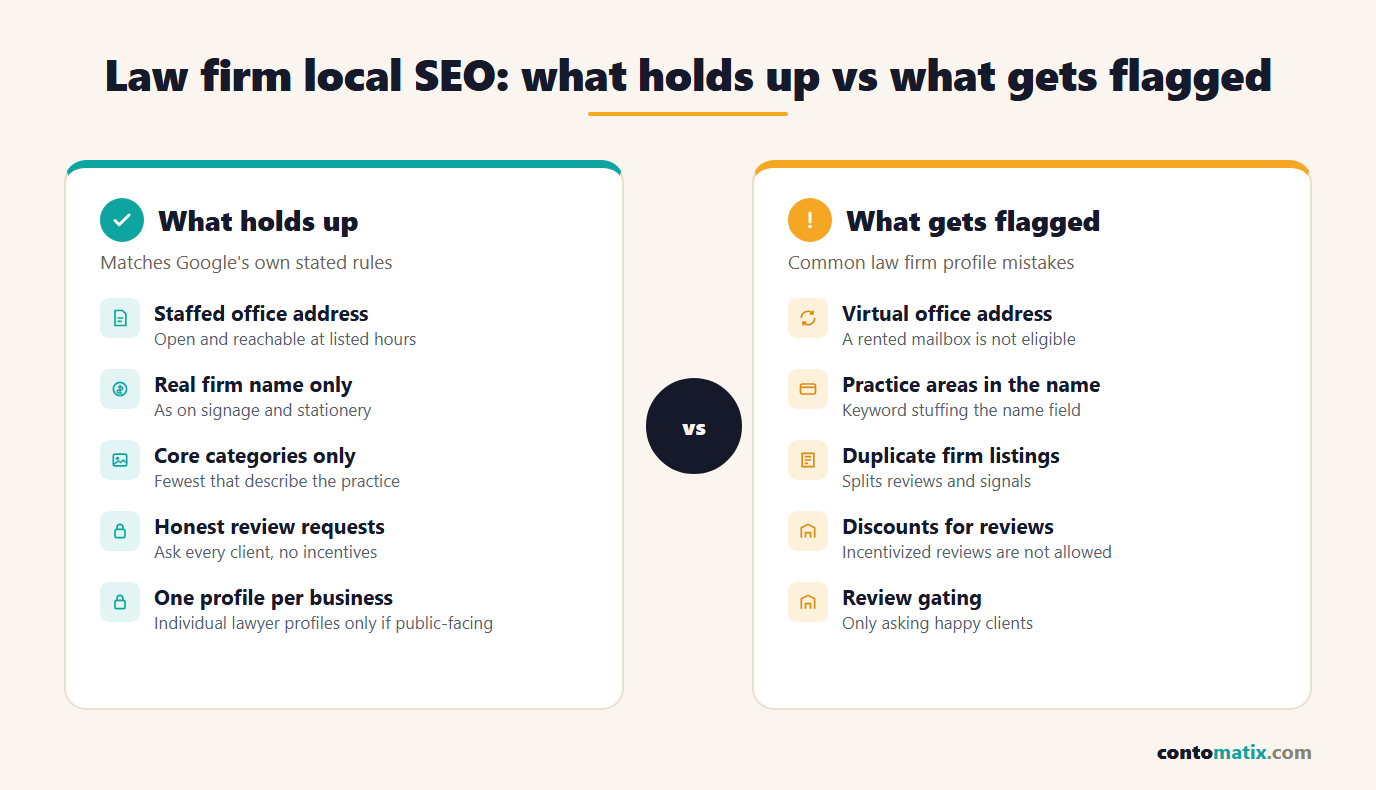
The single most common law firm profile mistake is listing an address where nobody actually works. Google's guidelines are direct. In its guidelines for representing your business, Google states that if a business "rents a physical mailing address but doesn't operate out of that location, also known as a virtual office, that location isn't eligible for a Business Profile."
Shared office space is not banned outright, but the bar is high. Google's wording is that an office at a co-working space is only acceptable if it "maintains clear signage, receives customers at the location during business hours, and is staffed during business hours by your business staff." A conference room you book twice a month does not meet that standard, and neither does a mailbox with a suite number.
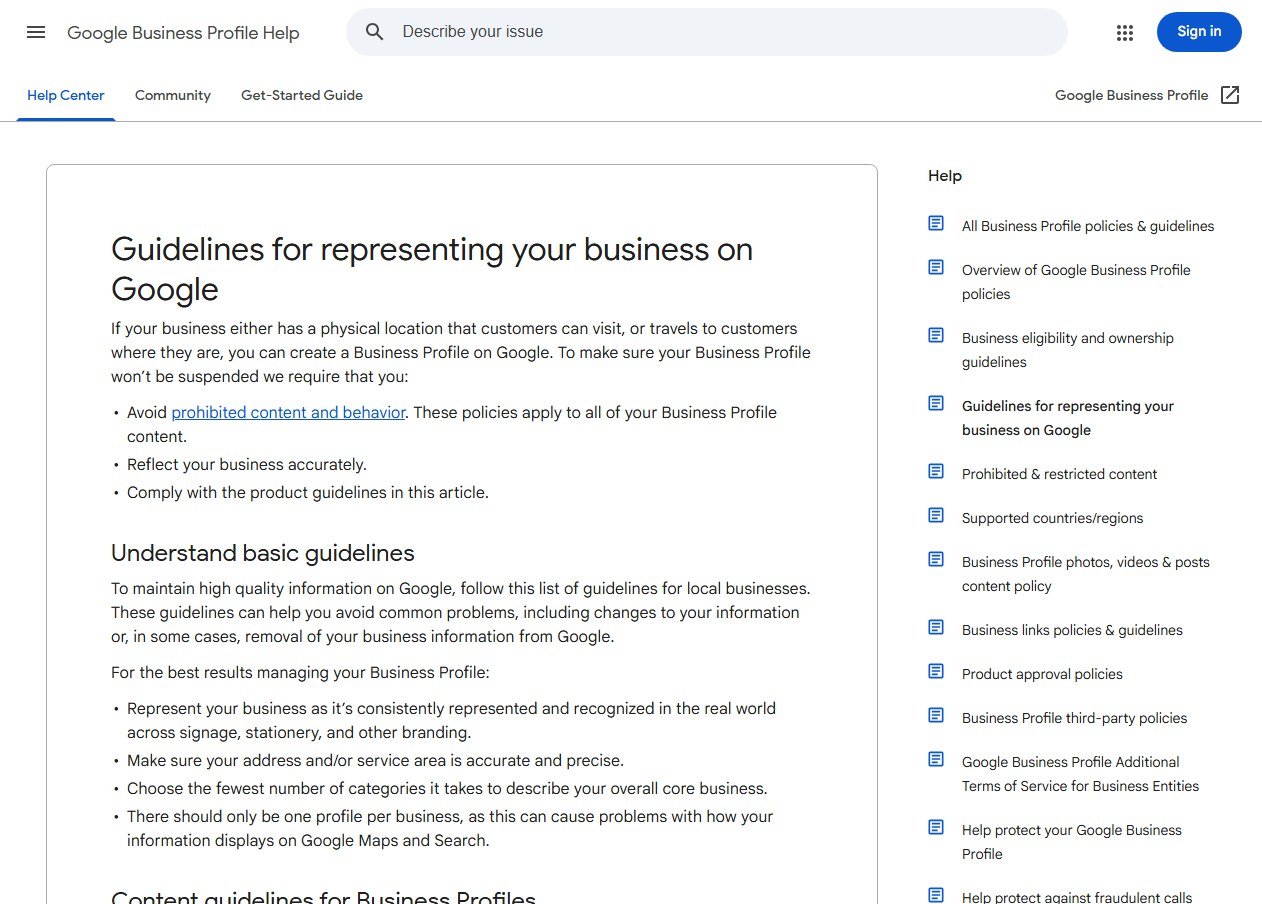
For a solo lawyer working from home, the rule that applies is the service-area one. Google says that if you are a service-area business you should hide your address from customers, using the example of a plumber who runs the business from a residential address and clears that address from the profile. A lawyer who meets clients at their offices, by phone or by video fits the same pattern. The profile can still show a service area, which keeps the business visible without publishing a home address.
One Firm, One Profile, and the Question of Individual Lawyers
Google's basic guidelines include a short line that matters a great deal for firms: there should only be one profile per business, because duplicates can cause problems with how information displays on Maps and Search. For a firm with six lawyers at one address, that means one firm profile, not one per partner plus a firm profile that all compete with each other.
Individual lawyers are a separate case. Google's guidance for individual practitioners says they should create their own dedicated profile if they operate in a public-facing role and can be contacted directly at the verified location during stated hours. A partner who takes client meetings in an office with their own direct line can reasonably qualify. A junior associate who works from the shared pool and is never contacted directly generally does not.
The practical test is whether a client could walk in or call and reach that specific person. If the answer is no, the profile is likely to be a duplicate that dilutes the firm's listing rather than adding to it. If the answer is yes, it can help a lawyer with a strong personal reputation show up for searches that include their name, without competing with the firm for generic practice-area searches, provided the two profiles are kept clearly distinct.
Business Name: Resist the Practice Area
The naming rule is the same one that affects every local trade, covered in more detail in our guide to SEO for locksmiths. Google asks for a business name that reflects "your business's real-world name, as used consistently on your storefront, website, stationery." It specifically excludes marketing taglines and extra descriptive information.
Law firms are tempted by this more than most, because practice areas are exactly what clients search for. Adding "Personal Injury Lawyers" or "DUI Attorney" to a firm called Harlan & Reeves looks like an easy way to match the query. It is also the kind of change that gets a profile flagged. The better route is to let the category field and the profile's services section carry the practice-area signal, and to keep the name exactly as it appears on the door, the letterhead and the website.
Reading a Real Legal Map Pack
A live search shows how the pieces fit together. Here is Google Maps for a family-law query in a major Texas city.
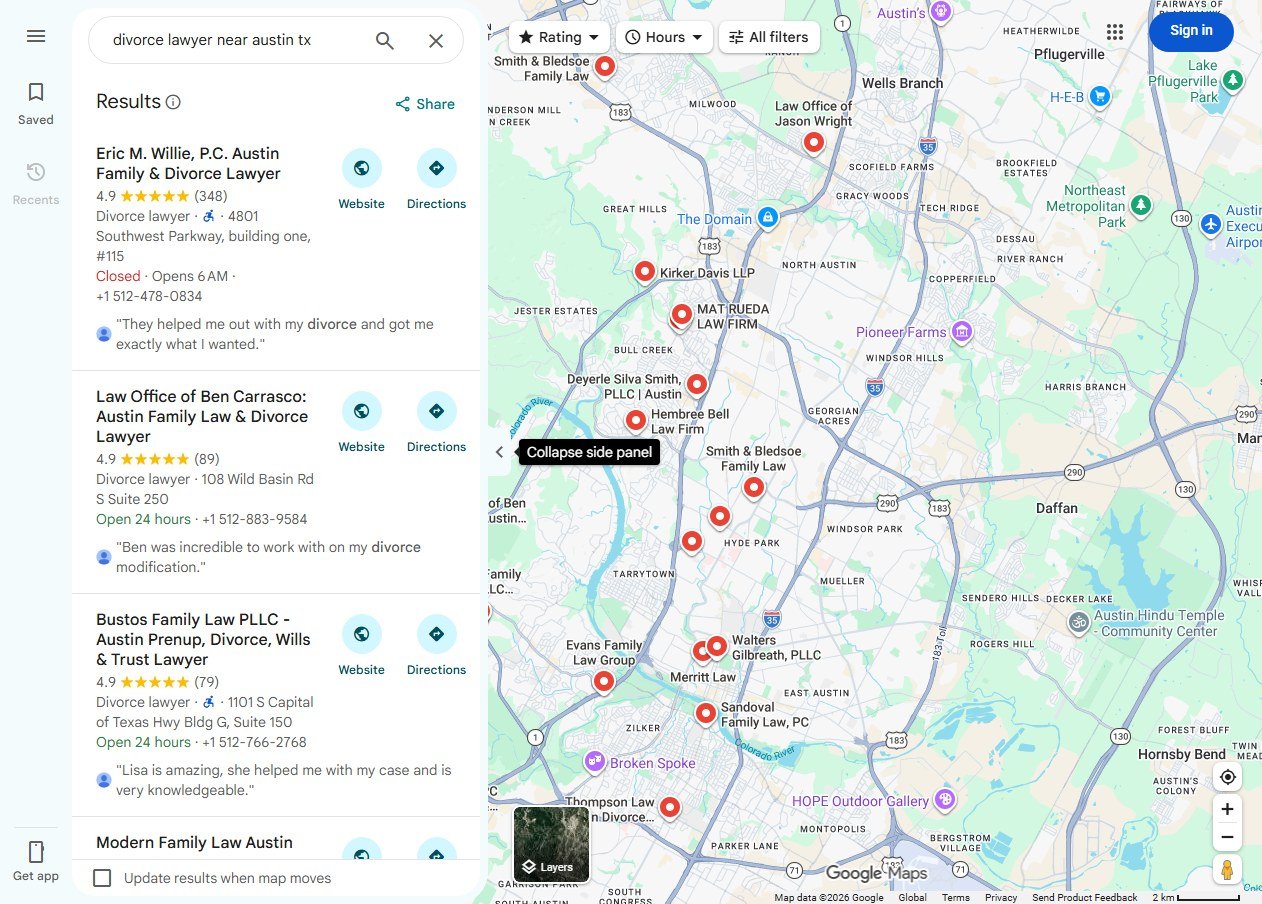
Three things stand out. Every result carries a star rating and a review count, and the top listing shows 348 reviews and the next two show 89 and 79, which tells a searcher at a glance which firms have a track record. Each listing shows a practice label and a real street address, and the map pins show those offices spread across the city rather than clustered at a single mailbox. And the snippets pulled from reviews quote clients describing a specific outcome, which is the kind of content that persuades someone choosing between two similar firms.
None of that happens by accident. A profile gets there through a staffed address, a correct category, accurate hours and a steady flow of genuine client feedback.
Categories: Pick the Practice, Not the Profession
Google's guidance on categories is to choose the fewest categories it takes to describe your overall core business. For a general-practice firm that might be a single "Law firm" category. For a firm built around one specialty, the specialist category, such as divorce, immigration or personal injury, usually matches searches more precisely than the general one.
The mistake to avoid is stacking every practice area the firm touches into the category list. A firm that handles twelve kinds of cases but earns most of its revenue from three is better served by naming those three clearly on the website and in the profile's service descriptions than by trying to appear in twelve different local searches with a thin signal in each.
Reviews: Ask Everyone, Offer Nothing
For a law firm, reviews are the strongest trust signal a profile can have, and they are also where the rules are tightest. Google's policy on incentivized or biased reviews says merchants must not offer incentives such as payment, discounts or free services in exchange for posting a review, or for revising or removing a negative one. A "free consultation for a five-star review" offer breaks that rule outright.
The related practice to avoid is review gating, where a firm sends happy clients a review link and routes unhappy ones to a private feedback form. Google's rating-manipulation policy covers attempts to influence a place's star rating through misleading content, including pressuring customers for particular ratings. The clean approach is to ask every client at the end of a matter, in the same words, and let the ratings fall where they do.
Separately from Google's rules, lawyers answer to their own state bar. Rules on testimonials, on paying for referrals and on confidentiality differ from state to state, and a public reply to a review is a place where a lawyer can accidentally reveal client information. Check your state's rules before drafting a review-request process or a standard reply, and keep replies generic: thank the reviewer, avoid confirming that the person was a client, and move any detail to a private channel.
Practice-Area Pages That Match Real Searches
The profile gets a firm into the map pack. The website decides whether the click turns into a call. One page that lists every service in a bulleted block is the weakest option, because it cannot answer the specific question a searcher has.
- One page per practice area the firm genuinely wants more of, written around the questions clients ask in that area rather than around generic marketing copy.
- A city or region signal on each page: the courts you appear in, the counties you serve, the local rules that affect a case. Avoid creating dozens of near-identical city pages with only the place name swapped.
- Attorney profile pages with real credentials, bar admissions and practice focus, linked from the practice pages they relate to.
- Consistent name, address and phone number on every page and matching the Business Profile exactly.
The same fundamentals apply as for any local business, covered in our local SEO for small business guide. What changes for lawyers is the weight on staffed addresses, careful reviews and specific practice-area content.
Links and Citations for a Law Firm
Local rankings lean on prominence as well as proximity, and prominence for a law firm tends to come from sources that are specific to the profession. State and local bar association directories, legal directories with real editorial standards, local news coverage of a case that is already public, and community involvement all produce links and citations that a reviewer would recognize as genuine. Our guide to link building for lawyers goes further into what moves rankings and what only looks busy.
What Local SEO for Lawyers Costs
There is no standard price list, and anyone quoting a flat rate without asking about the firm's size, practice areas and market is guessing. What can be said is where the money goes. Profile setup and cleanup is a one-off task. Ongoing work splits between content for practice-area pages, a review process and citation maintenance. Competitive metro markets cost more to compete in than small-town ones, because the same keywords are being targeted by more firms with larger budgets.
A sensible check on any provider is whether they will explain, in plain terms, how they handle the address and review rules above. A firm that proposes a virtual office address, offers incentives for reviews or suggests adding practice areas to the profile name is proposing exactly the tactics that lead to suspensions.
A Short Checklist Before You Start
- Confirm the listed address is staffed during the hours shown on the profile. If it is not, switch to a service-area setup and hide the address.
- Search Maps for your firm name and address to make sure there is only one firm profile, and merge or remove duplicates.
- Check that the name field matches the door sign and letterhead exactly.
- Pick the category that matches the core practice, and add the others only if they are genuinely separate lines of work.
- Write a review-request message that goes to every client, with no incentive attached, and review your state bar's rules on testimonials before using it.
- Build or tighten one page per priority practice area, each tied to a real local signal.
Quick Recap
- Google says a rented mailing address or virtual office is not eligible for a Business Profile; a shared office qualifies only with signage, customer visits and your own staff during business hours.
- Solo lawyers working from home should use a service-area setup and hide the address.
- Keep one profile per firm. Individual lawyers get their own only if they are public-facing and reachable at the verified location during stated hours.
- Keep the business name identical to the real-world name. Put practice areas in categories, services and page content instead.
- Google bans incentivized reviews and rating manipulation, so ask every client and offer nothing in return, and check your state bar's rules on testimonials and replies.
- Build one page per priority practice area with genuine local signals rather than near-duplicate city pages.
Frequently Asked Questions
Can a lawyer use a virtual office address for Google Business Profile?
No. Google states that a rented mailing address where the business does not actually operate is not eligible for a Business Profile. A shared office can qualify only if it has clear signage, receives clients during business hours and is staffed by your own people.
What should a solo lawyer working from home do?
Set up the profile as a service-area business and hide the home address. The profile can still list the areas you serve without publishing where you live.
Should each lawyer at a firm have their own profile?
Only individual lawyers who are public-facing and can be contacted directly at the verified location during stated hours are eligible. Others should be represented through the single firm profile, since duplicates can cause display problems.
Can I put my practice areas in my firm's Google name?
No. Google asks for the name used consistently in the real world on signage and stationery, and excludes marketing taglines and extra descriptors. Use categories, services and your website to carry practice-area signals.
Can I offer a discount for a client's Google review?
No. Google's policy does not allow merchants to offer payment, discounts or free services in exchange for reviews, or for changing or removing a negative one.
Is it okay to only ask happy clients for reviews?
That is review gating, and it conflicts with Google's rating-manipulation policy. Ask every client the same way and accept the mix of ratings you receive.
How should a lawyer reply to a negative review?
Keep it short and generic, avoid confirming the reviewer was a client, and move specifics to a private channel. Client confidentiality and state bar rules apply to public replies, so check your jurisdiction's guidance first.
How many Google categories should a law firm choose?
Google advises choosing the fewest categories it takes to describe your core business. A specialist firm usually does best with the matching specialist category rather than a long list.
Do I need a separate page for every practice area?
For the areas you want more clients in, yes. A dedicated page lets you answer that area's specific questions and show local relevance, which a single services list cannot do.
How long does it take for local SEO to work for a law firm?
Profile fixes can show effects within weeks, but review volume and content build more slowly, and competitive metro markets take longer. Treat it as an ongoing process, not a one-off project.