The top-ranking competitor page for "SEO Suffolk County NY" opens with a specific claim: roughly 1.5 million residents spread across 912 square miles, attributed to "the Census Bureau." It never links to census.gov. A few paragraphs later it cites a "2-3x swing" in Hamptons search volume, sourced to "Google Trends 2023-2025" — again, no link, no chart, nothing a reader could check. Suffolk County SEO done properly starts from the opposite instinct: state a number, then show exactly where it came from, because a business owner deciding who runs their local search program deserves to verify the data before trusting a strategy built on top of it.
This guide follows through on that promise. Every population and geography figure below links to census.gov. Every seasonal claim about the Hamptons or the North Fork traces back to reporting from people who actually work the East End tourism calendar. And the ranking-timeline section names the real variables that move results faster or slower, instead of promising a flat 60-to-90-day window. Suffolk isn't one search market — grounding that idea in checkable data, rather than agency marketing copy, is the whole point of what follows.
Suffolk County SEO Starts With Verifiable Numbers
Per the U.S. Census Bureau's own QuickFacts figures for Suffolk County, the population stood at 1,525,920 at the 2020 Census, with the Bureau's more recent one-year estimate putting it just above 1.53 million. Land area comes in at 910.9 square miles — not the rounder "912" figure that keeps getting repeated on marketing pages with no link back to where it came from. Median household income sits above $126,000 in the Bureau's latest estimate, well ahead of the national number, and that detail matters more for local SEO than it might look at first: higher-income buyers research more before they call, and a thin, generic service page gets skipped here more often than in lower-income markets.
Geographically, Suffolk runs on the order of 85 miles end to end, from the Nassau County line near Huntington to Montauk Point at the island's easternmost tip. That distance is the actual reason a single, undifferentiated county-wide strategy doesn't hold up: an HVAC company in Huntington Station and a bed-and-breakfast in Montauk aren't competing for the same searches, the same seasonality, or the same competitors, even though both sit inside the same county line.
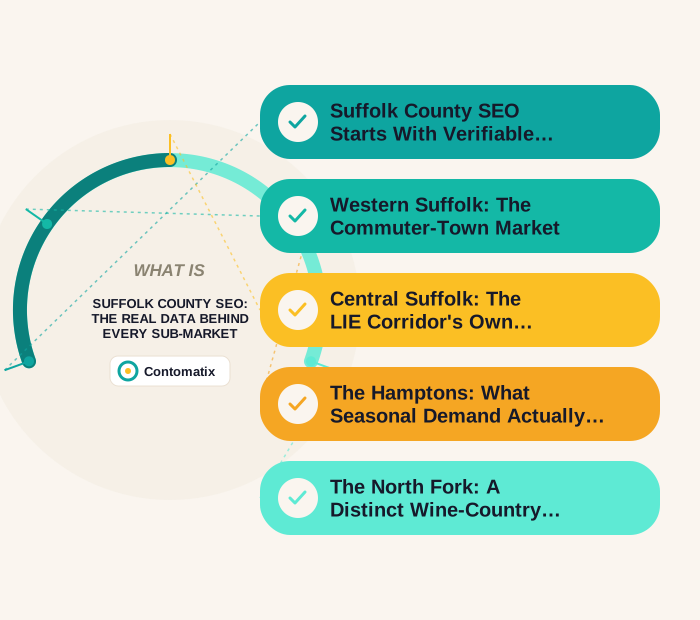
Western Suffolk: The Commuter-Town Market
Huntington, Smithtown, Islip and the towns closest to the Nassau border function like an extension of the New York City commuter belt. Search behavior here looks like suburban search anywhere near a major metro: dense population, high competition for home-service and professional-service keywords, and a real overlap with Nassau County demand for businesses sitting near that county line. A roofing company in Huntington Station is realistically competing against Nassau-based firms as much as other Suffolk businesses, and a service-area profile that only lists "Huntington" as a target is leaving cross-border searches on the table.
This is also the part of the county where local SEO is hardest to win purely on effort, because it's the most contested. Established agencies serving Nassau and western Suffolk both have deeper backlink profiles and longer track records here than almost anywhere else on Long Island. A new entrant needs a genuinely differentiated Google Business Profile and real citations from local bodies — not just volume of directory submissions — to make a dent.
Central Suffolk: The LIE Corridor's Own Search Behavior
Along the Long Island Expressway and Route 25 corridor — Ronkonkoma, Central Islip, Hauppauge, out toward Riverhead — the market mixes suburban retail with a real institutional and healthcare base. Stony Brook University Hospital anchors a genuine regional healthcare economy in this stretch of the county, and that means healthcare-adjacent local search here isn't just urgent-care listings; it includes specialist referral searches, medical office park searches, and a fair amount of B2B search tied to the corridor's office parks and light industrial space.
Riverhead sits at the hinge point of Central Suffolk, functioning as both a retail hub (the outlet mall draws searches from across the county) and the gateway to the North Fork. A business here often needs to speak to two different search intents in the same content: local Riverhead residents, and visitors passing through on their way east.
The Hamptons: What Seasonal Demand Actually Looks Like
The competitor page's "2-3x Hamptons search volume swing" claim, sourced to an unlinked Google Trends citation, oversimplifies what's actually happening on the East End. Reporting from Dan's Papers, a Hamptons-based publication that covers East End tourism year-round, put Suffolk County hotel occupancy at 80.5% in July 2025, up from 79.6% the year before — a real, measured peak, not an estimate. But the same reporting quotes Bryan DeLuca, president of the East End Tourism Alliance, describing a market that no longer shuts down after Labor Day: weddings now run through roughly ten months of the year, hotels stay busy on fall weekends at high rates, and Discover Long Island's own data shows Suffolk County residents accounting for 19% of regional tourism spend, up from 16% the year before — meaning local, non-tourist demand is a growing share of what drives East End business even in the traditional off-season.
The practical implication for search strategy: a Hamptons business that builds its entire SEO calendar around a summer spike and goes dormant from October through April is leaving real, documented shoulder-season demand unaddressed. The honest seasonal pattern isn't a clean multiplier — it's a shift from tourist-driven summer demand to a mix of wedding season, resident spending, and off-season leisure travel that Gurney's Resorts and other East End operators are now actively marketing around.
The North Fork: A Distinct Wine-Country Identity
The North Fork runs a genuinely different calendar than the Hamptons, and treating the two as one "Hamptons & East End" bucket — as the competitor page does — misses this. DeLuca's own comment on the region is specific: "For us, fall on the North Fork is very busy. The farms are busy. It's harvest time." Vineyards, farm stands and agritourism businesses here peak around harvest and fall foliage, not midsummer, which means content built for "Hamptons summer" seasonality actively points North Fork businesses at the wrong calendar.
For a North Fork winery, farm stand or wedding venue, search content built around harvest events, fall wedding packages and foliage-season day trips will outperform anything modeled on Hamptons beach-season search behavior. The two sub-markets sit twenty minutes apart by car and run on almost opposite seasonal logic.
How Seasonal Suffolk Businesses Should Adjust SEO Effort by Month
Rather than a single seasonal multiplier, a working calendar for a seasonal East End business looks closer to this:
- January through March — the lowest-competition window for content and technical work. Build out service pages, refresh Google Business Profile photos and descriptions, and publish the content that needs to be indexed before demand rises. Almost nobody else is publishing during this window, which makes it disproportionately cheap.
- April through Memorial Day — early-booking demand starts, particularly for lodging and event venues; Hamptons rental activity often begins locking in well before summer itself. This is when paid search and organic visibility both need to already be in place, not when work should start.
- June through Labor Day — peak Hamptons tourist demand. Content and GBP work should already be finished; this window is for review generation, photo updates and monitoring, not new page builds.
- September through November — the shoulder season the competitor's flat multiplier misses entirely. Fall weddings, North Fork harvest tourism and rising resident spending keep genuine demand alive here. This is a second real opportunity window, not a wind-down.
- December — holiday-specific content for wineries, gift-focused retail and indoor venues, distinct from both summer and fall demand patterns.
Google Business Profile Service-Area Setup for Multi-Town Suffolk Businesses
A Suffolk County business serving several towns — a plumber covering Huntington through Smithtown, or a landscaper working both Riverhead and the North Fork — needs its Google Business Profile configured as a genuine service-area or hybrid business, not a single-location profile with a wide radius bolted on. Google's own guidance on managing service areas allows up to 20 defined areas by city, postal code or region, and specifically recommends listing the actual places served rather than relying on a generic radius, which tends to both overreach into towns you don't genuinely serve and underreach into adjacent demand you do.
A few setup details that matter more than they seem to: if you don't serve customers at your business address, Google's guidelines say to remove that address from the profile entirely rather than leave it listed with a service-area flag. Primary category selection outweighs almost every other field for how a profile ranks. And services should each carry their own description — most Suffolk competitors leave this blank, which is unclaimed keyword surface sitting in plain sight on their own listing.
Realistic Suffolk County SEO Ranking Timelines
The competitor page's "60-90 days for meaningful map pack movement, 4-6 months for top-3 visibility" claim treats ranking speed as fixed, which it isn't. What actually drives the timeline:
- Competition level in the specific sub-market. A home-service keyword in Huntington competes against Nassau County's deeper agency landscape; the same keyword in a North Fork town might have almost no serious local SEO competition at all. Those two scenarios don't move at the same speed.
- Existing domain authority and site history. A domain with years of legitimate history and existing backlinks moves faster on new content than a brand-new domain starting from zero, regardless of how good the new content is.
- Content velocity and depth. A handful of thin pages published once rarely outcompetes a smaller number of genuinely detailed, town-specific pages published consistently over months.
- Citation and review profile. A profile with accurate, consistent citations from real local bodies and a steady flow of genuine reviews outperforms one with a large volume of low-quality directory submissions.
Given those variables, Google Business Profile changes can show visible movement within weeks in low-competition sub-markets. Competitive Western Suffolk terms realistically take several months of sustained work before top-3 visibility is likely, and a provider promising a fixed number of days for either outcome is describing a guarantee nobody can actually make.
What Actually Drives Suffolk County Ad Costs
The competitor page's "$6-$45 typical CPC" range for high-intent commercial queries is wide enough to be close to meaningless on its own, and it isn't linked to any verifiable Keyword Planner export. The real driver of cost-per-click in Suffolk County is vertical and season, not the county itself: a personal injury attorney or a home-services emergency keyword competes in a fundamentally different auction than a wine-tasting-room or farm-stand keyword, and Hamptons-adjacent commercial terms genuinely do get more expensive during peak booking season as lodging and hospitality advertisers bid harder. Anyone quoting a single fixed CPC range without first asking what your specific keywords, sub-market and competitors are is estimating, not reporting.
Common Mistakes in Suffolk County Local SEO
The recurring ones: treating the county as a single market instead of at least four distinct ones, building a Google Business Profile with a generic radius instead of named service areas, writing Hamptons-seasonality content for a North Fork business (or the reverse), and going quiet on content and outreach the moment Labor Day passes — right when shoulder-season demand is still real and much less competitive to rank for.
The costliest mistake is generic content that could describe any Long Island county. In a market this geographically specific — commuter towns, an institutional healthcare corridor, a resort economy and a wine region all inside one county line — genuinely local detail is what separates a page that converts from one that gets skipped.
DIY vs. Hiring Help for a Suffolk County Business
A single-location business in a lower-competition Suffolk sub-market can genuinely handle its own Google Business Profile setup, citation building with real local bodies, and a review-request process built into how jobs close. That covers a meaningful share of available benefit before paid help becomes necessary.
Paid help earns its place once a business is competing in Western Suffolk's more contested market, needs sustained content across multiple sub-markets with different seasonal calendars, or needs technical work beyond profile management. Our SEO agency versus freelancer comparison covers what each model realistically delivers, and the same sub-market logic that applies here shows up in how we approached local SEO in a smaller, single-identity market like Edmonds, WA — the details change, but the discipline of grounding strategy in verifiable local data doesn't.
Is a Dedicated Suffolk County SEO Strategy Worth It?
Yes, and the Census Bureau's own numbers explain why: a county of 1.5 million people spanning commuter suburbs, an institutional corridor, a resort economy and a wine region isn't a market that a single templated strategy serves well. A business that segments its Google Business Profile, content and seasonal calendar by actual sub-market — and can point to real sources for every claim behind that strategy — is working from a genuinely different foundation than a page that asks you to trust unlinked numbers.
Frequently Asked Questions
What makes Suffolk County SEO different from a general Long Island strategy?
Suffolk spans roughly 85 miles from the Nassau County line to Montauk Point and contains at least four distinct search markets — western commuter towns, the Central Suffolk institutional corridor, the Hamptons resort economy, and the North Fork wine region — each with different competition levels and seasonal patterns.
How many people actually live in Suffolk County?
1,525,920 as of the 2020 Census, with the Bureau's more recent one-year estimate putting it just above 1.53 million, per the U.S. Census Bureau's QuickFacts page.
Does the Hamptons really go quiet in winter?
Less than most marketing pages suggest. Reporting on East End tourism describes fall weddings running through roughly ten months of the year and rising resident spending, rather than a hard summer-to-winter shutoff.
What's a realistic budget for Suffolk County local SEO?
It depends heavily on sub-market. A single-location business in a lower-competition area can often manage on a modest monthly spend; a business competing in Western Suffolk's more contested market against Nassau-based agencies typically needs a larger, sustained investment to move competitive terms.
Should my Google Business Profile list every town I serve?
Yes, using Google's service-area feature, which allows up to 20 defined areas by city or postal code. Listing the towns you genuinely serve, rather than relying on a generic radius, is what Google's own guidance for service-area and hybrid businesses recommends.
How long does it take to rank in Suffolk County?
It depends on competition level, existing domain authority, content velocity and citation quality far more than on any fixed number of days. Google Business Profile changes can show movement within weeks in lower-competition sub-markets; competitive Western Suffolk terms typically take several months of sustained work.
Is the North Fork a separate SEO market from the Hamptons?
Yes. The North Fork's peak season is harvest and fall foliage, driven by wineries and agritourism, while the Hamptons peak on summer tourism. Content and seasonal calendars built for one don't transfer cleanly to the other despite the short physical distance between them.
What citation sources actually matter in Suffolk County?
Real, checkable local bodies outperform generic directory submissions: town and county chambers of commerce, Discover Long Island for tourism-facing businesses, and New York Secretary of State business registration as the legal-name source every other citation should match.
Should Western Suffolk businesses also target Nassau County searches?
Often, yes. Towns near the county line function as one continuous commuter market, and a service-area profile that only lists the Suffolk side of that line misses real, adjacent demand.
Is a "guaranteed rankings" pitch ever legitimate for Suffolk County businesses?
No. Nobody controls Google's algorithm, and a fixed guarantee — on ranking position or on a specific number of days — is a more reliable signal to keep evaluating other providers than a mark of confidence.
Related Reading
- For the same sub-market-driven approach applied to a different city, see our Petaluma local SEO guide.
- See how the same discipline plays out in a smaller, single-identity market in local SEO in Edmonds, WA.
- Deciding how to staff a Suffolk County program? Our SEO agency vs. freelancer comparison covers what each option realistically delivers.
Contomatix builds Suffolk County SEO strategy around the sub-market a business actually operates in — Western Suffolk commuter demand, the Central Suffolk institutional corridor, Hamptons seasonality, or North Fork harvest tourism — grounded in sources you can check yourself. Want a free audit of where your Suffolk County business stands right now?
Get a free audit →

