Last updated: September 2026
Lawn care SEO is one of the few local categories where search demand itself swings hard by month, not just by year, and a strategy built around a single snapshot of "what ranks well" ignores that a lawn care company's busiest search season and its slowest one call for genuinely different content and different Google Business Profile management, sometimes just weeks apart. Good SEO for a lawn care business plans for that shift ahead of time rather than reacting to it.
Why Lawn Care SEO Runs on a Season, Not a Funnel
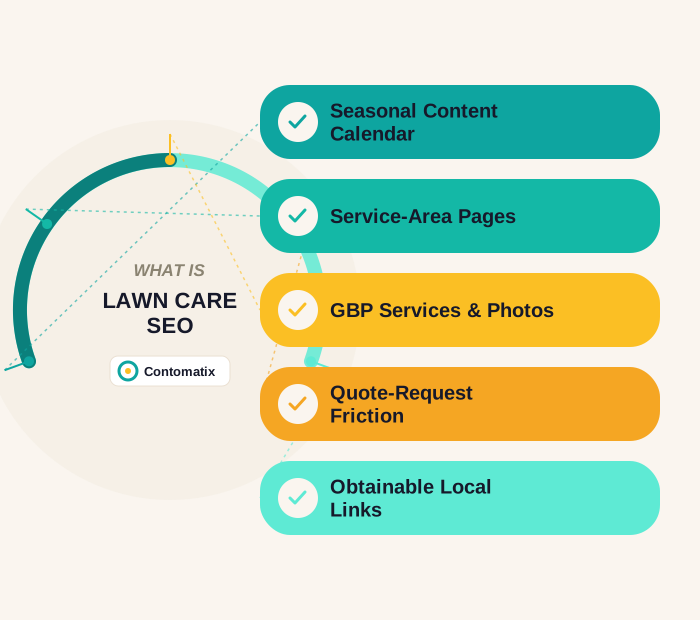
Interest in mowing, fertilization, and weed control climbs sharply as lawns green up in spring, holds through summer, and shifts toward aeration, overseeding, and fall cleanup as the season turns — and in regions with real winters, shifts again toward snow removal for companies that offer it. A company that only updates its Google Business Profile and website content reactively, once a season has already started, is publishing spring content after the spring rush has already been decided by whoever showed up first. The practical fix is a simple content and profile calendar built a season ahead: fertilization and pre-emergent weed control content goes up before the first warm week, not during it, and fall aeration content goes up in late summer, not once leaves are already falling.
Service-Area Pages Done Right, Not as City Spam
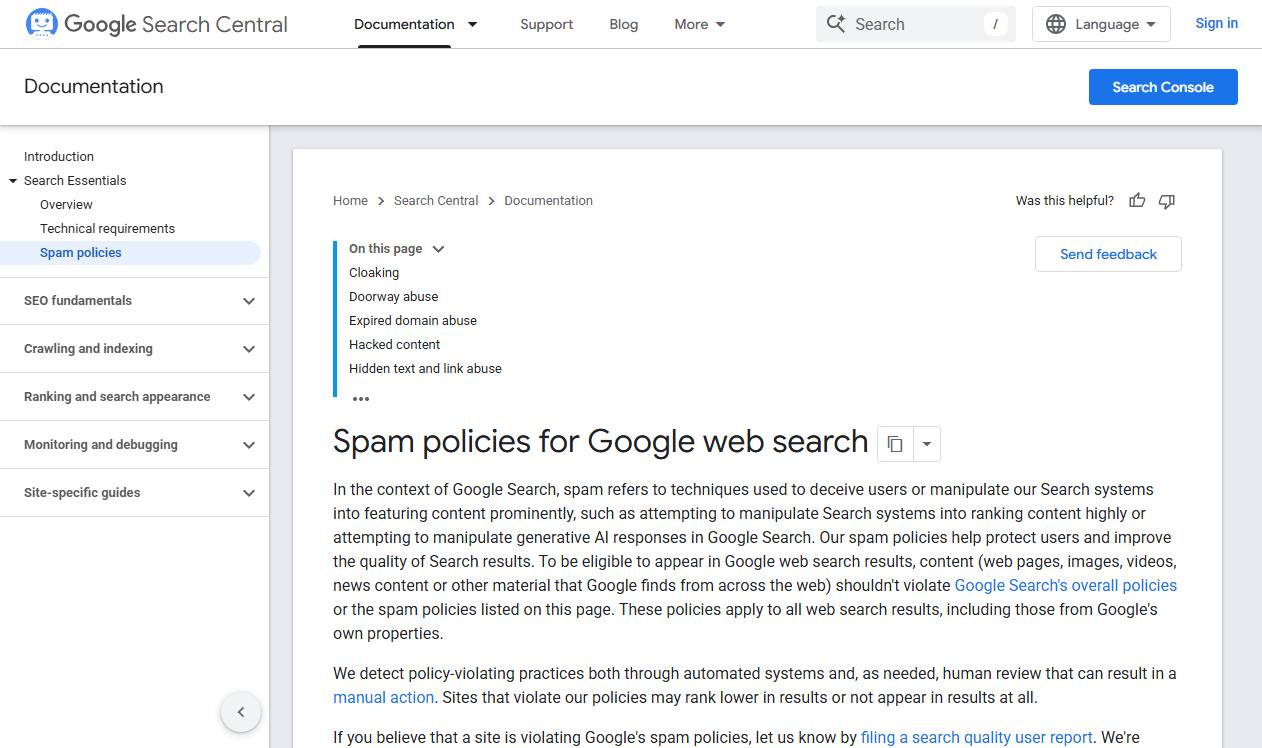
Lawn care companies often serve a real, definable radius around a home base, which tempts a template approach — one thin page per nearby town with the city name swapped and everything else identical. That pattern is a well-known low-quality signal to Google (sometimes called a doorway page), and it rarely helps rankings the way it looks like it should. A better approach keeps one strong primary location page and adds separate service-area pages only where there is genuinely different content to put on them — different grass types common to that specific area's soil and climate, a different crew or route schedule, or HOA-specific mowing-height rules that actually vary by community. If there is nothing distinct to say about a given town beyond "we also serve this town," it does not need its own page; a clearly listed service-area section on the main page, plus that area covered in the Google Business Profile service area setting, does the job without creating thin duplicate pages.
Google Business Profile: Services, Photos, and Seasonal Posts
The Services section should list every actual offering by name — mowing, fertilization, weed control, aeration, overseeding, mosquito treatment, leaf removal, snow removal where relevant — rather than a single generic "lawn care" entry, since Google matches specific service searches against what is actually listed there. Photos matter more for this category than the industry tends to treat them: real before-and-after shots of an actual property, rather than stock imagery of a generic green lawn, build more trust with someone comparing three companies at once. Scheduled Google Business Profile posts timed to the season ahead — a spring pre-emergent reminder, a fall aeration push — keep the listing active in a way Google and prospective customers both notice, more so than the same volume of posts published at random.
Reducing Quote-Request Friction
A homeowner requesting lawn care quotes is very often requesting from several companies at once and will frequently go with whichever one responds first with a clear price range, not necessarily the lowest bidder. A long, multi-step quote form asking for property size, service history, and five other fields before showing any information back is a real conversion leak in this category — a short form (address, phone number, service wanted) that gets a fast human response tends to outperform a longer form that looks more thorough on paper. Response speed itself is a competitive factor here in a way it is not for a considered, weeks-long purchase decision.
Reviews and the Recurring-Customer Trust Signal
Because lawn care is typically a recurring, scheduled service rather than a one-time job, reviews that mention reliability — showing up on the day scheduled, communicating about weather delays, consistent crew quality over a season — carry real weight alongside reviews about the quality of the work itself. A homeowner comparing companies for an ongoing weekly or biweekly service is implicitly asking "will this company still be reliable in month four," and reviews that speak to that directly answer a real hesitation a one-time-job review does not.
Local Link Ideas That Are Actually Obtainable
Most local link-building advice for home-service businesses is generic, but a few options are genuinely realistic for a lawn care company specifically. Equipment and product manufacturers often maintain "authorized dealer" or "certified applicator" directory pages that link to local businesses using their products or certifications — worth checking directly with any supplier or fertilizer brand the company already uses. Local youth sports teams, community gardens, and neighborhood associations frequently list sponsors or partners on their own sites in exchange for modest, genuine sponsorship, which is a realistic and honest way to build a handful of relevant local links rather than a purchased or templated one. A local chamber of commerce membership listing is a smaller but easy, legitimate addition. None of these require volume or tricks — they require actually being a member, sponsor, or certified applicator, which is the point.
Citation Consistency Matters More Once There Is More Than One Truck
A single-crew operation can usually get away with loose citation management, but the moment a company adds a second crew, a second service area, or an equipment-financing or franchise relationship, name-address-phone consistency across the website, the Google Business Profile, and directory listings starts to matter in a way it did not before. A prospective customer or a partner checking a company's legitimacy before signing a season-long contract will often cross-check the phone number and address across more than one listing, and inconsistent details read as a small but real trust gap, especially for larger recurring contracts like HOA or commercial property accounts rather than a single residential yard.
Content for the Questions Homeowners Actually Ask
Beyond service pages, the content that genuinely helps answers practical, often region-specific questions: the right mowing height and frequency for the grass type common in that area, when to apply pre-emergent weed control relative to local soil temperature, and when aeration and overseeding actually make sense for that climate rather than a generic national calendar. Local university extension offices frequently publish exactly this kind of region-specific turf guidance, and content that reflects the same local specificity — rather than a generic national lawn-care calendar copied from elsewhere — reads as more credible to both homeowners and, indirectly, to Google.
Landscaping SEO vs. Lawn Care SEO: Where the Overlap Is
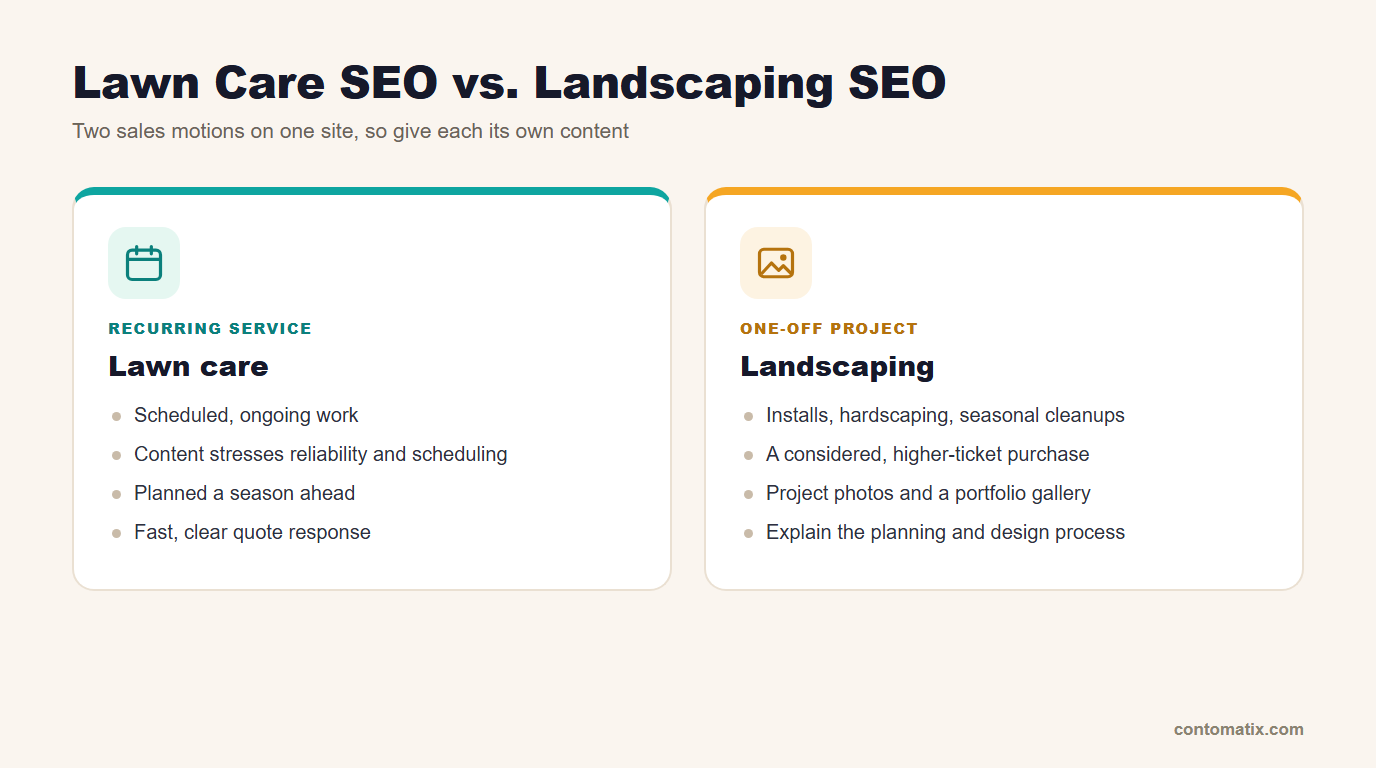
Companies that offer both recurring lawn maintenance and one-off landscaping projects (installs, hardscaping, seasonal cleanups) are effectively running two different sales motions on one site, and it helps to treat them that way in the content structure. Recurring lawn care content should emphasize reliability, scheduling, and season-ahead planning, the way covered above; landscaping and installation content is closer to a considered, higher-ticket purchase and benefits more from project photos, a portfolio-style gallery, and content explaining the planning and design process rather than a quote-speed pitch. Folding both into one generic "our services" page tends to undersell whichever one is not the company's original core offering.
DIY or Bring in Outside Help
A single-crew, single-location lawn care business can usually manage Google Business Profile updates, seasonal posts, and review requests without outside help, especially with a simple recurring calendar to work from. Building out genuinely distinct service-area pages, doing the seasonal keyword research that a national calendar will not capture, and pursuing the realistic local link-building options above tends to be where outside help pays off, particularly for a company managing several trucks and a wider service radius. Our guide to vetting a local SEO company covers the general questions worth asking, and for a seasonal business specifically, it is worth asking directly whether a prospective provider plans content a season ahead or only reacts once a season has already started.
Measuring Whether Lawn Care SEO Is Working
Quote requests and phone calls from Google Business Profile and organic search, tracked by season rather than as an annual average, show whether the site and profile are actually capturing demand when it exists rather than only after it has passed. A company that ranks well in July for terms that peak in April missed the window that mattered most, even if the annual traffic number looks fine. Comparing the same month year over year, rather than comparing this month to last month, gives a much clearer read on whether a seasonal push actually worked.
What is the most common lawn care SEO mistake?
Managing content and the Google Business Profile reactively instead of a season ahead, so spring or fall content goes up after the relevant search demand has already peaked and been decided by competitors.
Should a lawn care company have a page for every nearby town?
Only where there is genuinely different content to put on it. Thin, near-identical city pages read as a spam pattern to Google and rarely help; a listed service area plus one strong primary page usually performs better.
How important are photos on the Google Business Profile?
More important than most companies treat them. Real before-and-after photos of actual properties build more trust than stock lawn imagery, because they show what the finished work actually looks like.
What is the difference between landscaping SEO and lawn care SEO?
Lawn care is a recurring, scheduled service where reliability and response speed matter most; landscaping is closer to a one-off, higher-ticket purchase where portfolio content and design process matter more.
What quote form length converts best?
Shorter forms that get a fast human response tend to outperform long, detailed forms, since many homeowners are requesting quotes from several companies at once and often choose whoever responds first with a clear answer.
Are local links realistic for a lawn care business to get?
Yes, through genuine channels — manufacturer or supplier dealer directories, sponsorship of local youth sports or community groups, and chamber of commerce membership — rather than purchased or templated links.
Does seasonality really affect SEO for a lawn care business?
Yes — search demand for specific services shifts by month, so content and Google Business Profile activity planned a season ahead consistently outperforms the same effort done reactively once a season has started.
Sources: Google's guidance on Business Profile categories, EPA WaterSense, Google Search spam policies (doorway abuse).
Lawn care SEO rewards planning a season ahead more than almost any other local category. Contomatix offers a free audit if you want a second opinion on whether a lawn care site and profile are ready for the next season before it starts.
Get a free audit →