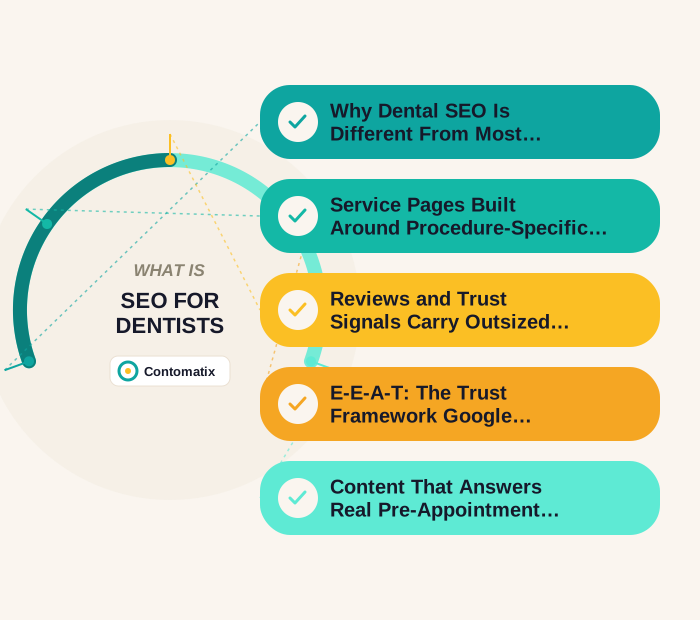
A general dentist's practice usually competes against a handful of other practices within a five-mile radius, but that competition is denser than it looks — dentistry is one of the most saturated local categories on Google, with multiple practices, DSOs (dental support organizations), and specialists all fighting for the same "dentist near me" searches. SEO for dentists is less about outranking everyone nationally and more about winning a small, specific map pack, over and over, for the handful of searches that actually turn into booked appointments.
Why SEO for Dentists Is Different From Most Local Businesses
Two things make dental SEO distinct from, say, a plumber or a taxi company. First, dentistry is a "Your Money or Your Life" (YMYL) category in Google's own quality guidelines — content that touches health, safety, or financial wellbeing gets held to a higher accuracy and trust bar than a typical local business page. Second, most new-patient searches aren't generic ("dentist near me") — they're procedure-specific ("dental implants," "emergency tooth extraction," "Invisalign consultation"), and each of those searches has a completely different intent, urgency level, and expected page.
That combination means a dental practice's SEO can't just be a single well-optimized homepage. It needs a structure that matches how patients actually search, backed by the kind of trust signals Google expects from a healthcare-adjacent category.
Google Business Profile: Where Most New Patients Actually Start
For a dental practice, the Google Business Profile map pack is usually the single highest-traffic entry point — often outperforming the website itself for pure visibility. Every field matters: primary and secondary categories (General Dentistry, Cosmetic Dentistry, Pediatric Dentistry, etc. — list every service actually offered), complete hours including any Saturday or emergency availability, and real photos of the office, team, and equipment rather than stock imagery.
One dental-specific detail worth getting right: if the practice offers multiple specialties under one roof (general, orthodontics, oral surgery), decide whether that's one listing with multiple service categories or genuinely separate listings for separate providers — mixing this up is one of the most common Google Business Profile mistakes dental practices make, and it can trigger a suspension under Google's own representation guidelines for duplicate or misleading listings.
Service Pages Built Around Procedure-Specific Search Intent
A single "Our Services" page listing fifteen procedures in a bullet list will not rank for any of them individually. Each high-value procedure — implants, root canals, Invisalign, emergency care, teeth whitening, pediatric dentistry — needs its own dedicated page answering the specific questions a patient searching that term actually has: what it costs, what the process involves, what insurance typically covers, and what makes this practice qualified to do it.
Emergency dental pages deserve particular attention. "Emergency dentist near me" is a high-intent, high-urgency search, and a page that clearly states same-day availability, after-hours contact information, and what counts as a genuine emergency will convert dramatically better than a generic services page that happens to mention emergencies in passing.
Reviews and Trust Signals Carry Outsized Weight
Choosing a dentist is a trust decision more than almost any other local service search — people are picking who gets to work inside their mouth. Review volume, recency, and content all matter more here than in most categories. A steady flow of recent reviews mentioning specific staff by name, specific procedures, and specific positive outcomes (pain-free, gentle, explained everything clearly) does more for both rankings and conversion than a large but stale review count.
Practices should build review requests into the actual patient checkout flow — a text or email sent right after a completed appointment, while the experience is fresh, consistently outperforms asking days later. Responding to every review, including the occasional negative one, is public evidence someone is actually managing the practice's reputation.
E-E-A-T: The Trust Framework Google Actually Applies Here
Google's quality rater guidelines put real weight on Experience, Expertise, Authoritativeness, and Trustworthiness for YMYL content, and dental sites are evaluated against exactly that framework. In practice, that means: author bylines on blog content that name the actual dentist or hygienist who wrote or reviewed it, credentials and school/residency information on doctor bio pages, and clear practice information (address, licensing, insurance accepted) that isn't buried or missing.
A blog post about "how to whiten your teeth safely" written with no attributed author and no dentist review carries less weight, in Google's own stated framework, than the same content with a named, credentialed dentist attached to it. This is one of the few SEO factors that's explicitly, publicly documented rather than inferred.
Content That Answers Real Pre-Appointment Questions
Beyond service pages, a genuinely useful content strategy for a dental practice answers the questions patients actually have before booking: what does a root canal actually feel like, how much do implants typically cost without insurance, what's the difference between a crown and a veneer. This kind of content does two jobs at once — it captures top-of-funnel search traffic, and increasingly, it's the kind of specific, well-sourced content that AI answer engines like ChatGPT and Google's AI Overviews pull from when someone asks a dental question conversationally rather than searching directly.
Local Citations and Insurance-Specific Pages
Consistent name, address, and phone number listings across dental-specific directories (Healthgrades, Zocdoc, Delta Dental's own provider finder) matter alongside the general local citation sources. For practices that accept a wide range of insurance, a page listing accepted plans by name is a small but genuinely useful piece of content — "does this dentist take my insurance" is a real, common pre-booking question, and a page that answers it directly reduces phone-tag before the first visit.
Local SEO for Dentists: How the Pieces Fit Together
Local SEO for dentists isn't a separate task from the ones covered above — it's what happens when the Google Business Profile, the review strategy, and the practice-area pages are built to reinforce each other instead of sitting as three disconnected projects. A profile with the right categories and real photos earns the map-pack visibility; a steady flow of recent, specific reviews confirms to both Google and the searcher that the practice actually delivers on that specialty; and a dedicated page for that same procedure gives the click somewhere accurate to land, instead of a generic homepage that never mentions it by name.
The practical failure mode is doing one of the three well and leaving the others generic: a fully optimized profile that links to a homepage with no implant-specific page loses the click it just earned, and a great practice-area page nobody's profile or reviews ever mention rarely gets found in the first place.
Measuring Whether Dental SEO Is Actually Working
Track new-patient phone calls and form submissions attributed to organic search and Google Business Profile separately from paid channels, not just overall traffic or keyword rankings. A practice ranking well for a dozen procedure keywords that never converts to a booked exam isn't succeeding — tie every metric back to actual scheduled appointments, and where possible, to case acceptance value for higher-cost procedures like implants or orthodontics.
DIY vs. Hiring a Dental SEO Specialist
A single-location practice with front-office staff who have some spare time can reasonably manage Google Business Profile updates, review requests, and basic citation consistency in-house. Where it gets harder to DIY is the YMYL-compliant content structure, technical SEO, and the ongoing review-generation systems that need consistent process rather than occasional attention. We've written a fuller breakdown of that general trade-off in our SEO agency vs. freelancer guide, and dental practices should weigh the same considerations, with extra attention to whether a prospective agency has actual healthcare-category experience.
Common Dental SEO Mistakes
The recurring mistakes we see: a single generic services page instead of procedure-specific pages, blog content with no attributed, credentialed author, an incomplete or duplicate Google Business Profile, no systematic review-request process, and treating SEO as a one-time project rather than ongoing maintenance in a category where competitors are actively working on the same handful of high-value keywords.
Is SEO Worth It for a Dental Practice?
Given how directly local search drives new-patient volume for most general and specialty practices, and how much a single new implant or orthodontic case is worth over its lifetime, the return on well-executed dental SEO is usually clear within a two-to-three-month window on Google Business Profile improvements, and six-plus months for broader organic content and rankings. The practices winning new-patient searches today are the ones treating their online presence with the same rigor as their clinical reputation.
How much does SEO for dentists cost?
Broadly in line with US averages — agencies around $99 an hour and roughly $3,200 monthly, freelancers around $72 an hour and $1,350 monthly. Costs run higher in saturated metros and lower in mid-sized markets.
How long before a dental practice sees results?
Google Business Profile and review improvements often show within a few weeks. Procedure pages and broader organic rankings typically take three to six months, with the highest-value terms like implants taking longest.
What is the highest-impact fix for most practices?
A complete, correctly categorised Google Business Profile. For most practices the map pack drives more new-patient calls than the website itself, yet profiles are routinely left half-finished with missing services or stock photos.
Why is dental content held to a higher standard?
Dentistry falls under "Your Money or Your Life" in Google's quality guidelines, meaning health-adjacent content is assessed more strictly for accuracy and trust. Named, credentialed authors matter more here than in most industries.
Do I need a page for every procedure?
For the procedures that drive revenue, yes. A single services page listing fifteen treatments will not rank for any of them individually, while a dedicated implants or Invisalign page can rank and convert on its own.
How should a multi-specialty practice set up its listing?
Carefully. Whether multiple providers or specialties belong on one listing or separate ones depends on how the practice is actually structured, and getting it wrong is a common route to a suspension that removes you from the map pack.
What is the best way to collect patient reviews?
Build the request into checkout — a text or email immediately after the appointment. Reviews naming a specific staff member, procedure or outcome do more for rankings and trust than a high count of generic ratings.
What should I measure to know it is working?
New-patient calls and form submissions from organic search and the Google Business Profile, tracked separately from paid, and tied to actually booked exams — ideally splitting high-value cases like implants from routine cleanings.
Related Reading
- Want a local example of these tactics in action? See our guide to SEO for dentists in Tulsa.
Contomatix works with healthcare and dental practices on exactly this — Google Business Profile optimization, procedure-specific service pages built to meet Google's YMYL standards, and a review pipeline that actually drives new-patient bookings. Want a free audit of where your practice stands online right now?
Get a free audit →