The average gym loses somewhere between 30% and 40% of its members every single year, with some facilities seeing churn as high as 50%. That single fact reframes what SEO for gyms is actually for: it isn't a vanity project aimed at ranking higher for its own sake, it's the mechanism that has to replace a third or more of a gym's membership base annually just to stay flat, let alone grow. A gym that isn't consistently visible to new local searchers isn't just missing out on growth — it's running a business with a structural leak that nothing else in the operation fixes.
It's worth being precise about what that means in practice. A gym owner who improves retention programming, upgrades equipment, or hires better trainers is doing genuinely valuable work — but none of it changes the fact that roughly a third of the membership base needs replacing every single year regardless of how good the in-facility experience is. Retention efforts slow the leak; they don't eliminate the need for a constant intake of new members, which is precisely the job local search visibility does.
This guide covers what SEO for gyms actually involves in 2026 — why churn makes this more urgent than most local businesses realize, and the specific work that turns local search visibility into a steady stream of new memberships.

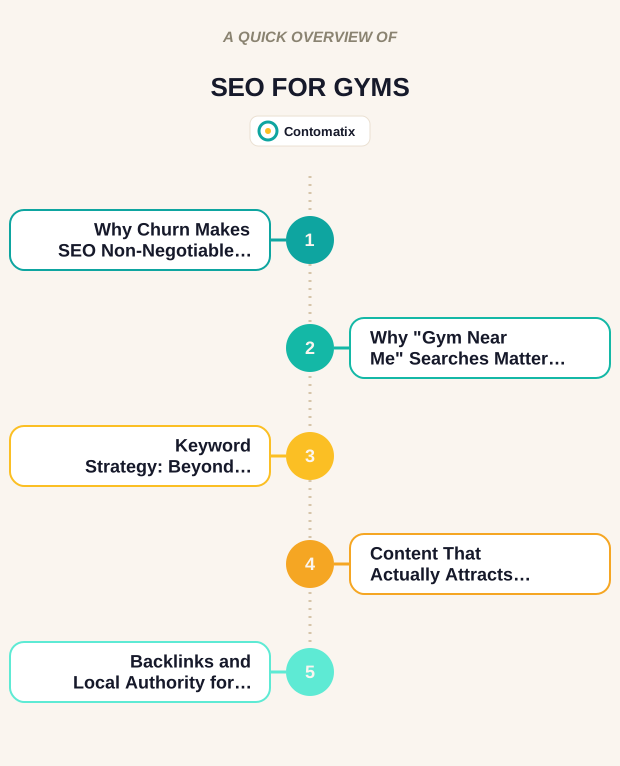
Why Churn Makes SEO for Gyms Non-Negotiable
Gyms lose roughly 30% of new members within the first three months alone, and industry-wide figures put annual retention at around 71.4% — meaning close to 29% of a typical gym's entire membership walks out the door every year regardless of how good the facility is. For a gym with 1,000 members at a 40% annual churn rate, that works out to 400 lost members a year, which at a modest $50 monthly fee is roughly $240,000 in lost annual revenue if none of it gets replaced.
That math is exactly why gym marketing can't be treated as optional or seasonal. A restaurant or a retail shop can survive on repeat customers, growing steadily on top of a relatively stable base. A gym is structurally different: it needs a constant, dependable flow of new local leads just to offset predictable, ongoing attrition, which makes consistent local search visibility closer to a survival requirement than a growth nice-to-have.
Why "Gym Near Me" Searches Matter So Much
Location is one of the strongest predictors of gym membership retention — 68% of gym members cite convenient location as a primary reason they stay, which means the same location-driven logic applies just as heavily to acquisition. "Gym near me" is consistently one of the highest-intent search phrases in the fitness category, alongside terms like "fitness classes near me" and "personal trainer near me," and someone searching that phrase is typically ready to make a decision within days, not months.
This is a search category where the map pack — the three local business results shown alongside a map at the top of Google — effectively functions as the entire first impression. A gym that isn't appearing there for its core local terms is invisible at exactly the moment a high-intent prospective member is deciding where to go.
The speed of that decision is worth dwelling on. Someone searching "gym near me" has typically already decided they want to join a gym — the search itself is the final step before choosing which one, not an early research phase the way a more considered purchase might involve. That compressed decision window means a gym showing up prominently and looking credible (accurate hours, real photos, recent reviews) in that single moment often wins the membership outright, regardless of factors like price or amenities that might matter more in a slower-paced buying decision.
Google Business Profile: The Highest-Leverage Fix for Most Gyms
For most gyms, a properly optimized Google Business Profile is the single fastest, lowest-cost improvement available — the correct primary category (Gym, not a generic "Health Club" catch-all when a more specific category applies), accurate hours including holiday exceptions, real photos of the actual facility and classes rather than stock imagery, and a genuine, ongoing stream of reviews. A profile with the "Services" and class-type attributes filled in also gives Google more to match against specific searches like "yoga classes near me" or "24 hour gym," rather than relying on a generic gym listing to catch every variation.
Weekly Google Business Profile posts — a new class announcement, a member spotlight, a promotion — are a low-effort way to signal an actively maintained business, and most competing gyms skip this step entirely, which makes it a comparatively easy way to stand out in a crowded local pack.
Review volume and recency deserve particular attention for gyms specifically, since a prospective member choosing between several nearby options is often making a genuinely personal decision — will they feel comfortable here, is the equipment well-maintained, are the trainers actually helpful — that reviews answer far more convincingly than a gym's own marketing copy ever could. A steady, ongoing review request process (asking members directly after a positive class or milestone, rather than a single push at signup) tends to outperform a one-time review campaign that goes stale after a few months, both for search ranking purposes and for the honest signal it sends prospective members.
Photos deserve the same ongoing attention. A profile with real, recent photos of the actual equipment floor, group classes in session, and the facility's current state reads as meaningfully more trustworthy than one with a handful of photos uploaded once when the gym first opened, especially if the facility has since renovated or added new equipment and classes that current photos don't reflect at all.
Keyword Strategy: Beyond Just "Gym"
Broad terms like "gym" or "fitness center" are both highly competitive and often the wrong target for a specific facility's actual strengths. Long-tail, service-specific keywords — "personal training in [neighborhood]," "women's only gym near me," "24 hour gym with childcare" — usually convert at a much higher rate because they match a searcher who already knows what they want, rather than someone still comparing broad categories. A gym offering CrossFit, yoga, and traditional weight training benefits from targeting each of those audiences with dedicated, specific content rather than one generic homepage trying to speak to all three at once.
Dedicated landing pages for each major class type or membership tier also give a gym multiple distinct entry points into search results, rather than funneling every possible search intent toward a single homepage that has to compromise on messaging for all of them at once. A prospective CrossFit member and a prospective yoga student are looking for genuinely different things — different vocabulary, different concerns, different social proof — and a page built specifically for each audience converts meaningfully better than a shared page trying to speak to both simultaneously.
This is where genuine keyword research earns its cost for a gym specifically: understanding which class types, membership tiers, and neighborhood-specific phrases actual local searchers use, rather than guessing at generic city-plus-"gym" combinations that miss the more specific, higher-converting searches entirely. We've seen the same generic-versus-specific gap play out for other local service categories — see our guide on local SEO for taxi companies for how the same principle applies to a completely different kind of high-intent local search.

Content That Actually Attracts and Retains Members
A gym's blog or content section does double duty when it's built correctly: it attracts new organic search traffic from people researching fitness topics, and it reinforces retention for existing members who engage with genuinely useful content between visits. Workout guides, class-specific content (what to expect at a first CrossFit class, how to choose between yoga styles), and trainer-authored advice tend to perform well specifically because they demonstrate real expertise, which both search engines and prospective members respond to.
Content built around genuinely common member questions — class difficulty levels, what to bring to a first session, membership comparison guides — also reduces a real source of early churn: new members who felt unprepared or unsure what to expect in their first few visits, which is exactly the window where the highest share of cancellations happen.
This dual purpose is worth designing for deliberately rather than treating content purely as a top-of-funnel acquisition tool. A "what to expect at your first CrossFit class" guide, for instance, serves a prospective member deciding whether to try the gym at all, and it serves a brand-new member nervous about their second or third session just as directly — the same piece of content doing acquisition and retention work simultaneously, which is a meaningfully more efficient use of content investment than writing separate acquisition-only and retention-only material.
Backlinks and Local Authority for Gyms
Solid link building from genuinely relevant sources — local health and wellness blogs, community sports leagues, nutrition and physical therapy practices a gym partners with — carries more local relevance weight for a fitness business than generic national directory links. Sponsoring a local 5K, partnering with a nearby physical therapy clinic for referrals, or getting covered by a local lifestyle publication all produce the kind of genuinely local, topically relevant backlinks that compound into stronger local authority over time.
These kinds of partnerships also tend to produce direct referral traffic alongside the SEO benefit, which is worth factoring into how a gym prioritizes outreach targets. A physical therapy clinic referring patients toward strength and mobility work post-recovery, or a nutrition practice recommending a gym to clients starting a new fitness routine, both generate warm, pre-qualified leads that convert at a higher rate than cold organic search traffic — making these relationships worth pursuing even before accounting for the backlink value at all.
The Hybrid Membership Shift and What It Means for SEO
Nearly 60% of gym members now prefer a hybrid membership model that combines in-person visits with virtual or on-demand content, a meaningful shift from a purely facility-based membership model. That shift changes the keyword landscape too — searches for "gym with app," "virtual classes plus gym membership," and similar hybrid-specific terms are a growing category that a gym's SEO strategy needs to account for directly, rather than treating the website as purely a brochure for the physical facility.
This shift also changes what a gym's own content and page structure needs to communicate clearly. A prospective member comparing hybrid options wants to know specifically what's included in the virtual component — live-streamed classes versus on-demand libraries, whether virtual access is bundled into a standard membership or sold separately, and how the two modes actually integrate for someone who wants to use both. A gym's website that doesn't address these questions directly is leaving a genuinely large and growing segment of prospective members to guess, or to find that information on a competitor's site instead.
How Long SEO Actually Takes to Pay Off for a Gym
Realistic timelines matter here given how much churn a gym is working against every month. Meaningful map pack movement for a well-optimized Google Business Profile and cleaned-up citations typically shows up within 60-90 days. Broader keyword rankings for blog content and service pages generally take longer — often four to six months — to mature into consistent, dependable lead flow. A gym expecting SEO to fully offset a bad month of churn within weeks is setting itself up for disappointment; this is a compounding channel that needs to be running continuously, not switched on during a slow month and off during a busy one.
Budget consistency matters more here than the specific monthly spend amount. A gym that runs SEO aggressively for two months, pauses for three, then restarts loses much of the compounding benefit that comes from sustained content publishing, review accumulation, and citation building — each pause effectively resets momentum that took real time and money to build in the first place. Treating local SEO as an always-on operating expense, similar to a lease or utility bill, tends to produce far better long-term results than treating it as a discretionary spend that gets cut whenever cash flow tightens.
Getting Started
If you're evaluating your gym's local search visibility, get in touch and we can walk through what a realistic SEO plan looks like for your specific membership mix, class offerings, and local market. Ask specifically how a prospective partner would handle your Google Business Profile, your class-specific keyword targeting, and your review pipeline — the answers to those three questions tend to reveal more about actual fitness-industry experience than a generic pitch about "ranking higher on Google" ever will.
How does SEO help gyms get more members?
By making the gym visible in Google Maps and organic search results for high-intent local searches like "gym near me," it turns ongoing search demand into a steady, replaceable stream of new leads — essential given that most gyms lose 30-40% of their membership base to churn every year.
How long does SEO take to work for a gym?
Google Business Profile and local pack improvements typically show movement within 60-90 days. Broader keyword rankings and content-driven traffic usually take four to six months to mature into consistent lead flow.
What keywords should a gym target?
Beyond broad terms like "gym near me," long-tail and service-specific keywords — "personal training in [neighborhood]," "women's only gym near me," specific class types — tend to convert better because they match searchers who already know what they want.
Is Google Business Profile really that important for gyms?
Yes — for most gyms it's the single highest-leverage, lowest-cost fix available, since "gym near me" and similar searches are answered almost entirely through the local map pack rather than traditional organic listings.
Does content marketing help gym retention, not just new leads?
Yes. Content addressing common member questions (class difficulty, what to expect at a first session) can reduce early-stage cancellations, which are concentrated heavily in a new member's first three months.
How does the shift to hybrid gym memberships affect SEO?
With nearly 60% of members now preferring hybrid in-person-plus-virtual models, gyms need to target hybrid-specific search terms and present their website as more than just a brochure for the physical facility.
Do backlinks matter for gym SEO?
Yes — genuinely local, topically relevant backlinks from health and wellness sites, local sports leagues, and partner practices carry more local relevance weight than generic national directory links, and often come with referral traffic on top of the SEO benefit.
Should a small independent gym bother with SEO against big chain competitors?
Yes — local searches like "gym near me" are won largely on Google Business Profile completeness, review volume, and neighborhood relevance rather than brand size alone, which gives independent gyms a genuine opportunity to outrank larger chains for hyper-local searches.
Related Reading
- For a Texas market example, see our guide to SEO in McKinney, TX.
- For a different regional market example, see our guide to SEO companies in Brentwood, TN.